The Ideal Model for a Leading Tourism Nation That Japan Should Aim For Beyond the COVID-19 Pandemic, as Seen Through the Promotion of "Adventure Tourism"

This September, the "Adventure Travel World Summit 2021," a global conference on adventure tourism, will be held virtually. With "coexistence" as its theme, the summit will also highlight the diverse natural environment and unique culture of Hokkaido, the first Asian host of this event. In this article, we will explore the future vision of adventure tourism while considering the model of a leading tourism nation that post-pandemic Japan should strive to become.
This September, the "Adventure Travel World Summit (ATWS) 2021," a global conference on adventure tourism (hereinafter referred to as AT), will be held virtually. The summit will focus on Hokkaido, with its rich and diverse natural environment and unique culture, and will explore the future role of AT under the theme of "coexistence. "Prior to the COVID-19 pandemic, the number of people traveling globally was steadily increasing, and the burden on nature and local communities caused by overtourism had become a serious issue. Currently, global travel is severely restricted due to the pandemic, but there are concerns that we will face the same challenges again as we move from recovery toward growth. As changes in travel styles are anticipated in the wake of the spread of COVID-19, this article examines the future vision for AT in the post-COVID era, while also considering the direction Japan should take as a leading tourism nation and the role the tourism industry should play.
1. The Theme of the Adventure Travel World Summit 2021: “Coexistence” and the Responsibilities of the Tourism Industry
This September (for four days from the 21st to the 24th), AT’s global conference, the “Adventure Travel World Summit (hereinafter ATWS) 2021,” will be held. Organized by the Adventure Travel Trade Association (hereinafter ATTA), an international body comprising approximately 1,300 members from 100 countries, this event is the world’s largest conference and trade fair for the adventure travel sector, bringing together around 800 industry professionals—including tour operators and media representatives—from around the globe. The Japan Adventure Tourism Council (JATC), which our company manages, has provided support for all aspects of the event, from preparation to operation. Originally scheduled to be held in Hokkaido—the first time in Asia—the event was unfortunately moved online due to the ongoing global pandemic, which made it difficult for participants to travel to Japan.
The theme of this year’s summit is “Symbiosis.” “Symbiosis” is a traditional Ainu concept of living in harmony with nature—a mutually beneficial relationship in which nature provides life to humanity, and humanity returns that favor by caring for nature. This year’s ATWS will focus on Hokkaido and Japan, with their rich and diverse natural environments and unique cultures. Through various sessions, participants will explore the role of AT in “symbiosis” through discussions with AT professionals from around the world.
Prior to the pandemic, the movement of people was expanding worldwide, and in some tourist destinations, the burden on nature and local communities due to overtourism was growing, leading to discussions about the role the tourism industry should play. In its Value Statement, ATTA states that as part of its “responsibility,” it will maximize social and economic benefits for local communities, as well as cultural and natural heritage, while minimizing negative impacts. For AT, it is crucial that tour operators and local businesses adopt a long-term perspective on sustainability.
For Japan to become a “leading tourism nation” in the future, it is necessary to shift policy away from “quantity-focused” tourism—which targets only tourist numbers and economic impact—toward “quality-focused” tourism that leads to the revitalization of local economies, the preservation of the environment and culture, and the sustainable development of host communities. As post-pandemic travel styles shift toward “small groups,” “a return to nature,” and “activity-oriented” experiences, I believe that developing tourist destinations based on the premise of maximizing economic benefits through mass tourism, as in the past, will no longer be attractive to travelers. It is precisely in the vision of destinations that AT aims for that we can glimpse the future of a leading tourism nation.
2. The Importance of the “Guide’s” Role in AT and Its Contribution to Sustainability
AT is defined as travel where two or more of the following three elements—"Interaction with Nature," "Cultural Exchange," and "Physical Activities"—constitute the primary objectives of the trip.AT is a form of travel that developed in the European and American markets, typically involving small-group tours lasting one to two weeks. Destinations are primarily in North and South America and European countries, though the trend is expanding to countries worldwide, including Southeast Asia and the Middle East.AT travel products allow participants to appreciate the value of natural resources and the importance of conservation by engaging in activities such as hiking, cycling, and kayaking in rich natural environments. Through cross-cultural experiences facilitated by interaction with local residents, travelers can gain a deep understanding of the stories embedded in the land. These are high-value-added trips that offer special experiences not found in conventional travel.
What makes these trips truly special is the presence of “guides” who convey the value of nature and culture. The “Adventure Travel Guide Standard (ATGS),” developed by ATTA to outline standards for AT guides, lists the following three responsibilities for guides:
Sustainability
AT participants expect to take part in activities in places protected from social and environmental harm, and to contribute to the local economy. AT guides play a fundamental role in safeguarding the environmental, social, and economic sustainability of the local communities and ecosystems where activities take place.
Safety
AT guides must undergo training to minimize risks and ensure the safety of participants, local partners, and the local community. Additionally, AT guides must receive training in appropriate first aid and post-incident response procedures, in accordance with the requirements of their employer, the activity, and the destination.
Quality & Meaning
While tourism makes a significant contribution to local economies, the threat of climate change and its growing impacts are calling into question the very act of traveling for leisure, compelling travel to seek more noble purposes. As AT participants can gather a wide range of information online, their expectations for high-quality services and experiences are rising. Furthermore, with an emphasis on sharing meaningful experiences, the role of guides in meeting these expectations is becoming increasingly important.
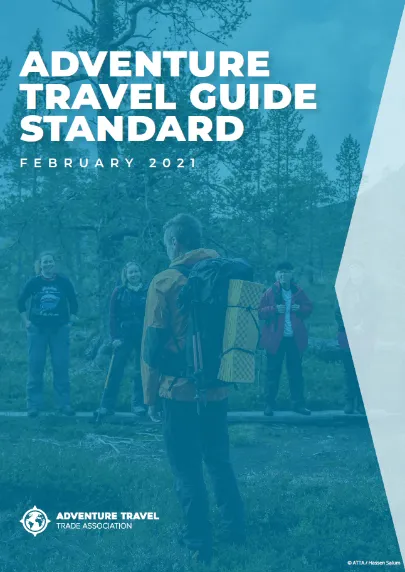
Although these standards for AT guides were revised in February 2021, a key feature compared to the previous version is the higher priority placed on “sustainability.” Furthermore, the first item listed under “Core Competencies” for AT guides is “SUSTAINABILITY AND SUSTAINABLE TRAVEL COMPETENCIES,” which addresses the following five points.
- AT guides must respect the human rights of all participants in the activity.
- AT Guides must minimize adverse impacts on biodiversity, ecosystems, and the natural environment.
- AT guides must protect animal welfare*1 and report any abuse of animals.
- AT guides must respect domestic and international treaties regarding the illegal trade of wildlife and cultural property and report any violations.
- AT guides must share information with participants and business partners regarding best practices for sustainable tourism in the tourism regions where AT activities are conducted.
(*1) Refers to the physical and mental state of animals in relation to the environment surrounding their lives and deaths. (Source: Ministry of Agriculture, Forestry and Fisheries website)
Since AT tour participants themselves have a very high level of awareness regarding “sustainability,” it is becoming increasingly difficult for businesses providing activities and experiences to enhance customer satisfaction unless they pay close attention to every aspect, including the natural environment, cultural properties, and local communities. Interacting with guides who take pride in their region and are committed to preserving and passing on the local nature and culture to future generations during the tour leads to participants’ “self-transformation” and “personal growth,” creating an unforgettable and special experience.
3. The Four Perspectives of Destination Management and the Concept of “Stewardship”
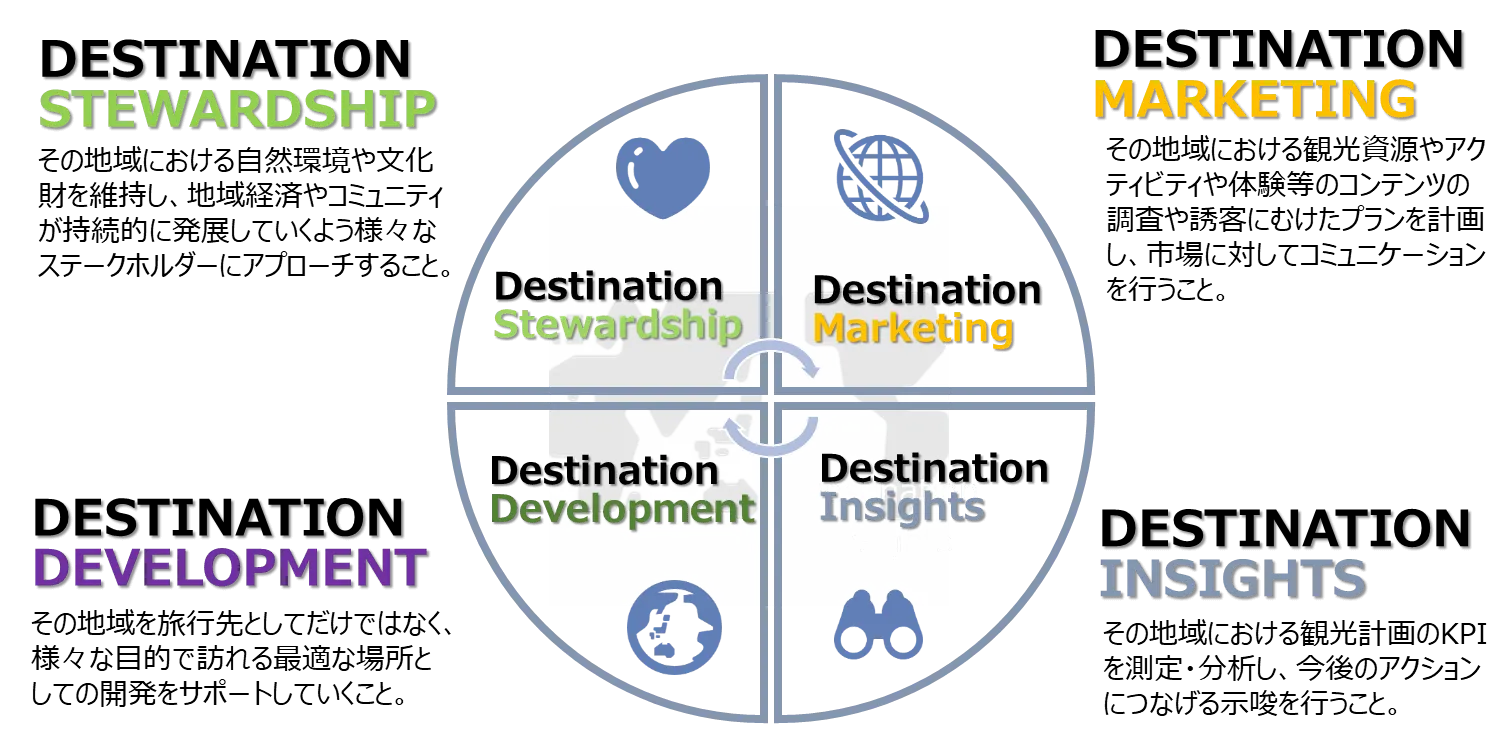
Until now, Japan has emphasized the importance of “destination marketing” as a means to effectively attract visitors. However, in some regions, the so-called “overtourism” problem—where increased tourist numbers negatively impact the lives of local residents—has become apparent, and there have even been cases where rising visitor numbers did not necessarily lead to the revitalization of local communities. In the post-COVID era, to create sustainable tourism destinations, we believe it is necessary to consider destination management from the four perspectives shown in the figure below. A particularly important perspective in promoting AT is the concept of “Destination Stewardship” (the management and conservation of tourism regions). Originally, “stewardship” is a term used in the management and operation of assets; in the context of tourism, it refers to the concept of “utilizing assets (resources) inherited from our predecessors with a conscious effort to pass them on to future generations. ”Until now, the focus has been on “development” to promote visits to the region. However, moving forward, it will be crucial to approach not only tourism operators but also various local stakeholders to help them understand the importance of protecting and passing on natural and cultural resources—which are the shared assets of the nation—to future generations. It is essential that tourism operators, local residents, travelers, and government work together as one to think and act in unison.
Promoting AT is insufficient if viewed solely through the lens of developing high-value-added travel products for Western markets. It is only when destinations approach destination management from a long-term perspective that the diverse experiences offered there become uniquely attractive and unmatched anywhere else in the world. Since AT involves engaging in activities within nature and experiencing local culture, the stewardship of the businesses involved is of the utmost importance.
In the post-COVID era, we must rethink the role of tourism and the significance of our efforts. We must adopt a more profound perspective—moving “from sustainability to stewardship”—to consider the sustainable development of tourism. Should we not put an end to the era of tourism that merely chases visitor numbers, and instead aim for a form of tourism where both travelers and hosts work together to pass on our treasures (resources) to the next generation?
著者