An island that lives in harmony with nature beyond human understanding, moving forward into the future with strength and resilience

This project explores the "line" between the everyday and the extraordinary in the lives of travelers, examining different perspectives on "travel." The third installment focuses on Miyakejima, a volcanic island in Tokyo.During the 2000 eruption, an evacuation order was issued to the entire island population, and life in evacuation lasted for four and a half years. With disaster preparedness receiving increased attention these days, we spoke with residents of Miyakejima—which is about to mark 20 years since the return of evacuees following the island-wide evacuation—to hear about their lives today.
An island with a diameter of approximately 8 km, located about 180 km south of central Tokyo and part of the Tokyo Metropolitan Government’s island regions. It is characterized by an oceanic climate influenced by the Kuroshio Current, with a warm, rainy climate and an average annual temperature of around 18 degrees Celsius. The main industries are tourism and agriculture. Activities such as diving and fishing, which take advantage of the island’s particularly rich natural environment, are especially popular.The island is composed of five main districts: Kamichiku, Izu, Igaya, Ako, and Tsubota. Volcanic activity is frequent; there have been 17 recorded eruptions, with four occurring specifically since 1900—in 1940, 1962, 1983, and 2000. During the eruption that began in late June 2000, volcanic gas continued to be emitted, leading to a decision on September 1 of that year to evacuate the entire island. As a result, all 3,845 residents living on the island at the time were evacuated off the island (with the exception of some personnel involved in disaster prevention and essential services).The evacuation lasted approximately four and a half years, and residents finally began returning to the island in February 2005. The current population is approximately 2,210 (as of December 2024). Map of Miyakejima (Source: Overview of the Miyake Branch Office, Tokyo Metropolitan Government)
In modern society, surrounded by ever-evolving technology, we often find ourselves relying on—and at times over-relying on—technology and predictions, to the point where we may even feel we have become arrogant toward nature. At the same time, natural disasters such as earthquakes and torrential rains are on the rise worldwide. Moreover, in an era marked not only by such cataclysms but also by rapid change and uncertainty, I feel that each of us is called upon to make our own judgments and cultivate the resilience to survive. Since the 20th century, Miyakejima has experienced four eruptions at approximately 20-year intervals. How do those who have returned to a world where they live alongside nature—beyond the reach of human technology and prediction—and those who have newly settled here live their lives? And what might visitors come to realize?
An island where you can feel the Earth’s energy and live alongside a volcano
When people hear the name Miyakejima, many may immediately think of “volcanoes.” The island itself can be considered a volcano; including the seabed, it has a diameter of 25 km and a height of about 1,200 m. I was struck by a comment from one islander who said, “It’s as if we’re living at the 800-meter mark of an active volcano.”Across the island, you can see dynamic terrain formed by numerous volcanic activities and traces of eruptions from various eras. You can also observe the entire process of the land—once turned into a wasteland by lava and volcanic gases—regenerating into forest. As if watching over the island, giant trees that have survived countless eruptions, such as the 1,000-year-old Japanese chinquapin tree “Miyaki no Yomi no Shii”—which boasts the largest trunk circumference in Japan—stand here and there.
Miyakejima is the only island from which all seven of the Izu Islands* are visible, and it is said that in ancient times, it was an object of worship as a “fire-spewing island.” Through its eruptions, typhoons, and unique vegetation, one can feel the breath of the Earth; it is an island where it is easy to realize that life does not merely exist, but is sustained.As some say, “Volcanoes aren’t just a bad thing for us; they’re also a source of blessings.” Perhaps because of this gratitude for nature’s gifts—such as spring water, hot springs, and fishing grounds—the number of Shinto shrines here is particularly high compared to the other Izu Islands.
A distinctive feature of Miyakejima’s residential areas is that there are five districts arranged around the central Mount Oyama.This stands in contrast to Kozu Island and Niijima, which belong to the same Izu Islands and have similar population sizes, where the population is concentrated in a single district. According to islanders, there are theories that the population naturally dispersed at the foot of the mountain and that it was intentionally dispersed to mitigate disaster risks; however, the result is that the island as a whole has a moderate population density, and multiple distinct regional cultures—symbolized by taiko drumming and Kiyari—coexist within close proximity.
During the 2000 eruption, an evacuation order was issued for the entire island population due to volcanic gas. It is estimated that the population, which was approximately 3,800 at the time of evacuation, had decreased by about 1,000 by the time residents returned. On the other hand, there was a time in the past when the population peaked at over 7,000, and it is said that some administrative functions, public facilities, and community activities are based on that era.The challenge now is how to sustain the island in the face of a rapid population decline following the disaster, an aging population, and the fact that the population is scattered across five distinct residential areas. During my stay, I had the opportunity to meet people who are cheerfully tackling these challenges.
*The Izu Seven Islands refer to the seven islands belonging to the Tokyo Islands Region: Izu Ōshima (Ōshima), Toshima, Niijima, Kozushima, Miyakejima, Mikurajima, and Hachijojima.
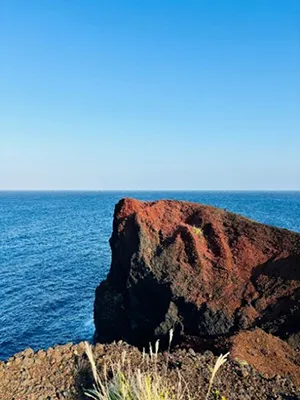
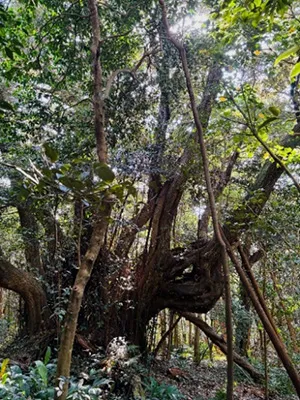
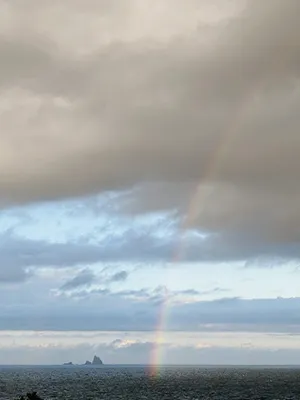
Unique landforms created by volcanic activity can be seen all over the island and extend into the sea. Some of these have long been objects of worship for the people of Miyakejima.
The present-day lives of those who experienced the 2000 eruption and returned to the island
How do the people who returned to the island after the 2000 eruption feel about living alongside the volcano once again?
This may be common to islands rich in nature, but the islanders do not rely solely on weather forecasts; they live by reading the wind direction and sea conditions with their own senses. When ferry services are canceled, the island faces shortages of supplies, and people may not be able to go out as planned, but that is simply part of living in nature. “When I’m bathed in the energy of nature every day, my own worries seem so small that I think, ‘I should stop fighting against things.’ That is the charm of this island,” one person told me.
Many of those who have returned to the island experienced not only the 2000 eruption but also the one in 1983, and some even have memories of the eruptions in 1962 and 1940. In fact, thanks to their daily preparedness, there were no casualties from the eruptions in 2000, 1983, or 1962.Furthermore, Miyakejima, with its mountains and sea, is no stranger to damage from typhoons and other natural disasters, and the island has a history of recovering from such events each time. As a result, there is a constant awareness of “what if…?” scenarios; a mindset of disaster preparedness is second nature, and some people even said they routinely think through potential patterns of unforeseen events. Against this backdrop, the phrase “No matter what happens, we’ll manage somehow; we can handle it” was heard naturally from many people’s lips.
However, even for these islanders, the 2000 eruption was different from the damage caused by previous eruptions or typhoons. The unprecedented situation—in which the entire island was affected and all residents were forced to live in evacuation for four and a half years—inflicted significant damage, yet it also had a positive impact on the relationships among the islanders.
Before the 2000 eruption, islanders’ lives revolved around their respective districts; while they might recognize the faces of people from other settlements, there was little interaction, and at times, they even viewed each other as rivals.Furthermore, since the effects of previous eruptions had been limited to specific districts, those in less-affected areas tended to view the situation as “a fire on the other side of the river”—meaning they felt it was someone else’s problem. However, the 2000 eruption forced the entire population to evacuate, and upon returning, everyone had to work together to rebuild the entire island, which naturally brought the five districts together as one.
In particular, many children—from elementary school through high school—ended up living together at a boarding school in Akiruno City, Tokyo, where they were evacuated. They lived together like older and younger siblings, regardless of grade level. “We were often hounded by the media as ‘poor children,’ and life was tough—we had no private space, our time was restricted, and we were separated from our families. But there were also many happy moments, and that life in evacuation allowed us to become close with people of similar ages across different districts.That connection has continued even after we returned to the island,” say the islanders, now in their 30s and 40s. It could be said that the hardships of the disaster ultimately deepened the bonds among islanders who had previously been somewhat divided. Additionally, some say that the experience of the entire island population leaving the island made people more sociable and open-minded, and that attitudes toward newcomers have changed since their return.
These changes are also evident in festivals. While festivals used to be primarily organized by residents of a single district, in recent years—partly due to a shortage of manpower—they have opened their doors to residents of other districts, newcomers, and visitors.While each district traditionally used its own distinct yukata patterns, a festival organizer noted that the recent sight of people in varied yukata mingling and carrying the mikoshi together felt like a new form of festival—one where everyone works together to preserve the tradition while deepening mutual understanding and connection.
Precisely because they are in daily contact with the immense power of nature and have experienced severe disasters many times, they understand that human technology is not omnipotent, yet they also know that human effort can rebuild what has been lost. In their demeanor, I sensed a strength of spirit and a positivity that are absent in the city.
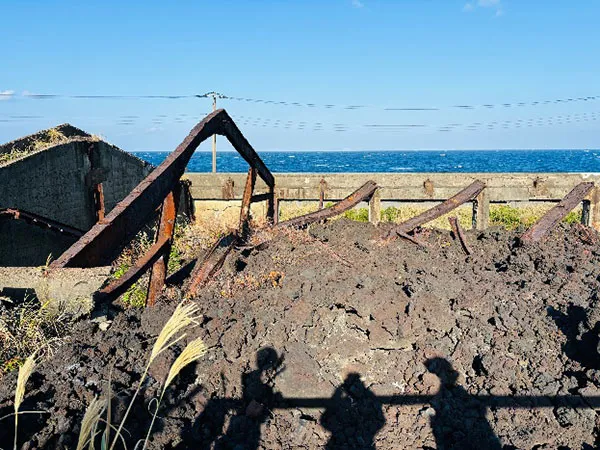
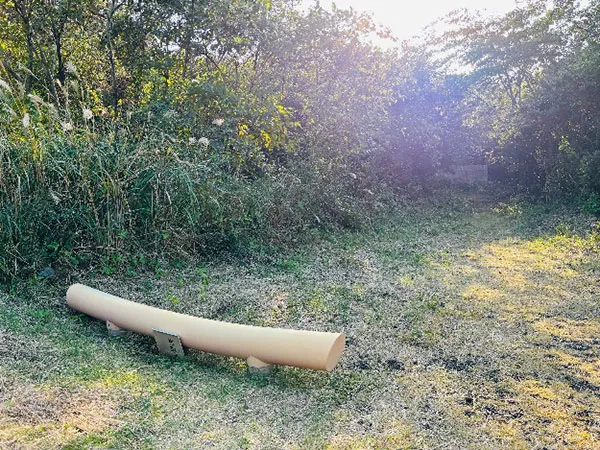
Sites that evoke the ferocity of past eruptions are scattered across the island, such as the ruins of a school buried by lava flows and a shrine hall and torii gate swallowed by massive mudflows.
Learning through a Volcano Climbing Experience at the Site of the 2000 Eruption
An experience called “Mt. Oyama Volcano Hike 775,” which allows participants to learn about Miyakejima’s volcanic history and geographical features, as well as the disaster preparedness mindset of the people living on the island today, has been offered since last year.
In this program, participants—after completing preparatory study—hike up to near the summit of Mt. Oyama, the epicenter of the 2000 volcanic activity, accompanied by a local guide.The trail was once so overgrown with trees that the view was obstructed before the eruption, but now the view is clear, offering a panoramic vista of the villages at the foot of the mountain and the sea beyond. As you climb, you receive explanations about the terrain formed by past volcanic activity, the observation equipment installed by the Japan Meteorological Agency and research institutions, and the emergency shelters for use in case of an emergency.
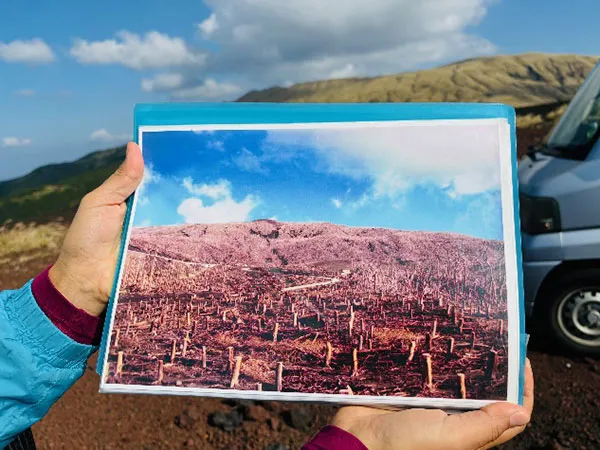
The vegetation along the way consists mainly of short plants, particularly pampas grass. While dead trees were still visible here and there in the distance, the forest is steadily recovering. This is a valuable site where one can observe the phenomenon of vegetation change through the stages of recovery known as vegetation succession. Since the forest used to be dominated by evergreen trees, the colors did not change with the seasons, but on this day, the entire area was golden.“It’s already different from when we first began our surveys a few years ago. A year from now, five years from now—this is a forest that changes. It changes every time you visit; it’s a place where you can truly feel the recovery,” our guide told us as we finally reached the caldera formed in 2000.
Before the 2000 eruption, Mount Oyama, located at the center of Miyakejima, stood at an elevation of 815 meters. Near the summit were fumaroles known as the “Oyama Sauna” and a wetland called Hachōdaira, where rare flowers and plants thrived.For the islanders, it was a place of relaxation for school field trips and weekend hikes, and many still remember those scenes. However, the collapse caused by the 2000 eruption created a massive caldera, turning the land into a barren wasteland due to volcanic gases. Mount Oyama’s current elevation is 775 meters, a drop of 40 meters. Although I, the author, have never seen it in its former state, standing before the exposed caldera, I could vividly imagine the immense energy of nature that was released here.
In addition to the landscapes shaped by the forces of nature, another highlight of this experience lies in the diverse group of guides. Some are native islanders, while others are people who moved here after the eruption. The guides come from a variety of backgrounds—including professional nature guides, farmers, and those in the hospitality industry—and their tours go beyond simply explaining the natural and geographical features. They weave in personal anecdotes about their own experiences during the eruption, lessons learned about disaster prevention, and their perspectives as newcomers, offering a vivid glimpse into the present-day reality of Miyakejima.
One guide, a settler who lived through the 2000 eruption, shared: “What you’ve always taken for granted can disappear overnight. But as long as you’re alive, things will work out. I know we can start over. The people of this island are incredibly resilient because they live that way. In a world inextricably linked to disasters, they have a strong mindset of surviving alongside nature while practicing disaster prevention. I was captivated by people who can remain positive and accept whatever comes, and that’s why I decided to make my life here on this island.”
Another guide, who works in agriculture, said that since coming to Miyakejima, he has stopped drawing rigid boundaries around things. Farming in the island’s unpredictable climate means that daily tasks can change depending on the weather or season. Furthermore, because the population is small, people often take on multiple roles within the community, such as helping out with various tasks. As a result, he said he has naturally become more flexible regarding working hours, his own responsibilities, and everything else. He began guiding because he felt that, as someone who constantly observes Miyakejima’s weather and nature, he had unique insights to share.
For visitors, this is not only an experience unlike any they have had before, but also a unique opportunity specific to Miyakejima—a place where islanders who lived through that era and their children can reflect on the changes that have occurred since the year 2000. In this era of increasing natural disasters, it is a valuable opportunity to witness the power of nature firsthand, to experience the spirit of resilience, and to reevaluate one’s own disaster preparedness.
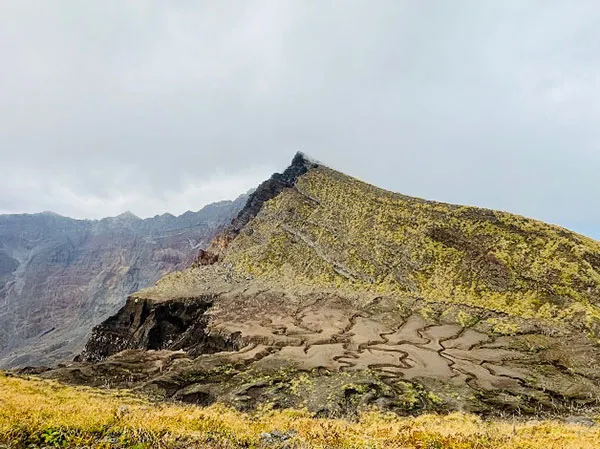
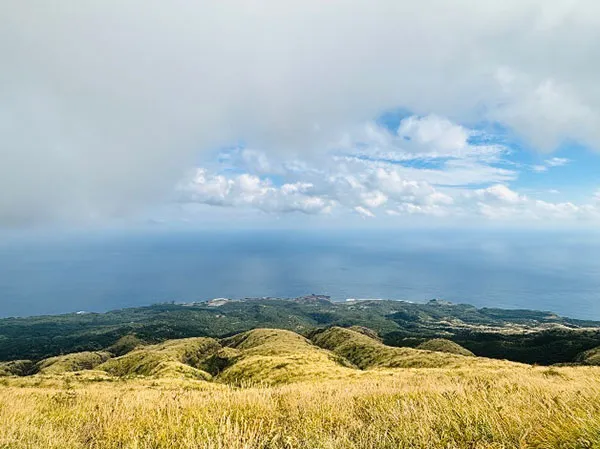
The caldera measures 1.6 km in diameter and is approximately 500 m deep. Looking in the opposite direction, we could see Niijima floating in the sea.
What is necessary to navigate an uncertain future with resilience
While speaking with the islanders, what struck me was that although they are sometimes asked, “Is it really safe to live here with a volcano?” many expressed the opinion that city life is far more frightening. Death can come anywhere; accidents and disasters happen everywhere. The potential disasters on Miyakejima—such as typhoons, volcanic eruptions, and tsunamis—can be narrowed down to a certain extent, allowing for preparation.Compared to an island where everyone is highly aware and there are close-knit, face-to-face connections, they feel that the city—where you don’t even know your neighbors and could get caught up in any kind of incident—is actually more dangerous.
Mr. Hirano, who served as our guide this time—a native of the island who offers various experiences related to Miyakejima’s nature and culture, and who is the representative of the Miyakejima Regional Experience Workshop “Shimanone” as well as a guide for the Mount Oyama Volcano Climbing Experience 775—says, “On the island, self-reliance is the foundation; next comes mutual aid with those around you; and finally, we seek public assistance.“But in urban areas, I hear that many people rely on public assistance immediately when they find it impossible to manage on their own, even though community ties are weak and they aren’t adequately prepared. For islanders, the basics of life include maintaining connections with others, protecting oneself, preparing for emergencies, taking responsibility, and bouncing back—all on a daily basis. I want to pass on this resilience and flexibility of island life to the younger generation living in these uncertain times.“I started this project because I want this way of life—one that cultivates the essential strength to live in harmony with nature and cherishes human connections—to continue into the future. I hope that people from off the island can also experience this unique opportunity to hone their life skills, available only here on Miyakejima.” As I listened to his story, it struck me that living with responsibility and preparing for every possible situation seems to be a fundamental foundation necessary for everyone’s life.
Perhaps due to the effects of global climate change, the ocean around Miyakejima is changing; the types of fish caught are shifting, and whale sightings in winter are becoming more frequent. I believe that no matter how the environment changes, the people of Miyakejima will continue to live with resilience and flexibility. At the same time, I felt as though they were asking us city dwellers, “Are we prepared to survive an uncertain future?”
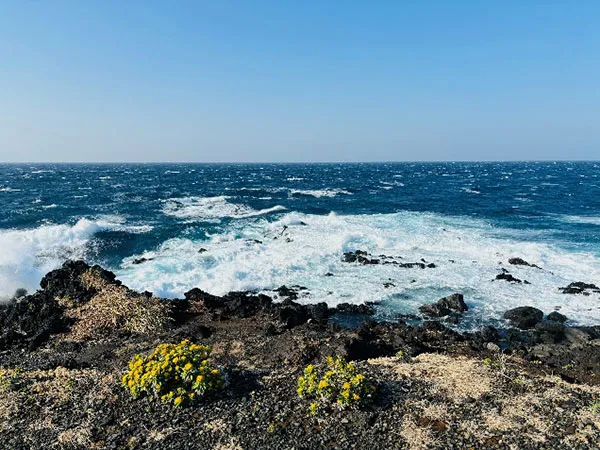
*All photos were taken by the author
A Word from the Observer of “Lines”
I personally experienced the Great Hanshin-Awaji Earthquake (1995, M7.3) at my home in Kobe, and the Western Tottori Prefecture Earthquake (2000, M7.3) while climbing Mt. Daisen (1,729 m), near the epicenter, at around the 9th station. Both were intense events that taught me the sheer power of nature and made me realize that life is a continuous series of uncertainties that we must simply endure. Generally, when people choose a destination rich in natural beauty, their primary goal is likely to enjoy nature. However, when we shift our perspective to focus on the way of life of the people who live there, we may discover something different from the mere enjoyment of travel. There are many ways to deepen one’s travel experience; even when visiting the same place, the possibilities for different experiences are endless. In a sense, this is akin to each individual using their own judgment to make choices and navigate life.
著者