The Nighttime Economy in the Spotlight: Examining Japan’s Nightlife from the Perspective of Foreigners’ Lifestyles and Cultural Backgrounds
The nighttime economy refers to economic activity that takes place at night (generally from sunset to sunrise). Countries around the world are implementing various initiatives to promote the nighttime economy, with the expectation that it will expand consumer spending and business opportunities. In Japan, too, there are high expectations for nighttime entertainment, particularly among foreign tourists visiting the country. On the other hand, some people say, “There are few entertainment and cultural facilities or public transportation options in Japan that operate late into the night, making it difficult to enjoy the evening.” In this column, we will examine the state of nightlife in Japan based on the “Survey on Nightlife Tourism in Tokyo” conducted by the Tokyo Metropolitan Government in FY 2018.
1. Survey on Nightlife Tourism in Tokyo
In FY 2018, the Tokyo Metropolitan Government conducted a survey*1 to clarify the current state of nightlife tourism in Tokyo. To do so, the scope of the survey was expanded beyond services such as nightclubs—where visitors can enjoy alcohol, dancing, and music—to include leisure and entertainment activities (such as viewing nightscapes and visiting cultural facilities), dining, shopping, transportation, and information dissemination. The survey examined actual needs and case studies of initiatives from overseas. It took into account nightlife behaviors and consumption patterns unique to Tokyo or Japan, as well as the behavioral patterns of travelers visiting the city.
The survey results reveal differences not only between Japanese and foreign visitors but also in how residents of Western cities such as London and New York differ from those in Asian cities like Shanghai and Seoul in their engagement with nightlife. Since lifestyle significantly influences how local residents engage with nightlife, it is necessary to consider these cultural differences when introducing measures and systems to promote nightlife tourism.
2. Insights for Promoting Nightlife Tourism from the Survey Results
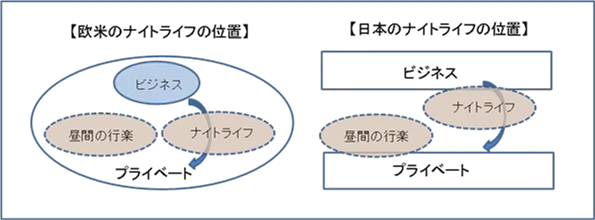
Let’s take a closer look at the survey results. In the business sectors of London, New York, and Singapore, overtime is generally not required, and a 48-hour workweek is the standard. Consequently, there is a tendency to stop by a pub on the way home from work (in the UK) or to go out again after returning home to enjoy nightlife activities such as musicals or dinner (in New York). In Western countries, nightlife often involves stepping away from work to spend time privately, which differs from the Japanese culture where dining and socializing with coworkers is common.
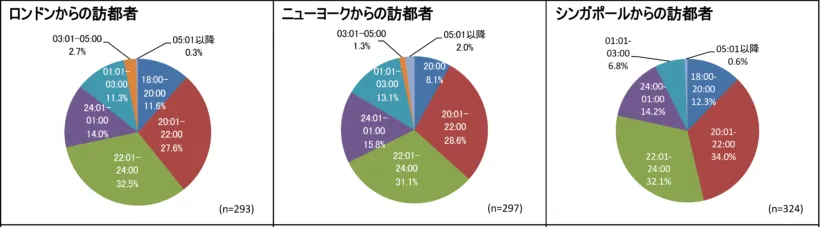
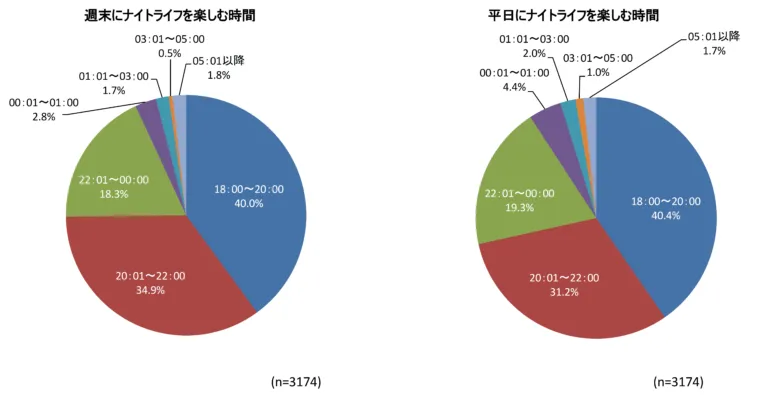
In terms of daily life, the percentage of people who enjoy nightlife past midnight is approximately three to four times higher in London and New York than in Japan. Even when traveling abroad, Japanese people tend to return to their hotels earlier than is typical for people in London or New York. The fact that nightlife has not taken root among Japanese people is attributed not only to insufficient transportation and infrastructure but also to differences in lifestyle. This is believed to be influenced by cultural differences rather than economic factors. In Western countries, nightlife is seen as a time for private enjoyment, with venues located near people’s homes. In contrast, in Japan, nightlife is viewed more as an extension of work; many nightlife establishments are located near workplaces, and until recently, at least, it was primarily viewed as a male-dominated business. Consequently, the concept of nightlife has struggled to take root in Japan, and there is a tendency to feel uneasy about the nighttime operation of leisure facilities and zoos.
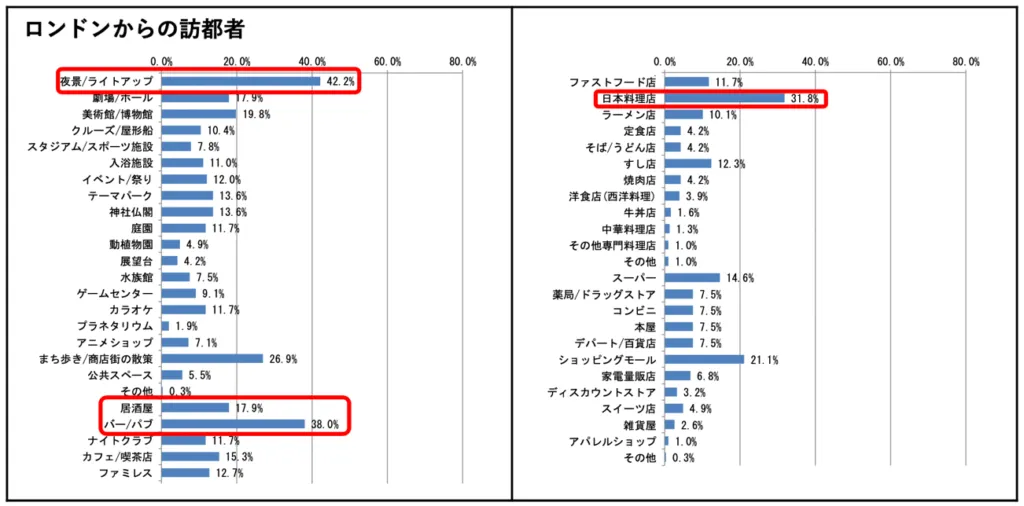
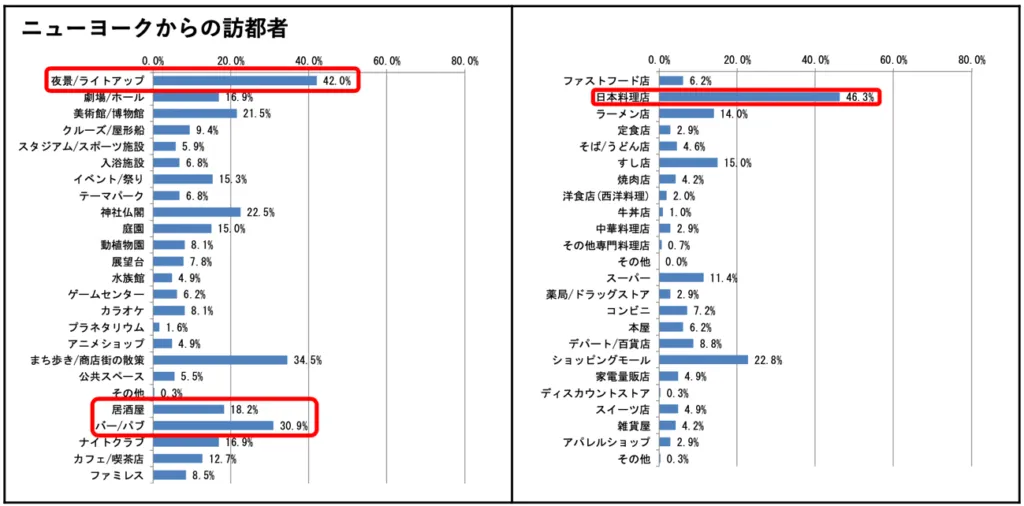
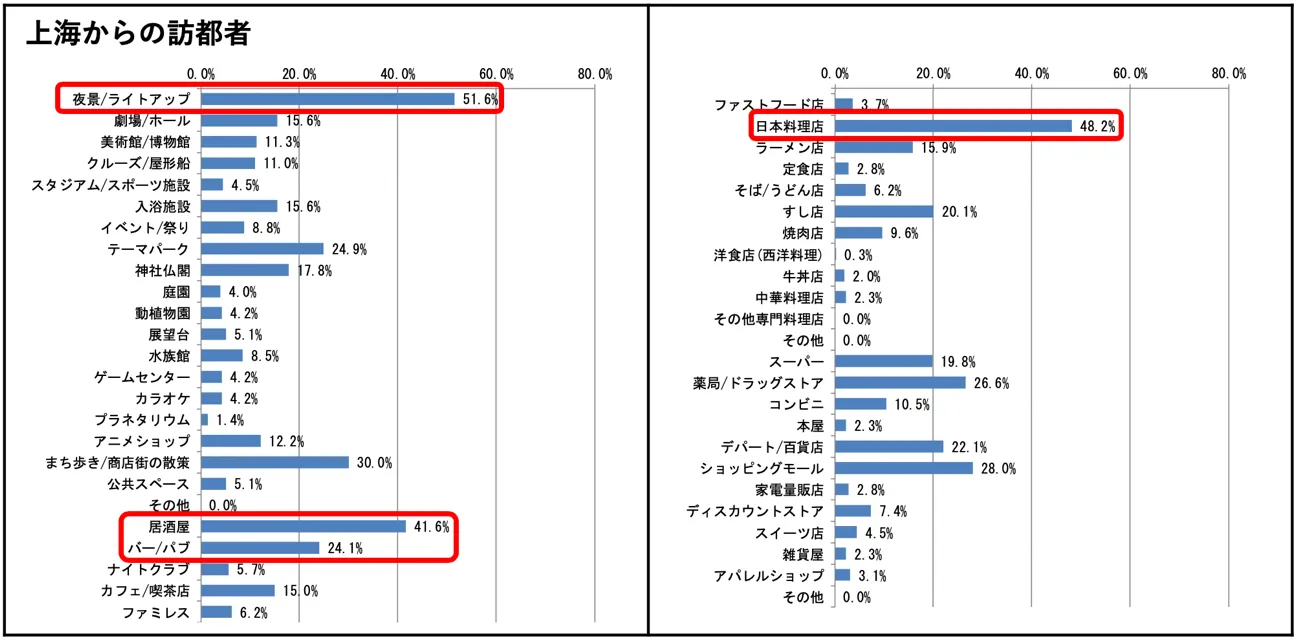
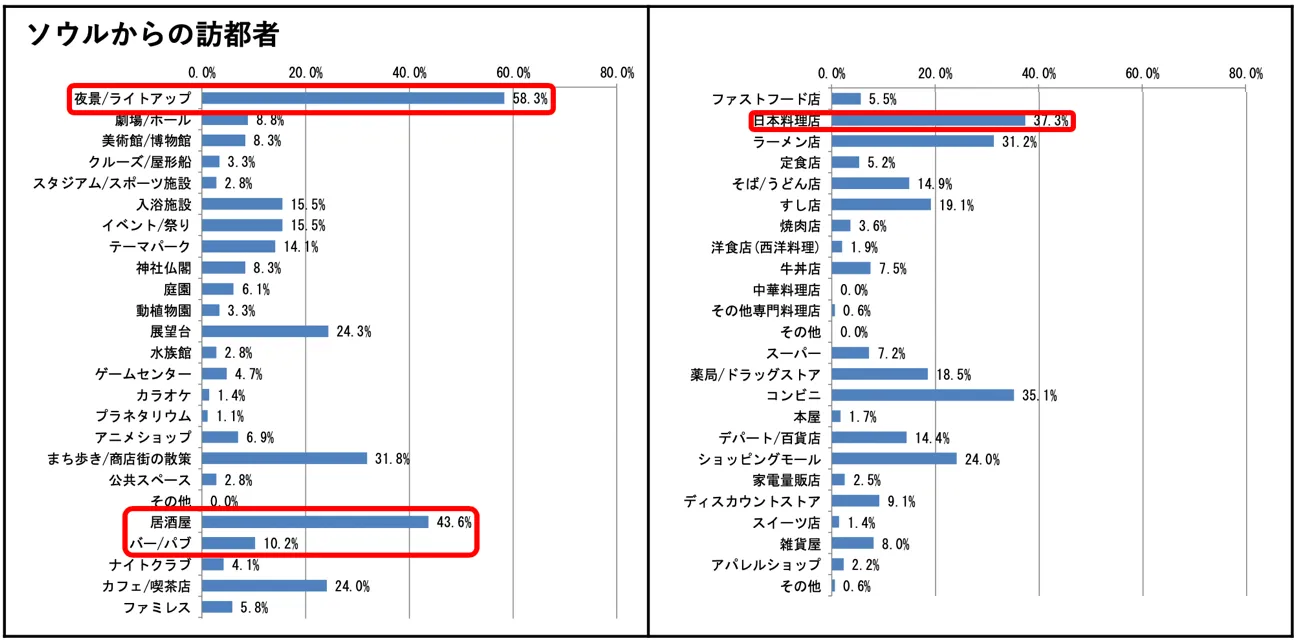
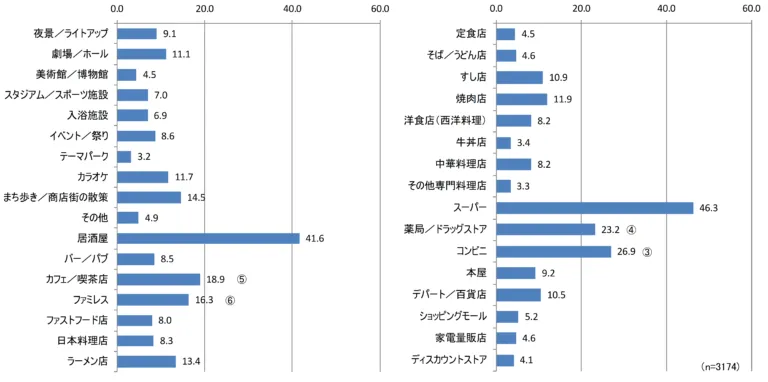
In the food and beverage sector, “izakaya” (Japanese pubs) play a major role in Tokyo’s nightlife. While the usage rate among Japanese people is around 30% to 40%, it exceeds 40% among foreign visitors to Tokyo, particularly those from Asia (Shanghai and Seoul). Foreigners’ impressions of izakaya include being able to stay for long periods and relax, which are sentiments shared by Japanese people as well. On the other hand, while the extensive menu is viewed negatively by Japanese people—who find it “difficult to choose” or “expensive”—foreigners view it positively as a way to enjoy a variety of dishes in small portions. As seen in the opinions of information providers, it can be said that izakayas have established a unique position as a distinctly Japanese cultural experience. Meanwhile, foreign visitors from London and New York also frequent bars and pubs.
We have gained some insights regarding which types of dining establishments should be expanded to enrich Tokyo’s nightlife. Many foreigners are interested in Japanese restaurants, and since they are visiting Japan as tourists, there is a view that they do not find bars and restaurants similar to those in their home countries particularly appealing. On the other hand, Westerners are more likely to spend time at bars and pubs they are familiar with. To enhance Tokyo’s nightlife, we can consider a two-pronged approach that emphasizes both the everyday and the extraordinary.
When offering experiences that are part of everyday life for Japanese people to foreign visitors, efforts should be made to ensure they can enjoyably engage with a different culture. Conversely, for establishments like bars and pubs—which are part of foreigners’ daily lives—it will be necessary to operate them in a way that feels natural and comfortable. In places that are out of the ordinary for foreigners, such as izakayas and Japanese restaurants, the presence of Japanese customers can also serve as a positive atmosphere-enhancing element.
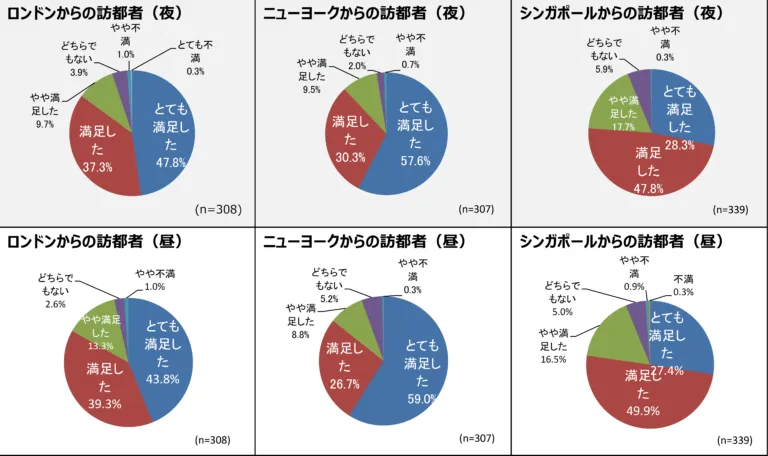
Data 1: Satisfaction with Nighttime vs. Daytime Tourism in Tokyo
Data 2: Types of Experiences in Tokyo’s Nightlife (Top chart: Foreign visitors to Japan; Bottom chart: Japanese residents)
Data 3: Time Spent Enjoying Nightlife in Their Place of Residence (Top chart: Foreign visitors to Japan; Bottom chart: Japanese residents)
3. The Role of Nightlife from an Urban Development Perspective
Competition to attract international tourists is taking place not only among major metropolitan areas within Japan but also among cities worldwide. Regarding the utilization of nightlife, fierce competition is unfolding among international cities over how to develop the “time market” based on the concept of the “nighttime economy. ”One initiative worth noting is in London, where Mayor Sadiq Khan appointed a “Night Mayor” to create a post-Olympic nighttime economy. Acting as a bridge between the public and private sectors to coordinate interests, this initiative has succeeded in creating new markets during nighttime hours.
In Japan, while many foreign visitors are now coming to major metropolitan areas such as Tokyo and Osaka, the focus has been largely on localized or partial issues like overtourism, which has, in some ways, constrained efforts to revitalize nightlife. It cannot be denied that there is a concern among the Japanese public that nighttime activities—especially those late at night—might shatter the myth of safety and security.
Furthermore, considering that Japanese society will likely become more diverse in the future by welcoming not only foreign tourists but also many foreign workers, it will be necessary to engage in discussions on “urban planning”—specifically, how to design cities and neighborhoods—rather than focusing solely on nightlife. There are numerous challenges that go far beyond the scope of what a single company can resolve through its own efforts, including not only service-related issues but also securing the personnel to operate them and gaining the understanding of local residents. For example, as seen in London, the national and municipal governments must cooperate to align their policies and concrete measures regarding nightlife, and collaborate with private-sector operators. It is essential to examine the future of nightlife not merely from the perspective of the nighttime economy, but within the broader context of “town planning”—aiming to create spaces that can be enjoyed together with local residents. How can we showcase Japan’s “nighttime face” to both domestic and international audiences? It will be necessary to generate ideas unique to each city and region.
*1 Tokyo Metropolitan Government, “Survey on Nightlife Tourism in Tokyo,” Tokyo Metropolitan Government website