From Volume to Value: Decoding the Evolving MICE Evaluation Criteria

Could it be that the criteria for evaluating MICE are currently changing? The capabilities of cities and countries—which have traditionally been measured by “numbers” such as the number of events held or the number of participants—have in recent years begun to be evaluated based on a more multifaceted concept of “value.”This trend is drawing attention not merely as an update to ranking methods, but as a shift that prompts us to reexamine the very question of “what constitutes the value of MICE.”
*This column is a reprint, with permission, of an article originally published in the June 2026 issue of “Monthly MICE Japan” (MICE Japan Co., Ltd.).
A Shift Toward Prioritizing Event Value
In recent years, there has been a growing global trend toward reevaluating the very criteria used to assess MICE events. Until now, statistics focused on “numbers”—such as the number of events held and the number of participants—have been used as the primary indicators for MICE, particularly for “C” (Conventions), such as international conferences and academic meetings.These figures serve as clear measures of a country or city’s performance and have undoubtedly functioned as powerful decision-making factors in the selection of host locations. Consequently, it is only natural that countries and cities have strived to improve their rankings.
However, there is now a growing trend toward evaluating host cities from a more multifaceted perspective—looking not only at the number of events held but also at factors such as the host city’s industrial clusters, research environment, business networks, and the experiential value provided to participants.In particular, in the fields of M (Meetings) and I (Incentives), events are often conducted as internal corporate activities, making it difficult for statistics such as the number of events held to be publicly available.Consequently, organizers and planners of M and I events may be selecting host cities based on the perspective of “which region can create the most value for their specific objectives,” while utilizing a city’s track record of hosting international conferences as one indicator.In fact, some forward-thinking convention bureaus are moving beyond simply introducing venues and conducting bid campaigns to actively supporting collaboration with domestic researchers, academics, and businesses. This may indicate that the region’s research and industrial networks themselves—not just the number of events held—are being valued as key factors in selecting a host location.
ICCA Statistics Begin to Visualize Competitiveness by Field
This shift in thinking is also beginning to spread to the C: Convention and E: Exhibition sectors.In these sectors, which were traditionally evaluated primarily based on scale—such as the number of events, participants, and attendees—there is a growing consensus that a single metric cannot fully capture a region’s capabilities. A symbolic example of this trend is the introduction of new rankings in recent international conference statistics.
In statistical reports published by the ICCA (International Congress and Convention Association), evaluations are now based on multifaceted indicators—such as sector-specific rankings—in addition to the traditional number of events held. In the 2025 sector-specific rankings released this month, Japan ranked second in the “Technology” category and third in the “Science” category, while Tokyo ranked second among cities in the “Science” category.In an analytical commentary titled “EVERY SECTOR HAS ITS CHAMPION,” it is noted: “Although Japan does not rank among the top five countries in terms of total number of events hosted, it demonstrates a strong presence in the technology sector, with the three cities of Tokyo, Osaka, and Yokohama hosting a large number of international technology conferences.This suggests that ‘sector-specific competitiveness’—which is difficult to gauge based solely on the number of events hosted—is likely to become an increasingly important evaluation criterion in the future.”
The Perspective of “Value Assessment” Expanding into Japan’s MICE Policy
This trend is not unrelated to Japan’s MICE policy. In the “MICE Marketing Strategy” recently announced by the Japan Tourism Agency, factors such as consumer spending, attracting visitors to regional areas, high-value-added experiences, and human resource development—not just the number of events—are identified as key perspectives. In other words, it can be said that we have now entered a phase of enhancing MICE competitiveness from every angle, including the value of hosting events.
The Shift Toward Multidimensional Evaluation Has Begun in the Exhibition Industry as Well
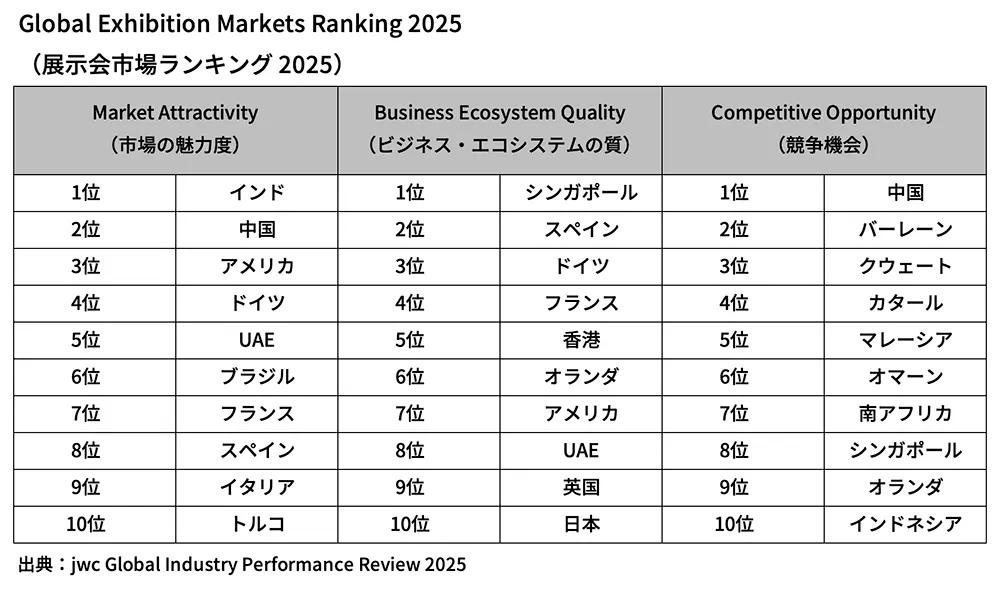
A similar trend is emerging even more clearly in the exhibition sector. The “Global Industry Performance Review 2025,” released in March 2026, introduced country-by-country rankings based on a multidimensional framework for the first time.This ranking provides a comprehensive evaluation based on three perspectives: market attractiveness, the quality of the business ecosystem, and competitive opportunities. As a result, markets are now viewed from a different perspective than before, highlighting the presence of emerging markets such as the UAE and India in addition to major markets like China, the United States, France, and Germany.
Particularly noteworthy is the introduction of the “quality of the business ecosystem” indicator. As stated in the report, this evaluates “the infrastructure and systems that indirectly support trade shows,” assessing the entire supporting environment—including related industries, institutional frameworks, logistics, and human resources.The introduction of this multifaceted evaluation system helps visualize market characteristics and growth potential that were difficult to discern using traditional single indicators. It is a welcome change in that it creates opportunities for countries and cities to more clearly demonstrate their strengths.
In this “Quality of Business Ecosystem” ranking, Japan was ranked 10th. Japan’s trade show industry, which has developed primarily around the domestic market, has often been regarded as a highly distinctive market.Furthermore, the Ministry of Economy, Trade and Industry’s “FY 6 Supplementary Budget Project to Support Creative Businesses (Survey and Research on Assessing the Current State of the Exhibition Industry for Internationalization)” concluded that “the significant potential value of trade shows and methods for utilizing that value should be more widely communicated to the public.”The results of this Business Ecosystem Quality Ranking indicate that Japan’s foundational elements—such as its systems, infrastructure, and human resources—are receiving a certain level of international recognition.This point is of great significance as Japan’s trade show industry seeks to deepen its connections with the global market in the future. In other words, shouldn’t the Japanese trade show industry more accurately recognize its own strengths and become a key player in supporting various Japanese industries to enhance their presence in the global market?
Challenges Regarding Diversification of Evaluation Criteria and Ranking Transparency
On the other hand, as these new evaluation methods become more widespread, it is necessary to examine the evaluation methods themselves. Traditional indicators—such as the number of events held, visitor numbers, and exhibition space—have the advantage of being clearly quantifiable, making the basis for comparison straightforward.In contrast, concepts such as “market attractiveness” and “quality of the business ecosystem” can sometimes make it difficult for outsiders to see what criteria are used for evaluation, how much weight is assigned to each factor, and what methodology is employed to derive the final rankings.Now that rankings influence the evaluation of countries and cities—and even policy decisions—the emergence of new evaluation criteria is a welcome development. However, it is likely that only those rankings that demonstrate high transparency in their calculation processes and fairness in their results will be utilized as reliable sources.
The Expected Redefinition of MICE Value
Viewed in this light, the changes currently taking place are not merely a phenomenon of an increase in the number of new rankings, but rather a process of redefining the fundamental question of “what constitutes the value of MICE.”
Of course, traditional metrics such as the number of events held and the number of participants have not lost their importance. These figures provide clear benchmarks and allow for an objective and continuous assessment of a country or city’s performance; as such, they are likely to remain key indicators that enable fair comparisons in the future.
That said, going forward, we can expect a growing trend toward selecting the most suitable host locations not just based on rankings of the number of events held, but also according to the theme and purpose of the MICE event, the participant demographic, and the desired experiential value.
The fact that evaluation criteria are expanding signifies that a wider range of values is beginning to be recognized. That is precisely why, in promoting MICE going forward, it is crucial to focus not on getting caught up in the ups and downs of rankings themselves, but rather on accurately understanding the specific areas and values in which one’s own city or region excels, and effectively communicating those strengths to organizers and participants who need them.
By clearly highlighting our unique characteristics while taking into account both quantitative indicators—such as the number of events hosted—and the value of hosting—including industrial clusters, research environments, business networks, and participant experiences—we can achieve greater success in attracting MICE events that are well-suited to our city.
Source: MICE Japan Co., Ltd., “Monthly MICE Japan 2026, June Issue”
*This column is a reprint, with permission, of the original article published in “Monthly MICE Japan 2026, June Issue” (MICE Japan Co., Ltd.).
著者