The Use of Digital Transformation in Ryokan Management and Its Future: The Introduction and Outlook of Digitalization in Small and Medium-Sized Ryokans

With the recovery of tourism demand following the pandemic, the ryokan industry now faces urgent challenges in accommodating inbound tourists and addressing labor shortages. Drawing on the author’s practical experience managing a ryokan in Nagano Prefecture, this article examines the current state and challenges of digital transformation (DX) adoption in small and medium-sized ryokans, the potential for operational improvements through AI, and the future strategies required for ryokan management.
1. Introduction
The author has managed a hot spring inn in Nagano Prefecture for approximately 10 years and currently teaches “Ryokan Management” at the graduate level. This paper discusses the significance and future direction of digitalization in ryokans, based on the current state and challenges observed from both practical and academic perspectives.
Since the onset of the COVID-19 pandemic, domestic and international tourism demand has recovered rapidly, and the increase in inbound travelers, in particular, has been a major boon for ryokan across the country. However, this has simultaneously placed a severe strain on on-site operations and human resource management. Issues such as labor shortages, the pressure to provide multilingual support, the surge in reservations and inquiries, and the need to accommodate diversifying dietary needs (vegetarian, gluten-free, etc.) have transformed the ryokan environment into one that demands a high degree of flexibility and responsiveness.
Against this backdrop, DX (Digital Transformation) is no longer viewed merely as the utilization of IT tools but is positioned as a strategic initiative that determines the sustainability of ryokan management. This article organizes and examines the current state of DX in ryokans, its challenges, practical case studies, and the DX strategies that small and medium-sized ryokans should adopt.

2. Current Status and Challenges of DX in Ryokan
2-1. Current Status of System Implementation
Supported by institutional measures such as IT introduction subsidies, the adoption of accommodation management systems—centered on PMS (Property Management Systems) and site controllers—is progressing rapidly.A PMS is a core system that serves as the nerve center of ryokan and hotel operations, playing a role in centrally managing fundamental data for accommodation operations, such as reservation management, check-in and check-out, room occupancy status, customer information, and revenue processing. By integrating the cumbersome operations that traditionally relied on paper ledgers and Excel spreadsheets, it achieves operational standardization, labor savings, and data consistency, making it the “central nervous system of the ryokan.”
On the other hand, a site controller is a system that allows for the centralized management of room inventory and rate information listed across multiple OTAs (Online Travel Agencies). This frees inns and hotels from the need for manual updates on each OTA platform, dramatically improving the efficiency of sales and inventory management.
According to a survey by Cadish Co., Ltd. (2025), the adoption rate of PMS systems among accommodation facilities has reached approximately 65%, indicating that a digital operational foundation is gradually being established. Furthermore, the adoption of site controllers is progressing with the aim of reducing the burden of OTA management, and it can be said that the digitization of the reservation and sales sectors is steadily deepening.
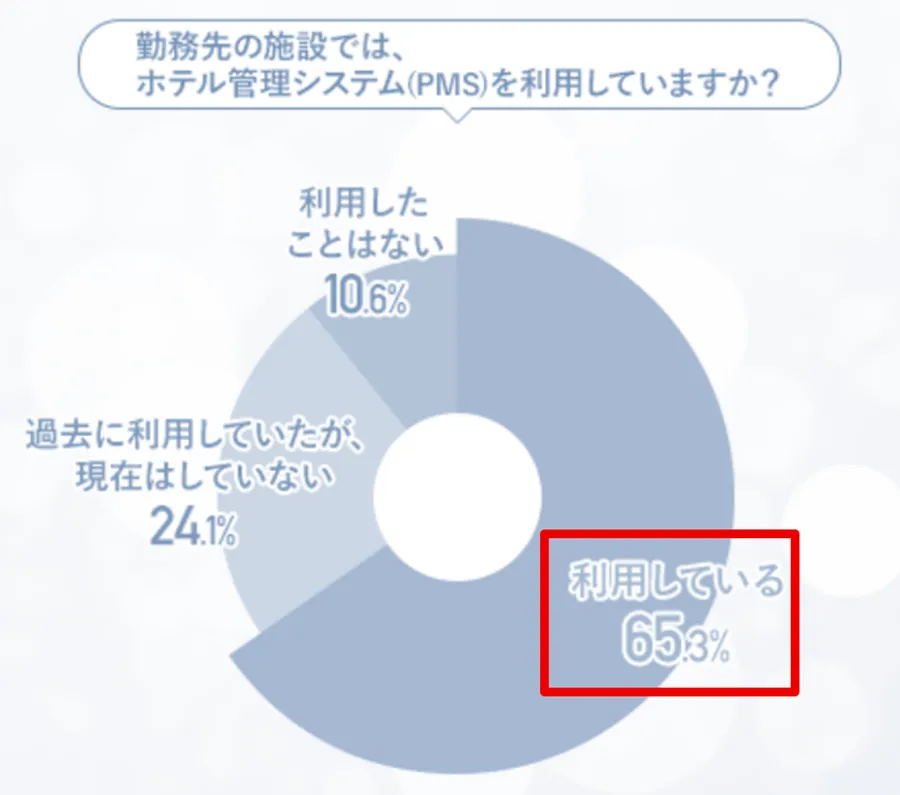
However, only about 40% of facilities reported that they “fully utilize their PMS,” while approximately 60% are in a situation where they “have implemented it but are not making full use of it.” This gap suggests not merely an issue with implementation, but a lack of organizational capability to elevate DX to the operational stage.
2-2. Structural Challenges Hindering DX
The primary challenges facing accommodation facilities in advancing DX are as follows.
- Lack of Operational and Training Systems
- Disparities in Employee IT Literacy
- A fragmented system architecture lacking integration
- Increasing Implementation and Operational Costs
- Delays in standardization and the creation of manuals due to reliance on individual expertise
Particularly in small and medium-sized inns, operations rely heavily on “tacit knowledge,” and the lack of standardized work processes is a major factor hindering digital adoption. Since DX involves not only the introduction of technology but also a transformation of organizational culture and processes, the “resilience to change” of frontline staff is being put to the test.
3. Practical Applications of AI in Small-Scale Inns
3-1. Overview of Implementation
At the small-scale inn in Nagano Prefecture that I manage, we are promoting DX management utilizing AI to address these challenges. Specifically, AI handles the following tasks:
- Internal phone calls (including multilingual support)
- Handling external calls (currently in preparation)
- Handling inquiries
- Automated guidance before and after reservations
- Translation tasks
- FAQ responses
AI has replaced the majority of communication tasks previously handled manually, and approximately 30% of all operations are expected to be automated. However, at this stage, inconsistent usage among employees remains a challenge.
3-2. Benefits of AI Implementation
The benefits gained from AI implementation can be summarized into three main points.
- Labor Savings and Improved Work Efficiency: Stable customer support is now possible with a small staff, significantly reducing the workload, particularly during nighttime hours and breaks.
- Standardization of Service Quality: Multilingual support and handling inquiries are areas where human-provided service quality can vary significantly. The introduction of AI has stabilized responses to customers, contributing to improved satisfaction among foreign travelers.
- Reduction of Administrative Burden: Automated responses via AI have reduced the time spent on phone calls, allowing staff to focus on “value-generating tasks” such as front desk operations, housekeeping, and meal service.
3-3. Implications for DX Implementation in Small-Scale Ryokans
Because small-scale ryokans have limited staffing resources, the benefits of DX implementation are likely to be directly reflected in overall operations. In particular, the use of AI is a highly effective means of simultaneously improving productivity and customer satisfaction while compensating for chronic labor shortages.
4. Key Points for Ryokan DX: Overall Design and API Integration
4-1. Overall Design as the Foundation of DX
The success of DX in ryokan depends not on the “quantity” of systems implemented, but on the quality of the overall architectural design of the business. It is necessary to break down ryokan operations into “customer acquisition,” “reservations,” “customer service,” “housekeeping,” “accounting,” “marketing,” and “customer management,” deploy digital tools corresponding to each function, and then design the integration structure between systems.
4-2. The Significance of API Integration
API (Application Programming Interface) integration serves as the foundational technology for advancing the digital transformation of ryokan in a seamless, end-to-end manner. An API is a mechanism for automatically exchanging data between different systems, eliminating errors caused by manual data entry and enabling real-time information synchronization.
The conceptual diagram of system integration is shown below.
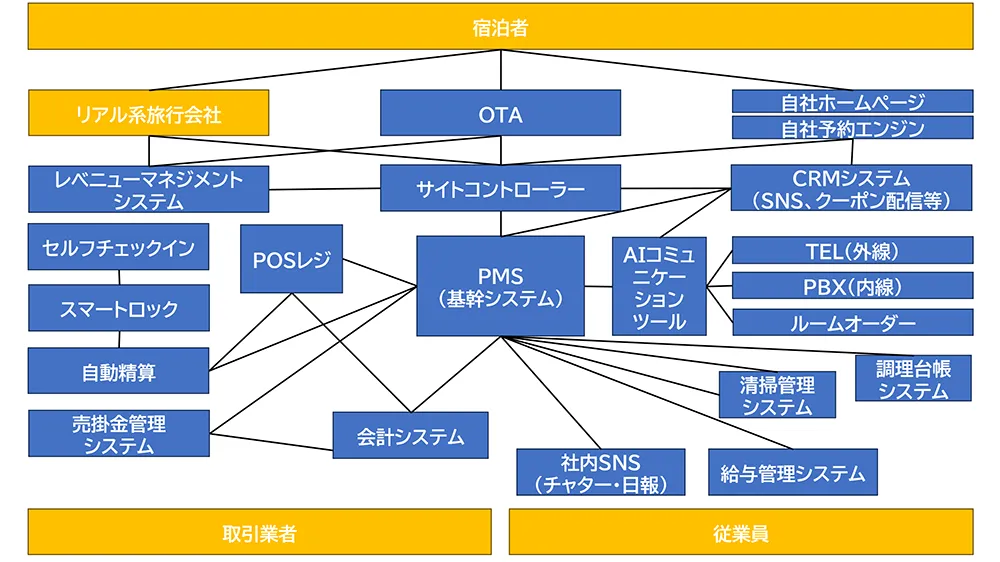
To comprehensively digitize ryokan operations, it is essential to build the suite of systems shown in Figure 2. Furthermore, depending on the facility, integrating additional systems—such as hot spring temperature control systems or automated ordering systems—enables even more advanced operational management. In other words, a key feature of API integration is its flexibility to expand the scope of integration according to the specific operational needs of the ryokan.
4-3. Advantages of API Integration
While most system integrations are achieved via APIs, the benefits of API integration can be summarized into the following four points.
- Business Automation and Labor Savings
- Improved Data Consistency
- Accumulation of Analyzable Data
- Enhanced Customer Experience (CX)
These benefits enable data to be automatically transferred between systems, reducing duplicate data entry and errors, and significantly improving operational efficiency. The effects are particularly pronounced in areas where diverse processes—such as reservations, customer management, payments, and check-in—must be integrated, as is the case with ryokan operations.
4-4. Challenges of API Integration
On the other hand, API integration also presents the following challenges.
- Inconsistent specifications among vendors
- Variations in the Scope of Integration
- Increased costs due to the growing number of systems
- Risk of Operational Breakdown Due to Lack of On-Site Training
In the lodging industry in particular, there are instances where vendors do not fully disclose their API specifications, making seamless integration difficult in some cases. Furthermore, API integration often incurs additional costs, and the financial burden this places on small and medium-sized ryokans acts as a barrier to decision-making—an area that requires improvement in the future.
As described above, despite these challenges, it is entirely possible to create a state where “different systems are organically connected and data flows freely” in ryokan operations through the appropriate use of API integration. This is the core significance of the implementation phase of DX in ryokans and will serve as the foundational technology supporting future ryokan management models.

5. Conclusion: The Future and Challenges of DX Adoption in Ryokan
5-1. Utilizing DX and Human Resource Development in Ryokans
At the author’s ryokan, the integrated use of key systems—including a PMS, in-house booking engine, site controller, AI communication tools, and cloud-based accounting—has simultaneously streamlined back-office operations and strengthened our capacity to handle inbound tourism. This has enabled us to establish an operational framework capable of accommodating over 1,000 international travelers annually. These results serve as concrete evidence that DX in ryokans can deliver a sufficient return on investment even for small- and medium-sized lodging facilities.
However, the greatest challenge in promoting DX remains “human resource development.” To effectively utilize the implemented systems and AI tools and ensure their operational sustainability, it is necessary to foster an environment where employees embrace the digital environment as the foundation of their work. In other words, DX is not merely a matter of introducing technology, but an organizational transformation process involving employee learning and behavioral change; without overcoming this hurdle, true DX in ryokan management cannot be achieved.
To ensure the successful adoption of DX, a phased training program such as the one described below is essential.
- Provide employees with opportunities for hands-on practice
- Enable them to accumulate achievable success experiences, even on a small scale
- Remove psychological barriers to IT by fostering an environment that allows for failure
This is precisely the core challenge in promoting DX in the future hospitality industry, leading to “organizational reform” that goes beyond mere technology adoption.
5-2. The Future of DX in Ryokan
In the future management of ryokan, a key challenge will be how to integrate “digital utilization” with “value creation through human service” to achieve an optimal balance.The essential value of a ryokan lies in attentive interaction with guests and unique experiences rooted in local culture. However, excessive automation of these elements risks diluting the “ryokan essence” and undermining the emotional value that guests seek. On the other hand, traditional operations that rely solely on human service face difficulties in improving productivity and expanding revenue due to the limitations of labor-intensive processes.
To resolve this dilemma, it is first necessary to systematically clarify “in which areas human value is best demonstrated” and “which areas should be replaced or supplemented by digital technology.”
- Areas that generate customer experience value = Deepening human-centered services (analog)
- Operational Areas Requiring Reproducibility and Accuracy = Thorough Utilization of DX and AI (Digital)
In other words, it is essential to clarify the division of roles as described above and then transition to a management model where the two function in a mutually complementary manner.
This approach is not merely aimed at improving operational efficiency. Rather, it is about laying the groundwork to redefine the corporate and organizational cultures that ryokans have cultivated over many years into forms suitable for the digital age, thereby elevating them into new forms of value. Furthermore, as previously mentioned, human resource development is an extremely critical requirement for implementing and sustaining such transformation.
Ryokans of the future are expected to serve as “hubs for experiencing Japanese culture,” transforming local history, customs, and culinary traditions into experiential value, while simultaneously acting as “venues for international exchange” to promote cross-cultural understanding. To achieve this, it is essential to view DX and AI not merely as tools for operational efficiency, but to redefine them as a management foundation that supports the intangible value inherent to ryokans and communicates it to the world.
The digital transformation of future ryokans has reached a stage where “digital” and “analog” are no longer opposing concepts, but rather are evolving into a conceptual framework for reconstructing the ryokan’s intrinsic value through mutual complementarity.
■References
Cadish Co., Ltd. (2025). Hotel and Ryokan Profit Improvement Project: Survey on PMS Adoption Rates and Usage Status. 489ban.net.
著者