A New Approach to Promoting Health Management® Through Health Tourism: Fostering Health Awareness While Having Fun
The average life expectancy in Japan is 81.25 years for men and 87.32 years for women, both of which rank among the highest in the world. However, the gap between life expectancy and healthy life expectancy is approximately 8 years for men and 13 years for women. Health expectancy refers to the period during which a person can live without their daily life being restricted by health issues. To improve QOL (Quality of Life) in an aging society, it is necessary to work toward extending health expectancy and narrowing the gap with average life expectancy. The key lies in maintaining a high level of health awareness from the prime of one’s working life.In recent years, interest in Health Management®* has been growing among many companies. While extending future healthy life expectancy is a major goal, there are also expectations that employees will improve their performance and that the burden of health insurance premiums will be reduced. As a means to achieve this, many companies are utilizing health tourism (travel for health promotion).While the spread of COVID-19 appears to have prompted more companies to adopt telework, as employees’ work styles evolve, ensuring employee health remains a major challenge for companies. In this article, we introduce an approach where companies utilize health tourism to promote Health Management®—allowing employees to gain health awareness while having fun. *Health Management® is a registered trademark of the NPO Health Management Research Association.
1. Why Are More Companies Adopting Health Management®?
We are increasingly seeing news reports about companies launching projects to promote employee health or obtaining certification as “Healthy Management® Excellence Corporations.” “Healthy Management®” refers to a management approach that treats employee health management as a business priority and addresses it strategically. It is based on the concept of the “Healthy Company,” originally proposed by American psychologist Dr. Robert Rosen. The Ministry of Economy, Trade and Industry defines Health Management® as follows: “By considering the health management of employees and others from a management perspective and implementing it strategically, investing in the health of employees and others in accordance with corporate philosophy is expected to revitalize the organization by enhancing employee vitality and productivity, which in turn leads to improved business performance and higher stock prices.”
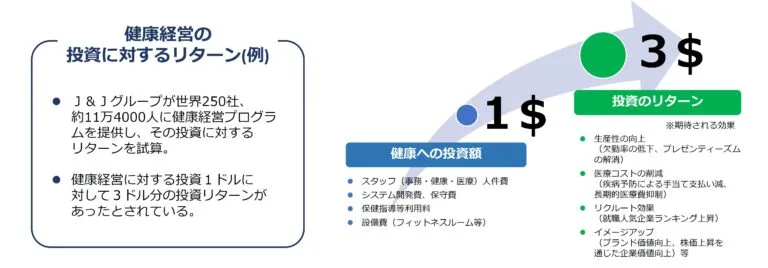
The J&J Group provided health education programs to approximately 114,000 people at 250 companies worldwide and calculated the return on investment (ROI). It was found that for every dollar invested in Health Management®, there was a return of three dollars.
The increase in companies adopting Health Management® is driven not only by the extension of healthy life expectancy mentioned at the beginning but also by the need to address labor shortages caused by a declining working-age population and employees leaving their jobs to provide care, as well as rising social security costs due to the arrival of a super-aged society. It may seem that Health Management® and measures to address labor shortages are not closely related, but according to the “Survey on the Impact of Health Management on the Labor Market” conducted by the Ministry of Economy, Trade and Industry, the results show that today’s students place a high priority on employee benefits and health considerations (see Figure 1).
Furthermore, to support the promotion of Health Management®, the Ministry of Economy, Trade and Industry has established a system that “visualizes” the initiatives of companies strategically implementing Health Management® and recognizes them as “Health Management Excellence Corporations,” thereby enabling them to receive social recognition.
In the post-COVID-19 society, corporate attention to employee health is likely to attract increasing attention, not only from job seekers but from a broader audience as well.
Figure
1 Q. "Job Seekers": What kind of companies would you like to work for in the future? (Up to 3 answers)
Q. "Parents": What kind of companies would you like your children to work for? (Up to 3 answers)

While the number of companies implementing Health Management® is gradually increasing, various challenges are anticipated in its promotion. We often hear comments such as: “Even if the HR department wants to implement it, management doesn’t understand because it doesn’t directly lead to sales,” “We don’t know where to start,” or “We started, but employees aren’t taking the initiative.” Above all, it will be difficult to achieve results unless employees’ health awareness changes and they take the initiative to participate.
The reason for this is that unless employees themselves change their mindset and modify their health-related behaviors, any measures the company implements will ultimately be in vain. A while back, even at the company where I work, pedometers were distributed during health campaigns, but people who were indifferent to health in the first place didn’t even open the package. In other words, no matter how good the app or initiative, it won’t resonate with those who aren’t interested. Therefore, to get employees to take a proactive approach, it is crucial to spark their interest in health.
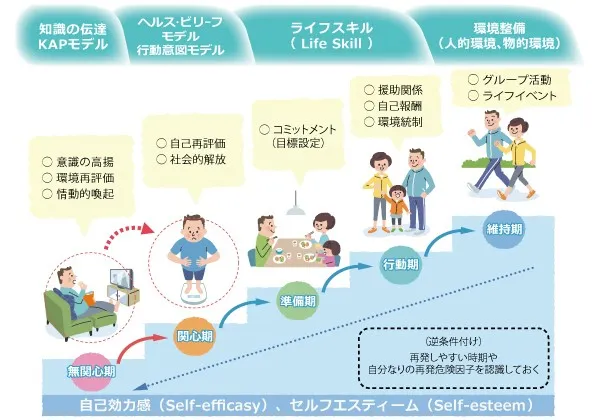
The diagram below is known as the Stages of Change Model, which illustrates the stages of behavior when people change their lifestyle habits related to health. The first step—how to get people on the far left, who are indifferent to health, to take an interest (how to move them to the “concerned” stage)—is the most difficult and the most important.
2. Utilizing Health Tourism
As mentioned earlier, behavioral change toward healthy lifestyle habits is crucial as the first step toward health. However, lifestyle habits are precisely the kind of thing people understand they need to change but often cannot. This is where health tourism is gaining attention. While “health tourism” literally translates to “travel for health,” one or two trips alone will not make you healthy. So, why is travel considered beneficial for health?
Self-efficacy is crucial for accomplishing tasks that fall into the category of “I know I should, but I can’t seem to change.” Self-efficacy refers to the confidence and conviction one has in accomplishing something. The Health Tourism Research Institute believes that the setting of a travel destination—an environment removed from daily life—tends to enhance self-efficacy. This is thought to be influenced by new experiences and challenges encountered while traveling, as well as the sense of accomplishment derived from taking on new endeavors.
Naturally, it’s easy to imagine that the results will differ significantly depending on whether you proceed with confidence or reluctantly.
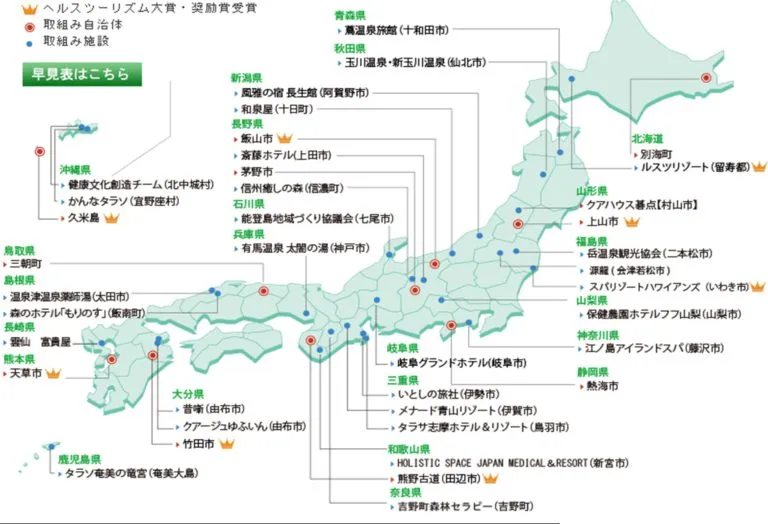
[Health Tourism Promotion Destinations Across Japan]
Furthermore, events that occur in the extraordinary setting of a travel destination tend to leave a lasting impression.
In this way, health tourism offers the potential to create a strong impression and encourage behavioral change by allowing people to enjoy health-related experiences with friends in a travel setting where self-efficacy naturally increases. In the context of promoting Health Management®, it can serve as a catalyst to move people from the “uninterested” stage—the most challenging phase—to the “interested” stage. Regions engaging in such health tourism are spreading across the country, and initiatives are beginning to emerge, such as local governments and companies signing partnership agreements to promote the region as a health resort through health tourism.
Furthermore, as these initiatives gain momentum, the Ministry of Economy, Trade and Industry (METI) has launched the “Health Tourism Certification System” to objectively evaluate service quality from a new “travel and health” perspective. The Health Tourism Certification Committee began accepting applications for review in FY 2018, and as of May 2020, 37 programs have been certified. The evaluation criteria are based on three pillars: “consideration for safety and security,” “provision of emotional value such as enjoyment and joy,” and “promotion of health awareness.” Healthcare services are evaluated and certified according to these criteria, and the results are “visualized” so that users can immediately recognize the quality of the services.
Health Tourism Certification Logo
As such, the environment is becoming increasingly conducive to utilizing health tourism as a solution for promoting Health Management®. While traveling may be difficult right now due to COVID-19, why not consider utilizing health tourism in the future to relieve stress and boost your immune system by immersing yourself in the natural environment?