The Evolving Purpose and Role of the Travel Business Manager Certification
The tourism industry has been a frequent topic of discussion lately. The "Travel Business Manager" certification, one of the national qualifications in the tourism sector, was once taken only by those working in the travel industry, but in recent years, the reasons for pursuing this certification have shifted. What exactly are these changes?
Introduction
As expectations grow for tourism to become a key industry in regional revitalization, the development of human resources to support the tourism industry has become a major challenge. Universities across the country are also focusing their efforts on cultivating talent to support the future of the tourism industry, with an increasing number establishing new faculties or departments dedicated to tourism or related fields. Furthermore, recently, even faculties not directly related to tourism—such as economics and business—have begun incorporating “Travel Business Manager Exam Preparation Courses” into their curricula.
The “Travel Business Manager” is one of the national qualifications related to the tourism industry, alongside the “Certified Interpreter-Guide.” As a qualification required for travel businesses, it is primarily sought by students aiming to join major travel agencies and employees already working in the travel industry. However, recently, organizations other than traditional travel agencies—such as railway companies and regional tourism associations—have begun taking an interest in this qualification and are making efforts to obtain it. This trend is driven by the deregulation of registration requirements for Type 3 travel agencies, aimed at promoting destination-based tourism. An increasing number of tourism associations are obtaining travel agency registration to enable the planning and sale of destination-based travel products. Furthermore, as the tourism industry becomes more closely intertwined with diverse sectors due to rising tourist numbers, the view that adopting a broad “tourism perspective” is beneficial for business is likely gaining traction.
Below, drawing on the changes in examinees and trends in exam questions observed through our many years of publishing exam preparation materials and offering correspondence courses, I would like to discuss the roles expected of tourism professionals.
From a Qualification for Travel Agents to a Qualification for Personnel Supporting Tourism
1. What Is a Travel Business Manager?
The role of a Travel Business Manager is to manage and supervise the “maintenance of fair transactions in travel business,” “ensuring travel safety,” and “promoting traveler convenience” at each business office (i.e., branch). The Travel Agency Act stipulates that at least one Travel Business Manager must be assigned to each business office (i.e., branch).To become a Travel Business Handling Manager, you must obtain either the “Domestic Travel Business Handling Manager” (hereinafter “Domestic”) qualification, which allows you to handle only domestic travel business, or the “Comprehensive Travel Business Handling Manager” (hereinafter “Comprehensive”) qualification, which allows you to handle both domestic and international travel.
2. The number of examinees for the "Domestic" exam required for Type 3 Travel Agencies has seen a slight increase over the past three years
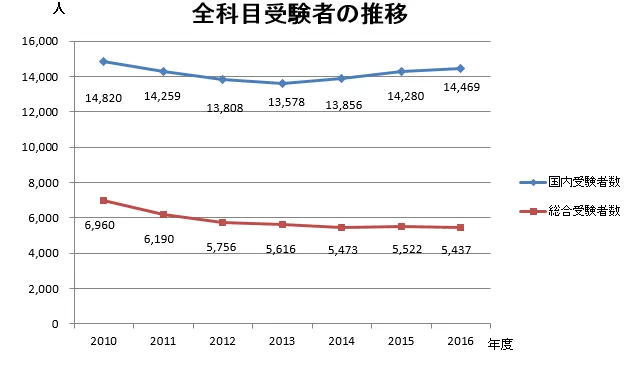
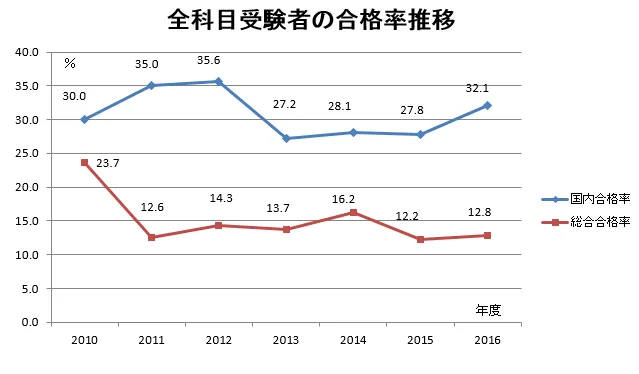
In fiscal year 2016 (Heisei 28), the number of examinees for all subjects of the "Domestic" exam was 14,469, with a pass rate of 32.1%, while the number of examinees for all subjects of the "Comprehensive" exam was 5,437, with a pass rate of 12.8%.The trends in examinee numbers over the past seven years are as follows. The number of examinees for all subjects of the "Domestic" exam has been increasing slightly since 2013. The pass rate for the "Domestic" exam also exceeded 30% for the first time in four years. The number of examinees for all subjects of the "Comprehensive" exam has decreased slightly, and the pass rate has remained in the 10% range since 2011 (Figures 1 and 2).
3. From a Qualification for Travel Agencies to a Qualification for Personnel Supporting the Tourism Industry
The stagnation in the number of “Comprehensive” exam takers is due to a decline in the number of candidates from so-called traditional travel agencies (Type 1). Candidates from the travel industry and related fields account for approximately 40% of the “Comprehensive” exam. With the rise of OTAs (Online Travel Agents), the number of travel agency branches is on a downward trend.
In contrast, for the “Domestic” exam, the proportion of candidates from the travel industry is relatively low at 12.2%, while students account for 47.6%, or roughly half of the total. Recently, examinees have included those from the transportation industry (3.7%), the lodging industry (3.2%), and the tourism industry (2.5%), as well as company employees (including civil servants) (20.0%). The transportation industry is focusing on expanding destination-based tourism centered around their own railway lines and routes; as mentioned earlier, tourism associations are also prioritizing this certification to attract travelers to their regions. It can be said that the changes surrounding the tourism industry are reflected in the composition of examinees for the Travel Business Handling Manager exam.
The Skills Required of Tourism Professionals, as Seen Through the Exam Subjects
The competencies required of personnel supporting the tourism industry include: (1) accurate knowledge of laws and regulations; (2) practical knowledge for concluding contracts with customers; (3) knowledge of domestic and international tourist destinations and trending spots; and (4) practical knowledge necessary for operations, such as immigration laws and overseas business practices. The specific exam subjects are the following four:
1. Travel Agency Act
Knowledge of the laws that travel agents must comply with and the associated penalties (criminal penalties and administrative sanctions). The exam includes multiple-choice questions requiring candidates to select all correct answers, testing their precise legal knowledge as managers and supervisors.
Exam Preparation Materials
2. Travel Agency Terms and Conditions
These are the so-called “agreements made with travelers.” The ability to accurately explain the terms of the contract to customers is required. The exam covers topics such as the written contract provided when contracting for “package tours” and the amounts payable when a contract is canceled.
Exam Preparation Materials
3. Domestic Practice
In the Domestic Practices section, questions are broadly divided into two categories: those regarding “domestic tourism resources” such as tourist destinations, and those concerning fares, fees, and regulations for JR, domestic airlines, chartered buses, and similar services. Both require knowledge of the latest information and current events. Additionally, following the bus accident in Karuizawa last January, many questions related to chartered buses were included.
[Examples from the FY 2016 Exam]
- Mishima Skywalk (opened in December 2015)
- The National Museum of Western Art (designated a World Heritage Site in July 2016)
- Hokkaido Shinkansen fare calculations and GranClass fares (Hokkaido Shinkansen opened in March 2016)
Exam Preparation Materials
- "Travel Industry Practice Series 3: Domestic Fares and Rates"
- "Travel Industry Practice Series 4: Domestic Tourism Resources"
4. Overseas Practice
The "Overseas Practice" section applies only to the "Comprehensive" exam. The content covers five areas: "Overseas Tourism Resources," international airfares, immigration laws, travel English, and overseas practice. As with the domestic section, questions are based on the latest information and include many practical problems designed with travel agency employees in mind.
[Examples from the FY 2016 Exam]
- ANA Economy Class Discount Fare (a new fare introduced in FY 2016 with separate outbound and return fares)
- LOT Polish Airlines airline code (service began in January 2016)
Exam Preparation Materials
- "Travel Industry Practice Series 5: Immigration Laws and Practical Operations"
- "Travel Industry Practice Series 6: International Air Fares and Charges"
- "Travel Industry Practice Series 7: Travel English"
- "Travel Industry Practice Series 8: Overseas Tourism Resources"
- "Travel Industry Practice Series 9: Overseas Travel Practices"
The table below shows the difficulty levels for each subject based on our analysis.
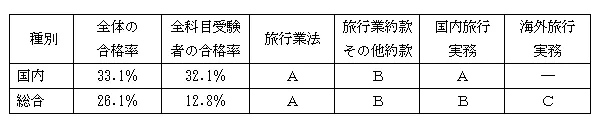
2016 Exam Based on Our Analysis (Note) 3-tier rating (A: Easy, B: Somewhat Difficult, C: Difficult)
Recent Trends Among Test Takers: The Rise of Smartphone-Based Study
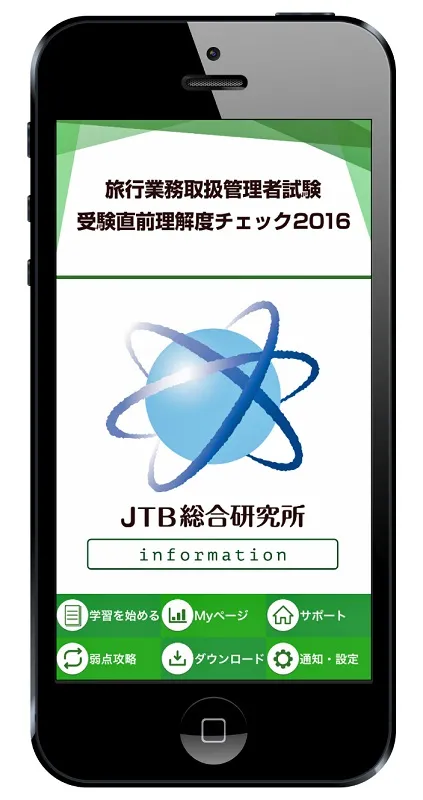
Our company has been publishing exam preparation textbooks since 1982 and launched a correspondence course the following year. In 2015, in response to the shift toward digitalization, we developed and began selling an exam preparation question bank app.
The learning style of today’s students seems well-suited to reviewing material studied in textbooks in an enjoyable way via smartphone, and over 1,000 people used the app in 2016.The app offers proven benefits: (1) it allows users to effectively utilize spare moments, such as during commutes on the train or breaks from part-time jobs, and (2) the bookmark feature helps users identify their weaknesses and enables repeated study to overcome them. Some schools are even adopting innovative study styles, such as designating the first 10 minutes of the morning for app-based study.
Exam Preparation Materials
- Workbook App: “Last-Minute Proficiency Check for the Travel Business Handling Manager Exam”
- Correspondence Courses
Challenges and Prospects for Developing Human Resources to Support Tourism
We received the following comment from a staff member who actually obtained this certification and joined a tourism association: “Obtaining the Travel Business Handling Manager certification allowed me to approach my work with confidence. At the same time, I was able to learn about tourist destinations not only in my own region but also in other regions, which helped me see the strengths of my own region compared to others and identify what we can learn from other areas. Furthermore, by learning about overseas destinations, I’ve become able to feel a sense of familiarity toward foreign visitors who come to my region.”
The Japan Tourism Agency is currently considering a registration system for land operators and the sale of destination-based travel packages by accommodation facilities. In light of these new societal trends, and assuming that the opportunities and settings where human resources supporting tourism are needed will change, we must recognize that the scope of work for “Travel Business Handling Managers” will not always remain the same. Furthermore, as ICT evolves in society, we need to consider what role the Comprehensive Travel Business Handling Manager will play in the future—not only to determine what value people can provide within existing travel agencies but also to question the very nature of their role.
Exam Preparation Materials
Guide to Tourism-Related Certifications, Including "Travel Business Handling Manager"