An Analysis of the Fifth Basic Plan for Promoting Japan as a Tourism-Oriented Nation

The Fifth Basic Plan for Promoting Japan as a Tourism-Oriented Nation aims to further increase the number of visitors to Japan and their spending while placing a strong emphasis on addressing overtourism. It also sets a goal of significantly raising the value added in the lodging industry by FY 2030, requiring a new approach amid a severe labor shortage.
*This column is a reprint, with permission, of an article originally published in “Real Estate Economy Focus & Research No. 1578” (Real Estate Economy Research Institute).
Introduction
The Fifth Basic Plan for Promoting Japan as a Tourism-Oriented Nation has been launched. While anticipating further growth beyond the 2025 targets of 42.68 million international visitors and 9.5 trillion yen in spending, the plan places strong emphasis on protecting residents’ livelihoods from issues such as overtourism.Furthermore, the plan aims to significantly increase the added value of the lodging industry from 4.3 trillion yen in FY 2024 to 6.8 trillion yen in FY 2030. Given that the lodging industry faces a severe labor shortage compared to other sectors, a new approach is necessary to achieve these goals.
A Look Back at the Fourth Basic Plan for Promoting Japan as a Tourism Nation
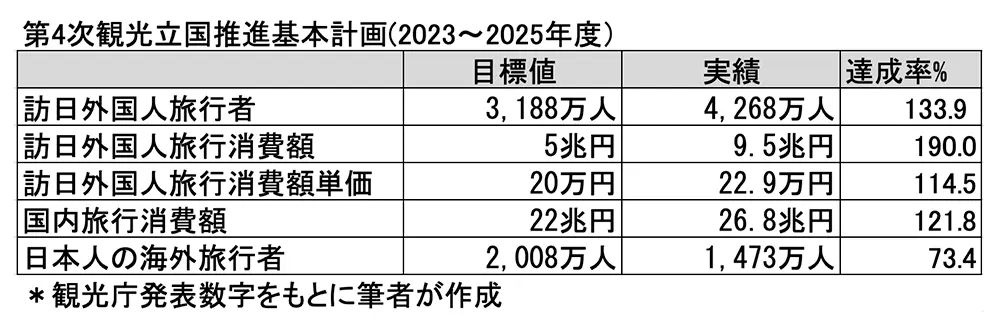
The previous plan, the Fourth Basic Plan for Promoting Japan as a Tourism-Oriented Nation, was originally scheduled to be formulated in FY 2020—following the conclusion of the Tokyo Olympic and Paralympic Games—and to begin in FY 2021. However, due to the COVID-19 pandemic, the formulation process could not begin, resulting in a three-year plan that started in FY 2023 and will end in FY 2025.
The main targets are for the number of inbound international visitors and the number of Japanese travelers abroad to exceed 2019 levels (31.88 million and 20.08 million, respectively),to reach 5 trillion yen in spending by international visitors to Japan, 200,000 yen in per-visitor spending, and 22 trillion yen in domestic travel spending. However, due to surging travel demand resulting from a rapid recovery from the COVID-19 pandemic and the continued depreciation of the yen, the results significantly exceeded the target figures—with the exception of the number of Japanese travelers abroad.
According to figures released by the Ministry of Finance on May 13, 2026, Japan’s total exports for FY 2025 amounted to 111,345.1 billion yen; comparing this figure helps illustrate the scale of spending by foreign tourists visiting Japan.Exports of automobiles (finished vehicles)—a key industry for Japan—in 2025 are estimated to be around 17.65 trillion yen, and spending by foreign tourists visiting Japan (9.5 trillion yen) is approaching 53.8% of that figure.
Overview of the Fifth Basic Plan for Promoting Japan as a Tourism-Oriented Nation
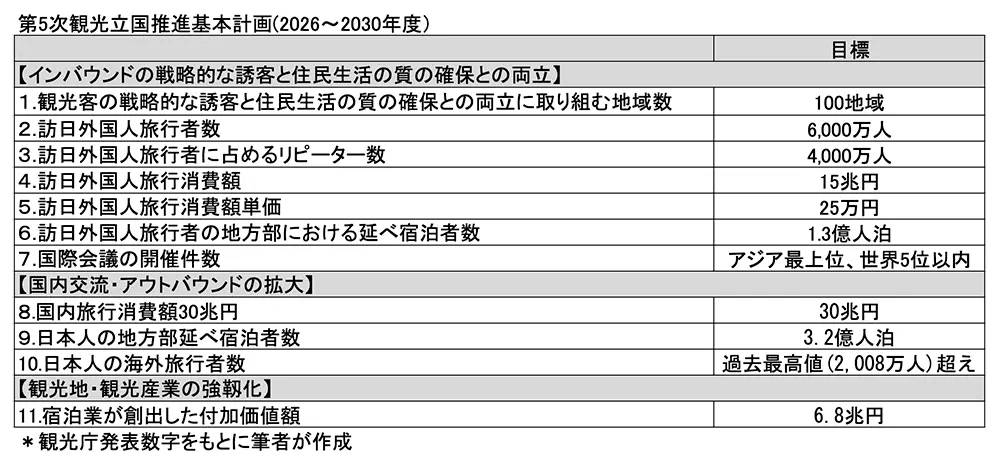
The Fifth Basic Plan for Promoting Japan as a Tourism-Oriented Nation, approved by the Cabinet in March 2026, is the first step toward making tourism a core industry, as outlined in the 2040 Industrial Structure Vision, and carries great expectations. At the same time, the plan demonstrates the utmost consideration for residents’ lives, addressing issues such as overtourism. The pillars of the plan are“Balancing the strategic attraction of inbound tourists with ensuring the quality of life for residents,” “Expanding domestic travel and outbound tourism,” and “Strengthening tourist destinations and the tourism industry.” It clearly states that the vision for 2030 is “tourism as a strategic industry that sustainably passes on and develops Japan’s charm and vitality to future generations.”
Major Challenges in Enhancing Value Added in the Lodging Industry
As tourism establishes itself as a pillar industry, improving productivity in the lodging sector—which lies at its core—is, needless to say, the most important goal.The Fifth Basic Plan for Promoting Japan as a Tourism-Oriented Nation sets a target of 6.8 trillion yen for the value added generated by the lodging industry, while also stating that “we will closely monitor trends in average wages in the lodging industry to ensure that growth in value added is being passed on to employees.”
In the lodging industry, both the Consumer Price Index and value-added have shown greater growth than the average for all industries, driven by rising room rates resulting from the increase in foreign visitors to Japan.Based on 2020 as the base year, the Consumer Price Index for the accommodation industry in 2025 is projected to be 164.6%, compared to the all-industry average of 111.9%, while value added in 2024 is projected to be 338.3% for the accommodation industry, compared to the all-industry average of 130.6%.On the other hand, while the growth in monthly wages for employees—using 2020 as the base year—exceeded the all-industry average of 111.9% in 2025 at 132.4% for the lodging industry, this figure remains insufficient compared to the growth in the Consumer Price Index and value added.In FY 2025, the job openings-to-applicants ratio stood at 1.2 nationwide, whereas in Miyakojima City, for example, it was 1.56—indicating that regions where tourism is the main industry tend to have higher ratios. Despite a severe labor shortage, particularly in the lodging industry, wages are not being distributed sufficiently, and the industry continues to struggle to secure workers.Can the 6.8 trillion yen in value added to be generated by the lodging industry—as outlined in the Fifth Basic Plan for Promoting Japan as a Tourism-Oriented Nation—truly be achieved without sufficient labor migration from other industries?
Implementation of Physical AI Holds the Key
To date, I have consistently argued to various stakeholders that securing a workforce is the tourism industry’s greatest challenge.While the Fifth Basic Plan for Promoting Japan as a Tourism-Oriented Nation identifies “Strengthening Tourist Destinations and the Tourism Industry” as one of its three pillars—outlining measures to secure personnel for these sectors and achieve labor-saving through tourism digital transformation (DX)—it does not appear to represent a significant enough transformation to make the industry’s emergence as a core sector a realistic prospect.
Physical AI holds the key to transforming the tourism industry into a core industry. The National Institute of Advanced Industrial Science and Technology (AIST) defines “Physical AI” as “artificial intelligence (AI) that possesses a physical body and acts within the real world; examples include not only robots and humanoids but also autonomous vehicles and industrial machinery operating within factories.“While AI to date has primarily been responsible for recognizing information and making judgments, the major difference with physical AI is that it can execute those judgments as actual movements,” the institute states.
The Ministry of Economy, Trade and Industry’s AI Robotics Study Group forecasts that the market for multipurpose robots (general-purpose robots)—including humanoids, which are central to physical AI—will expand rapidly around 2030 and reach approximately 60 trillion yen globally by 2040.In other words, it is expected that Physical AI will have become firmly established in everyday operations by 2040—the same period specified in the Industrial Structure Vision, which states that tourism will have secured its position as a core industry.In a video shown to me by a Physical AI researcher with whom I recently exchanged views, two humanoids (human-shaped general-purpose robots) were perfectly making beds in hotel rooms.
The implementation of physical AI will mark a historic turning point for the tourism industry, which has long been characterized by low productivity—a weakness typical of labor-intensive industries. Furthermore, the mass production of humanoids will significantly transform the global industrial structure, finally bringing to life the world of fantasy I imagined as a child.With only 15 years remaining until 2040, I cannot help but hope that the Fifth Basic Plan for a Tourism-Oriented Nation will mark the first step for the tourism industry.
Source: Real Estate Economics Research Co., Ltd., “Real Estate Economics Focus & Research No. 1578”
*This column is a reprint, with permission, of an article originally published in “Real Estate Economy Focus & Research No. 1578” (Real Estate Economy Research Institute).
著者