Architecture as a Tourist Attraction

Japan’s historic buildings and streetscapes are a major attraction for visitors to the country. Not only do they allow visitors to experience Japan’s unique culture and spiritual values through architecture, but the architectural techniques that enable structures to withstand natural disasters are also highly regarded. On the other hand, preserving these buildings sometimes requires changes to their form or function. This article examines the essential considerations for protecting these structures and leveraging them for tourism.
*This column is a reprint, with permission, of an article originally published in “Re No. 223,” the journal of the Architectural Conservation Center (Public Interest Incorporated Foundation).
1. Architecture as a Tourist Attraction
When asked about “architecture visited by tourists,” the first thing that comes to mind is likely famous temples and shrines. In a survey conducted by TripAdvisor on “Popular Japanese Tourist Spots Among Foreigners,” Fushimi Inari Taisha held the top spot for six consecutive years through 2021 (in 2022, the Hiroshima Peace Memorial Museum—including the Atomic Bomb Dome and Peace Memorial Park—took first place).
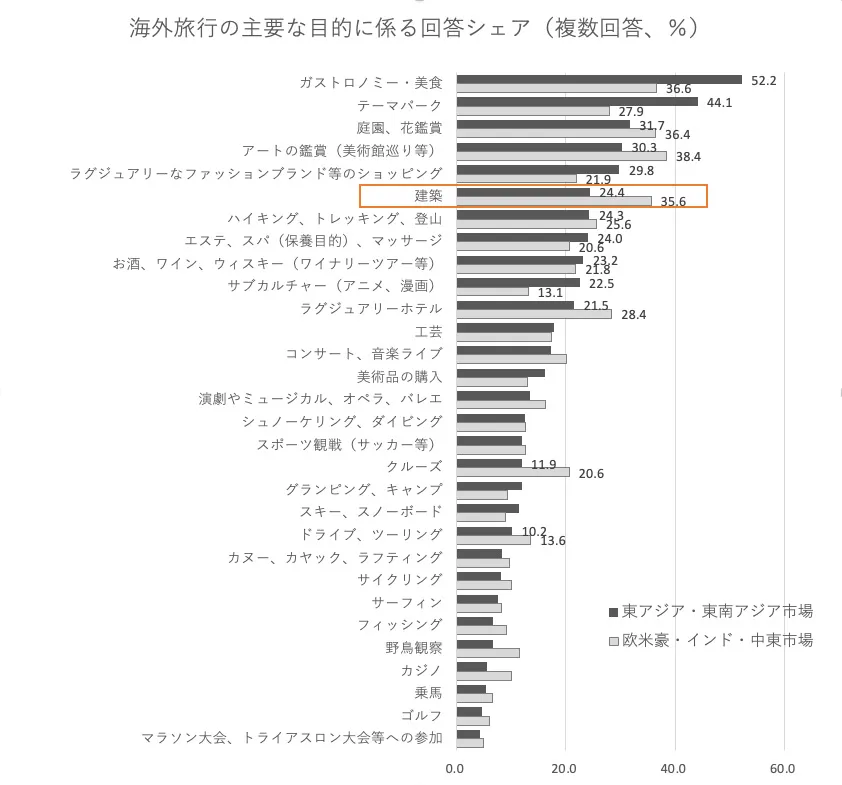
Looking at the main purposes of overseas travel (multiple answers allowed), for residents of Europe, the U.S., Australia, India, and the Middle East, “architecture (35.6%)” ranked fourth, following “art appreciation (38.4%),” “food (36.6%),” and “gardens and flowers (36.4%).”Among residents of East and Southeast Asia, this figure was 24.4%, about 10 percentage points lower, indicating that the perception of architecture as something “worth seeing” is stronger in non-Asian cultural regions (Figure 1).
For these groups, various types of architecture other than historical and cultural resources such as shrines and temples are also likely to become tourist attractions.
Figure 1: Main Purposes of Overseas Travel
2. The World Travelers Experience Through Architecture
Since ancient times, Japanese architecture has been made of paper, wood, and earth, and this mainstream tradition continued for a long time until the Meiji period. Isabella Bird delivered a scathing critique of the Westernized urban architecture of the early Meiji era, calling it “vulgar” and “more like sugar candy than buildings,” while praising the old town in the Niigata area as “clean and picturesque” and a “fairy-tale land. ”When we see today’s visitors walking along Japan’s old highways, strolling through rural areas, and staying at temple lodgings, it’s hard to say that the perspective of travelers from nearly 150 years ago is all that different from that of today’s visitors.
Travelers, ourselves included, set out on journeys expecting a certain pre-determined harmony—such as “I want to take that photo there” or “I want to be moved by seeing the highly acclaimed [X]”—but at the same time, we also hope to bring back our own highly personal experiences and discoveries. Architecture is, by its very nature, something whose value is experienced by spending a long time within the structure and enjoying the functions it is designed to provide. However, when considering travelers specifically, they can only experience architecture through “looking,” “entering,” and “listening to explanations” during their extremely brief stays. What kinds of discoveries and personal reflections might they find through Japanese architecture within that limited contact?
(1) “Japanese-ness” as Seen in Spaces of Faith and Ritual
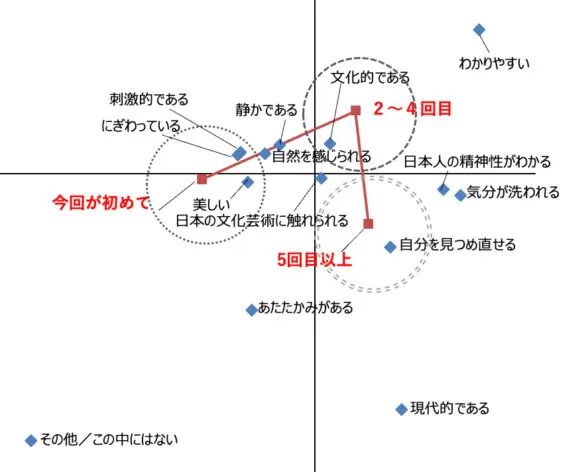
While many visitors to Japan do not visit shrines and temples with a clear understanding of them, the sensations they feel upon entering these architectural spaces and the environments they create clearly change depending on the frequency of their visits and their level of experience. In 2019, a survey was conducted among visitors to shrines and temples in Tokyo (Kanda Shrine, Meiji Shrine, Tsukiji Honganji, and Zojoji Temple). Among those visiting for the first time, tended to describe the experience as “lively” and “stimulating,” while those on their [2nd to 4th visit] found it “cultural,” and those on their [5th or more visits] reported impressions such as “it allows me to reflect on myself” and “I can understand the Japanese spirit.” As the number of visits increases, the percentage of responses related to the “experiential” aspects they perceive from the architecture and space rises (Figure 2).Since the Shikinen Sengu (periodic relocation of the shrine) was the standard practice for shrines, the worship hall and main hall were not designed to be permanent, completed structures. The dwelling of the gods must remain pure at all times, and unnecessary decorations are excluded. Shrines are surrounded by sacred forests, and in some cases, they even incorporate nature itself. This is overwhelmingly different from the faith spaces found within buildings like churches or mosques, where the world is contained within the structure. While this makes it difficult to evaluate the architectural value or design excellence of the building itself as a cultural asset, it allows visitors to experience a form of faith that expands the space to encompass the world itself. The source of the popularity of Fushimi Inari Taisha, mentioned at the beginning, lies in the landscape of the thousand torii gates. However, this is due to the power of a sort of “pressure of intention”—a sense that a tunnel of torii gates, resembling a different dimension, has been gradually formed by the intentions of as many donors as there are gates. If these had been neatly arranged according to a single person’s design from the outset, this “pressure” that attracts everyone would likely not have been created. Compared to shrines, temples are built with the premise of “lasting for a long time,” and their characteristics vary significantly depending on sect and era. Furthermore, because visitors can view the design from both inside and outside the building and observe the setting in which Buddhist statues are enshrined, there is a wealth of visual information and a broad range of experiences. In recent years, many facilities have begun offering spiritual practice experiences such as zazen meditation, sutra copying, and temple cleaning, making it possible to experience the building’s functions through all five senses.Through observing the structure and design of shrines and temples, the daily rituals performed there, and the interactions with worshippers and devotees, visitors to Japan seek to grasp the roots of the Japanese sense of beauty and spirituality. By understanding the differences from their own religions through the architecture and spatial design, they sense something akin to the origins of Japan’s unique cultural landscape. Using the standards they have held until now, they discover beauty and fascination and take these experiences home with them.
Figure 2: Impressions upon visiting temples and shrines
(2) The Unique Nature of Structures Designed to “Harmonize” with the Principles of the Land
Japanese architecture has developed since ancient times through coexistence with earthquakes and natural disasters such as floods and wind damage. When I explain that the same vibration-damping technology used in the central pillar of the Five-Story Pagoda at Horyu-ji Temple—built approximately 1,300 years ago—has been applied to the 21st-century structure known as the Tokyo Skytree, most foreigners are amazed. In Otari Village, Nagano Prefecture—an area with many slopes prone to landslides—the local shrine was moved to safety by “hiki-ie” (house-moving) every time a landslide risk arose. Had it not been for Japan, where architectural and urban planning is deeply rooted in the premise that buildings might collapse in an earthquake, burn down in a fire, or that the entire town might be submerged, the idea of constructing temporary housing and shelters from paper—which is now active in disaster areas both domestically and internationally—might never have been conceived. It is not immediately apparent that the techniques nurtured and grounded in Japan’s climate have been passed down to the present day, continuing to demonstrate the potential of traditional materials—paper and wood—to modern society. However, this is a distinctly Japanese approach to architecture that transcends time, one that truly comes to life through the guide’s explanation.
(3) The Unique Message Emitted by the Building
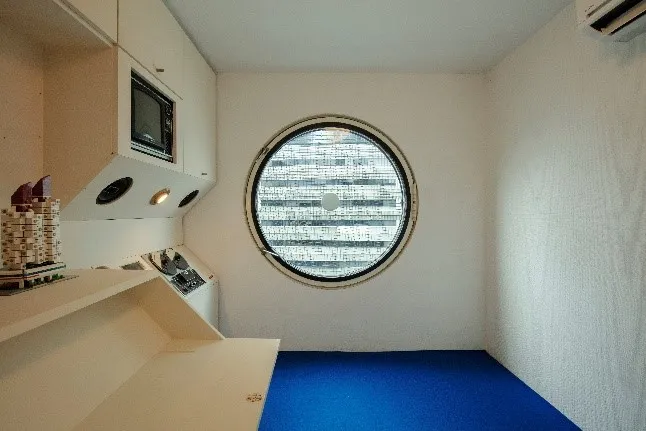
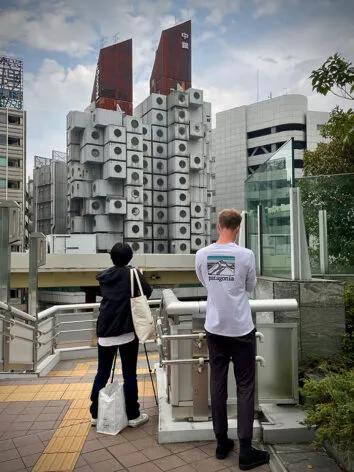
The Japanese building that attracted the most international fans was likely the Chuo Bank Capsule Tower, which was demolished in 2022. Some viewed its peculiar exterior as unsightly, and there was criticism that the cramped studio units fostered isolation; it certainly wasn’t known for its practicality. However, its intense individuality—which transcended these “easy criticisms”—and the fact that this apartment complex was located in Ginza, Tokyo, strongly reinforced the powerful message it conveyed: “The era of the individual and individual lifestyles come together and undergo a process of renewal.” Another building I love just as much is the Hirosaki City Crematorium, designed by Kunio Maekawa. For the people of the Tsugaru region, Mount Iwaki serves as a spiritual anchor; it was believed that when a person dies, their soul returns to Mount Iwaki. The gently sloping corridor connecting the Japanese-style room where the bereaved family waits and the hearth room evokes the image of Yomotsu-hirazaka, the path linking the underworld and the mortal realm. The skylight in the bone collection room is positioned so that the soul of the deceased can look back and see the family as it returns toward Mount Iwaki. While the functional aspects of the funeral hall are realized within the building, the spatial composition is highly symbolic, expressing the connection to the local community (the outside world) and conveying the concepts of the living world and the underworld across time and space.
Such architecturally expressive structures, which blend the designer’s individuality, the spirit of the times, and the unique character of the site, possess a high degree of originality. As one-of-a-kind works, they convey the profound meaning of “why that architecture exists in that specific place.”
The Chuo Bank Capsule Tower Building just before demolition
(4) Local Culture and Daily Life Reflected in the Streetscape
Whether it is the vibrancy of Asakusa’s temple town, the sight of shukubo (temple lodgings) and sub-temples lining the streets of Mount Koya, or the landscape woven from Gokayama’s gassho-zukuri houses and rice paddies, the way visitors view historic streetscapes is not significantly different from how they view historic architecture. In these historical spaces—where one can infer past ways of life from the architecture’s form, the types of shops, the street layout, and the elements filling the spaces between buildings—visitors comfortably enjoy a certain contrast with the latest goods and services offered there.
In contrast, modern commercial districts and areas known as “○○-kaiwa” are often praised for their “interesting atmosphere, which varies completely depending on the location and function. ”In Tokyo, popular attractions include the chaotic bustle of Ameyoko, the cyberpunk nightscapes of Akihabara and Kabukicho with their glittering neon lights, and the concentrated, function-oriented window shopping found in areas like Kappabashi Kitchenware Street and Nippori’s textile district. In regional areas as well, there are numerous unique landscapes born from the geographical characteristics, urban functions, and industries of the land—such as the steep-sloped neighborhoods of Nagasaki City where temples, shrines, and churches stand in close proximity; the network of canals winding through the samurai residential district in Shimabara City; and the scattered settlements of Izumo, where houses stand sparsely dotted among rice paddies. The wide variety of landscapes—far beyond what one might imagine from the phrase “Japanese streetscapes”—and the stories of local livelihoods and history that have shaped these differences can serve as compelling reasons to visit each town.
3. Preservation and Renewal
(1) Preserving Townscapes Means Preserving “Lifestyles”
The key to enhancing visitors’ appreciation of a townscape and their satisfaction with their stay is not simply whether it is photogenic. While “picturesque” locations certainly have a strong appeal on their own, in such cases, it is sufficient for them to be beautiful as a stage set—the elements of the stage do not necessarily have to be the “townscape” itself. What determines the evaluation of the “townscape” itself is whether the town continues to sustain its local livelihoods, whether there are local residents who use the town on a daily basis, and whether the preservation is not limited to “preserving only the exterior. ”Historic streetscapes often promote the removal of overhead power lines, which is effective in terms of disaster prevention and safety. However, this is precisely why I believe it is not necessarily essential for enhancing the appeal of a destination as a tourist resource. Between a streetscape that has had its power lines removed—resembling a theme park where only tourists are active—and a shopping district where power poles crowd the narrow sidewalks but vibrant daily life unfolds, the latter is overwhelmingly more exciting for visitors.
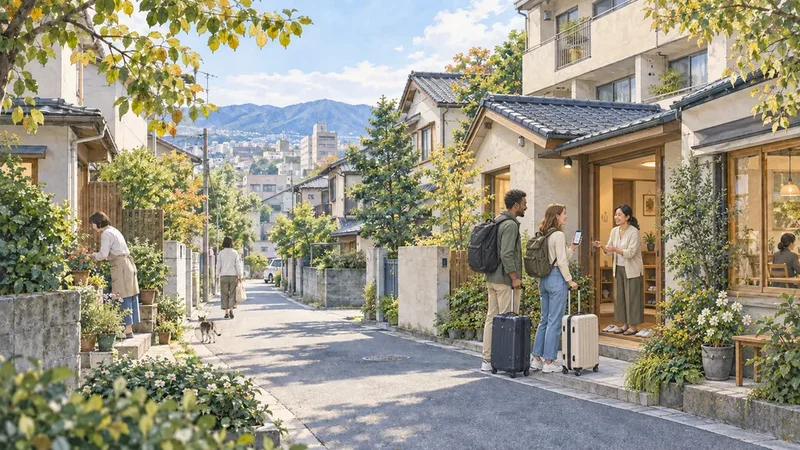
In Waki-machi, Mima City, Tokushima Prefecture, the “Udatsu Street” area—once deserted before the sun began to set—is transforming into a gathering place for people from both within and outside the region, thanks to the opening of guesthouses and cafes, as well as the establishment of a local tour hub and an incubation center. Starting with Osaka’s Fuse Shopping Street, an increasing number of towns are adopting the concept of “distributed hotels,” where accommodation facilities such as guest rooms, front desks, and restaurants are scattered throughout the area. By leveraging their historical structures while promoting functional repurposing to meet the needs of current industries, residents, and visitors—and thereby fostering continuous renewal—towns can create new reasons for residents, workers, and travelers to visit.
(2) Architectural Preservation Means Preserving the “Core of the Philosophy”
In the maintenance and preservation of architecture, authenticity is highly valued from the perspective of cultural heritage preservation; however, there are many cases where this cannot be achieved due to various factors such as technology and cost. At Kanda Shrine, a restoration plan is currently being considered with the aim of having the main hall designated as an Important Cultural Property. However, it is understood that fully recreating the roof structure—which was originally built using mortar and copper plates without any wood to prevent it from ever being destroyed by fire again—and restoring the shrine building, currently painted red, to its original all-lacquer finish from the time of its construction in 1934, will pose significant challenges both technically and financially. Several preserved capsules from the Chuo Bank Capsule Tower mentioned earlier have been shipped around the world, and five of them are scheduled to open as lodging facilities in Yokosuka City in the fall of 2024, allowing the concept of “metabolic renewal” to be expressed on a capsule-by-capsule basis. Even if some aspects of a building’s form or function change, it is crucial to identify the core philosophy that gave rise to the building in the first place. This allows us to carefully discuss and determine, one by one, which elements can be altered and which must remain unchanged, ensuring that the building’s significance and message continue to be conveyed to visitors.
4. Conclusion—Are We Ourselves Enjoying Architecture?
Looking inward, do we have our own words to describe the highlights and appeal of Japanese architecture? Are we able to grasp with high precision “what we want to show and convey” to visitors to Japan?
The incongruous, whimsical charm of fishing village houses painted pink and green with marine paint. The delicacy of stair railings in Modernist architecture, and the beauty of the plaster walls and plaster carvings on storehouses remaining in rural areas, along with their fire-prevention charms. The glare of nighttime neon lights, layered and blurred on wet asphalt. There is no common thread among the landscapes that have moved me in the past. Yet, all architecture is a tangible form of prayer for the certainty of tomorrow. Architecture is, in fact, such a universal tool of communication—one that enables dialogue and mutual understanding regarding this prayer, shared across all times and places, against the backdrop of each culture and environment.
Source: "Re No. 223," the journal of the Architectural Conservation Center
This column is a reprint, with permission, of the original article published in the Architectural Conservation Center (General Incorporated Foundation) journal “Re No. 223.”
著者