The Evolution of Corporate Communication ~On Hosting Business Events~

In response to the spread of COVID-19, online and hybrid formats have become increasingly common in B2B travel and events. We will examine how these formats have evolved during the pandemic, using specific examples.
Due to the COVID-19 pandemic, several states of emergency have been declared. Each time, restrictions on individual activities have been imposed, and requests for cooperation have been made to economic organizations—including labor and management groups and industry-specific employer associations—regarding the strengthening of infection prevention measures and health management in the workplace. Under these restrictions, various corporate activities that were previously conducted primarily in person have shifted to digital formats, and companies are likely still searching for the best solutions.The same applies to various business events. Now, in the post-COVID era, we are hearing concerns about whether to return to past formats or what formats would be most effective. Therefore, we will examine this issue using actual case studies.
1. Changes in Business Events During the COVID-19 Pandemic
Restrictions on movement began in earnest in FY 2020, forcing companies and schools to change their operations. The JTB Group also suffered a severe blow, with many of its projects being canceled or postponed. At the same time, however, the past few years have been a period of continuous exploration and reevaluation of how to conduct essential training sessions and events that simply had to take place.
Online meetings and events, which were unfamiliar at first, have become a major shift in the environment as companies have introduced various online tools and participants have grown accustomed to using them without psychological discomfort.
As the shift to online formats progressed, there were times when I sensed the possibility that nearly all communication might shift from in-person to online even after the pandemic. However, looking at actual data, it is clear that organizers’ behavior has not followed that trajectory.
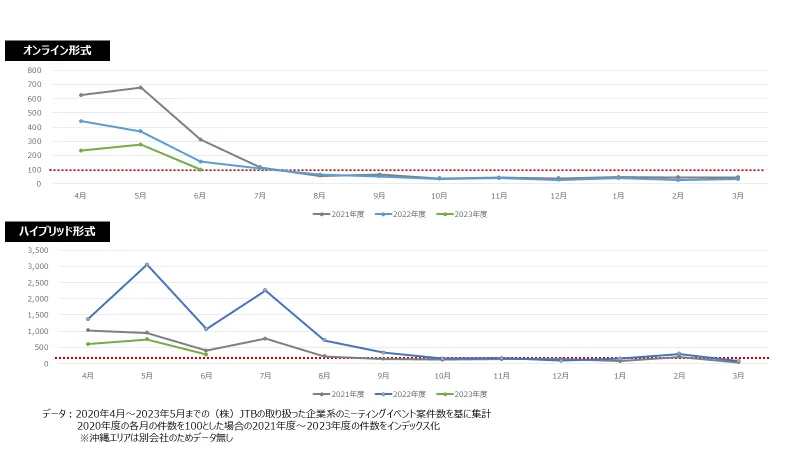
Business event projects handled by JTB Corporation(Note 1) Based on the data, if we set the number of “online/hybrid format” events in each month of FY 2020—when the COVID-19 pandemic began and various restrictions emerged—to 100, and then examine the number of events held each month from FY 2021 through May 2023, we see that while “online format” events exceeded the overall total and continued to increase until July 2021, a downward trend became apparent as we moved into FYs 2022 and 2023.Furthermore, from August onward, both FYs 2021 and 2022 fell below the levels of FY 2020, indicating a slowdown.
On the other hand, for “hybrid formats,” there were more months in FY2022 where the number exceeded that of FY2021, giving the impression that “hybrid formats” have gained ground, replacing “online formats.”
That said, overall, the momentum for both “online” and “hybrid” formats has declined in FY2021 and FY2022. Even after May 2023—when COVID-19 was reclassified as a Category 5 infectious disease under the Infectious Diseases Control Law, effectively removing economic restrictions—the trend shows a slowdown compared to FY2020.
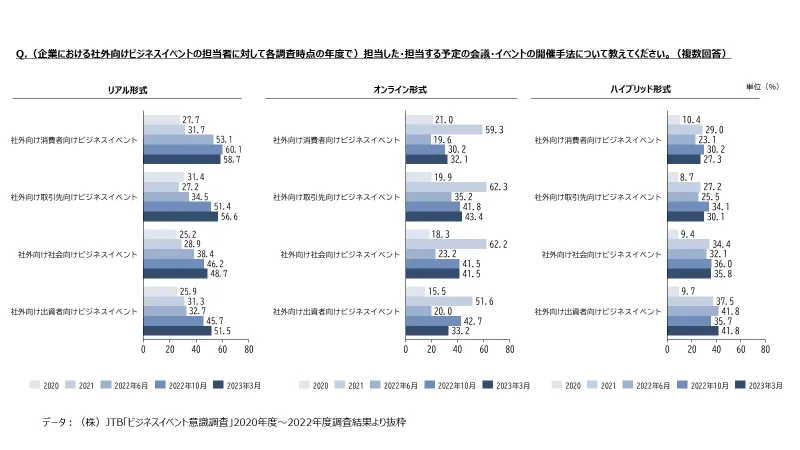
This trend is also evident in the results of a separate survey we conducted.
Although the questions pertained solely to external business events, when we asked corporate event organizers about the formats they used to hold events, we found that while the overall number of events held was low in FY 2020, there was a marked increase in online events in FY 2021, and by FY 2022, in-person events had begun to rise steadily again. (Figure 2)
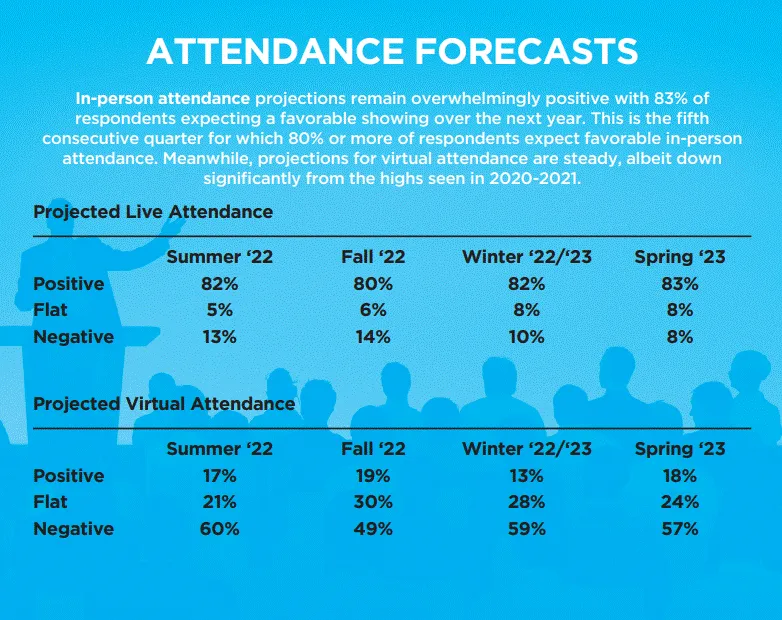
Globally, it is expected that in-person meetings and the number of attendees at such meetings will increase significantly in the future.In "Meetings Outlook™ 2023 Spring" (published in May 2023) by MPI (Meeting Professionals International), 83% of respondents predicted that attendance at in-person meetings would remain strong over the next year, indicating overwhelming support. This marks the fifth consecutive quarter in which more than 80% of respondents have predicted strong attendance at in-person meetings. (Figure 3)
While this trend initially brought to mind the rising expectations for in-person business events in Japan, driven by the country’s unique culture of “reading the room,” it appears that the “deeply connected relationships” fostered by face-to-face interactions are being recognized globally as a significant value.
2. Examples of New Initiatives
As mentioned earlier, while there is a trend toward a return to in-person events, it is also being recognized that events previously assumed to require physical attendance can now be conducted in hybrid or online formats. This has created the benefit of being able to attract a broader range of participants than before.
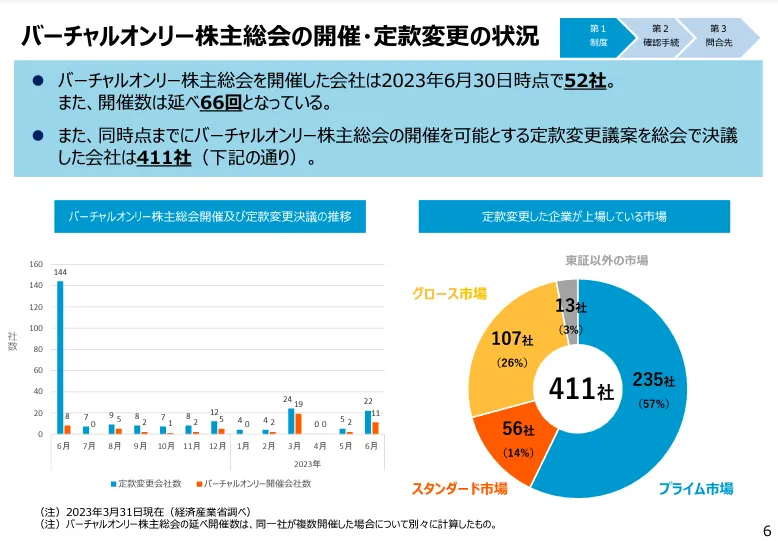
For example, following the amendment of the "Act for Partial Revision of the Act on Strengthening Industrial Competitiveness, etc." in June 2021, listed companies are now permitted to hold "virtual-only general meetings of shareholders"—that is, general meetings without a designated physical location.Previously, only “in-person general meetings” and “hybrid (participation/chairperson) virtual general meetings” were permitted. This amendment was enacted to adapt to the COVID-19 pandemic, taking into account the benefits of making it easier for a larger number of shareholders—including those in remote locations—to attend, as well as cost savings resulting from the elimination of the need for a physical venue.
Although requirements such as being a “listed company” and “provisions in the articles of incorporation” must be met to hold such meetings, the Ministry of Economy, Trade and Industry (METI) reported that as of June 30, 2023, 52 companies had held virtual-only general meetings, totaling 66 sessions. This clearly demonstrates the growing demand and expectations for this format. (Figure 4)
In addition, there have been numerous cases where corporate kickoff events and award ceremonies were inevitably shifted to online or hybrid formats due to the COVID-19 pandemic. By eliminating the need to gather participants at a single venue, these events have created benefits such as enabling participation from individuals who previously faced not only geographical constraints—such as the distance to the venue—but also time constraints, such as those who find it difficult to attend on weekends or in the evenings due to childcare or caregiving responsibilities, while still allowing them to share a sense of unity during the event.
In this way, by shifting the format of business events from in-person to online or hybrid, we can expect not only a categorization of participants into in-person or online groups but also an expansion of the overall scale of business events, including participants who were previously unable to attend.
3. Future Outlook
So far, we have considered business events from the organizer’s perspective, but what about the participant’s viewpoint?
According to a survey by the Tokyo Metropolitan Government, the telework implementation rate among companies in Tokyo (with 30 or more employees) stood at 44.0% in June 2023. Since this figure is the same as that from the May survey, it appears the decline has stabilized. Nationwide, the telework implementation rate has decreased, particularly among small and medium-sized enterprises. However, due to the diversification of work styles in recent years, the values and desired working conditions of job seekers—especially among younger generations—have been changing, and there are many who prefer telework.
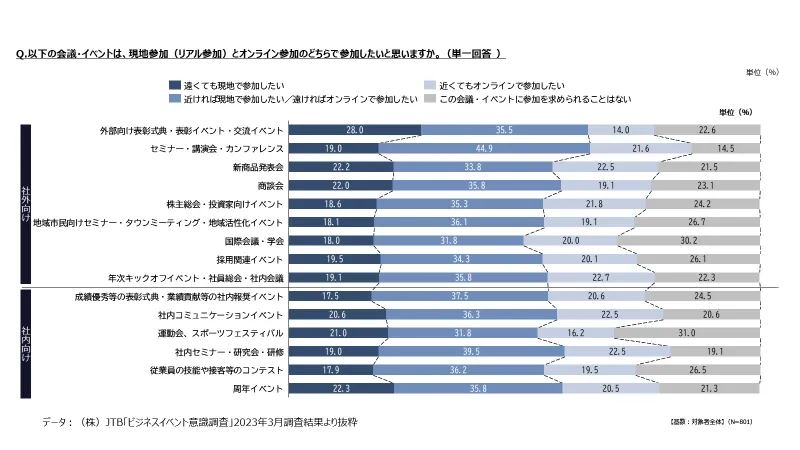
A March 2023 survey by JTB Corporation asked participants about their willingness to attend various events. The results showed that while there is strong interest in attending events involving physical activity, such as sports, in person—regardless of distance—there is also a strong desire to attend events in person for networking and negotiations, to see or touch actual items, or to experience a sense of connection with people or objects.On the other hand, about 30% of the total respondents expressed a preference for participating online even if the event is nearby. Combined with the aforementioned shift toward remote work, it appears there is a certain level of demand for online participation.
We have increasingly heard concerns from companies regarding business events aimed at launching a counteroffensive after the pandemic, such as “we can’t attract as many attendees as we’d like” or “we held the event but didn’t achieve the desired results.” It is possible that these challenges arise because the event formats—whether in-person, hybrid, or online—are not well-aligned with participant needs, suggesting that aligning objectives with methods will become even more critical.
Over the past two to three years, corporate entities, organizations, and schools have been experimenting with communication methods. Through this process, they have learned to assess each event’s content to determine what works best online, what must be in-person, and what benefits from a hybrid format to broaden its reach. Although the COVID-19 pandemic led many to predict that business events would shift online due to efficiency and cost considerations, the crisis has instead served to reaffirm the value of in-person events, and we are now seeing a trend toward their revival and continuation.
However, one crucial point that must not be overlooked is that the decision-making power regarding how business events are held is shifting from the organizers to the participants. Participants now determine their own objectives for attending and select the participation method that best suits those goals. If an event fails to deliver results, it may be because the organizers have not fully understood “what the participants aim to achieve and what they prioritize most.”Going forward, it will be increasingly important not to create events based solely on the organizer’s intentions, but to carefully listen to participants’ needs and build the optimal format accordingly.
While technology evolves at a rapid pace, the universal value created through human interaction will never be lost. Therefore, I hope we can explore the expansion of business events by skillfully combining purpose and format.
Note 1) Business events: Here, this specifically refers to various internal and external meetings and events held by companies.
著者