Current Status and Challenges in the Development of Business Continuity Plans by Tourism Businesses

This presentation explains disaster and crisis preparedness and response strategies for tourism businesses, drawing on the latest research findings and concrete case studies. You will learn about the importance of business continuity plans (BCPs) and how to develop them, and receive tips on enhancing the resilience of the tourism industry.
Introduction
Tourist traffic is recovering rapidly, and major domestic tourist destinations are bustling with visitors from both Japan and abroad. At the same time, however, the risk of tourists, travelers, the tourism industry, and tourist destinations being affected by disasters is increasing due to the growing frequency and severity of weather-related disasters such as typhoons and heavy rains, as well as the heightened likelihood of major earthquakes, tsunamis, and volcanic activity.
Looking back over the past decade or so, every time a natural disaster has struck—such as the 2011 Great East Japan Earthquake, the 2016 Kumamoto Earthquake, large-scale flooding across the country, and the Noto Peninsula Earthquake that occurred on New Year’s Day this year—tourism businesses have suffered significant damage and economic impacts, facing the threat of bankruptcy. In addition to natural disasters, during the spread of COVID-19, the tourism industry suffered significant economic impacts over an extended period due to travel and movement restrictions accompanying states of emergency, voluntary travel restraint to prevent infection, and a sharp decline in foreign tourists visiting Japan caused by border closures.
According to the Cabinet Office’s “Survey on the Actual Status of Business Continuity and Disaster Prevention Initiatives in Companies for FY 2023” (*1) (hereinafter referred to as the “Cabinet Office BCP Survey”), 42% of respondents in the “Accommodation and Food Service Industry” stated that “since the Great East Japan Earthquake, natural disasters such as earthquakes and floods occurring in Japan have actually affected the continuity of their business.”
How should tourism businesses prepare for such disaster and crisis risks?
1. The Impact of Disasters and Crises on Tourism Businesses
When disasters or crises occur, they have a serious impact not only on travelers and tourists but also on tourism businesses. Damage to buildings and facilities, as well as damage to equipment necessary for operations, can occur. At restaurants and lodging facilities in areas where the shaking from an earthquake was severe, even if the damage to the building itself is minor, many dishes may fall and break or become damaged, hindering the ability to serve meals. If a disaster causes a prolonged power outage, lighting, air conditioning, elevators, and other systems within the facility become inoperable, making a stay there uncomfortable and inconvenient. Boilers and hot water pumps in bathhouses also stop working, making it impossible to provide bathing services. Under these circumstances, it is difficult to continue normal operations, and businesses are forced to close. Even after resuming operations, tourist facilities located in “disaster-stricken areas” face a continued slump in sales due to reservation cancellations and a sharp decline in visitors, making a deterioration in their financial situation unavoidable.
In addition to the damage and impact caused by the disaster itself, damage and impact arise from “reputational damage.” Reputational damage refers to the economic loss incurred by tourism businesses when people who have been exposed to information about a disaster or crisis—such as news reports from the affected area or information on the internet—assume that the damage and impact are greater than they actually are, and consequently cancel their planned trips or change their destinations. Furthermore, even when tourist destinations in the vicinity of a disaster have not actually suffered damage or been affected, travelers may avoid visiting them simply because they are “in the same region.” This leads to a decline in visitors and economic repercussions, which also constitutes reputational damage.
2. Tourism Operators’ Response to Disasters and Crises
When damage or impacts arise from a disaster or crisis, the primary measures tourism operators should take to ensure business continuity and tourism recovery are information dissemination, financial crisis management, and maintaining employment.
First is information dissemination.
The most critical measure to prevent reputational damage and limit its spread is to promptly disseminate accurate information about the local situation immediately after a disaster. Even after the disaster or crisis has subsided and it is safe to welcome tourists again, visitors are often slow to return. This is because while various media outlets compete to cover and report on the situation on the ground during a disaster, media coverage tends to diminish once the recovery phase begins. People continue to carry the impressions formed by disaster coverage with them, and due to psychological hesitation, they tend to avoid tourist destinations that have become “disaster-stricken areas.” This is where proactive information dissemination from the region is essential. By sharing messages such as “The area has largely returned to normal, and tourists are currently enjoying their visits,” accompanied by images and videos, you can help viewers recognize that “it’s safe to visit there now.”
Providing appropriate and effective information in a timely manner is no easy task amid the chaos of a disaster or crisis. By preparing in advance, however, it becomes possible to disseminate the right information in the right way even amidst the post-crisis confusion.
The next consideration is financial crisis management.
If a significant drop in revenue persists due to a large number of post-crisis reservation cancellations or business closures, tourism operators with already fragile financial foundations will quickly face a shortage of working capital. Repairing buildings and facilities damaged by a disaster or replacing broken equipment requires even more substantial funds. If you wait until this point to rush to financial institutions, there is no guarantee you will be able to secure the necessary funds immediately. It is essential to prepare for the risk of a business crisis caused by disasters and ensure business continuity by setting aside funds for emergency response during normal times, discussing emergency loans with your financial institutions, and re-examining the details of your property and casualty insurance, including profit compensation.
Maintaining employment after a crisis is also a challenge.
When a disaster or crisis causes business conditions to deteriorate, the first thing managers consider is cutting labor costs, which are the largest expense. It is possible that management will be forced to consider reducing or suspending bonuses, cutting shifts or terminating contracts for non-regular employees, and ultimately even adjusting the employment of regular employees. However, given the severe labor shortages across all industries, employees who leave the company—whether to move to another region or join another company—will not return to their former employer even after operations resume. This creates a new crisis: an inability to resume normal operations due to a lack of staff. Anticipating such scenarios, it is essential to prepare for long-term closures caused by disasters or prolonged slumps in sales. This involves maintaining employment contracts by reassigning employees to other business units or other companies during such periods, ensuring they can return to their original roles and contribute effectively once operations resume. This constitutes crisis management from a labor relations perspective.
3. Disaster and Crisis Preparedness for Tourism Businesses
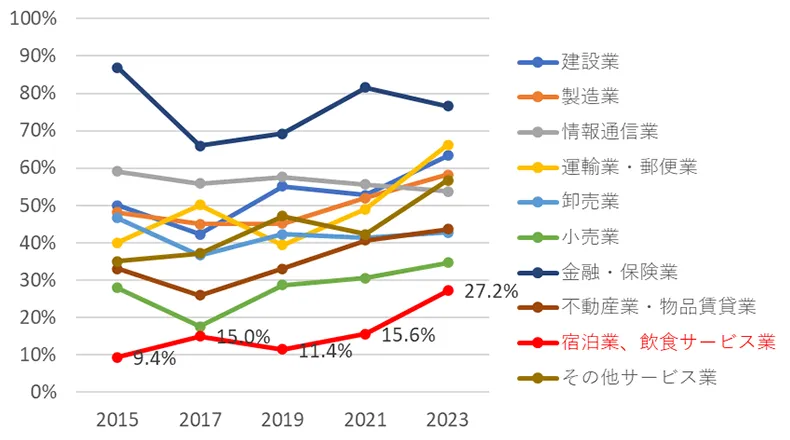
As such, tourism businesses, which are vulnerable to crises such as disasters, must prepare for business continuity during emergencies and for business recovery following disasters or crises. However, the reality is that crisis preparedness among tourism businesses is not always sufficient. According to the results of the Cabinet Office’s “Survey on Corporate Business Continuity and Disaster Prevention Initiatives,” while the rate of Business Continuity Plan (BCP) formulation in the “Accommodation and Food Service Industry” has been on an upward trend over the past few years, it remains the lowest among the surveyed industries at 27.2%. (Figure 1)
For tourism businesses that have already formulated a BCP, the “main reasons for formulating (or planning to formulate) a Business Continuity Plan (BCP)” were “as part of risk management” (27.8%), “requests from parent or group companies” (21.5%), and “past experiences with disasters or accidents” (21.0%). Compared to other industries, a higher proportion of tourism businesses cited “past experiences with disasters or accidents” as the reason for formulating a BCP.
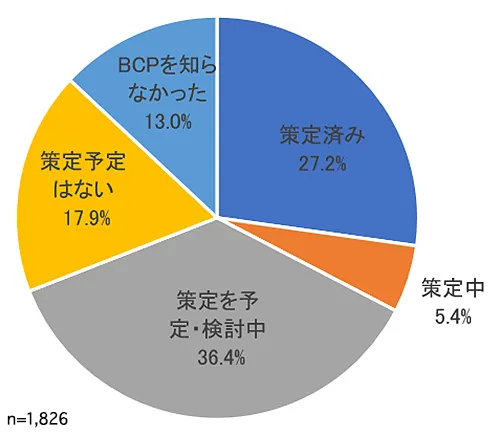
Among the surveyed companies, 5.4% reported that they are currently developing a BCP, and 36.4% stated that they “plan to develop one (including those under consideration).” In contrast, 17.9% responded that they “have no plans to develop one,” and 13% stated that they “did not know what a Business Continuity Plan (BCP) is.” (Figure 2) Notably, the proportion of companies unaware of BCPs was the highest among all industries surveyed.
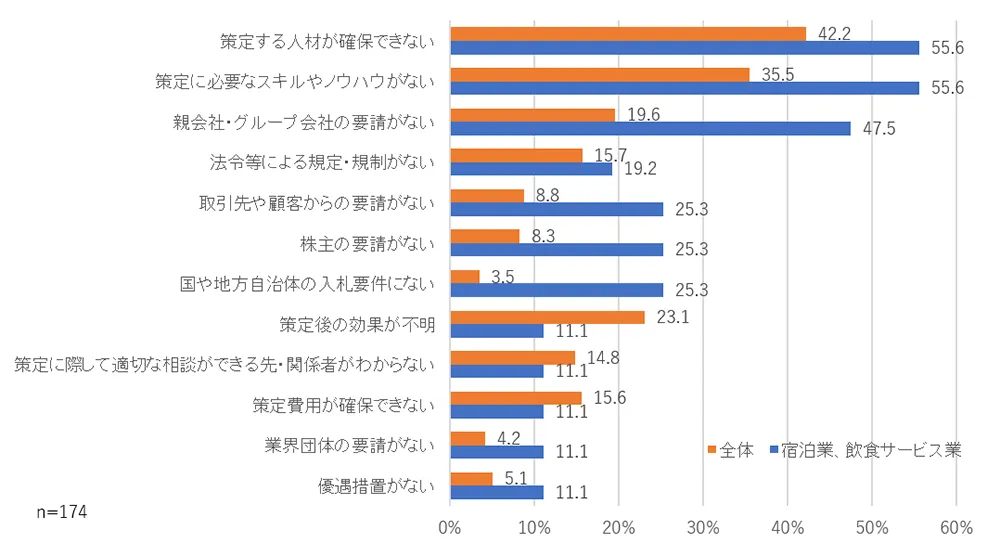
When tourism businesses that stated they had no plans to formulate a BCP were asked for their reasons, the top responses were “unable to secure personnel to formulate it” and “lack the necessary skills and know-how,” followed by “no request from the parent company or group companies” and “no legal requirements or regulations.” (Figure 3) The top three reasons significantly exceeded the average for all survey respondents. This highlights the current reality that many businesses have no plans to formulate a BCP or are unable to do so due to a lack of know-how and personnel. Furthermore, since “requests from parent or group companies” are a major catalyst for BCP development, the fact that some tourism businesses would develop a plan only if requested by their parent company or group—but would not proactively do so otherwise—suggests a lack of initiative regarding disaster prevention and crisis management on their part.
4. Support for BCP Development by Tourism Businesses
As we have seen, the primary reasons why tourism businesses do not or cannot formulate BCPs are the inability to secure personnel capable of doing so and a lack of the necessary skills and know-how for BCP formulation.
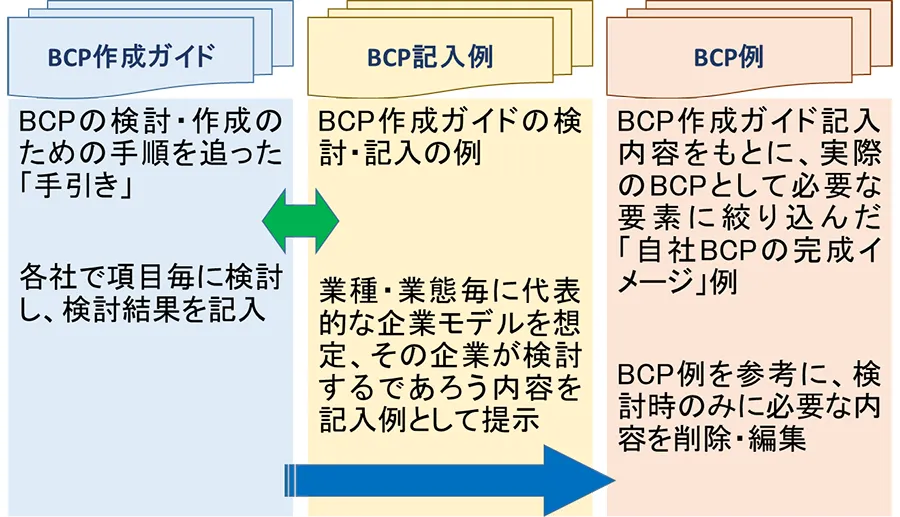
The “Tourism BCP Creation Guide” (*2), jointly developed by the Japan Chamber of Commerce and Industry and the Japan Tourism Promotion Association (JTA), can help address these issues. Traditionally, the Small and Medium Enterprise Agency’s Business Continuity Plan Model has been widely used as a tool for BCP development. However, perhaps because the model was originally designed with the manufacturing and distribution sectors in mind, tourism businesses face significant challenges when attempting to use it to create their own BCPs. Recognizing this situation, the Japan Chamber of Commerce and Industry and JTA developed and provided a user-friendly tool for tourism businesses with the goal of increasing the BCP adoption rate in the tourism sector.
A key feature of the “Tourism BCP Creation Guide” is that it allows businesses to discuss measures for business continuity during disasters and crises within their own organizations, tailored to the operational realities of four specific sectors: accommodation, tourist facilities, food and beverage (for corporations and small businesses/sole proprietors), and transportation (taxis, domestic shipping companies, chartered buses, and railways). The results of these discussions then directly form the draft of the BCP. The guide lists questions and discussion points in accordance with the BCP creation process, and is designed so that the results of these discussions are recorded directly on worksheets. "Sample entries" are provided for each industry in the guide to serve as a reference during the planning process.
In addition, the “Trouble Response Manual” (Management Edition) created by the JTB Association of Ryokan and Hotels for its members specifically details the decisions and actions that managers and administrators should take not only in the event of natural disasters but also during various crises and incidents that may occur at lodging facilities. This manual serves as a useful reference for member businesses of the association when developing their own BCPs.
Furthermore, the Japan Tourism Agency has published the “Guidelines for Creating Tourism Crisis Management Plans” (for businesses) as a tool to help tourism operators plan their crisis management responses in the event of disasters or other emergencies. (*3)
As such, even if a company lacks in-house experts or sufficient skills and know-how, it is possible to review and formulate a BCP by utilizing these tools.
Above all, the process of reviewing and formulating a BCP within the company itself leads to strengthening the company’s business continuity capabilities. Even if it is not a polished, visually appealing business continuity plan created by a consultant, a plan developed through the collective experience and wisdom of employees in various roles within the company is what will truly help ensure business continuity and secure employee jobs in an emergency.
*1 Cabinet Office, “Survey on Corporate Business Continuity and Disaster Prevention Initiatives in FY 2023”
*2 “Guide to Creating Tourism BCPs” Press Release (Japan Tourism Agency)
“Guide to Creating Tourism BCPs” Application Form
*3 Japan Tourism Agency, “Guidelines for Creating Tourism Crisis Management Plans, etc.” (March 2022)
著者