The COVID-19 pandemic has prompted us to reconsider what value is created when people are at the center of it all
Amid a rapidly changing social landscape driven by the COVID-19 pandemic, our purchasing behaviors are becoming increasingly diverse, with trends such as online customer service and "sales-free" stores gaining traction. To improve customer satisfaction, companies must understand and interpret customer sentiments to effectively engage with the customers who are at the heart of these purchasing behaviors. Since people are the foundation of any business, we must consider what value is created when people are at the center of our efforts.
Nearly two years have passed since the global spread of COVID-19 (hereinafter referred to as “COVID-19”).During this time, we have witnessed various environmental changes and the resulting shifts in consumer attitudes. The terms that immediately come to mind are likely those related to infection prevention in the “living with COVID-19” era, such as “accelerated digital adoption” and “social distancing.” Furthermore, regarding our daily lives transformed by COVID-19—and specifically people’s purchasing behavior—both customers on the buyer side and companies on the seller side have been forced to adapt. This is a change observed worldwide, and people are now experiencing shopping scenarios that would have been difficult to imagine before the spread of the virus.
In this article, we will examine how the shift in people’s values caused by COVID-19 has transformed customer service during the purchasing process—specifically, the real-world interactions between customers and sales staff. We will also consider which aspects of in-person customer service will continue to be valued and which will fall out of favor, as well as the future nature of the relationship between companies that rely on sales-oriented customer service and their customers.
1. How are companies striving to understand the sentiments of consumers and customers during the COVID-19 pandemic?
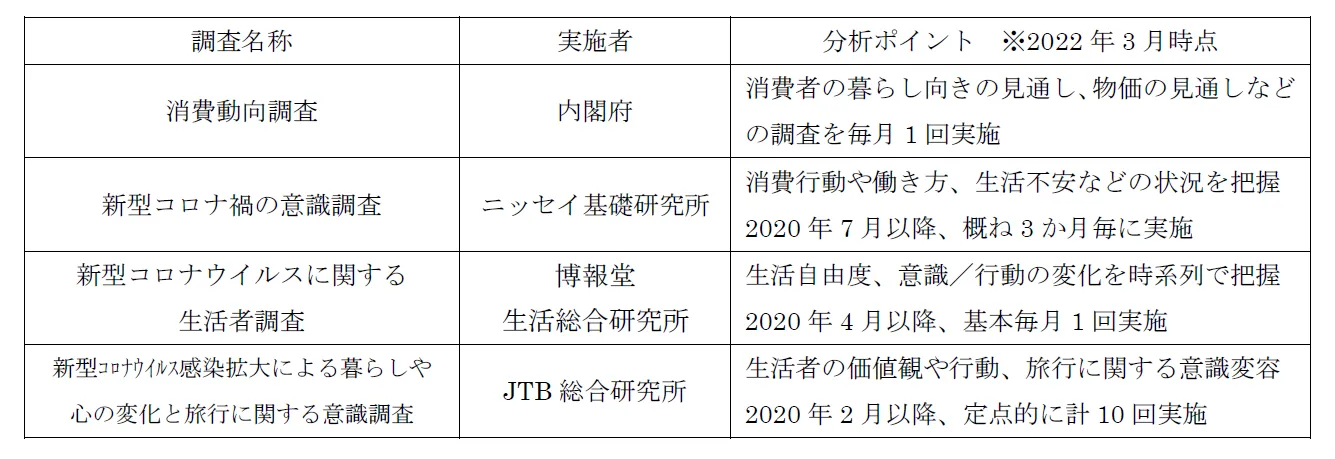
The COVID-19 pandemic has had a wide range of impacts on business activities, both large and small. One example is the difficulty in securing schedules with survey companies that conduct consumer awareness surveys for marketing purposes. Due to repeated waves of infections and the issuance of states of emergency over the past two years, which restricted movement and outings, sales at physical stores have stagnated. Consequently, there appears to be an increase in surveys aimed at understanding changes in consumer behavior and attitudes in response to the unprecedented situation of the prolonged pandemic. While much of the content and results of these surveys are not made public because they relate to each company’s business strategies, government and corporate research institutes—including our own—have conducted regular surveys on various themes and published trends in consumer attitudes and behaviors during the pandemic. Even among the pandemic-related surveys reported in the media, there were examples such as those shown in the table below (Table 1).
In the retail sector, brick-and-mortar stores that rely on in-person sales have suffered the most from the impact of COVID-19. Not only have sales declined, but opportunities to interact with customers have also decreased significantly due to the pandemic. Losing the opportunity to understand customer sentiment through face-to-face interactions is a major setback. For businesses that also utilize e-commerce, it is possible to grasp broad purchasing trends through various data sources. However, when dealing with key accounts or high-value, rare products, the meaning customers ascribe to a product and the value they perceive can often only be understood through face-to-face interactions. That said, online consultations are now on the rise, and digital solutions are becoming increasingly viable.
Regarding awareness surveys, while some are conducted online with a large number of consumers, others are conducted through dialogue with a small number of participants. Whether in a physical store or online, opportunities to understand customers can be gained through the dialogue of customer service. Rather than quantitative information such as purchase history or online communication records, it is possible to grasp customers’ attitudes and psychology as so-called qualitative information.
2. What Do Customers Want from the Sales Process?
So, what do customers expect from the sales process? E-commerce transaction volumes have grown significantly due to the COVID-19 pandemic. In an era where people can buy goods without visiting a store, questions arise as to whether human-provided service and hospitality are still necessary in the sales process. Hakuhodo conducted an analysis of the touchpoints between online and offline shopping in its “Survey on Purchasing Behavior in the New Normal Era” and published the following results.
[Perceptions and Benefits of Online vs. In-Store Shopping]
- "Speed," "affordability," and "convenience" rank highest as benefits of online shopping
- Over 70% cited “peace of mind” as a benefit of in-store shopping
[Price Points Suitable for Online vs. In-Store Purchases]
- For items under 10,000 yen, a majority of respondents said they “prefer to buy online”
- For items over 30,000 yen, over 60% said they “prefer to buy in-store”
[Future Shopping Attitudes]
- About 70% of respondents said, “I think I’ll end up buying everything online in the future”
- On the other hand, over 60% view physical stores as a point of contact where “a brand’s vision and philosophy are conveyed,” and expect them to become more enjoyable places
[Ideal Customer Service]
- For the majority, the ideal in-store customer service is “not being approached aggressively, but being assisted when I initiate contact” and “staff who are knowledgeable about the products and can accurately answer questions and address concerns”
Hakuhodo “Survey on Purchasing Behavior in the New Normal Era”
(Survey Period: May 29–30, 2021; Survey Participants: 1,100 men and women aged 18–69 nationwide)
Based on these survey results, we can infer that customers seek functional values such as speed and convenience online, while seeking emotional values such as a sense of security and empathy in physical stores. It is evident that customers tend to choose physical stores when making high-priced purchases that require careful consideration. Purchasing behavior can be categorized into situations where customers “choose for themselves” and situations where they “want to seek advice from someone or leave the decision to someone else. ”In the 2018 National Shopping Survey published in "Why Is 'That' Bought?" by the Hakuhodo Shopping Research Institute, purchasing behavior trends were analyzed using a four-quadrant model as shown in Figure 1.
Let’s focus on “Quadrant A,” which describes consumers who have a high level of interest in the product itself but also want to seek advice from or entrust the decision to someone else. The institute cites financial products, home appliances, travel, transportation, and cosmetics as examples of categories falling into “Quadrant A. ”The desire to entrust the decision to someone else likely stems from consumers feeling overwhelmed by the sheer variety of information, products, and purchasing methods available. On the other hand, the high level of interest in the shopping process itself is likely driven by the fact that purchase prices are relatively high, prompting consumers to want to consider their options carefully. For companies striving to ensure customer satisfaction, it is essential to organize specialized knowledge and reliable information and provide customer service that aligns with the intentions of customers who are ready to make a purchase.

3. Under What Conditions Does Customer Satisfaction Increase?
Customer satisfaction is one indicator of whether a company is meeting customer expectations. Under what conditions does customer satisfaction increase at the point of contact? The Japan Productivity Center, a public interest incorporated foundation that conducts surveys and assessments for the JCSI (Japan Customer Satisfaction Index), has identified several key factors related to customer satisfaction. While these factors vary by industry and company, we believe that “loyalty (trust in and attachment to the company)” and “customer expectations” are particularly important.
- High customer expectations directly influence customer satisfaction
Customer satisfaction influences loyalty
*Excerpted from "Service Excellence" (July 2021) by the Japan Productivity Center
Customers have preconceived expectations of a company or brand. When they receive service that exceeds or meets those expectations, they feel satisfied, which ultimately leads to loyalty. This demonstrates that for customer satisfaction, it is crucial for the seller to accurately interpret the customer’s preconceived expectations. Regarding preconceived expectations, service scientist Takumi Matsui points out in his book *Japan’s Excellent Service* that even for the same customer, there are “context-dependent preconceived expectations” that vary depending on the time and circumstances. In terms of customer purchasing behavior, even when buying the same item through the same method, a customer’s state of mind can vary depending on their physical condition, mood, and the circumstances at that moment. While it is not easy to decipher these shifts in customer sentiment, companies are required to strive to understand customers’ current expectations in order to enhance customer satisfaction. It is essential to identify the issues customers are facing and what they are seeking through customer interactions, and to proactively propose improvement measures and ideas.
4. Corporate Initiatives Aligned with Customer Preferences in the Digital Age Following the COVID-19 Pandemic
In response to the COVID-19 pandemic, digitalization is advancing rapidly. With the emergence of various digital tools, people can now more easily access a wide range of shopping experiences and information without having to travel or leave their current location. Meanwhile, companies have begun using digital tools to meet the expectations of customers visiting physical stores. For example, the following trends can be observed in commercial facilities:
- Disseminating information online from physical stores to enhance the customer shopping experience
- Online customer service provided by store staff, driven by the need for contactless interactions (which also enables engagement with customers in remote locations)
- Responding to customer inquiries using chatbots (AI-powered communication tools)
- Connecting Tokyo flagship stores with regional branches online to offer a wide selection to customers in regional areas
- Converting non-retail stores into showrooms, with customers making purchases via e-commerce
- Utilizing robots for customer service
Through these initiatives, it appears possible to pursue both the expectation that “stores will become more enjoyable places as touchpoints with brands,” as seen in the results of Hakuhodo’s “Shopping Survey in the New Normal Era,” and the “convenience and efficiency of online shopping. ”Furthermore, AI technology is now emerging that can interpret customers’ emotions from their text, voice, and facial expressions and apply this insight to customer service. This is expected to enable companies to propose purchasing behaviors tailored to each customer’s individual tastes and lifestyle. On the other hand, customers desire companies that understand them, know them, and share their values, as well as timely and appropriate information provided by such companies.
While humans have traditionally handled most customer service interactions, there is no doubt that the role of humans will evolve with the increasing use of digital technology. We must seriously consider what tasks should be left to humans in customer service settings. Customer service technologies like AI still have room for improvement and have not yet reached the level of human hospitality. There will continue to be a demand for in-store interactions that leverage the unique skills of human customer service.