Two Years Since the End of the COVID-19 Pandemic: A Look Back at Changes in Travel Demand—Based on Travel Trends for the 2025 Golden Week Holiday

On May 8, 2023—approximately two years ago—COVID-19 was reclassified from a Category 2 infectious disease to a Category 5 infectious disease. Based on JTB’s recently released Golden Week travel trends survey, we look back on the process by which freedom of movement returned and travel rapidly recovered following the COVID-19 pandemic.
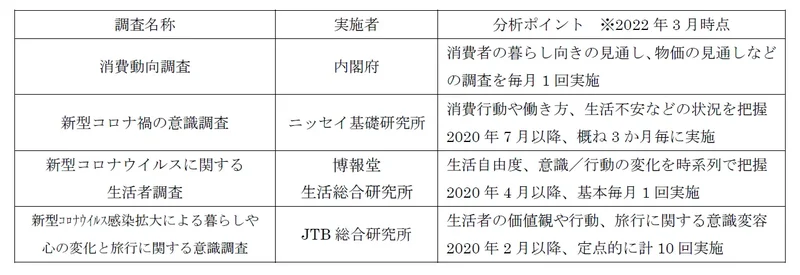
*JTB Corporation’s Travel Trends Survey is based on various economic indicators, industry trends, developments among transportation companies, accommodation booking status, and various opinion surveys. The survey has been conducted continuously since 1969 for Golden Week, summer vacation, and the year-end and New Year holidays, and since 1981 for annual forecasts. (Our company is responsible for the research and analysis in this report.)
Overview of This Year’s Golden Week Travel Trends
This year’s Golden Week (hereinafter “GW”) travel trends have been announced.
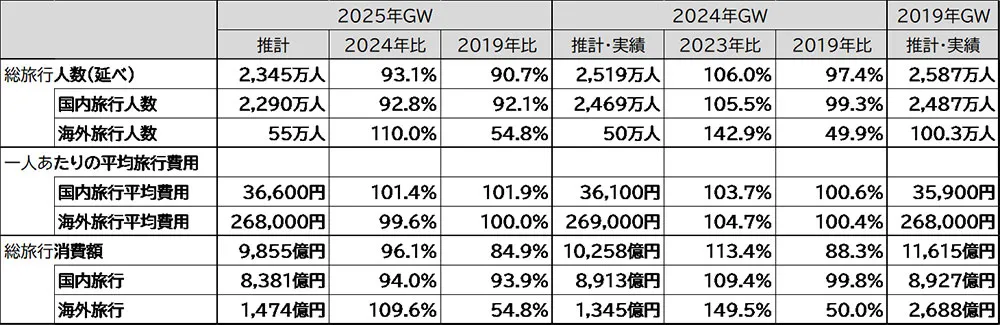
Although the total number of travelers reached 23.45 million and total travel spending amounted to 985.5 billion yen, these figures are estimated to have decreased compared to the previous year. This is believed to be due to several factors: the travel demand that had been suppressed by the COVID-19 pandemic having largely subsided by last year; the economic environment, including rising prices; and the calendar, which was split into two distinct periods—a series of scattered holidays in the first half of the period and a four-day weekend in the second half.
The number of domestic travelers fell slightly from the previous year to 22.9 million, due to household financial strain caused by soaring prices and a tendency to shift travel dates to avoid crowds. The average travel expenditure remained at the previous year’s level of 36,600 yen.A notable trend is that travel destinations are spreading beyond local areas, with an increase in travel to distant locations. Differences in travel destinations by gender and age group were also observed, such as the Kanto region being popular among men and women aged 29 and under, the Kinki region among women in their 30s, and Shikoku among women in their 60s.
Regarding reasons for choosing travel destinations, “It didn’t seem crowded with tourists, etc.” (7.9%) increased by 0.9 percentage points from the previous year and by 5.4 percentage points from the year before last. With the term “overtourism” becoming increasingly common due to the rapid growth of inbound tourism, the trend of shifting travel dates and seeking out hidden gems is growing stronger year by year.
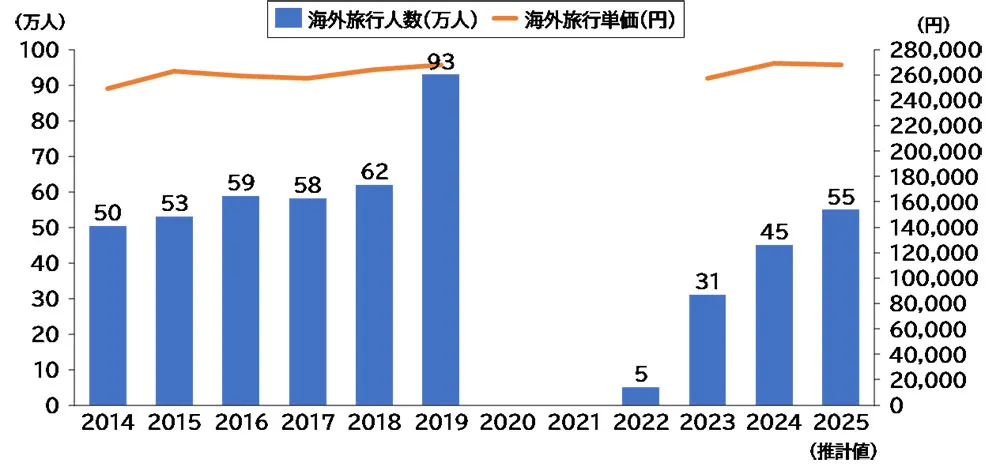
On the other hand, the number of outbound travelers is projected to increase to 550,000 compared to the previous year. Driven by the tailwind of inbound tourism, international flight capacity has nearly recovered to pre-COVID-19 levels. Combined with rising incomes among certain demographics and demand-stimulating campaigns, the figure is expected to exceed the previous year’s level.
It should be noted that during the 2019 Golden Week holiday, which spanned 10 consecutive days from April 27 to May 6 to mark the accession of the current Emperor, overseas travel was particularly brisk compared to previous years. Consequently, while the figure stands at 54.8% of the 2019 level, it is believed to be recovering to approximately 70–80% of pre-2018 levels.In terms of travel destinations, while relatively nearby destinations such as South Korea, Taiwan, and Singapore remain popular, a notable feature is the recovery of interest in distant destinations like Europe, which had seen subdued activity last year (Figure 1).
Looking Back at Golden Week from Pre-Pandemic Times to 2024
Here, we would like to look back at the social conditions and travel trends during Golden Week from 2019 (pre-pandemic) through last year, 2024.
2019
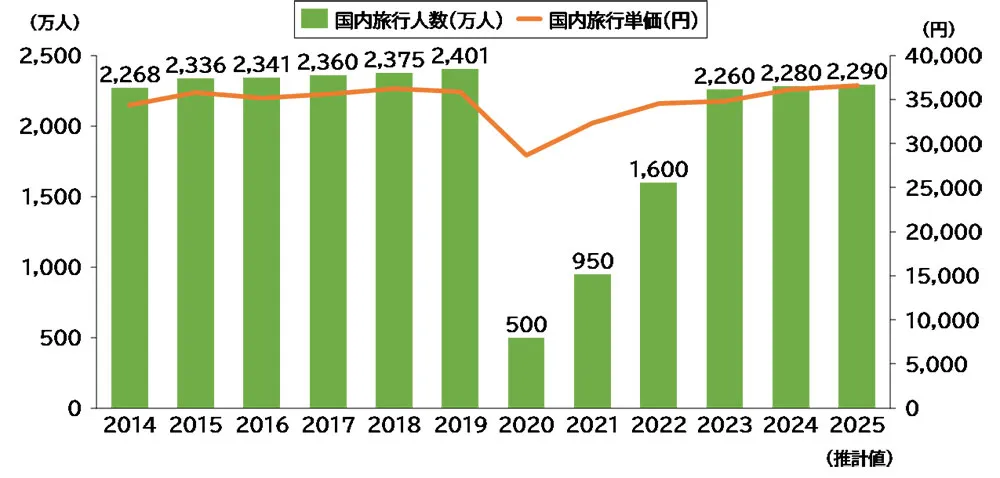
Due to the Emperor’s accession to the throne, there was a 10-day holiday period from April 27 to May 6. Domestic travel was naturally booming, and since the yen’s depreciation and rising prices had not yet accelerated to the extent they have today, overseas travel was exceptionally vibrant compared to previous years, with 929,000 overseas travelers.
2020
On January 15, Japan’s first case of COVID-19 was confirmed. As a measure to prevent the spread of the virus, a state of emergency was declared on April 7 for Tokyo, Osaka, Kanagawa, Chiba, Saitama, Hyogo, and Fukuoka. Subsequently, on April 16, the declaration was expanded to cover the entire country and remained in effect until May 25. Non-essential domestic travel and international travel were strictly restricted, with the exception of certain business activities.
2021
A state of emergency was declared on April 25 for Tokyo, Osaka, Kyoto, and Hyogo. As of April 25, “Priority Measures to Prevent the Spread of Infection” were also in effect in Miyagi, Saitama, Chiba, Kanagawa, Aichi, Ehime, and Okinawa. In these areas, restaurants were required to shorten their operating hours, and the number of domestic travelers fell to about 40% of 2019 levels, particularly in regional areas.
2022
The "Priority Measures to Prevent the Spread of Infection" ended on March 21, resulting in the first Golden Week in three years without nationwide restrictions on movement. The number of domestic travelers recovered to just under 70% of 2019 levels. Meanwhile, strict border control measures remained in place regarding international travel, including a cap of 5,000 people per day on the number of returnees and new arrivals, and restrictions on the entry of foreign nationals for tourism purposes.
2023
On January 27, the government decided to reclassify COVID-19 from a Category 2 to a Category 5 infectious disease effective May 8, following the Golden Week holiday. Riding this wave of optimism, domestic travel during Golden Week recovered to 95% of 2019 levels.Meanwhile, regarding overseas travel, border control measures were initially scheduled to continue until May 7, the final day of Golden Week. However, on April 28—just before Golden Week—it was announced that the measures would end the following day, April 29. Because this was a last-minute decision, it is believed that some people decided against overseas travel—including those who found the return procedures cumbersome, those who wanted to wait and see how the situation developed, and those who felt anxious or fearful about the virus.
2024
This was the first Golden Week since COVID-19 was reclassified as a Category 5 infectious disease. The number of overseas travelers increased to 450,000, representing 167.7% of the previous year’s figure. This increase was partly a rebound from people who had previously given up on overseas travel due to border control measures, and while it was affected by the rapid depreciation of the yen and rising prices, a recovery in overseas travel was evident, particularly to nearby destinations in Asia.Meanwhile, inbound tourism showed a sharp recovery, exceeding 2019 levels every month since February.
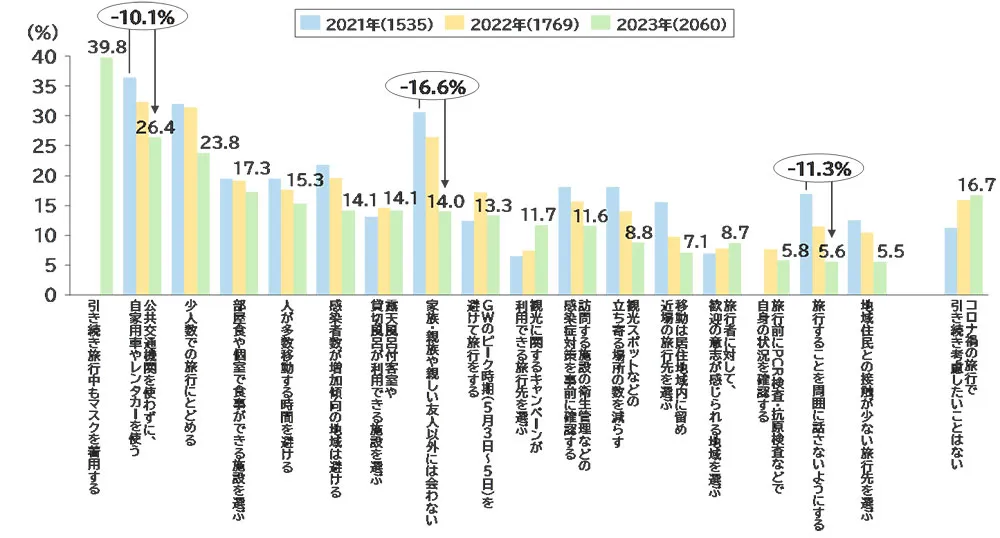
The survey also compared changes in travelers’ attitudes amid the rapidly evolving situation during the COVID-19 pandemic.Comparing 2021 and 2023, there were significant shifts: the percentage of respondents who said they “would not meet with anyone other than family, relatives, or close friends” decreased by 16.6 points; those who said they “would avoid telling others about their travel plans” decreased by 11.3 points; and those who said they “would avoid public transportation and use private or rental cars” decreased by 10.1 points.Conversely, preferences such as “choosing facilities with open-air baths in guest rooms or private baths” have shown little change over the past three years, suggesting that for some travelers, these choices have become established habits triggered by the pandemic (Figure 5).
With Rising Prices and Overtourism, How Will People Enjoy Travel?
In the wake of the COVID-19 pandemic, domestic travel in Japan is entering a new phase. Due to the global surge in prices, travel costs—including transportation, accommodation, and food—are on the rise.
This is particularly true for domestic travel. The memory is still fresh of how various campaigns by the national and local governments made relatively inexpensive travel possible during the period of sluggish demand caused by the pandemic, making the contrast with the current surge in prices all the more stark.
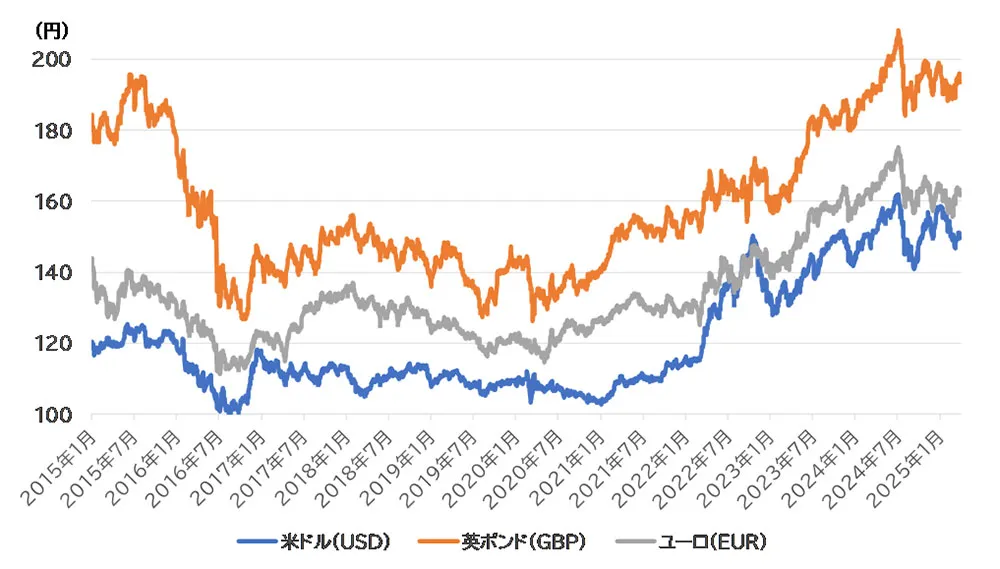
Furthermore, due to the pandemic’s impact, labor shortages are becoming severe in the tourism industry—particularly at the front lines, such as lodging facilities and restaurants—and this is especially pronounced in rural areas. Additionally, with the rapid surge in inbound tourism from overseas, there are growing concerns about overtourism in popular tourist destinations. When it comes to overseas travel, in addition to high prices, the rapid depreciation of the yen has made trips feel more expensive compared to 2019.
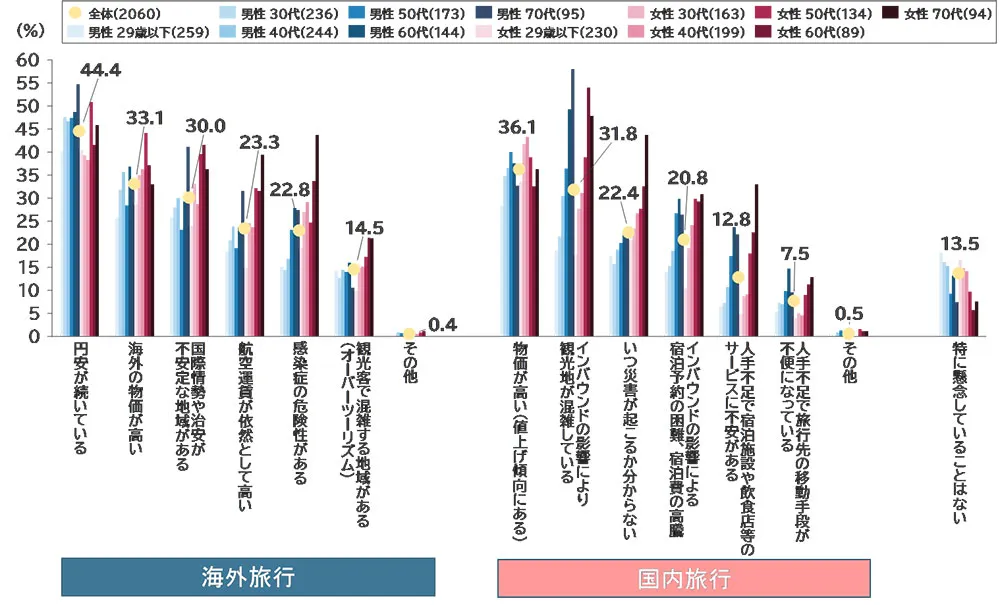
In fact, when asked during the 2024 Golden Week holiday about “concerns regarding travel in the coming year,” while “high prices (36.1%)” was a major concern for domestic travel across all genders and age groups, the concern that “tourist destinations are crowded due to the influx of international visitors (31.8%)” was particularly pronounced among older age groups.Regarding overseas travel, “the continued weak yen (44.4%)” was the most common concern, followed by “high prices abroad (36.1%)” (Figure 6).
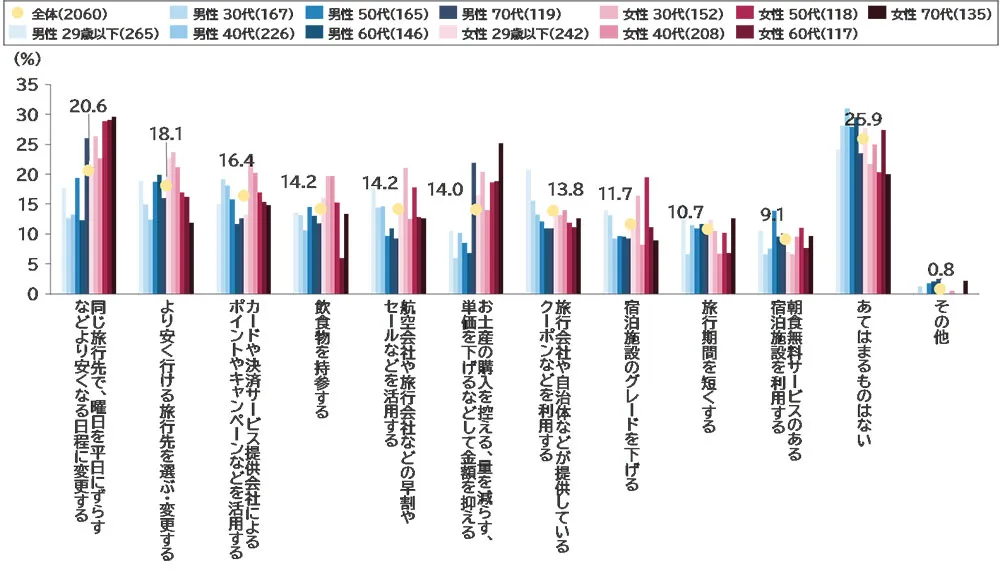
Even under these circumstances, travelers are devising various strategies to enjoy their trips. To keep costs down, the most common strategy was “changing the travel dates to cheaper options, such as shifting to weekdays while staying at the same destination (20.6%),” followed by “choosing or changing to a cheaper destination (18.1%)”—both of which relate to travel planning.Additionally, strategies such as “utilizing credit card or payment points and promotions (16.4%),” “bringing your own food and drinks (14.2%),” and “reducing costs by refraining from buying souvenirs, buying fewer items, or choosing cheaper options (14.0%)” were particularly common among women, indicating a growing trend of smart cost-saving practices across a wide range of methods while still enjoying travel (Figure 7).
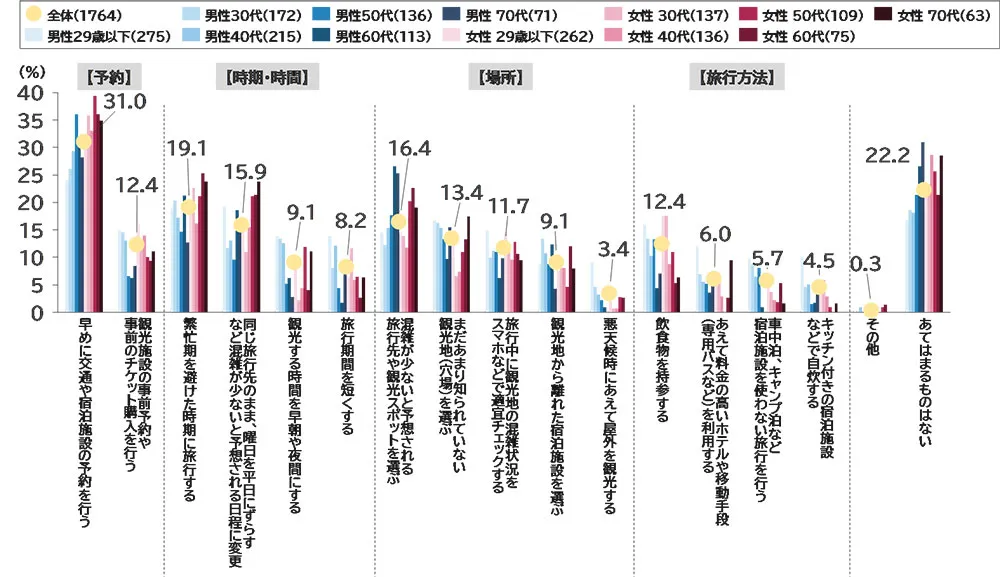
Regarding measures to address overtourism, “Booking transportation and accommodations early (31.0%)” was the most common response, followed by “Traveling during off-peak seasons (19.1%),” “Choosing destinations or tourist spots expected to be less crowded (16.4%),” and “Changing the travel dates to weekdays or other times expected to be less crowded while staying at the same destination (15.9%).”This suggests that travelers are adopting various strategies, such as securing seats and rooms through early booking and selecting times and locations to avoid crowds. The trend of using social media to discover hidden gems may also grow even stronger in the future (Figure 8).
These strategies are being utilized to enhance the quality of travel and ensure a comfortable experience, while simultaneously keeping costs down. In this rapidly changing era, travelers will likely continue to adapt to the evolving environment and explore new styles of travel. In this survey, we will continue to track not only the numerical data but also changes in travelers’ attitudes and behaviors.
著者