The Changing "Form" of School Trips · The Unchanging "Essence" of School Trips

School trips are one of the most important events in the school calendar. They have been significantly impacted by the COVID-19 pandemic from the end of the previous FY through this one. In this article, we examine how the school trips that students had been looking forward to have changed, and what values remain unchanged.
School trips in Japan are said to have originated in the Meiji era and have long been regarded as an important school event. Due to the spread of COVID-19, these important events have been forced to be canceled or have their destinations changed, making it impossible to conduct them in the same manner as before. On the other hand, examples of school trips being held in modified forms suggest signs of new changes on the horizon. We will examine this issue based on the actual implementation of school trips in FY 2022.
1. Changes in School Trip Destinations Due to COVID-19
According to the Ministry of Education, Culture, Sports, Science and Technology’s (MEXT) Curriculum Guidelines for Junior High Schools, school trips are classified as “school trip-related events” under “Special Activities.” They are defined as “activities conducted in a living environment different from the usual one, designed to broaden students’ horizons, familiarize them with nature and culture, and provide them with desirable experiences regarding group living and public morality. ”While the educational significance is undeniable, for students, it is also the school event they look forward to the most, and it remains as a cherished memory for the future. For example, while graduation albums typically feature many photos of various school events and club activities, we are hearing comments from schools such as, “There was no school trip this year, so we didn’t have a chance to take a group photo with everyone together,” or “We can only include photos where everyone is wearing masks, so it’s impossible to tell who is who.”
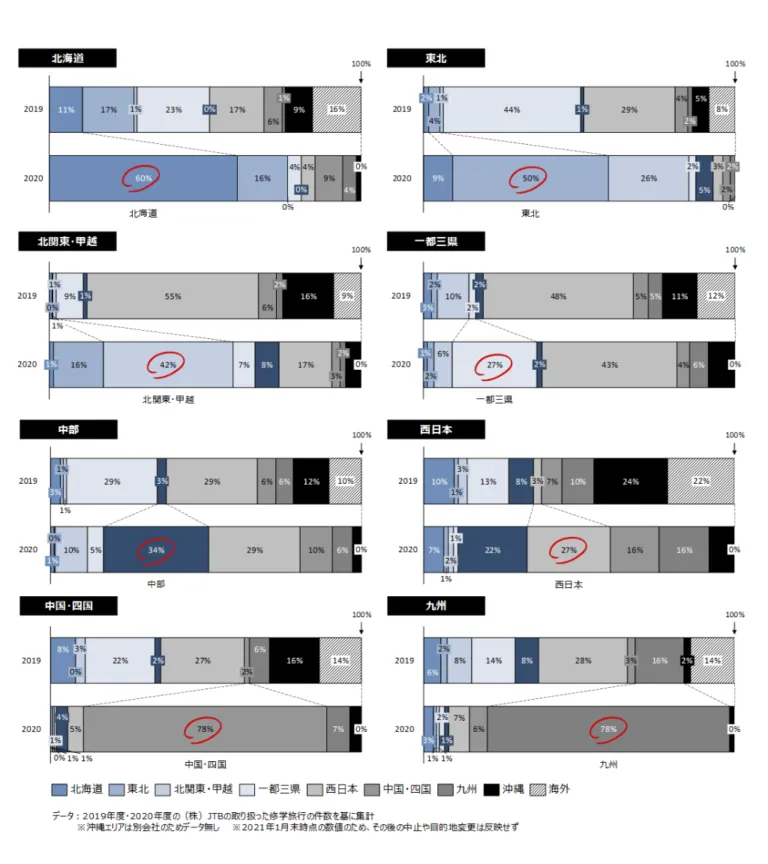
The extent to which school trips in the FY 2020 were canceled, had their destinations changed, or were replaced with alternative events will likely be revealed in the “Data Book,” the annual educational travel report published every December by the Japan School Trip Association, a public interest incorporated foundation. However, as reported in the media, there is no doubt that many schools were affected. Amidst this situation, a notable trend among schools that did hold school trips is the shift toward destinations in neighboring prefectures. While destinations such as “Western Japan (Kyoto, Nara, Osaka),” “the Greater Tokyo Area (Tokyo, Chiba),” and “Okinawa” were previously the mainstream, there has been an increase in patterns where students travel by bus within the same region. This can be attributed to efforts to avoid traveling to areas under a state of emergency, as well as the fact that using public transportation became difficult both from a risk management perspective and logistically. Therefore, based on school trip data handled by JTB Corporation, we will examine how destinations have changed by comparing the proportions of departure and arrival locations between FYs 2019 and 2020.
Looking at the percentage of arrival destinations by departure region, the proportion of trips within the same region increased in all eight regions, from Hokkaido to Kyushu. It is clear that travelers shifted from long-distance trips to nearby destinations. This trend was particularly pronounced in Hokkaido, Chugoku/Shikoku, and Kyushu, likely due to the physical challenges of traveling to other regions by land. On the other hand, while the proportion of travel within the same region in the Tokyo Metropolitan Area and the three neighboring prefectures increased significantly from 2% to 27%, the proportion of trips to Western Japan as a destination decreased only slightly, from 48% to 43%, indicating a tendency to continue the trips without changing their nature. This suggests that students avoided traveling within the same region where a state of emergency had been declared and instead chose Western Japan, where infection rates were lower. Regional external constraints and differences in public awareness may also have played a role. (Figure 1)
2. New “Forms” Emerged in FY20’s School Trips
As noted above, even among schools that did hold school trips, many changed their destinations to within their own region. Let’s examine three specific examples to see what these trips entailed.
The first example involves a school trip that leveraged cultural resources in neighboring prefectures. In Akita Prefecture, the nationally famous “Omagari Fireworks Festival,” typically held in August, was canceled, resulting in the loss of a major event that usually attracts approximately 750,000 visitors from within and outside the prefecture. The economic loss is immeasurable, not only for fireworks companies but for the local community as well. Daisen City, where Ōmagari is located, was deeply concerned about this situation and wondered if there was a way to show the fireworks to students who had been forced to cancel or change the destination of their school trips, in order to lift their spirits even a little. By launching “message fireworks” or “private fireworks” for each school that requested them, the city sought to preserve the traditional culture and brand of Ōmagari’s fireworks while also supporting the local economy by securing business opportunities for tourism-related companies within the prefecture and neighboring prefectures.
Additionally, a junior high school in Aomori Prefecture that typically holds its school trip in Okinawa each year was considering changing its destination to a neighboring prefecture due to rising infection numbers and safety concerns regarding travel. It was then informed by a travel agency about Daisen City’s initiative described above. Attracted by the prospect of a valuable, unique experience in a nearby prefecture with low infection rates, the school incorporated the fireworks display as part of its school trip itinerary. In addition to the fireworks display on the day of the trip, the school incorporated active learning elements, such as learning how to make fireworks from pyrotechnicians during the production phase. This became a new initiative that transformed one of Japan’s premier fireworks displays into original content for the school.
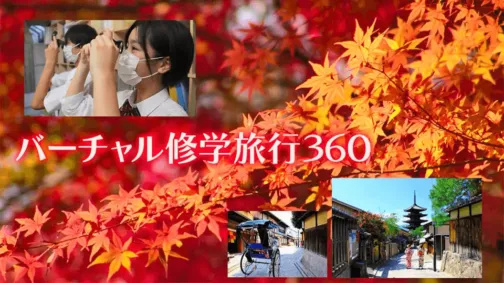
The second example is a case where a school trip was realized virtually. A junior high school in Shizuoka Prefecture had traditionally organized an annual school trip to the Kyoto and Nara areas. Rather than reevaluating the destination or the program, the school decided to conduct the same activities virtually this FY while students remained on campus. Although it was virtual, the combination of virtual and real-world elements—including a 360-degree immersive video experience powered by VR technology, online interactions with the host region, traditional cultural experiences that allowed students to get a taste of Japanese culture, and selecting souvenirs for friends and family—meant that students felt they could experience the atmosphere of a school trip, rather than simply watching a video. Digitalization and online learning are accelerating in the field of education. This new style of school trip not only provided a fresh experience but also heightened the students’ desire to “visit the actual locations someday,” helping to foster a sense of anticipation for real-life travel once the pandemic subsides.
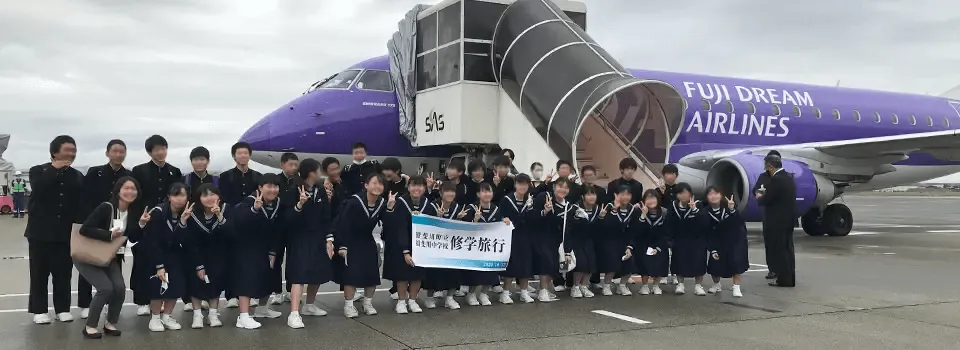
Finally, here is an example where, rather than venturing far, the school trip was turned into an opportunity to rediscover the charm of the local area. At a municipal junior high school in Gifu Prefecture, the school decided to cancel the overnight school trip and instead explore alternatives for a day trip. While a typical plan might involve touring nearby areas by bus and returning home, the school aimed for a uniquely local experience. By combining the “aviation industry”—an area where Gifu Prefecture is actively investing—with “hometown education,” they organized a visit to the Kagamihara Aerospace Museum and a chartered flight operated by a regional airline. Students were able to view their own region from the sky and gain a firsthand understanding of the locally rooted aviation industry through interactions with working professionals and hands-on experiences. Many students reported that this served as an opportunity to renew their sense of attachment to their hometown. Additionally, the itinerary included a session on table manners at a renowned local hotel during dinner, offering students a glimpse into a slightly more sophisticated world they don’t usually experience. While the people working in these industries are essential to sustaining local industries, these experiences during the formative years of junior high school may help foster the next generation of leaders.
3. Expectations for Future School Trips
While the COVID-19 pandemic has brought changes to the environment surrounding school trips, these changes are not necessarily all negative; we believe that by looking at them from a different perspective, we can create new value.
For Students and Teachers: Rediscovering the Importance of Shared Time and Space
While many schools shifted from traveling to distant destinations to trips within neighboring prefectures or within their own prefecture, a common sentiment among students was that, regardless of the destination, the time spent enjoying themselves with classmates and group members was the most enjoyable part. During the COVID-19 pandemic, when the everyday act of “spending time together” became an extraordinary experience, school trips—where teachers could share the same time and space with students—seemed to be recognized anew as a valuable opportunity for communication. In the past, destinations were often chosen based on their concentration of historical, cultural, or recreational attractions. However, when aiming to meet students’ psychological needs while fulfilling the educational objectives outlined in the curriculum guidelines, the range of potential destinations expands. Similarly, regarding activity formats, while group-based activities have been a recent trend in school trips to foster student autonomy, the benefits of whole-class activities are also beginning to be reevaluated.
For regions and local governments: Creating opportunities to learn about the region, sharing the region’s appeal
When host communities consider attracting visitors, they often focus primarily on exploring new markets—such as promoting to overseas audiences or targeting affluent travelers. However, considering the need to cultivate future leaders for local industries and the recent trend of micro-tourism, this could be seen as a valuable opportunity to turn our attention to the children who are the region’s residents. Akita Prefecture had previously struggled to attract school trips, but by leveraging its powerful traditional cultural asset—fireworks—it succeeded in welcoming new schools. Rather than chasing short-term spending spikes, it may be time to consider how to allocate budgets to foster sustainable local industries.
For Tourism-Related Businesses: Rethinking Hospitality Approaches and Creating New Business Opportunities
As seen in the case of Gifu Prefecture, local lodging facilities are beginning to open their doors to school trips. While there are requests to avoid crowding, especially during the COVID-19 pandemic, large-scale lodging facilities have the capacity to accommodate small groups per room, providing an opportunity to break away from reliance on inbound tourism. There is also potential for demand from adults who, carrying childhood memories in their hearts, visit with their families as adults, which could lead to building a long-term base of repeat customers. Furthermore, virtual school trips allow students to participate in various craft experiences by connecting businesses and schools online using materials sent in advance, creating business opportunities that are not bound by physical location. Experiences come in various forms—from those that let students feel the atmosphere and energy of a place, like watching fireworks, to those where they create something themselves while receiving remote instruction. Therefore, it would be beneficial to reevaluate the delivery methods and promotional strategies based on the specific characteristics of your business.
Although the format of school trips for FY 2020 has changed due to COVID-19, I believe the essential value they provide to students—the “joy of learning and spending time together in an extraordinary setting”—has remained unchanged. Isn’t it time for schools, local governments, and businesses to re-evaluate school trips—which hold great significance among school events—as valuable opportunities once again?
著者