Tourism That Contributes to Achieving the SDGs: An Overview of Sustainable Tourism
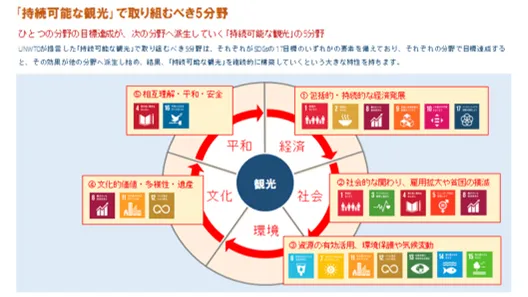
To achieve the SDGs in the tourism sector, five key perspectives are essential: (1) tourism that contributes to inclusive and sustainable economic growth; (2) social engagement, job creation, and poverty eradication; (3) efficient use of resources, environmental protection, and climate change mitigation; (4) the role of tourism in promoting cultural values, diversity, and heritage conservation; and (5) the role of tourism in fostering mutual understanding, peacebuilding, and safety and security. In this article, we present case studies illustrating the types of tourism practices that should be implemented under each of these perspectives.
To ensure we pass on this beautiful planet to future generations, the world has adopted the SDGs—the Sustainable Development Goals—comprising 17 goals and 169 targets. Discussions on sustainability are steadily gaining momentum within the tourism industry as well. It is also important to note that the COVID-19 pandemic has given rise to a shared value of protecting the health of all people living on Earth.
In Japan’s tourism sector, the SDGs were addressed as agenda items at the 2019 G20 Summit in Osaka and the G20 Tourism Ministers’ Meeting held in Kutchan, Hokkaido*1, and the Cabinet Office and Japan Tourism Agency are currently discussing a framework for “sustainable tourism” that contributes to achieving the SDGs*2.Furthermore, through discussions on the nature of sustainable tourism and the publication of the Japan Sustainable Tourism Standard for Destinations (JSTS-D)*3 (the Japanese version of the GSTC [Global Sustainable Tourism Council] standards), stakeholders are becoming increasingly aware of the positive and negative impacts tourism has on society, the economy, and the natural environment from the perspective of tourist destinations and tourism businesses.
In a previous column, “What Is the SDG Approach That Will Drive Transformation in the Tourism Industry Going Forward?”, I noted that achieving the SDGs in tourism requires five key perspectives. In this article, I will clarify the relevant goals for each perspective and present case studies illustrating the types of tourism that should be practiced.
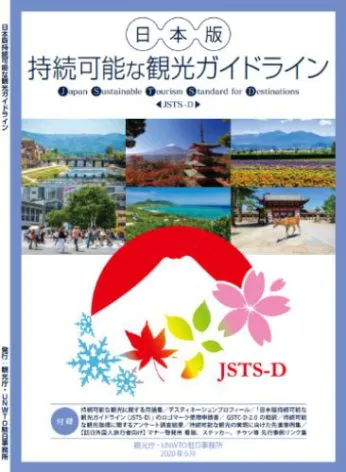
Figure 1: Correlation between the 5 Domains Defined by UNWTO and the SDGs
1. The Role and Responsibility of Tourism in Contributing to the SDGs and Regional Revitalization
The meaning of tourism and travel has been changing worldwide, including in Japan, over the past few years. This shift involves transforming tourism from a model that consumes facilities, goods, and resources into one that creates added value through information, dialogue, and connections, thereby stimulating consumption. What, then, should we do to achieve this? For several years now, it has been said that the core values sought in this context are “stories worth passing down,” “serendipity,” and “authenticity.” But what exactly lies at the heart of these values? Is it not nature, which flows unbroken from the past into the future; the people who live in those lands; and the history, traditions, and culture that those people have woven over time?
It is essential that sustainable tourism meets three conditions: “enabling economic growth,” “being socially and culturally desirable,” and “being environmentally sound. ”In promoting this, it is essential to give full consideration to the five areas defined by the United Nations in 2017 during the International Year of Sustainable Tourism: 1) inclusive and sustainable economic development; 2) social engagement, job creation, and poverty eradication; 3) efficient use of resources, environmental protection, and climate change; 4) cultural values, diversity, and heritage; and 5) mutual understanding, peace, and safety. It is crucial to support initiatives that ensure sustainability in each of these areas, taking into account the characteristics of the destination and the visitors who come there. Furthermore, amid the COVID-19 pandemic, a shared value of protecting the health of all people living on Earth is emerging. Below, we have organized perspectives, key challenges, and directions for these five areas, including issues arising from the COVID-19 pandemic.
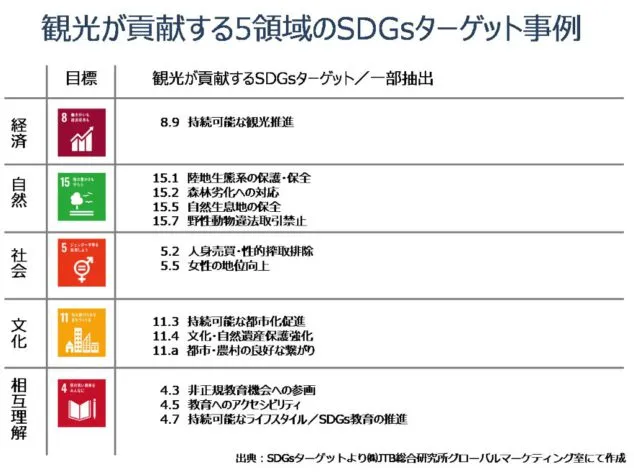
2. Five Areas Contributing to SDG Achievement and Key Perspectives
1) Tourism Contributing to Inclusive and Sustainable Economic Development
The relevant SDGs are the following six: (1: No Poverty, 2: Zero Hunger, 8: Decent Work, 9: Industry, Innovation and Infrastructure, 10: Reduced Inequalities, 17: Partnerships for the Goals). When considering the tourism value chain, SDGs such as Goal 14 (Fisheries), Goal 15 (Forests), and Goal 11 (Sustainable Cities and Communities) can also be linked to economic revitalization.
Tourism is a symbolic phenomenon of economic impact driven by the movement of people. From the perspective of sustainable tourism, there are two key aspects to consider regarding economic impact. The first is whether the framework is designed across the entire value chain—from market to destination—to ensure that businesses and individuals who wish to participate in the economic activities generated by tourism can do so—fostering an inclusive, open, and healthy tourism economy accessible to all. The second is whether the economic benefits generated by tourism are being returned to the residents of the destination and whether they are actually feeling those benefits—that is, minimizing economic leakage (the outflow of economic benefits from the region).
Specific actions include the "concept of local production for local consumption," "generating visitor flow through value creation during off-peak seasons and underutilized hours," "initiatives to attract repeat visitors and long-term stays," and "local circulation rates."
2) Social Engagement, Job Creation, and Poverty Eradication
The UNWTO has identified the following five SDGs as relevant: 1 (No Poverty), 3 (Good Health and Well-being), 4 (Quality Education), 5 (Gender Equality), and 8 (Decent Work and Economic Growth).In terms of elements directly related to tourism, Goal 6—which concerns the development of water supply and sanitation facilities, a critical social infrastructure—and Goal 11—which focuses on community development that coexists with tourism—can also be considered relevant. Furthermore, in light of the current COVID-19 pandemic, it is necessary to examine the responsibility tourism bears in realizing a society free of health inequalities (Goal 10).
“The days and months are passing travelers of a hundred generations, and the years that come and go are travelers as well.” Basho masterfully expressed how daily life is, in fact, the flip side of a life of travel. Travelers are residents, and residents are travelers. People gather, learn, and live in the places they love—where they were born and raised. Just as we love the town where we were born and raised, we should love the towns and regions we visit. I believe there are three key points for contributing to the creation of a better society through sustainable tourism. First, we must practice tourism that creates jobs to support the daily lives of local people. Second, we must weave a mindset that addresses the challenges faced by people living in poverty, as well as those facing gender-based or disability-related issues, into the promotion of tourism. And finally, we must promote the sharing between travelers and residents of both the intellectual infrastructure—such as rules and guidelines that protect the region from violence and epidemics and maintain safety, security, and peace—and the physical infrastructure—such as roads, restrooms, water supply systems, public halls, evacuation centers, and hospitals—through the creation of “Travel-Resident Inclusive” communities.
In response to SDG 3, “Good Health and Well-being for All,” we should also work on creating new rules that travelers and residents can share regarding the responsibilities and obligations of travel and tourism, which take the value generated by movement and exchange as their core value.
Specific actions include providing opportunities for local residents and travelers to manage and participate in community activities; utilizing existing local facilities through collaboration between the local community, travelers, and tourism operators; developing “industrial tourism” where production and work coexist with travel; and establishing and implementing public health guidelines for tourism operators and travelers.
3) Effective Use of Resources, Environmental Protection, and Climate Change
The relevant SDGs are the following seven: (6: Clean Water and Sanitation, 7: Affordable and Clean Energy, 11: Sustainable Cities and Communities, 12: Responsible Consumption and Production, 13: Climate Action, 14: Life Below Water, and 15: Life on Land).Goals 6, 11, 14, and 15 relate to land and food—including nature, cities, and the people who live there—where flora and fauna thrive, while Goals 7, 12, and 13 concern climate change, energy resources, and methods of consumption and regeneration. In relation to food, Goal 2, which promotes sustainable agriculture, is also relevant.
Nature and the environment are the most important areas within the SDGs. A key concept of sustainable development*5 lies in building a sustainable society based on the “conservation of the Earth’s ecosystems,” and there are three important principles for advancing this.
First, we must transform our mindset regarding the consumption of resources that depend on the global environment—such as energy and food, which we often take for granted—by recognizing that the Earth’s resources are finite. Second, we must cease actions that threaten the lives of the plants and animals inhabiting the Earth and ensure the complete conservation of endangered species and their ecosystems.
And third, ensuring that the benefits of the global environment are passed on to future generations.
Specific actions include initiatives for nature and global environmental conservation (climate change, loss of biodiversity), reducing local environmental issues (noise, waste problems),landscape conservation (satoyama landscapes, alignment with the Japanese national park model), avoiding the overuse of resources, preventing environmental pollution, addressing consumption and waste (plastic and food waste), and food-related issues (local production for local consumption, diversification of agriculture, forestry, and fisheries, and food waste), promoting the use of renewable energy, adopting a circular economy approach, and promoting the use of hybrid, electric, and hydrogen vehicles.
4) The Role of Tourism in Contributing to Cultural Value, Diversity, and Heritage Preservation
The UNWTO has identified the following three SDGs as relevant: 8 (Decent Work and Economic Growth), 11 (Sustainable Cities and Communities), and 12 (Responsible Consumption and Production).Furthermore, in terms of Goal 4 (Education), contributions to education through field trips (including school trips) can be considered. From the perspective of building a society that recognizes diversity, contributions to social development that include the socially vulnerable can also be explored in relation to Goal 5 (Gender Equality) and Goal 10 (Reduced Inequalities).
In addition to the three fundamental elements of sustainability—economic, social, and environmental—contributions centered on human-created culture are also considered a crucial perspective in tourism. The following three perspectives are essential for promoting these efforts. First, preserving irreplaceable traditions and cultures rooted in the local community and supporting current efforts to create new culture. Second, fostering a diverse society that respects diversity (including future generations and minorities) and acknowledges the existence of various values. Third, while tourism relies heavily on the tangible and intangible historical and cultural heritage that forms the foundation of modern life, it also plays a vital role in supporting these assets.
Specific actions include hiring people to work in the tourism industry with a focus on inclusivity; identifying the stories of the region’s tangible and intangible natural and cultural heritage that local people wish to preserve for the future and passing them on through tourism; implementing the conservation and restoration of the region’s tangible and intangible cultural and natural tourism resources; and incorporating interpretation provided by local experts and residents.
5) The Role of Tourism in Contributing to Mutual Understanding, Peacebuilding, and Safety/Security
The UNWTO has identified the following two SDGs as relevant: Goal 4 (Quality Education) and Goal 16 (Peace and Justice). If we were to add another, Goal 17 (Partnerships for the Goals) could also be considered an SDG to which tourism contributes, particularly from the perspective of building partnerships.
Tourism inherently possesses the capacity to foster partnerships, move hearts, and encourage dialogue through interactions and encounters between people, between people and culture, between people and the land, and between people and objects. As those of you who have traveled well know, recognizing cultural diversity and deepening mutual understanding helps build safe and secure societies, ultimately bringing peace to each region.
For the people living in the places they visit, engaging in dialogue with travelers and experiencing the local culture provides an opportunity to deepen their respect for people from other countries and their cultures. Through dialogue with the local community, travelers learn about the region’s cultural values and develop a deeper attachment to the land. Creating as many opportunities for such dialogue as possible is the essence of true sustainable tourism. In today’s increasingly digital world, there are cases where dialogue between travelers and residents diminishes, and others where digital tools are used to facilitate such dialogue. I hope you will reflect on “what constitutes genuine dialogue that should be carried out by people” and cherish and nurture the time spent on “dialogue”—the most essential element of travel.
Specific actions include promoting interaction between local residents and travelers (including attracting and hosting MICE events), ensuring public safety, implementing crime prevention measures, preparing for disaster response and business continuity planning (BCP), and building networks with the next generation from outside the region (such as through school trips and inbound tourism). Additionally, we should incorporate elements that allow travelers to actively participate in tourist destinations and engage with local residents.
3. Framework and Actions for Advancing Sustainable Tourism
To realize tourism policies and initiatives that promote sustainable tourism and contribute to the achievement of the SDGs, it is effective for relevant stakeholders (local businesses, local governments, academia, citizens and NPOs, regional DMOs, major domestic land operators, and overseas tour operators) to organize their efforts under the framework of: (1) Learning (information gathering, promoting understanding, and raising awareness),② Protect and Nurture, and ③ Connect and Support, and to advance initiatives collaboratively from short-, medium-, and long-term perspectives. I would like to introduce these along with specific examples of actions.
1) “Learn (Gather Information, Understand, and Disseminate in Japan)” Initiatives
- Promoting understanding of the relationship between the SDGs and tourism, as well as sustainable tourism indicators
- Collecting and sharing domestic and international sustainable tourism case studies through international conferences and surveys
- Developing and implementing tourism programs that teach the SDGs through the activities of educational institutions
- Raising consumer awareness to transform travelers’ consumption behaviors
2) “Preserve and Nurture” Initiatives
- Discovering and understanding local tangible and intangible cultural assets, natural environments, and expertise that contribute to solving global challenges
- Development, formulation, and promotion of sustainable tourism programs, guides, and facility services
- Promoting understanding of tourism crisis management in the region
- Evaluation of local SDG initiatives and destinations from an SDG perspective
3) “Connecting and Supporting” Initiatives
- Expanding the base of supporters through the formation and operation of the Japan Sustainable Tourism Promotion Council (tentative name)
- Promoting the digitization of tourism content (nature and culture) and destination management
- Building a sustainable tourism value chain and network
- Support for building sustainable tourism businesses, including consulting and funding
4. A Place to Return to After the COVID-19 Pandemic – Toward the Promotion of Sustainable Tourism Beyond
Sustainability is often used as a term symbolizing “protection and conservation.” However, in reality, isn’t it a value closer to the “sincere heart” that people have cherished within themselves, both in the past and in the future? It is said that new values are emerging every day during the COVID-19 pandemic. In fact, I believe these new values are by no means new; rather, they are the sincere hearts within us—values rooted in tradition, culture, and nature that have been woven into our communities by generations of ancestors.
Through tourism, people learn many things. Furthermore, tourism protects and nurtures the tangible and intangible values created by people and nature right before our eyes. Tourism empowers spaces where the next generation of young people can cultivate the motivation to take on new challenges, dreams for the future, and the courage to take risks. Isn’t that the very foundation of sustainable tourism? What the SDGs ask of and expect from tourism is, I believe, a new step toward a better tomorrow. As we navigate the process of transitioning to a new normal, now may be a good opportunity to take a fresh, ground-up approach to realizing a form of tourism that creates inspiration, dialogue, and exchange.
This article is based on the report titled “Basic Concepts for Promoting Sustainable Tourism for Regional Revitalization,” which was presented at the “Study Session on Contributing to the Achievement of SDGs through Tourism for Regional Revitalization,” a subcommittee of the “Public-Private Partnership Platform for Regional Revitalization and the SDGs” organized by the Cabinet Office in FY 2019.We plan to continue holding this study session in FY 2020 to evaluate practical sustainable tourism model projects and service selections. We encourage interested companies and local governments to participate.
[Sources]
*1: G20 Hokkaido Kutchan Tourism Ministers’ Meeting, Kutchan Declaration: “Promoting Contributions to the Sustainable Development Goals (SDGs) through Tourism”
*2: Cabinet Office, Regional Revitalization SDGs Public-Private Partnership Platform, Subcommittee Study Session on “Contributing to the Achievement of the SDGs through Regional Revitalization via Tourism” (JTB Corporation, JTB Tourism Research & Consulting Co., Ltd.)
*3: Japan Tourism Agency, Sustainable Tourism Guidelines *4: Although the UNWTO did not include Goal 2 “Zero Hunger” among the SDGs contributing to the natural environment during the 2017 International Year of Sustainable Tourism, the author proposes it as a goal related to food produced through agriculture.
*5: Ayako Fujigaki, “Sustainable Tourism: From the Perspective of Global Sustainability,” Koyo Shobo