Adventure Tourism in the Post-COVID Era

Adventure tourism, which is expected to drive the global tourism market, has been gaining increasing attention in Japan as an initiative aimed at shifting from a focus on the “quantity” of tourists to a focus on the “quality” of tourism—such as the preservation of nature and culture and regional development. Expectations for its role in promoting tourism in the new post-COVID era are likely to grow even further.
The COVID-19 pandemic continues to restrict global travel. According to the United Nations World Tourism Organization (UNWTO), the pandemic resulted in the loss of 850 million to 1.1 billion international travelers and $910 billion to $1.2 trillion in international tourism revenue in 2020, putting 100 million to 120 million direct jobs at risk. On the other hand, the Adventure Travel Trade Association (ATTA), an international organization for adventure tourism (hereinafter AT) headquartered in Seattle, announced in August that it forecasts U.S. travelers handled by ATTA member tour operators will return to pre-COVID-19 levels in 2021. This is three years earlier than the recovery of the overall U.S. travel market.
Due to the pandemic, traveler preferences have shifted globally toward “small group travel,” “travel to destinations away from cities,” and “travel that allows people to enjoy nature.” Adventure tourism meets these trends while providing high-quality experiences. Last year, our company established the Japan Adventure Tourism Council in collaboration with related industry stakeholders and is working to promote adventure tourism. In this article, I would like to discuss our current activities and the potential of adventure tourism in the “With/After Corona” era.
1. What Is Adventure Tourism (AT), Which Is Gaining Global Attention?
(1) The AT Market: Expectations for Early Recovery and Further Expansion
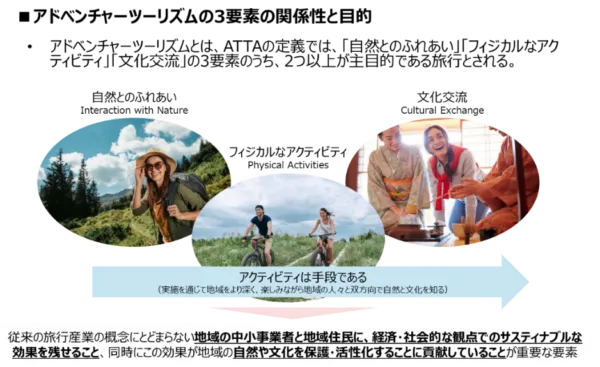
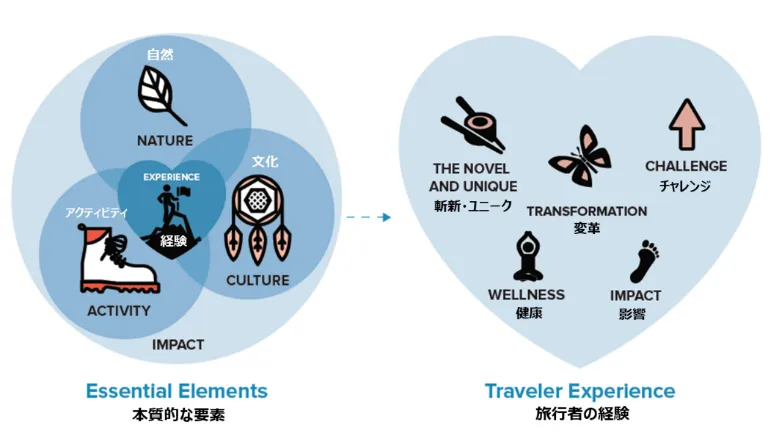
The ATTA defines AT as a form of travel where two or more of the following three elements—"Interaction with Nature," "Cultural Exchange," and "Physical Activities"—are the primary objectives.
It can be said that the current pandemic has significantly altered the “values of travel” for travelers worldwide. A symbolic trend within this shift is the growing preference for “small group travel,” “travel to destinations away from cities,” and “travel that allows one to enjoy nature,” and AT is expected to lead the global tourism market.
According to ATTA estimates, the AT market expanded from $263 billion (approximately 27.8 trillion yen) in 2012 to $683 billion (approximately 72.2 trillion yen) in 2017, growing at an average annual rate of 21%. This market is expected to recover quickly and expand further in the post-COVID era.
(2) What is authentic AT—more than just an outdoor experience?
The following are examples of experiences incorporated into AT travel products. Rather than rushed sightseeing tours of famous landmarks, this travel style involves spending one to two weeks walking through the region at a leisurely pace, using all five senses to experience local stories through nature and culinary culture. It is not merely an outdoor experience; it is a journey where travelers experience the rich natural resources and historical culture of their destination and learn various things through interaction with local residents.
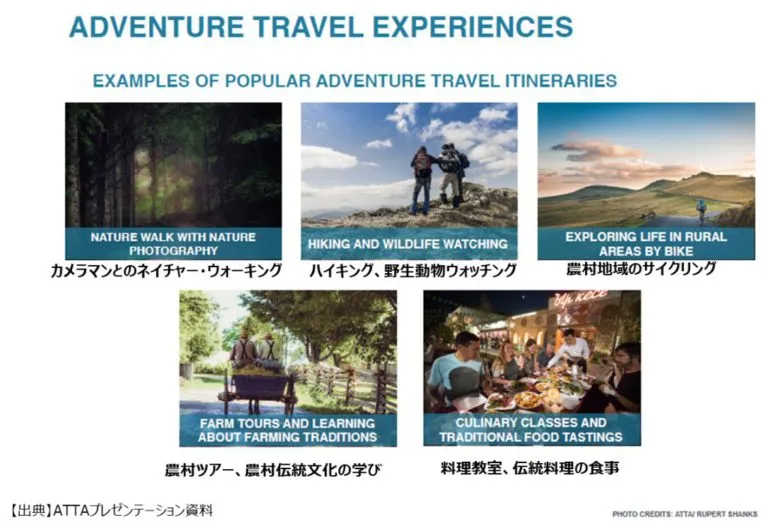
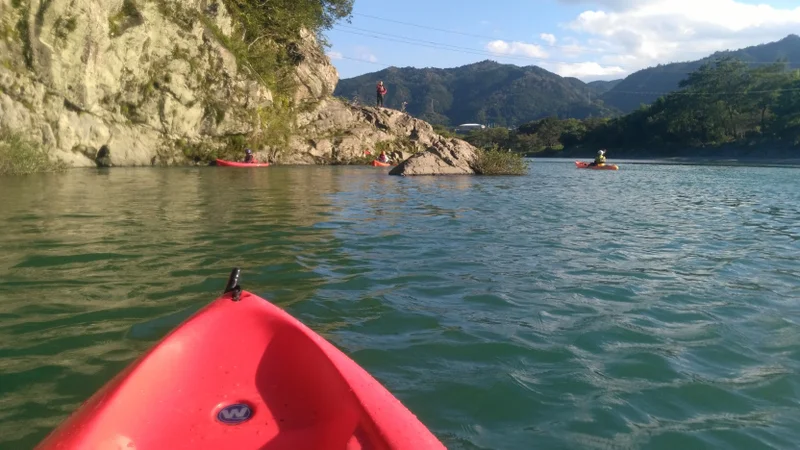
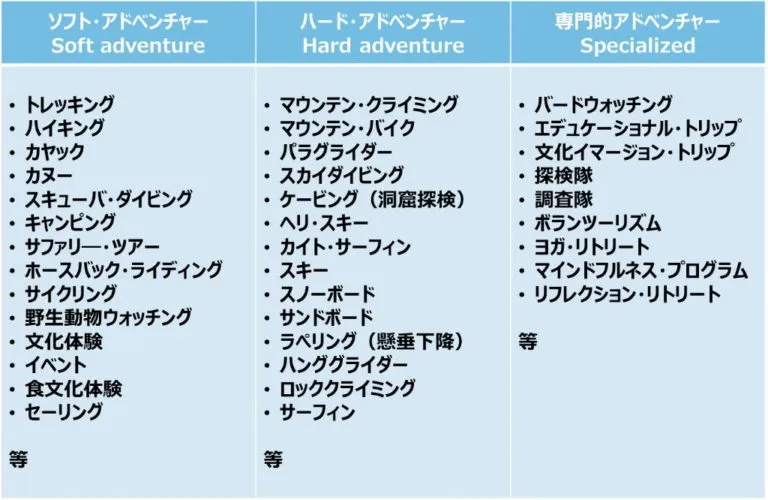
AT is not simply about moving efficiently by car. Hiking, trekking, cycling, rafting, kayaking, and other activities where people use their own strength to move and experience the environment are key elements. These activities also serve as a means to move while appreciating the richness of the local nature and to personally experience the natural ecosystem and historical and cultural heritage. Activities can be categorized into “soft adventures,” which require no special skills; “hard adventures,” which require considerable skill; and “specialized adventures,” designed for specific purposes. Furthermore, activities such as cycling and kayaking can be classified as either soft or hard adventures depending on the location and other factors.
A key aspect of the AT concept is that it prioritizes the creation of sustainable economic and social benefits for local small and medium-sized businesses and residents, while simultaneously ensuring that these benefits contribute to the protection and revitalization of the region’s natural environment and culture.
There are various reasons why Japan should pursue AT as part of its efforts to become a tourism-oriented nation, but I believe the following three points are particularly important: First, “the necessary elements are found precisely in rural areas”; second, “aiming to balance resource utilization with sustainability”; and third, “placing importance on the local economy.” Prior to the COVID-19 pandemic, the reality of tourism in Japan was that foreign tourists were concentrated in certain regions, making overtourism a social issue. Moving forward, tourism promotion must prioritize natural and cultural resources and the regions themselves, while also linking these resources to economic value through tourism. It is essential to shift from a focus on the “quantity” of tourists to a focus on the “quality” of tourism—such as the conservation of nature and culture and regional development. The vision of sustainable destinations that AT strives for is precisely the model of a tourism-oriented nation that Japan should aim for in the future.
2. Establishment of the Japan Adventure Tourism Association (JATO)
Last July, with ATTA serving as an advisor, the Japan Adventure Tourism Organization (JATO) was established through a collaboration between industry, government, and academia to promote world-class adventure tourism in Japan. Its main activities include raising awareness and promoting AT within Japan; supporting the planning and distribution of high-value-added, high-quality, and high-end AT products; human resource development; and attracting AT travelers to Japan, particularly from key markets in Europe and the United States.
Last year, the organization held symposiums and lectures in Tokyo and across the country. It has supported the formulation of strategies and human resource development for promoting AT in Hokkaido, Nagano Prefecture, Kyushu, and Okinawa Prefecture. Additionally, it supported the bid to host the “Adventure Travel World Summit (ATWS),” the global AT conference organized by the ATTA, and Hokkaido was tentatively selected as the host for the 2021 event. Currently, JATO is supporting the planning of inspection tours—to be held in several locations nationwide, primarily in Hokkaido, during the ATWS—as well as the development of reception systems and guide training. In collaboration with host regions, preparations are underway to welcome AT experts from around the world. The JATO website features interviews with key figures in the AT industry both in Japan and abroad, distributes instructional videos for AT human resource development, and introduces global AT-related information released by ATTA.
In the “Program for Realizing the Tourism Vision 2020” announced by the government this past July, “promoting adventure tourism” was listed as a measure to “enhance experiential activities that leverage the appeal of regional nature, climate, and culture. ”The Ministry of the Environment has also identified AT as a pillar of its “National Parks Enjoyment Project,” and it is beginning to be promoted as a national policy. Through JATO’s activities, we aim to further accelerate the promotion of AT, form an AT network with local governments, DMOs, and businesses across the country, and contribute to the development of regional tourism through AT.

3. Adventure Tourism Sought by the Next Generation of Travelers: Potential and Expectations in Japan
We believe that “ADVENTURE TRAVEL,” which has developed primarily in Europe and the United States, does not simply mean “adventure travel.” In Japan, it is often perceived as travel focused on enjoying outdoor activities; however, we believe the “ADVENTURE” here is not about “embarking on an adventure,” but rather is closer in meaning to “spending quality time engaging with nature and local culture to enrich one’s life.”
ATTA identifies the following five keywords as the experiential values sought by travelers who enjoy AT—so-called “adventure travelers”—through their travels.
- The Novel and Unique: Can you feel that this is an experience unique to that place, one you cannot find anywhere else?
- Transformation: Can you feel yourself growing and changing?
- Challenge: Does it offer challenges in various physical and psychological ways?
- Wellness: Do you feel healthier in both body and mind than before the trip?
Impact: Do you feel that negative impacts on culture and nature have been minimized?
[Source] ATTA Materials
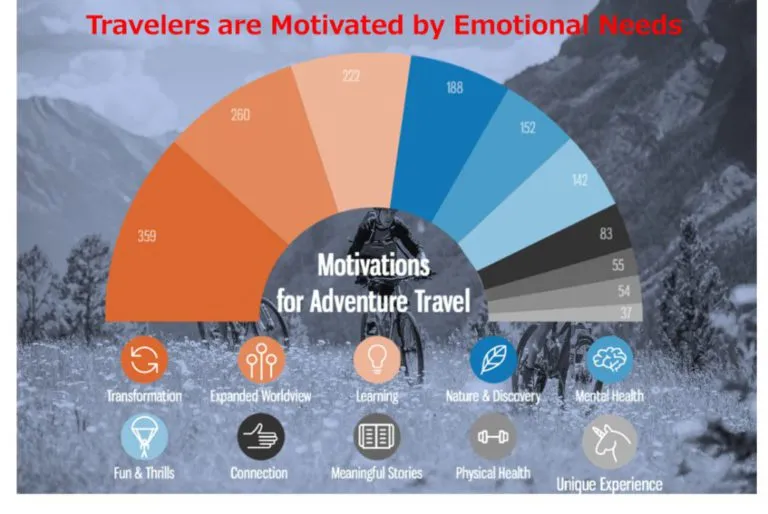
According to an ATTA survey, the top motivation adventure travelers seek from travel is “Transformation,” followed by “Expanded Worldview” and “Learning.” This indicates that AT travelers seek “self-transformation” while broadening their horizons and learning new things through travel.
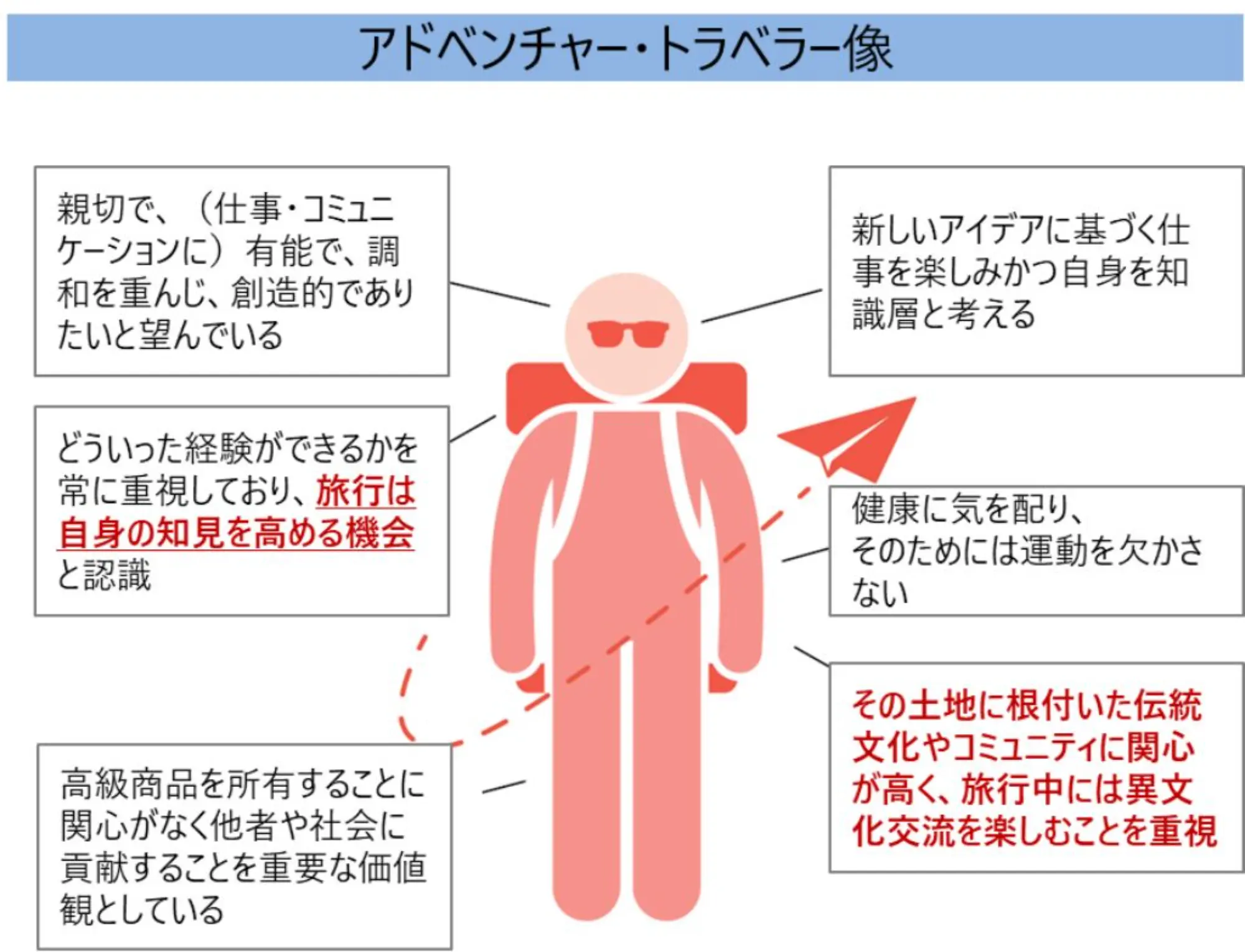
Generally, AT travelers in Europe and the United States tend to be progressive and open-minded, with a high level of awareness regarding health and nature. They can be categorized as the so-called affluent class, consisting of highly educated individuals with high income levels. However, they are not the "Classic Luxury" segment that favors high-end or luxury goods; rather, they are the so-called "Modern Luxury" segment, which values taking on new challenges and finding personal meaning, seeking authentic experiences over mere luxury. This segment is most commonly found among Millennials in their 20s and 30s, as well as the truly digital-native Generation Z.
ATTA has indicated that, within the United States, the AT market is expected to recover sooner than the overall U.S. travel market, and has emphasized that Generation Z, in particular, is crucial to the restructuring of the travel market. Similarly, in Japan, Generation Z is likely to be the key to the revival of the tourism industry, and as a travel style for the “With/After Corona” era, AT is likely to become established in domestic travel as well. While aiming for the eventual revival of inbound tourism to Japan, promoting AT holds significant importance for diversifying domestic travel and enhancing its value.
著者