What is the SDG approach that will drive transformation in the tourism industry?
Recently, we’ve been hearing the term “SDGs” more and more in contexts such as “SDG initiatives” and “contributions to the SDGs.” SDGs stands for “Sustainable Development Goals,” which is translated into Japanese as “Sustainable Development Goals.” To pass on this beautiful Earth to future generations, we now need a new set of principles and guidelines—the SDGs—that have been established on a global scale. It is crucial for the world of tourism to envision the future based on these goals. In this column, I would like to explore why the SDGs are important for tourism by explaining their underlying philosophy and background, as well as how the tourism industry can contribute to them.
Recently, we’ve been hearing the term “SDGs” more and more in phrases like “SDG initiatives” and “contributing to the SDGs.” SDGs stands for “Sustainable Development Goals,” which is translated into Japanese as “Sustainable Development Goals.” Today, in order to pass on this beautiful Earth to the next generation, we need a new way of thinking and a set of rules—the SDGs—that have been established on a global scale. It is also important for the world of tourism to envision the future based on these goals. In this column, I would like to explore why the SDGs are important for tourism by explaining the concept and background of the SDGs, as well as how tourism can contribute to them.
1. The SDGs and the United Nations
The SDGs were unanimously adopted by 196 member states at the United Nations Sustainable Development Summit in September 2015, based on the principle of “No one will be left behind.”" at the United Nations Sustainable Development Summit. The SDGs consist of 17 goals, 169 targets, and 232 indicators. They are development goals that humanity must pursue to solve social challenges—such as social, economic, environmental, cultural, and peace and security issues—that are prevalent across the globe, and they serve as an action plan for people, the planet, and prosperity.In response, each UN specialized agency is promoting new initiatives to achieve the SDGs within its respective field of expertise: UNESCO focuses on education and culture, UNICEF on child development and education, the FAO (Food and Agriculture Organization of the United Nations) on food, and the UNWTO (United Nations World Tourism Organization) on tourism.
I worked at the UNWTO (United Nations World Tourism Organization; hereinafter UNWTO) in Madrid, Spain, from 2014 to 2017.The period from the adoption of the SDGs at the 2015 UN Conference through to the “2017 International Year of Sustainable Tourism” was truly a formative phase in which the relationship between the SDGs and tourism deepened. At that time, Secretary-General Reifai took the lead, and lively discussions took place on how tourism should contribute to the SDGs; the term “SDGs” was on everyone’s lips at the Madrid headquarters.
Three years have passed since then, and today, thanks to the dedicated efforts of international tourism organizations such as UNWTO, the WTTC (World Travel & Tourism Council), and PATA (Pacific Asia Travel Association), the SDGs are gradually becoming a common language in the international tourism arena.
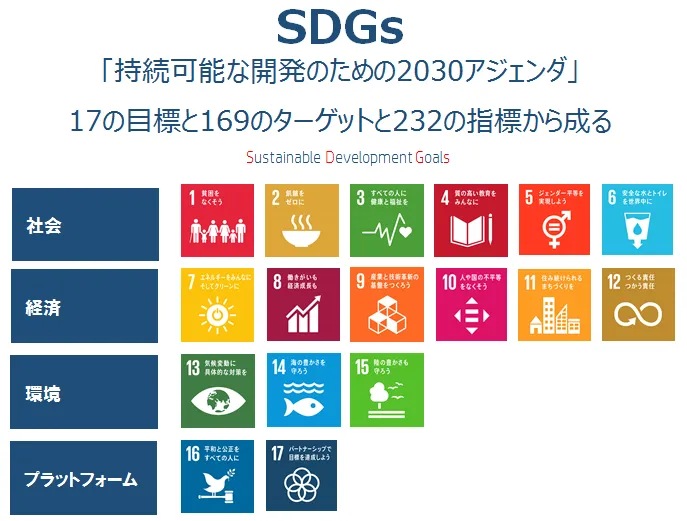
Source: Prepared by JTB Tourism Research & Consulting based on UN materials
2. The SDGs Have Yet to Take Root in the Tourism Industry
So, what is the current state of awareness regarding the SDGs among the tourism industry and those working in the field?
According to the UNWTO, the tourism industry generates 10% of global GDP, and one in ten people worldwide works in the sector, making it an industry with an extremely broad reach. In terms of global export value, the tourism sector ranks third worldwide, following the chemical sector (1st) and the fuel sector (2nd), and surpassing the automotive sector (4th) and agriculture (5th). Surprisingly, the fact that the tourism sector has such a significant ripple effect on the economy is not widely known.
At the May 2018 PATA (Pacific Asia Travel Association) General Assembly, where business leaders and executives from the Asia-Pacific tourism and travel industry gathered, the following took place.The event was held in Gangneung, South Korea—the host city of the curling competition that captivated Japan during the PyeongChang Olympics—and featured former UN Secretary-General Ban Ki-moon as a guest speaker. During the travel committee session, the chair posed a question to the participants:“Please raise your hand if you are familiar with the ‘SDGs 2030—Sustainable Development Goals 2030.’” In response, not many of the participating committee members raised their hands.The chairman acknowledged that he was one of them and continued, “The Sustainable Development Goals are a shared goal and action plan for humanity to pass on the beautiful landscapes of our planet and the culture and heritage inherited from our ancestors to the next generation. We have entered an era where everyone conducting business on this planet is expected to deepen their understanding of these goals and contribute in whatever way they can. Let us at PATA also work to deepen our understanding and awareness of the SDGs going forward.”
Tourism continues to grow while having a significant impact on the global economy, society, and the natural environment. That is precisely why I believe it is crucial for us, as industry professionals, to recognize that our social responsibility is growing and to take action accordingly.
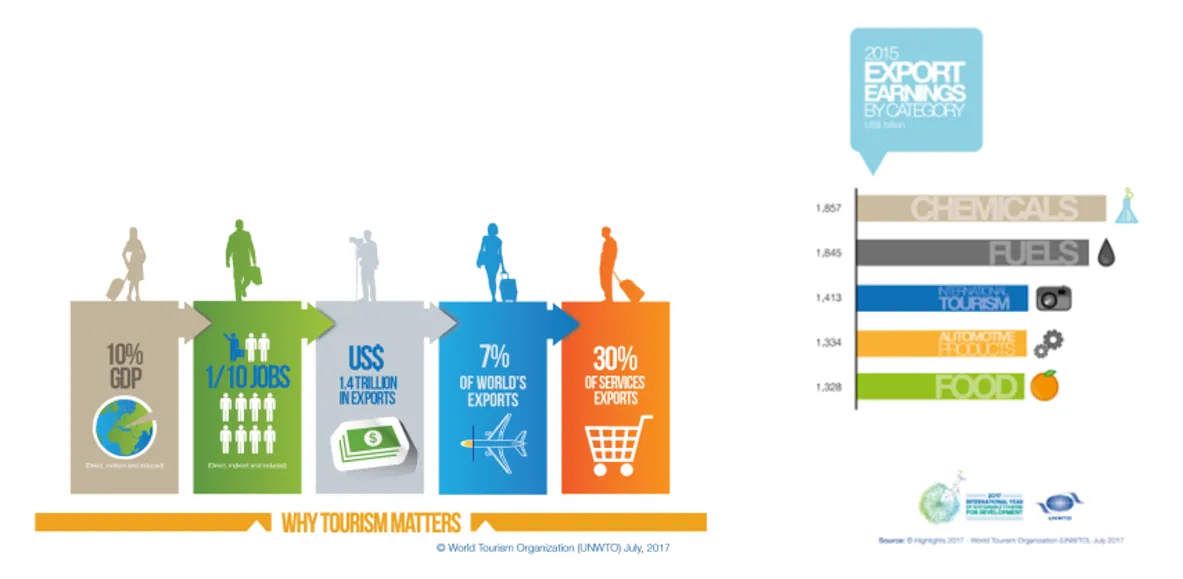
Source: UNWTO
3. Areas of SDG Initiatives the Tourism Industry Should Address and Specific Actions
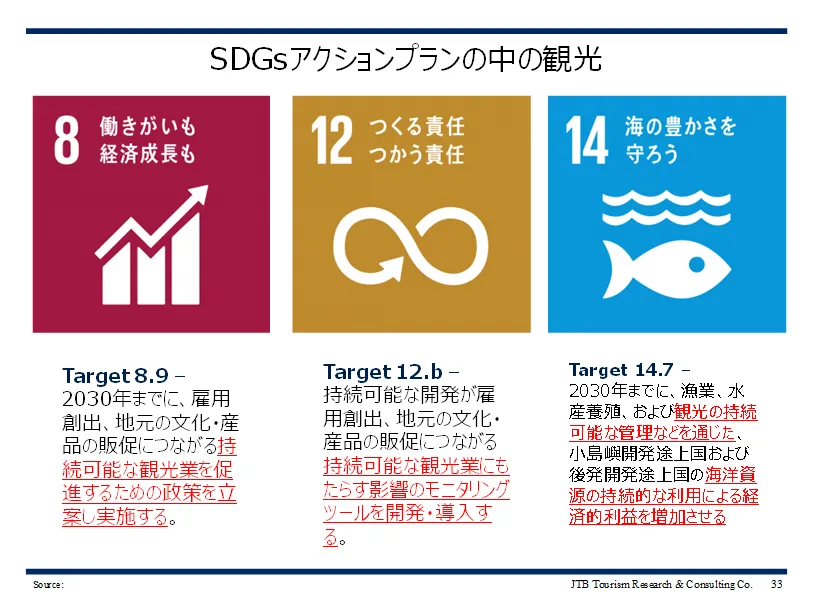
Following extensive discussions, the UNWTO identified three of the 17 SDGs to which the tourism sector contributes: “Goal 8: Decent Work and Economic Growth,” “Goal 12: Responsible Consumption and Production,”and “Goal 14: Life Below Water.” As specific indicators, for Goal 8, it set the objective of “promoting sustainable tourism that supports local communities and economies”; for Goal 12, “developing methods to measure sustainable tourism”; and for Goal 14, “considering how to utilize marine tourism resources in island nations facing the threat of sea-level rise.”
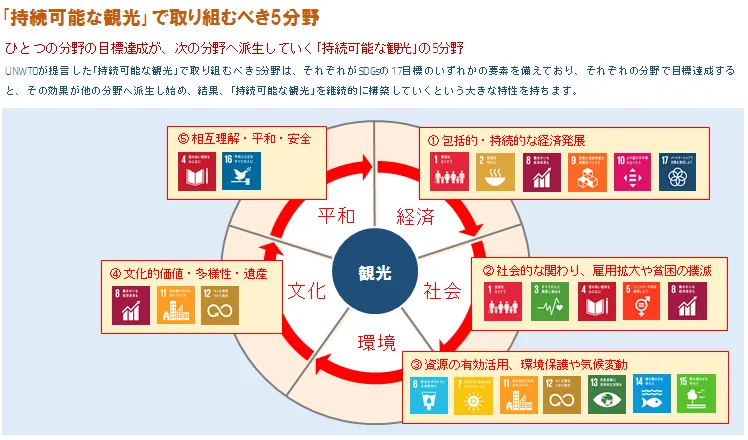
However, Executive Director Reify’s vision did not stop there.“The tourism industry, which operates on a global stage, can contribute to the achievement of all SDG goals. It must contribute.” We believe that tourism can make significant contributions not only in economic terms but also in areas such as society, poverty, nature and the environment, culture and heritage, and the fostering of mutual understanding and peace. During the “International Year of Sustainable Tourism for Development 2017,” we presented the following five areas in which tourism can contribute:
- Inclusive and sustainable economic development
- Social engagement, job creation, and poverty eradication
- Efficient use of resources, environmental protection, and climate change
- Cultural values, diversity, and heritage
- Mutual understanding, peace, and security
: Prepared by JTB Tourism Research & Consulting based on UNWTO materials
4. SDG Initiatives Already Underway at Companies Around the World
SDG initiatives are currently gaining momentum among companies worldwide. Royal Caribbean Cruises has begun notifying its contracted operators—including travel agencies such as JTB—to obtain Global Sustainable Tourism Council (GSTC) certification as part of its efforts to promote sustainable tourism.Since these efforts cannot be undertaken by operators alone, it is necessary to work in step with businesses at tourist destinations, such as hotels, restaurants, and attractions, to advance these initiatives. In response to this trend, some hotels in Europe have begun introducing zero-energy systems.
In Taiwan, hotels are beginning to reevaluate their daily provision of two bottles of PET-bottled mineral water from the perspective of reducing plastic use. In the food sector, the Pacific Asia Travel Association (PATA) is conducting a study on food waste generated by buffet services at hotels in Thailand.Businesses in the food sector are investigating how to improve their practices in accordance with the SDGs, considering not only domestic ingredients but also those produced overseas—including the water and land used, the labor involved, and the petroleum fuel consumed during transportation.
The World Travel & Tourism Council (WTTC) has signed memorandums of understanding with the United Nations Framework Convention on Climate Change (UNFCCC), the UK government, and the World Wide Fund for Nature (WWF), and has established a global working group to explore how the tourism industry can contribute to climate change initiatives and wildlife conservation. It can be said that we have entered a phase where we must also re-examine the nature of tours that involve touching or swimming with dolphins, riding elephants, or holding koalas.We have entered an era where we must consider, for each segment of the value chain—including accommodation, transportation, food, employment, and local communities—what kind of responsible travel services we should promote.
5. Tourism that values local charm contributes significantly to the SDGs
So, are we ready for the SDGs?
Everyone has a beautiful landscape etched in their memory. There is always a favorite dish or a delicious meal you want to share with someone. Everyone feels the desire to share those landscapes and foods, and to pass them on to the next generation.The towns and landscapes that serve as the stage; the sound of a babbling brook, local folk music, birdsong, ridgelines bathed in the morning sun, and the twinkling of stars—these are the sound and lighting effects. And the residents who love the local culture and traditions—the true actors—and pass them on to the next generation. Isn’t tourism, as it should be, an art form in which the people who live there weave the region’s blessings—nature, townscapes, food, and culture—into beautiful stories?
The SDGs serve as a vital compass for passing on the charm of our land (and our planet) to future generations. When tourism aligns with the SDGs and sets its course toward the sustainability of local communities, nations, and the entire planet, the wheels of major transformation begin to turn. Moving forward, as we consider sustainable tourism, I believe we can better contribute to the SDGs by broadly categorizing the various tourism programs currently offered across the country into the following types of tourism.
- Tourism that is accessible to everyone and generates sustainable economic benefits for the entire region
- Tourism that contributes to job creation and poverty reduction
- Tourism grounded in resource conservation and protection that takes the environment and climate change into account
- Tourism that embodies cultural values that recognize the coexistence of tradition, uniqueness, and diversity
- Tourism that contributes to mutual understanding, supporting peace and security
“There are 12 years left until 2030. We are in an era of the ‘Travel Revolution,’ where countries are enthusiastic about inbound tourism. What can we do now to realize a better society through tourism?The SDGs are a reliable companion and compass guiding us in the right direction.” These were the words entrusted to me by Secretary-General Taleb Rifai as I returned to Japan. As I reflect on what I can do in my current role, I look forward to continuing to explore with all of you how tourism can contribute to a sustainable society and how it will contribute to the SDGs.
<Reference>
The 5 Key Areas Identified by UNWTO for the “International Year of Sustainable Tourism”
In conjunction with the 2017 International Year of Sustainable Tourism, led by UNWTO, five key areas were identified where tourism contributes to the SDGs. In addition to the “economic,” “social,” and “environmental” components of the triple bottom line, “culture” and “mutual understanding and peacebuilding” were added as areas where tourism creates value and contributes to the SDGs. The relationship between tourism and each of these areas is defined as follows:
1) Inclusive and sustainable economic growth
Tourism that is accessible to all and generates sustainable economic benefits for the entire region
Goal 1 (No Poverty)
Goal 2 (Zero Hunger)
Goal 8 (Decent Work and Economic Growth)
Goal 9 (Industry, Innovation and Infrastructure)
Goal 10 (Reduced Inequalities)
Goal 17 (Partnerships for the Goals)
2) Social Inclusiveness, Employment, and Poverty Reduction
Tourism that contributes to job creation and poverty reduction
Goal 1 (No Poverty)
Goal 3 (Good Health and Well-being)
Goal 4 (Quality Education)
Goal 5 (Gender Equality)
Goal 8 (Decent Work and Economic Growth)
3) Resource Efficiency, Environmental Protection, and Climate Change
Tourism that takes into account resource conservation and protection with regard to the environment and climate change
Goal 6 (Clean Water and Sanitation)
Goal 7 (Affordable and Clean Energy)
Goal 11 (Sustainable Cities and Communities)
Goal 12 (Responsible Consumption and Production)
Goal 13 (Climate Action)
Goal 14 (Life Below Water)
Goal 15 (Life on Land)
4) Cultural Values, Diversity, and Heritage
Tourism that embodies cultural values that recognize the coexistence of tradition, distinctiveness, and diversity
Goal 8 (Decent Work and Economic Growth)
Goal 11 (Sustainable Cities and Communities)
Goal 12 (Responsible Consumption and Production)
5) Mutual understanding, peace, and security
Tourism that contributes to mutual understanding, which underpins peace and security
Goal 4 (Quality Education for All)
Goal 16 (Peace and Justice for All)