Entrepreneurship and Human Resource Development

Entrepreneurship and human resource development play a crucial role in revitalizing the Japanese economy. This article examines these issues through the lens of labor mobility, challenges facing humanities graduates, the potential of new educational platforms, and the challenges facing Okushiri Island, which is facing increasing depopulation.
In Japan’s stagnant economy, entrepreneurship and human resource development are becoming increasingly important. The government has identified startups as one of its top policy priorities and is aiming to build an ecosystem and establish a platform to foster entrepreneurship. As a professor at Teikyo University who also travels across the country as a regional management consultant, I would like to share my thoughts on entrepreneurship and human resource development.
1. Labor Mobility and Liberal Arts Graduates
It goes without saying that labor mobility toward growth industries is essential to revive the Japanese economy, which is facing declining international competitiveness. To achieve this, we must first re-examine the relationship between the mass hiring of new graduates and the mandatory retirement system—two practices that are inextricably linked as the entry and exit points of the workforce.Given the current situation where the mass hiring of new graduates allows students to enter the workforce without acquiring the skills they should have mastered, and amidst cries of a labor shortage, is it truly appropriate that workers over 60—despite the existence of re-employment systems—are losing opportunities to fully utilize the skills they have accumulated? We have reached a stage where a broad discussion on these issues is necessary.
According to the “Survey and Research on the Current Status and Challenges of Tourism Education at Universities,” a project commissioned to Wakayama University in FY 2021, the employment rate for tourism graduates at 34 universities—divided into tourism business, tourism practice, and comprehensive humanities clusters—was higher than in previous surveys.However, while the tourism industry is hiring talented individuals regardless of their specific specialization, a mismatch is emerging between the industry and universities that are seeking to develop highly specialized talent.
Furthermore, the quality of humanities graduates from Japanese universities must also be considered. As a result of many universities changing thesis writing from a required course to an elective, many humanities students graduate without acquiring the minimum necessary writing skills. In contrast, for science and engineering students, thesis writing is a mandatory requirement for graduation at most universities, ensuring they enter the workforce having acquired a certain level of foundational skills.While the brain drain of science and engineering talent is often cited as a problem, if it is the role of humanities graduates to implement the outputs generated by science and engineering talent into society, it is no exaggeration to say that Japan’s declining competitiveness is also attributable to the education of humanities students at universities.
Now that we have entered the so-called era of universal university admission—where the number of available spots exceeds the number of applicants—universities must not only strengthen their financial foundations but also reaffirm their commitment to providing the kind of education society demands from institutions of higher learning, thereby cultivating talent capable of succeeding in international competition.
Companies, too, might consider raising the bar for new graduate hires to a level where they can compete with mid-career hires. Doing so would compel Japanese students to study earnestly during their university years, just as students abroad do, thereby reducing the burden on companies for training new employees after they join the workforce.If companies shift their hiring criteria to focus on “what specific skills a candidate possesses,” specialized abilities will naturally come under greater scrutiny. To facilitate a smooth transition of labor into growth industries, we must scrap and rebuild the existing system; the time has come to engage not only industry, government, and academia but also the general public in this discussion.
2. ZEN University: A Potential Catalyst for Regional Transformation
ZEN University (tentative name), currently applying for approval to open in April 2025, is being prepared by a general incorporated association established by Dwango Co., Ltd. and The Nippon Foundation.The Kadokawa Dwango Gakuen Educational Corporation operates Japan’s largest high school system, comprising N High School and S High School, with a combined total of 27,712 students (as of the end of December 2023), and provides classes utilizing the internet. Graduates of N/S High School have gone on to attend prestigious universities such as the University of Tokyo, setting them apart from traditional correspondence education.
ZEN University is characterized by its ability to provide practical learning aligned with societal needs—such as the use of cutting-edge ICT tools and data analysis—and by leveraging the advantages of online learning to allow students to attend university lectures without having to leave their local communities.When high school students from areas without local universities pursue higher education, they face not only tuition but also the cost of living expenses sent from home, and it is not uncommon for them to give up on attending college due to their family’s financial situation. However, since ZEN University allows students to attend lectures from anywhere in Japan while staying at home, it helps mitigate disparities in college enrollment rates caused by economic inequality. Furthermore, by setting annual tuition at 380,000 yen, students can cover the full cost of tuition through part-time work.
Another advantage of an online university is the ability to attend classes from locations other than one’s home, allowing students to learn while connecting with society beyond their local communities. For example, by studying during long-term stays in villages where the population has dwindled due to aging demographics, students gain access to a learning environment that directly addresses social issues and provides valuable hands-on learning opportunities. Conversely, by interacting with local residents, students can also contribute to improving the IT literacy of the community.
ZEN University currently consists solely of the Faculty of Intelligent Information Society, aiming to produce highly specialized professionals capable of applying their skills to AI implementation, ICT analysis, and the resolution of social issues. A press release on February 2 announced program partnerships with 21 municipalities nationwide, signaling the development of an environment where students can leverage their expertise to tackle regional challenges.
3. Government-Promoted Startup and Entrepreneur Education
Since 2020, the government has selected eight cities as “Startup Ecosystem Hub Cities,” bringing together resources from universities, local governments, and industry. It is working to foster university-based startups and develop the human resources that form their foundation, thereby promoting the formation of an ecosystem.The number of participating universities has reached 95. Led by these universities, entrepreneurial education is being expanded autonomously and efficiently, and efforts are underway to develop human resources and improve the environment to foster entrepreneurship throughout the country.
University students who have participated in these programs have raised positive requests for future program development, such as “building networks with fellow entrepreneurs and supporting student communities” and “interaction with senior entrepreneurs and alumni.”
Furthermore, the government’s five-year startup development plan states, “Even Japan’s leading electronics and automotive manufacturers began their histories as startups founded by young people in their 20s and 30s immediately after World War II, and subsequently became global companies driving the Japanese economy.”It further states, “Given the current situation where nearly half of university students hope to join a startup, it is important to provide aspiring students with opportunities to receive entrepreneurship education and support from mentors and accelerators.”As part of these efforts, the plan states, “We will establish new support programs for entrepreneurship education targeting elementary, junior high, and high school students by inviting entrepreneurs as guest lecturers, and expand the implementation of entrepreneurship education for these students by utilizing class time allocated for comprehensive learning and other subjects.” Through the EDGE-PRIME Initiative, entrepreneurship education is being provided to elementary, junior high, and high school students nationwide, and a platform for fostering entrepreneurship from elementary school through college is nearing completion.
The concept of entrepreneurship promoted by the government should be understood not merely as starting a business, but as encompassing “a system of actions that uses innovation as a tool to discover opportunities amid change and achieve business success,” as Peter Drucker described. In regional areas suffering from economic stagnation caused by population decline, this has become one of the most critical forms of education.
4. Okushiri High School Entrepreneurship Education
Thirty years after the Hokkaido Southwestern Offshore Earthquake, Okushiri Island faces population decline and a shrinking economic base. Accommodations that once supported tourists and business travelers have closed due to the aging population, and vacant homes and storefronts are now being used as dormitories exclusively for construction workers.The number of restaurants, izakayas, and taxi operators has also declined, and economic activity is stagnant. While increasing the number of visitors is an effective strategy, it is becoming difficult to realize its benefits in the face of the rapid decline in the businesses that support them.
At Okushiri High School, the island’s only high school, all 57 students are carrying out the “Manabijima Okushiri PROJECT,” promoting three initiatives: “Town Revitalization Workshops,” “Scuba Diving,” and the “Okushiri Publicity Headquarters.” The objectives of the Okushiri High School Town Revitalization Workshop for FY 2022 were set as follows:
- To understand the challenges facing Okushiri Island in agriculture, fisheries, industry, and tourism; to devise, propose, and implement solutions; to reflect on the island’s future; and to foster pride in and affection for the island
- To cultivate the problem-solving skills, creativity, and practical abilities necessary for the future through activities that involve identifying “problems without clear answers,” analyzing their causes, and guiding them toward solutions
- To help students appreciate the “significance of contributing to society” and understand the “reality and challenges of the world” through interactions with people working to build society
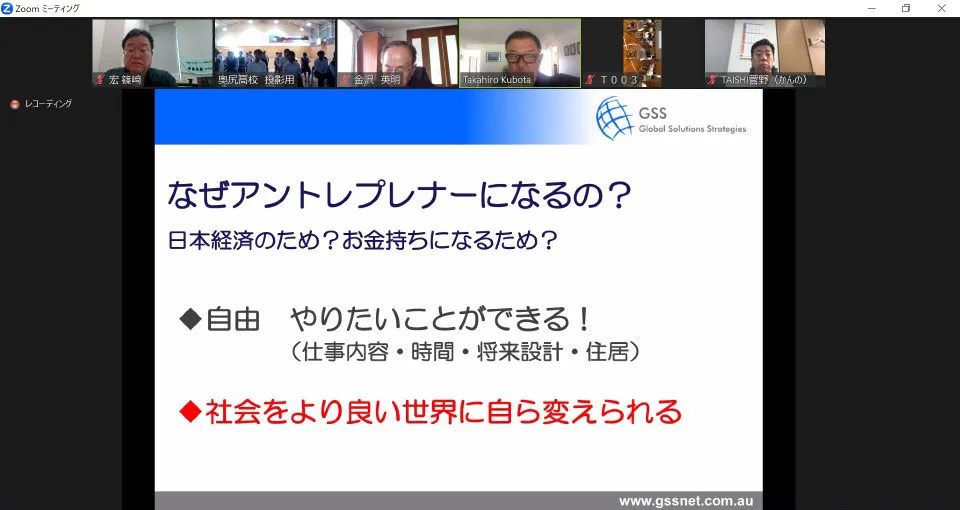
In short, Okushiri High School provides all students with the opportunity to acquire the problem-solving skills required in today’s world by confronting the challenges of Okushiri Island, while also encouraging them to take on new challenges without hesitation.In FY 2023, “entrepreneurship” was added as a new theme. The school invited Mr. Takahiro Kubota, representative of Global Solutions Strategies—a firm that has supported over 900 companies in Australia—as an online lecturer. He conducted lectures and group discussions on “the entrepreneurial spirit necessary for town revitalization workshops” and “strategic approaches for turning ideas into businesses.”At the final presentation session, four out of 14 teams focused on entrepreneurship, presenting business plans such as a frozen food vending machine business, Okushiri deep-sea wine, a souvenir business at Okushiri Airport, and the establishment of a relocation support company.
On remote islands, it is common for residents to leave to pursue higher education or employment, making population decline, in a sense, inevitable. However, while the number of business owners forced to close due to an aging population is increasing, opportunities to enter these vacant market niches are also growing. Okushiri High School’s entrepreneurship education program emphasizes that “even as Okushiri Island faces an aging population and population decline, it represents an opportunity from the perspective of business entry.”The participating students’ motivation was extremely high, and I couldn’t help but sense that some graduates who had left the island would eventually return as entrepreneurs after completing their education or careers. It is precisely in regions like Okushiri Island, where depopulation is progressing rapidly, that entrepreneurship education is most needed. By increasing the number of young people equipped with entrepreneurial skills, regional challenges should be resolved in the medium to long term.
5. Challenges in Tourism Workforce Education
Finally, I would like to touch on the education of tourism professionals.
In April 2023, the “Genghai No. 1,” a large-scale integrated tourism and offshore aquaculture system, opened in Shandong Province, China. This facility features large-scale offshore aquaculture, a fishing pond, dining facilities, lodging, an aquarium, and scientific research facilities, with a diameter of 120 meters and a lodging capacity of 241 people.Japan, which ranks sixth in the world in terms of marine area, has already commercialized large-scale offshore aquaculture, but it lags behind in the commercialization of tourism-integrated projects. When the author asked a major Japanese corporate group engaged in large-scale offshore aquaculture about the potential for developing tourism-integrated projects, the response was that they wish to focus on improving the technology of the large-scale aquaculture facilities themselves.While this is an expected response during the exploratory phase of technological research, there is a need for a scenario that looks beyond this stage to develop into a more profitable tourism-integrated business, as well as the personnel capable of managing it.
As mentioned earlier, if we consider that the role of humanities-oriented professionals is to implement the outputs generated by science and engineering professionals, then the current education programs offered by universities with tourism departments and the Japan Tourism Agency’s tourism workforce training programs are confined within a rigid, narrow definition of tourism and lack the innovative foresight needed to anticipate future trends. Precisely because tourism is a comprehensive industry, perspectives on startup and entrepreneurship education are crucial.Is it not a prerequisite for the tourism industry to become a leading industry in Japan that we cultivate talent with the broad vision to manage industries beyond tourism itself?
著者