Exploring the Potential of Practical Tourism Education

Recently, more and more universities have been actively incorporating more hands-on educational approaches, such as internships and active learning-based classes. What direction will this hands-on education take in the future?
In recent years, many universities have been expanding their educational partnerships with industry in order to incorporate practical education (applied learning) into their curricula, with the aim of producing graduates who are immediately ready for the workforce. A key catalyst for this expansion was the “Project to Support the Development of University Students’ Employability,” which was selected through a public solicitation by the Ministry of Education, Culture, Sports, Science and Technology (MEXT) in 2010. Although the initiative faced criticism at the time for being a “scattergun” budget, it is a fact that the selection of this project led to an increase in the number of universities collaborating with various sectors of industry. Subsequently, in 2012, the universities selected for the project were grouped by regional blocks and the initiative was succeeded by a new program titled the “Project for Improving Education and Establishing Systems to Meet Industry Needs.” Against this backdrop, our company has been pursuing comprehensive partnerships with universities over the past few years, proposing curricula and providing contracted lectures to ensure that students in the tourism field can immediately contribute as valuable assets to the industry. In this column, I will examine the potential for practical tourism education in the tourism sector, taking into account the broader social context.
1. The Current State of the Rapidly Worsening Labor Shortage in the Tourism Industry
In recent years, the tourism industry—which is increasingly viewed as a key driver of regional revitalization—has faced a serious labor shortage, particularly in service sectors such as the lodging and hotel industry and the food and beverage sector.
According to the Ministry of Health, Labour and Welfare’s Survey on General Employment Services, the total number of new job openings in the “Accommodation and Food Service Industries” increased by 1.58 times over the five-year period from 2011 to 2015. Furthermore, the job vacancy rate—including related industries—ranged from 3.26 to 4.37 times, indicating an inability to meet the expanding demand for workers (Figures 1 and 2).Furthermore, the "Survey on Corporate Trends Regarding Labor Shortages" conducted by Teikoku Databank revealed that 57.6% of companies in the inn and hotel industry reported a shortage of full-time employees—an increase of 11.2 percentage points since the previous survey (July of last year)—while 59.4% reported a shortage of non-regular employees, an increase of 11.3 percentage points from the previous survey.These survey results clearly show that labor shortages are accelerating at approximately 60% of companies in both sectors. In particular, the service industry—including ryokan and hotels—has a high proportion of non-regular employees, and there is a tendency for these positions to be avoided.
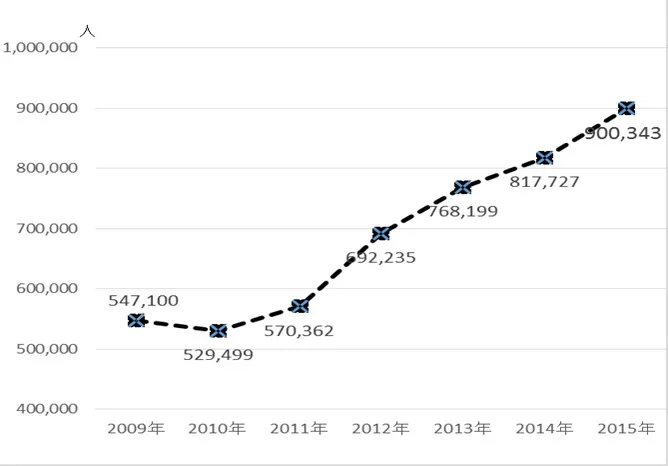
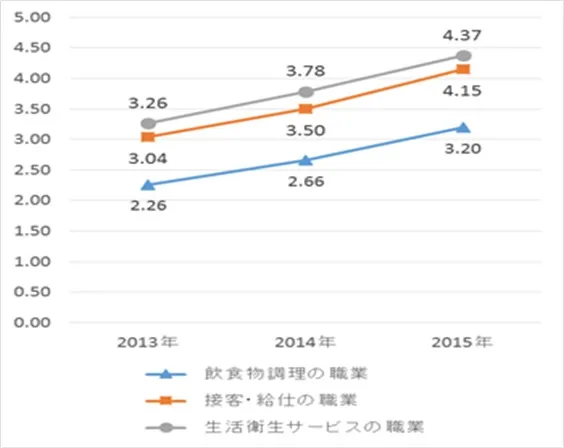
Source: Compiled by JTB Tourism Research & Consulting based on the Ministry of Health, Labour and Welfare’s General Employment Situation Survey Source
: Compiled by JTB Tourism Research & Consulting based on the Ministry of Health, Labour and Welfare’s General Employment Situation Survey (Figures 1 and 2)
2. The Need for Practical Tourism Education: Insights from Internships
Last FY, our group participated in Hyogo Prefecture’s “Project for Securing and Developing Human Resources in the Tourism Industry.” Through site visits and internships at local ryokan (traditional Japanese inns) by local university, junior college, and vocational school students, we sought to identify challenges in business operators’ recruitment activities and derive solutions.
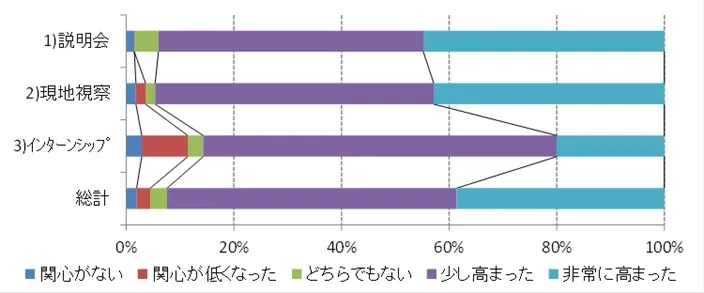
Results from a pre-internship survey of students revealed that positive perceptions of working at a ryokan included “the opportunity to learn about Japanese culture” and “the potential for personal growth through interacting with a diverse range of guests.” However, the survey also showed that negative perceptions—such as “long working hours,” “irregular schedules,” and “difficulty taking time off”—were also prevalent.Furthermore, as shown in Figure 3, after the internship, the percentage of students who reported “no interest” or “decreased interest” increased, while those who reported “significantly increased interest” decreased, resulting in a decline in average interest in employment. However, it is noteworthy that the image of the industry changed for some students due to seminars held before the internship to convey the appeal of ryokan work, as well as their experiences during the internship. Comments included, “My image changed because the relationships among the staff were good,” and “I thought the working hours were long, but since the schedule was mostly fixed, my image changed.”In this way, experiencing the workplace as part of practical education allows students to recognize both the realistic advantages and disadvantages of working at a ryokan. From the perspective of securing stable, long-term employees, internships are considered effective in preventing pre-employment mismatches.
3. What Are the “Professional Universities” and “Professional Junior Colleges” Proposed by the Ministry of Education, Culture, Sports, Science and Technology?
In March 2017, the Cabinet approved the institutionalization of “Professional Universities” and “Professional Junior Colleges.”This system stems from a consultation received by the Minister of Education, Culture, Sports, Science and Technology at the Central Council for Education in April 2015, titled “On the Diversification of Education and Quality Assurance to Unlock Individual Abilities and Potential and Achieve Problem-Solving Through Universal Participation.” Since then, concrete discussions have been held toward the establishment of new higher education institutions offering practical vocational education.If approved by the Diet, “Professional Universities” and “Professional Junior Colleges” will be authorized as higher education institutions. The key points emphasized for these new higher education institutions are as follows:
- Enhancing vocational education by bridging theory and practice
- Appropriately reflecting the needs of industry and local communities, and promoting education through collaboration with industry and local communities
- Addressing diverse learning needs, such as continuing education for working adults
- Ensuring quality assurance and international recognition as higher education institutions, and establishing educational conditions appropriate for practical vocational education
While there has been deep-seated resistance to practical education within universities, once approval for establishment is granted, practical education is expected to expand in the future.
Looking at the curriculum for “Professional Universities” and “Professional Junior Colleges,” 30% to 40% of graduation credits consist of practical training and exercises such as internships. Students are required to complete more than 300 hours of on-the-job training within the industry over two years, and more than 600 hours over four years.The required full-time faculty structure is also quite ambitious, with at least 40% of faculty members having served for five years or more. A key feature of these new universities is that students can earn a bachelor’s degree equivalent to that of a general university or junior college through this educational program.
In Japan, the number of workers in the tertiary sector has consistently increased since the post-war period and now accounts for 70% of the workforce; the tourism industry, with its broad base, is expected to be a major contributor to this sector. A key point in the Central Council for Education’s institutionalization of this system is that, among the examples of personnel required in growth sectors, the council explicitly lists—alongside the IT field—“individuals who excel as customer service professionals in the tourism sector and serve as leaders in improving on-site service.”
We predict that a significant number of vocational schools and universities will apply for accreditation as this new type of higher education institution in the tourism sector. Looking ahead, with a view to establishing comprehensive partnerships with professional universities, professional junior colleges, and universities seeking to incorporate practical tourism education, we aim to develop and provide practical tourism education that will attract more young people to the tourism industry and encourage them to pursue careers in it.
著者