The Appeal of "Esports," Which Has Young People Around the World Enthralled
Young people around the world are currently enthusiastic about “esports.” In Japan, too, its popularity is growing rapidly, and last year it made it into the top ten of the U-CAN New Words and Buzzwords Awards. Esports refers to competitive gaming viewed as a sport, and although tournaments are broadcast online, many young people still come to the venues to watch in person. What is the appeal of making the trip to an esports venue, and who are the people attending? In this article, using the experience of watching esports tournaments as a case study and drawing on survey data, we will examine the psychology of the people who actually attend these events.
1. The World’s Esports Craze
Katowice, a city in southern Poland. This regional city with a population of 300,000 becomes the most watched city by young people around the world once a year in March. That’s when the Intel Extreme Masters World Championship, a global esports tournament, takes place. Intel Extreme Masters (hereinafter IEM) is an international esports tournament that began in 2007, and the finals to determine the annual champion have been held in Katowice since 2014.
According to an announcement by ESL Gaming, the "Counter-Strike: Global Offensive" matches at IEM Katowice 2019, held in March 2019, were viewed by approximately 195 million people worldwide, with a total viewing time exceeding 126 million hours. Furthermore, combined with the adjacent IEM EXPO, the number of actual venue attendees exceeded 174,000 during the event, making it the world’s largest esports trade show (Note 1). Even though this is a tournament where spectators watch footage of players on a giant screen—unlike traditional sports like baseball or soccer where players run around the field—such a large number of people still come to the venue to watch.
In Japan, where interest is just beginning to take hold, this may be difficult for many people to understand, but globally, esports is already developing a cool image, and young people are increasingly citing professional esports players as their dream career. Globally, esports is establishing a status comparable to that of extreme sports, such as skateboarding and surfing. In South Korea, often cited as a leader in esports, top players’ annual salaries are now exceeding those of traditional athletes, and each professional player has a large fan base, receiving treatment on par with celebrities and singers.
2. Esports in Japan
So, what is the current state of esports in Japan? According to Gz Brain, the number of esports fans in Japan (those who have watched matches or viewed videos) was 2.3 million in 2017, but increased to 3.83 million the following year in 2018, and is projected to expand to 7.86 million by 2022.Furthermore, the domestic market size (including broadcasting rights, sponsorships, tickets, in-game purchases, prize money, merchandise, and copyright licensing) was a mere 370 million yen in 2017, but it is estimated to continue expanding to 4.83 billion yen in 2018 and 9.94 billion yen by 2022 (Note 2).Considering that the term “esports,” which was relatively unknown until two years ago, has gained recognition through increased media coverage of various events—such as the launch of the Japan Esports Federation in 2018, the Ibaraki National Sports Festival, and the Asian Games—it is likely that the growth rate will accelerate even further. Incidentally, the esports industry refers to 2018 as the “Year One of Esports.”
Now, looking at these fan numbers and market size, I imagine a question might come to mind for many of you. That is, “Isn’t the market size too small relative to the number of esports fans?” Despite there being 3.83 million esports fans as of 2018, a market size of 4.83 billion yen feels far too small. This disparity between fan numbers and market size indicates that domestic sports fans are shifting their attention to overseas content. In a world where the internet makes it easy to connect with the globe, Japanese youth are also becoming passionate about global tournaments like the Intel Extreme Masters World Championship, which I mentioned at the beginning. In fact, among the Japanese esports players I interviewed previously, some said, “I wanted to watch overseas esports matches, so I studied just enough English to get by.” If we can capture this demographic that has been flowing overseas, we can further accelerate the growth of the domestic market. Since this is a growing market, many companies are still exploring how to get involved, but I believe it would be best if we could collaborate with the shared goal of first energizing the domestic market.
3. The Appeal of Watching Esports
As mentioned in the previous chapter, while it is understandable that esports is a hot topic domestically, I believe many people who have never watched a match do not fully grasp why it is so appealing. To understand the preferences of those currently attending esports tournaments among the rapidly growing fan base, our company conducted an online survey in March 2019 targeting individuals aged 15 to 59.
(1) Percentage of People Who Have Attended Esports Tournaments in Person and Their Reasons for Attending
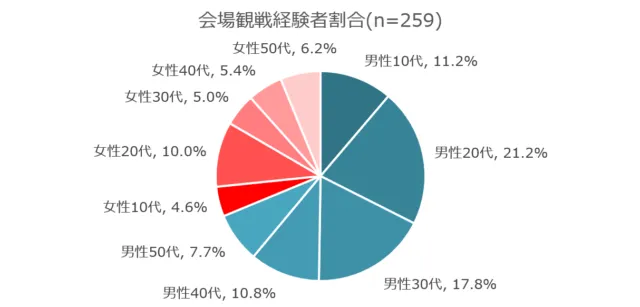
We surveyed 10,000 people, proportional to the population by age group. Of these, 259 respondents reported having attended an esports tournament in person, and the gender breakdown of these attendees is shown in Figure 1. Currently, men account for two-thirds of all attendees at esports tournaments, and the combined total of men in their teens, 20s, and 30s exceeds half of all attendees. On the other hand, while the largest group of female attendees is in their 20s, they are followed by those in their 50s and 40s, suggesting that many are accompanying their children who wish to watch the event. It is worth noting that the generation up to their early 30s today can be described as “digital natives,” a group that has been familiar with competitive online games since childhood.
Furthermore, in the “Survey on Smartphone Usage and Travel Expenditures” conducted by our company in FY 2023, interest in esports was highest among men aged 29 and under: 14.6% had played esports, 26.2% had watched matches (including online), and 39.8% intended to watch in the future. This clearly indicates that the trend is being driven by the younger generation of men.
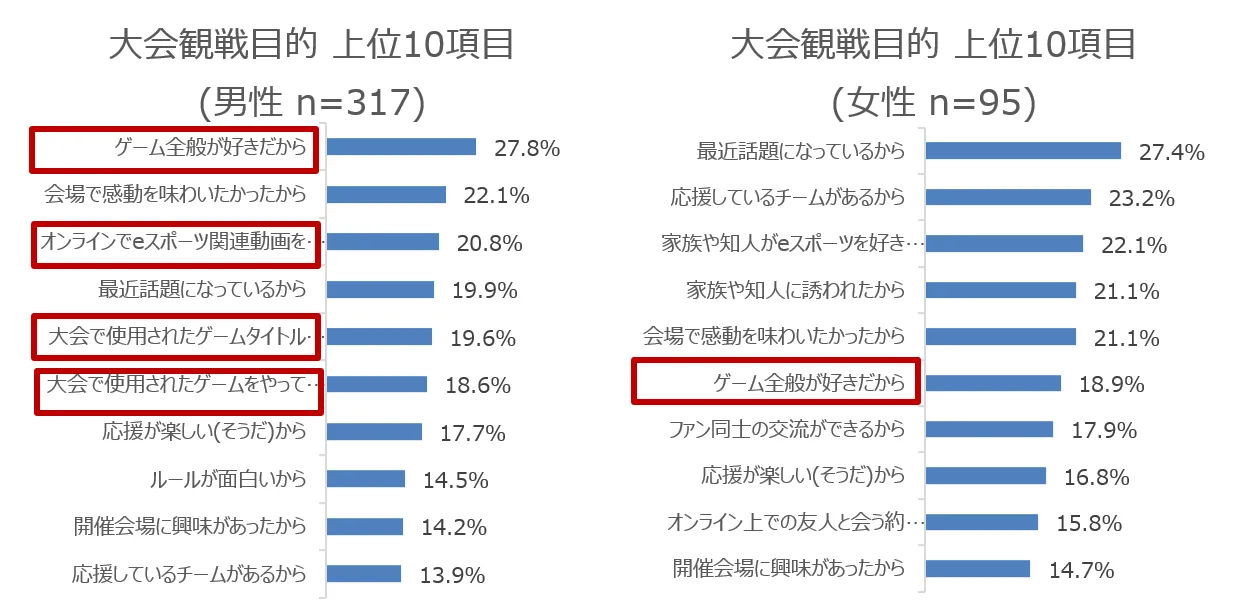
Next, when examining the purposes for attending esports tournaments in person (Figure 2) by gender, we see that for men, interest in the games themselves ranks highest, indicating that the core audience consists of fans who are already familiar with the games. On the other hand, when looking at women’s purposes, non-game-related items such as cheering at the venue and interacting with other fans rank highest. Additionally, items such as “because my family or friends like esports” and “because I was invited by family or friends” rank high among women, suggesting that a significant portion of attendees are accompanying family members or friends who are interested in esports but are not fans themselves.
(2) Satisfaction with Watching Esports Tournaments and Intent to Return
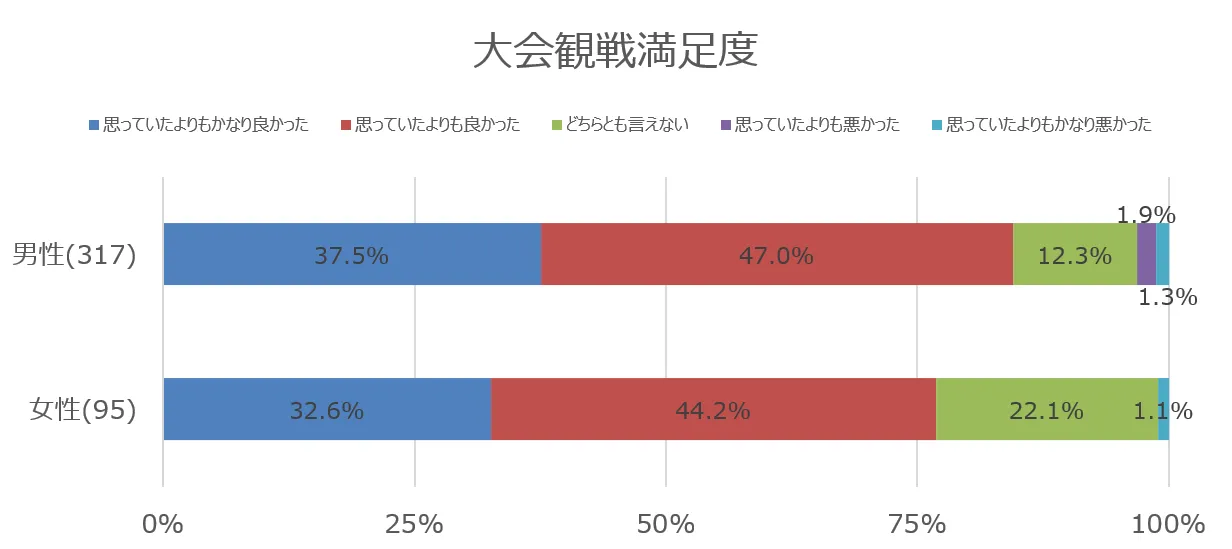
When asked how their satisfaction with watching the tournament (Figure 3) compared to their expectations before attending, the combined percentage of those who rated it as “much better than expected” or “better than expected” was very high at 84.5% for men and 76.8% for women. In particular, over 30% of both men and women selected “much better than expected,” indicating that for many attendees, esports tournaments were more enjoyable than anticipated.
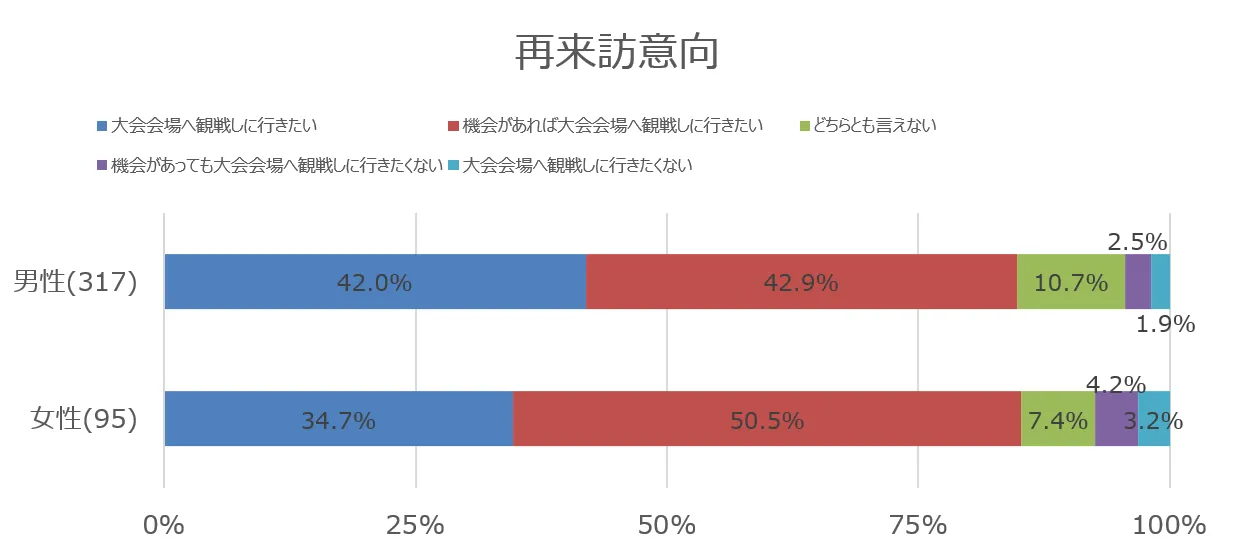
Furthermore, in response to the question of whether they would like to attend again, the combined percentage of those who answered “I want to go to the tournament venue to watch” and “I would like to go to the tournament venue to watch if I had the opportunity” exceeded 80% for both men (84.9%) and women (85.2%). This indicates that even among those who previously had no interest in esports or gaming, attending a single event makes them want to go again.
4. Summary
As of 2019, the most common reason for watching esports in Japan was “because I like games in general.” Looking at this response, it might seem as though esports is something only game enthusiasts can get excited about. However, I believe the true reason behind this esports boom lies in its strong ability to draw in people who happened to attend by chance. Among the responses to this survey were comments such as: “I used to think it was just a game, but seeing it live at the venue, the sense of realism, the players’ skill, and the excitement really got me pumped up” (female in her 20s),“My child wanted to go, so I took them, but my perspective changed completely” (male in his 40s), and “I got more excited than I expected—I found myself cheering along—and had a great time from start to finish” (female in her 40s). These responses reveal that a single viewing experience has caused people who previously had little interest in games to drastically change their view of esports. While the debate over whether “esports is a sport” continues, when viewed from the perspective of spectating, the excitement and sense of immersion at the venue are identical to those of traditional sports. I believe the number of people who continue to attend matches is growing because they seek the sense of unity that comes from cheering on the players together with the crowd. Although the field is still in its infancy, it is likely to gain even more momentum through word of mouth from those who have attended matches, and the number of people in Japan who say, “I don’t play games, but I have an esports player I support,” is sure to increase.
5. Conclusion
The year 2019, which marked the start of the Reiwa era, saw 41 years since the release of “Space Invaders” (1978) and 36 years since the release of the “Family Computer” (1983). The generation that was once passionate about video games has now become parents, and I imagine many have drifted away from gaming. In the survey mentioned in the previous chapter, a man in his 40s who selected “I want to go to a tournament venue to watch” cited “I want to show my children a new era” as his reason. While attending a match for the first time may seem daunting, I believe that once you actually visit the venue, you’ll be able to experience this new era.
Sources
: (Note 1) ESL Gaming, The Katowice Recap;
(Note 2) Gz Brain, News: “The 2018 Japanese esports market is estimated at 4.83 billion yen. Rapid growth, 13 times that of the previous year.”