"The G7 Summit in Japan: Insights on Raising Awareness and Promoting the Hosting of International Conferences"
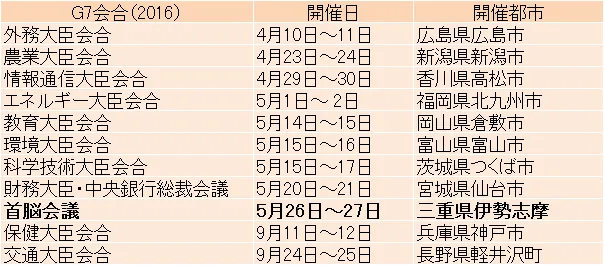
The G7 Summit, the first in eight years since 2008, will begin with a meeting of foreign ministers in Hiroshima on April 11 and 12, 2016. Following the leaders’ summit in Ise-Shima on May 26 and 27, a series of meetings will be held in various locations, including a meeting of health ministers in Kobe on September 11 and 12, and a meeting of transport ministers in Karuizawa on September 24 and 25.The G7 Summit, known as the “Summit of Leaders of Major Nations,” is a meeting of heads of state and government from seven countries—Japan, the United States, the United Kingdom, France, Germany, Italy, and Canada—as well as the President of the European Council and the President of the European Commission. I would like to examine the promotion and awareness-raising efforts in regions hosting summits and international conferences through the relationship between ministerial meetings and their host cities, the initiatives undertaken by host cities since their selection, and outreach and awareness campaigns targeting residents and citizens.
One of the reasons for selecting a host city for an international conference is "Why"
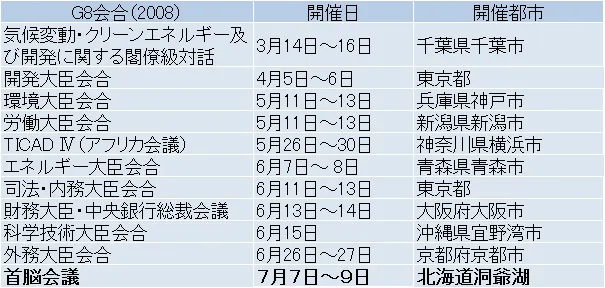
In 2008, the G8 Summit and related meetings were held in 10 cities across Japan (11 meetings).Of these, two cities—Kobe and Niigata—also served as host cities in 2016 (Kobe: 2008 Environment Ministers’ Meeting, 2016 Health Ministers’ Meeting; Niigata: 2008 Labor Ministers’ Meeting, 2016 Agriculture Ministers’ Meeting), making them consecutive venues for ministerial meetings. Furthermore, while the previous summit (2008) featured ministerial meetings on justice and home affairs, labor, development, climate change, and TICAD IV (the Tokyo International Conference on African Development), these meetings were not held this time (2016). Instead, ministerial meetings on education, transport, agriculture, information and communications, and health were scheduled.
There are examples suggesting a close relationship between the vision for the city pursued by the host municipality and the themes of the ministerial meetings at the summit. For instance, Niigata has been designated as an agricultural special zone under the National Strategic Special Zones initiative. Toyama City has become an environmental model city with the goal of realizing a low-carbon society. Kitakyushu City is promoting energy conservation and new energy sources from the perspective of combating global warming, as symbolized by its Next-Generation Energy Park. Tsukuba City is a science and technology city that hosted the “Tsukuba ’85 International Science and Technology Exposition” in 1985. While Kobe City hosted the previous Ministerial Meeting on the Environment, regarding this year’s Ministerial Meeting on Health, the city is currently utilizing its National Strategic Special Zone status to develop regenerative medicine and the Kobe Medical Industry City.
When hosting international conferences, the “why”—the reason for selecting a particular city as the venue—is often questioned. It is important that the city’s vision and regional characteristics align with the conference’s purpose, and that it is a place that inspires participants to attend.
Junior Summit for Junior High and High School Students Held as a Side Event to the Summit
The Ministry of Foreign Affairs held the “2016 Junior Summit in Mie” from Friday, April 22, to Thursday, April 28, immediately prior to the G7 Summit, with Kuwana City in Mie Prefecture serving as the main venue. Two male and two female students aged 15 to 18, selected from G7 member countries, participated and exchanged views on related topics under the main theme of “A Planet for the Next Generation: Environment and a Sustainable Society.”
The youth summit for junior high and high school students began with the 2005 G8 Gleneagles Summit (UK). National teams discuss agenda items related to the leaders’ summit and draft an outcome document. Although the event was suspended after 2009, it was resumed for the 2015 G7 Elmau Summit (Germany), with a team from Japan also participating. It was decided that the event would also be held prior to the 2016 Ise-Shima Summit, organized by the Ministry of Foreign Affairs. It took place at several locations within Mie Prefecture, including Kuwana City.
During the Foreign Ministers’ Meeting held in Hiroshima on April 10–11, the “G7 Hiroshima Foreign Ministers’ Meeting Pre-Event: Hiroshima Forum for Former Youth Special Envoys for a Nuclear-Free World—What Young People Can Do Now to Realize a World Without Nuclear Weapons” was held in Hiroshima City. On April 9, 2013, in The Hague, the Ministry announced the launch of the “Special Envoys for a Nuclear-Free World” program, and to date, a total of 13 appointments have been made, involving 107 individuals.
Examples of Initiatives to Promote the G7 Summit in Sendai
What kinds of side events are being held at ministerial meetings in various locations? For example, in Sendai City, where the G7 Finance Ministers and Central Bank Governors Meeting was held in May, the following events were organized.
- December 1, 2015 (Tue) – May 20, 2016 (Fri) G7-Related Panel Exhibition
To commemorate the meeting, a traveling panel exhibition was held at various City Hall branch offices, introducing the meeting’s overview, the significance of holding it in Sendai, profiles of participating countries, and details of reconstruction support provided to Sendai and Tohoku by each country following the earthquake. Target Audience: Citizens visiting City Hall branch offices, etc. - Friday, January 22: Café Summit “Deepening Our Understanding of Summit Participating Countries”
An event featuring talks and networking with foreign residents in Sendai from the six summit participating countries (Canada, France, Germany, Italy, the United Kingdom, and the United States), excluding Japan. Target Audience: Sendai citizens - February 9 (Tue): Commemorative Event Marking 100 Days Before the G7
Summit On February 9, exactly 100 days before the G7 Summit, a commemorative event will be held to examine the significance of the G7 and the impact the summit will have on Sendai. The event will feature a keynote speech by a representative from the Ministry of Finance, as well as a panel discussion with local residents and experts. Target Audience: Sendai residents - April 2 (Sat) – 3 (Sun): G7 Zoo Stamp Rally & Panel Exhibition
A stamp rally featuring animals associated with G7 member countries at the local Yagiyama Zoo, along with a panel exhibition introducing the summit’s overview. Participants who collect stamps from designated animals and other items will receive a commemorative gift. Target audience: Sendai residents (apparently aimed particularly at schoolchildren) - April 15 (Fri) – May 21 (Sat): G7 Library Fair.
Libraries throughout Sendai will display books and panels related to the G7. Target audience: Sendai residents - April 20 (Wed) G7 Talk: “Reflecting on ‘Omotenashi’ with Participants from Summit Countries”
One month before the summit, participants from the host countries will discuss the appeal of Sendai and Tohoku from a foreigner’s perspective, as well as the hospitality they have experienced in Japan, to deepen understanding of each country. Target audience: Sendai residents - April 23 (Tue) Commemorative Event Marking One Month Before the G7 Summit:
Keynote speeches titled “Challenges Facing the International Financial Economy and Future Prospects” by Professor Kazushige Ito of the University of Tokyo, and “The Status of Local Companies’ Overseas Expansion and Future Possibilities” by an executive from the local financial institution, The 77 Bank. Target Audience: Sendai Residents - Lecture by Yozo Tachibana, President of the Rakuten Eagles: “Soar into the World! High School Students.”
This event invites thepresident of the local Rakuten baseball team to share stories about interacting with people from around the world and his work experiences, inviting participants to reflect together on the importance of engaging with the global community and the connections between the local region and the world. Target Audience: High School Students
In summary, through these eight major events, Sendai City is working to promote an understanding of the significance of hosting the G7 Summit and the Summit itself among its citizens. This is achieved by providing information on the member nations through panels and books, as well as by organizing active initiatives such as panel discussions and lectures. Although the target audience is Sendai citizens, the city is making significant efforts to raise public awareness, such as holding lectures specifically for high school students led by representatives of the local baseball team to appeal to younger audiences, and organizing events at the zoo designed to be game-like and engaging for schoolchildren.
Examples from Other Cities
In Niigata City, where the G7 Agriculture Ministers’ Meeting was held, a commemorative symposium and food exchange event were held on Sunday, January 24. The event featured lectures and served dishes inspired by the G7 member countries, offering content that encouraged reflection on food, agriculture, and the future. Additionally, the national flowers of participating countries were introduced on a weekly rotation, and Japanese culinary culture and local products from Niigata City were showcased.
In Takamatsu City, which hosted the G7 ICT Ministers’ Meeting, the city organized an exhibition and events showcasing cutting-edge ICT technologies, introduced free Wi-Fi spots available within Kagawa Prefecture, conducted press tours, and held the G7 Student ICT Summit. Ten students from eight countries—the G7 nations plus Sweden, an EU member state—participated in the summit. In addition, the “ICT Citizen Experience Day in Takamatsu Central Shopping District” was held in the city’s shopping district. In line with the theme of the ICT Ministerial Meeting, activities were organized where participants used their smartphones to visit checkpoints within the shopping district and collect characters.
To Promote Understanding of Hosting International Conferences
In recent years, many cities have been actively working to promote understanding of and attract international conferences and MICE events. It is encouraging to see progress in developing the necessary infrastructure—such as physical facilities, multilingual signage, and other soft infrastructure—to create a welcoming environment. Traditionally, the organizing side—including local governments and convention bureaus—has focused on approaching the organizing bodies of MICE events and on activities designed to provide convenience and various services to participants. However, they have not placed much emphasis on promoting understanding among the general public and relevant organizations. Of course, some explanation regarding economic benefits and tourism impacts is provided, but this tends to be a one-way, push-type approach to awareness-raising. Unless it directly affects them, citizens are unlikely to take an interest in the hosting of international conferences. Furthermore, the citizenry consists not only of adults but also of children and students who will shape the future. It is important to employ methods that capture the interest of these groups to foster their understanding.
In many cities, the G7 Summit provides an opportunity to promote the host city to the six participating nations plus the EU and the media through food, traditions, and culture. However, it is equally essential to secure the understanding and cooperation of local stakeholders and citizens. Depending on the meeting, events may be held on weekdays, and since venues are often located in downtown areas, there will be significant traffic restrictions. Therefore, the understanding and cooperation of citizens are of the utmost importance. Not limited to the G7 Summit, I hope that efforts will go beyond simply requesting one-sided cooperation to attract and host MICE events. Instead, I expect that, starting a certain period before the event, efforts will be made to promote and generate follow-up interest through various events, while also seizing various opportunities to advance the development of the necessary infrastructure.
<References>
Ministry of Foreign Affairs
: Basic Q&A on the Summit Ministry of Foreign Affairs
: Official Website of the G7 Ise-Shima Summit Ministry of Foreign Affairs
: 2016 Junior Summit in Mie Ministry of Foreign Affairs
: Youth Special Envoys for a Nuclear-Free World 2016 G7 Sendai Finance Ministers and Central Bank Governors Meeting Promotion and Cooperation Committee Official Website
of the
G7 Niigata Agriculture Ministers’ Meeting Special Website for the G7 Kagawa-Takamatsu Information and Communications Ministers’ Meeting