The Growing Potential of MICE
While the MICE policies of the national government and JNTO have tended to focus on international conferences, there has recently been a growing emphasis on the importance and potential of M, I, and E in particular.In particular, since “corporations” are the central drivers of the M and I sectors and obtaining relevant information has been extremely difficult, there have been no quantifiable data available—but the Japan Tourism Agency is now taking on this major challenge.
In April of this year, the Japan Tourism Agency announced estimates stating that “the economic ripple effect of international conferences held in Japan amounted to 5,905億円, with 54,000人分の employment created and tax revenue of 455億円.”(Source: FY Heisei 28 Report on the Economic Ripple Effects and Market Research of MICE). Calculating the economic ripple effects of MICE events such as this one involves summing the “participant spending”—the amount spent by each “participant”—and“event expenses” incurred by “organizers” to host the MICE event, and—in the case of E (Exhibition), for example—“exhibitor expenses” for each booth, are added together and estimated using an input-output table.Although this announcement focused solely on international conferences, estimates of economic ripple effects are scheduled to be conducted in the future for “I (Incentive)” and “E (Exhibition)” as well, following the “C (Convention)” category.
While government and JNTO policies have traditionally tended to focus on international conferences, the importance and potential of M, I, and E have recently been highlighted more prominently.In particular, since “corporations” are the central players in M and I, and obtaining relevant information is extremely difficult, attempts to calculate their economic ripple effects have been made several times in various quarters but have not been successful, and no quantified data currently exists. In that sense, the Japan Tourism Agency’s future efforts are expected to pose a major challenge.
By the way, while many of you have likely heard the term “MICE” numerous times, how many of you can actually visualize what it means? MICE is an acronym formed from the initials of M (Meeting), I (Incentive), C (Convention), and E (Exhibition/Event), and the term itself has no inherent meaning.Furthermore, M, I, C, and E each differ in purpose, format, scale, and content; as information developed as part of business operations, it can be difficult for those outside the industry to fully grasp or understand.“MICE” is essentially “industry jargon” in the tourism sector—said to have been first used by the Singapore Tourism Board in the early 1990s—but its actual nature is quite difficult to visualize. This stands in stark contrast to “inbound tourism,” a term that has rapidly gained widespread public recognition in recent years as a way to describe “foreign travel to Japan.”In fact, MICE-related keywords account for a very large portion of the search terms on our company’s website.
In this column, to help readers visualize MICE more concretely, I’d like to return to the basics and examine the topic from the following perspectives: 1. The basic structure of MICE; 2. The objectives of MICE—“business expansion” and “value sharing”; and 3. The MICE supply chain and its economic ripple effects.
1. The Basic Structure of MICE
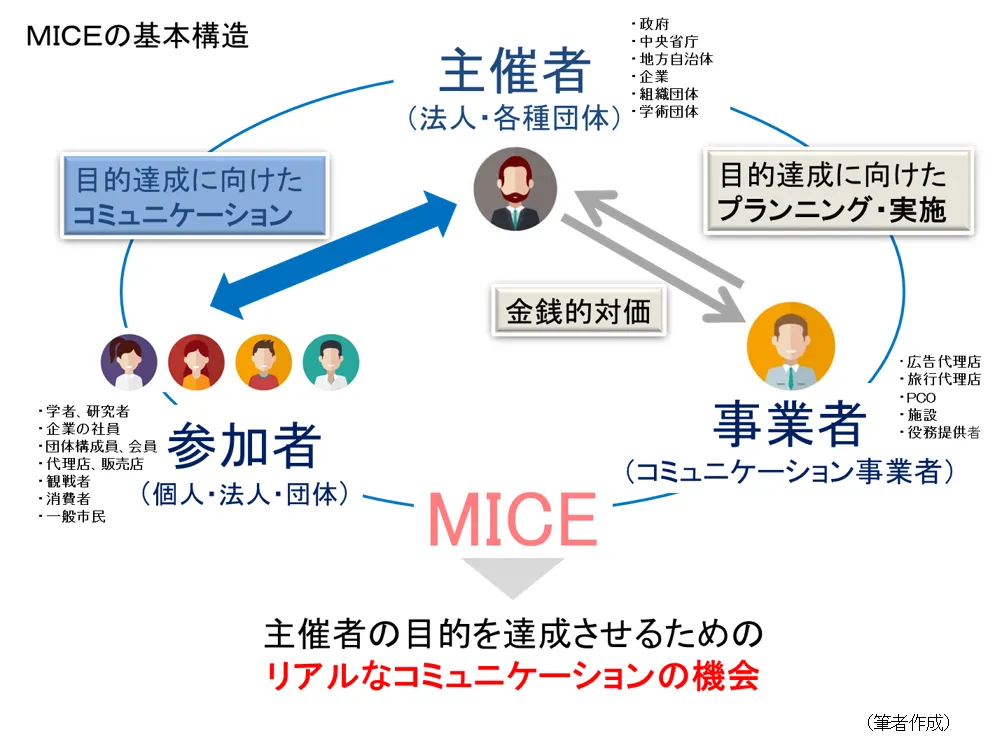
To understand MICE, let’s first consider the basic structure common to all MICE events. The three key parties involved in MICE are the “organizer,” the “participant,” and the “service provider.”“Organizers” are the entities that host conferences and events—such as companies, academic institutions, and industry associations. The employees or members of these organizations who attend are the “participants,” and those who plan and manage MICE events as part of their work are the “service providers.”
So, why do “organizers” hold MICE events in the first place?
Organizers have values—such as insights, information, technology, and aspirations—that they wish to share with participants, and they utilize MICE as a platform to convey these directly.With the cooperation of service providers, MICE events are planned and executed; if the message is effectively conveyed to participants, the event is considered a “success” for the organizer, and the service providers receive compensation. It is crucial that MICE creates a “win-win-win” relationship for all three parties.
2. The Objectives of MICE: “Business Expansion” and “Sharing Value”
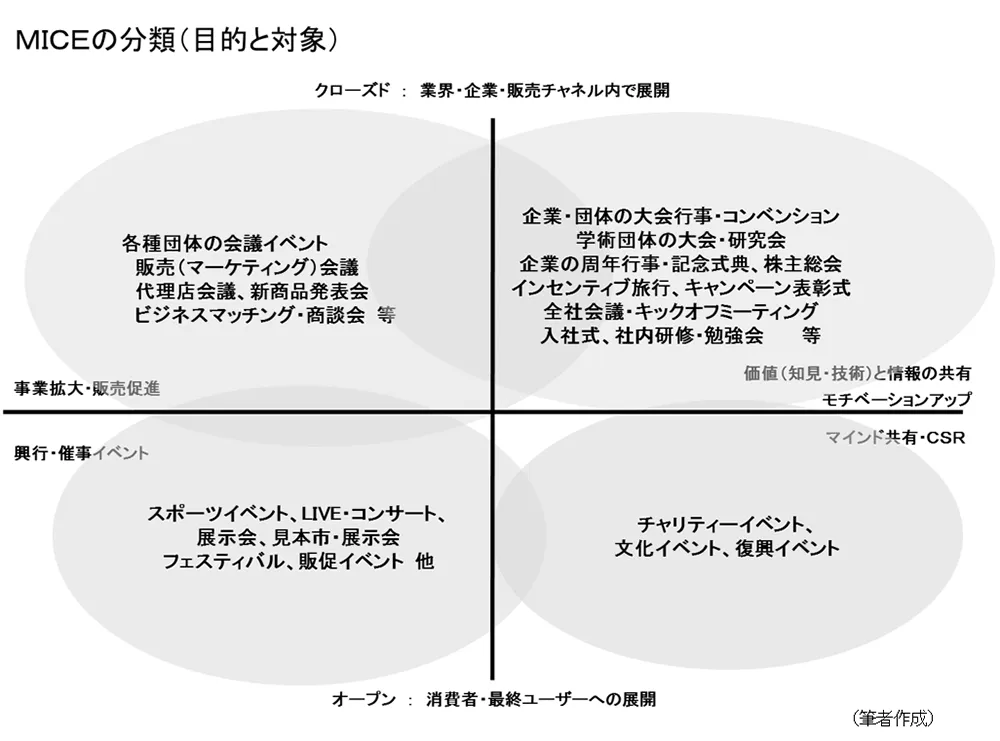
Next, I would like to consider the purposes for which “organizers” hold MICE events and the nature of their “participants.” Broadly speaking, I believe the organizers’ purposes for holding MICE events can be broadly categorized into “business expansion” and “value sharing.”The former aims to generate direct revenue, with MICE events centered on themes such as “marketing” and “advertising and sales promotion” serving as prime examples. The latter includes MICE events held for purposes such as “academic conferences for sharing knowledge and technology,” “organizational strengthening,” “branding,” and “social contribution.”There are also quite a few cases where an event serves both purposes. The “participants” targeted by these MICE events are classified as “Closed” or “Open,” depending on whether participation is generally open to the public.“Closed” events are limited to stakeholders and related parties within the company’s own network—such as employees, members, and sales agents—while “Open” events are aimed at general consumers and end users.When considered by MICE format, M (Meetings), I (Incentives), and C (Conventions) are often held as “Closed” events, while among the E categories, Events are typically held as “Open” events, and Exhibitions are generally held as “Open” events within the relevant industry.However, there are cases—such as when an international conference, which is typically held as a “Closed” event among industry stakeholders, includes “Open” components such as exhibitions or lectures and events for the general public as part of its program. Such arrangements are considered a factor contributing to the complexity of MICE. From the perspectives outlined above, MICE can generally be classified as shown in the figure below.
3. The MICE Supply Chain and Economic Ripple Effects
Finally, let’s consider the “breadth of the supply chain,” which is one of the major characteristics of MICE. The larger the MICE event, the more time and effort are required for preparation, and the greater the number of businesses and industries involved.From the planning stage through implementation—that is, beginning with venue setup and construction, through production elements such as sound and lighting, the procurement of necessary equipment and supplies, the printing of various materials and editing of recording media, to on-site security, crowd control, and the deployment of operational staff on the day of the event, as well as participants’ transportation, lodging,meals, and site visits—as well as the development of dedicated systems and web interfaces for participant registration—it is essential to fully leverage the specialized expertise of businesses across a wide range of fields and pool our efforts toward the common goal of “event success.”For your reference, examples of MICE-related businesses are listed below. As you can see, the MICE supply chain is diverse and extensive, and as a result, it generates significant economic ripple effects.
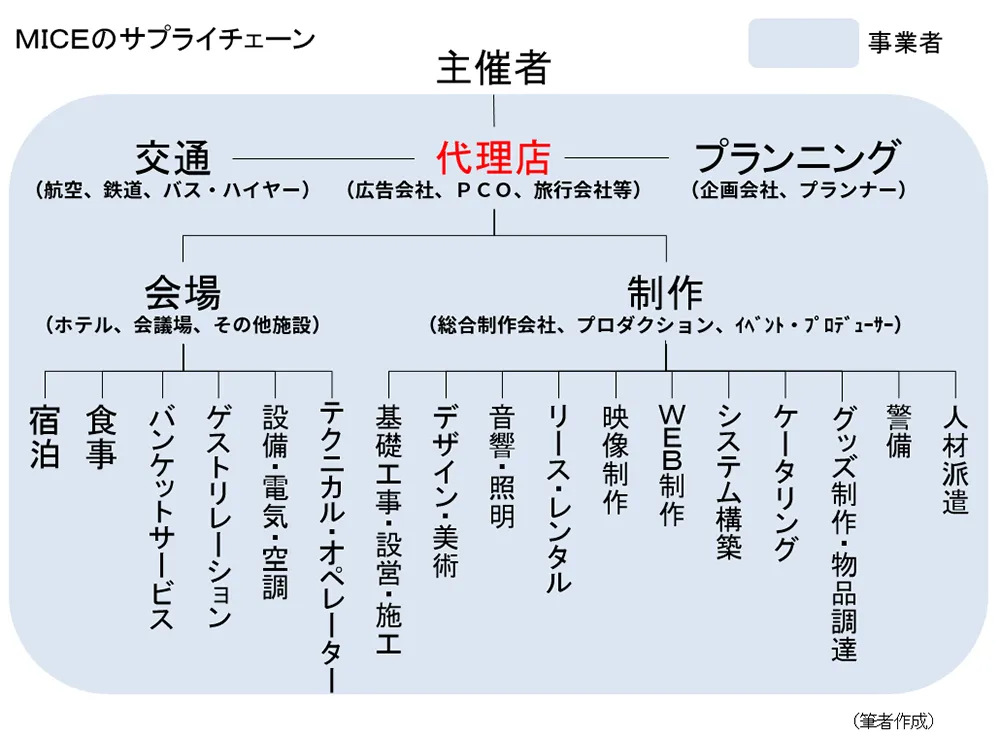
Considering the above, I believe MICE can be described as “opportunities (or means) for real-world communication carried out with a specific purpose.”While MICE events take many forms, if you look around carefully, you’ll likely notice that they are held frequently and everywhere. In addition to the organizers’ initial objectives of “business expansion” and “value sharing,” MICE also yields various benefits as a result of the event—namely, marketing based on the latest firsthand information,new business opportunities and innovation driven by the accumulation of knowledge, information, and networks; economic benefits resulting from increased visitor traffic; infrastructure development and enhanced brand power for host cities; and, above all, the development and globalization of the workforce involved in MICE.
While it depends on the scale and content, MICE holds great potential in these areas. I sincerely hope that this will serve as an opportunity for you to take a greater interest in and have higher expectations for MICE.