Integrated Resort (IR) Concept—Reprinted from the November 2016 Issue of MICE Japan
Recently, discussions regarding integrated resorts (IRs) have once again garnered significant attention. On October 12, the General Assembly of the Parliamentary League for the Promotion of the International Tourism Industry (commonly known as the IR Parliamentary League) was held in the Multipurpose Conference Room of the House of Representatives Second Members’ Building. The “IR Promotion Bill,” a piece of legislation aimed at promoting integrated resorts (IRs), has remained stalled for several years despite ongoing deliberations. The goal is to pass this bill as a private member’s bill through a bipartisan parliamentary league comprising members of the Liberal Democratic Party, the Democratic Party for the People, and others.As the ruling party responsible for building a tourism-oriented nation—with targets of 40 million visitors by 2020 and 60 million by 2030—it views the passage of this bill as a critical priority. The MICE industry is also closely tied to this issue, and there is a possibility that the bill could pass as early as November. We would like to take this opportunity to reexamine and explore the close relationship between Integrated Resorts (IRs) and the MICE industry.
Strictly speaking, the IR Promotion Bill is officially titled the “Bill on the Promotion of the Development of Integrated Resort Zones,” and the most recent version was submitted to the Diet on April 28, 2015. Although it has been submitted to the Diet in the past, it has not been enacted due to delays in deliberations and other factors.A bipartisan parliamentary league has been formed by political groups excluding the Communist Party (though not necessarily comprising all lawmakers), and it is expected to have significant economic ripple effects, including growth strategies, increased tax revenue, job creation, promotion of inbound tourism, tourism revitalization, and regional revitalization. The main point of contention is the anticipated social impact, such as an increase in gambling addiction, negative effects on youth, and a deterioration of public safety. It is also a fact that various organizations, including the Japan Federation of Bar Associations, oppose this.In this article, as someone involved in the MICE industry, I will provide a basic understanding of Integrated Resorts (IRs) and focus my analysis specifically on MICE—which consists not only of recreational and accommodation facilities but also conference venues and exhibition halls.
From Resort to Integrated
Casino (CASINO) games originated in Europe. Originally, they were perceived as a playground for the wealthy classes, such as royalty and nobility, while in the New World, such as the United States, they are strongly associated with the image of anyone with money seeking to strike it rich.Furthermore, the European model features a single facility attached to a resort, typically located in a small-scale hot spring resort like Monte Carlo or Baden-Baden in Germany. In contrast, the American model represents the prototype of a truly integrated resort, typified by Las Vegas, where multiple large-scale facilities are clustered together and feature theaters and various forms of entertainment.
Since then, they have evolved into integrated resorts (IRs) that combine casinos with conference centers, exhibition facilities, shopping centers, restaurants, theaters, and various forms of entertainment. Representative examples include Marina Bay Sands (opened in 2010) and World Resort Sentosa (opened in 2010) in Singapore.
Marina Bay Sands features a massive international conference center and exhibition hall, successfully attracting not only leisure travelers but also business guests. Meanwhile, World Resort Sentosa incorporates Universal Studios Singapore within its grounds and includes facilities such as the massive Marina Life Park aquarium, creating an integrated resort with a strong focus on leisure.
Singapore had banned casinos since its founding in 1965, but after carefully considering the negative social impacts and economic benefits and striving to build consensus among residents, the concept of an “IR” (Integrated Resort)—which goes beyond a simple casino—emerged in 2005 amid a slump in the tourism industry, and the government decided to adopt it.Key points include limiting development to two locations—the Marina Bay area and the Sentosa area—and stipulating that casinos must occupy no more than 5% of the total site area.
IR and MICE
The IR (Integrated Resort, including casinos), which had been under consideration in Singapore since 2005, was subsequently developed into a new type of integrated resort distinct from European, American, or Macau models by adhering to the aforementioned stipulation that casinos occupy no more than 5% of the site area and by incorporating proposals to include facilities such as conference and exhibition halls.Starting around the time of Hong Kong’s handover in 1998, the rise of low-cost carriers (LCCs) and the development of international tourism—which could be described as an era of extensive exchange within Asia—along with events such as the Severe Acute Respiratory Syndrome (SARS) outbreak, led to a slump in international tourist arrivals and hotel occupancy rates in Singapore. However, after hitting bottom in 2003, the sector showed a V-shaped recovery and has been on an upward trajectory ever since, with the exception of the 2009 Lehman Shock.
This is the result of Singapore designating international tourism as a national goal and actively promoting MICE (Meetings, Incentives, Conferences, and Exhibitions) through initiatives such as integrated resort development and attracting international conferences. The approach to integrated resort development in Singapore is based on the concept that “it is an IR, not just a casino.” This involves creating integrated resorts that combine conference halls, exhibition facilities, shopping centers, restaurants, theaters, and various forms of entertainment—including casinos—and introducing them through private investment.In particular, the Marina Bay Sands proposal is the very embodiment of an IR, integrating MICE facilities—including conference and exhibition spaces exceeding 100,000 square meters—along with recreational areas, art and science museums, rooftop gardens and pools, and accommodation facilities. It also serves as a successful case study of the integration of leisure and business, a model the Sands Group has successfully implemented in Las Vegas and elsewhere.
IR and MICE in Japan
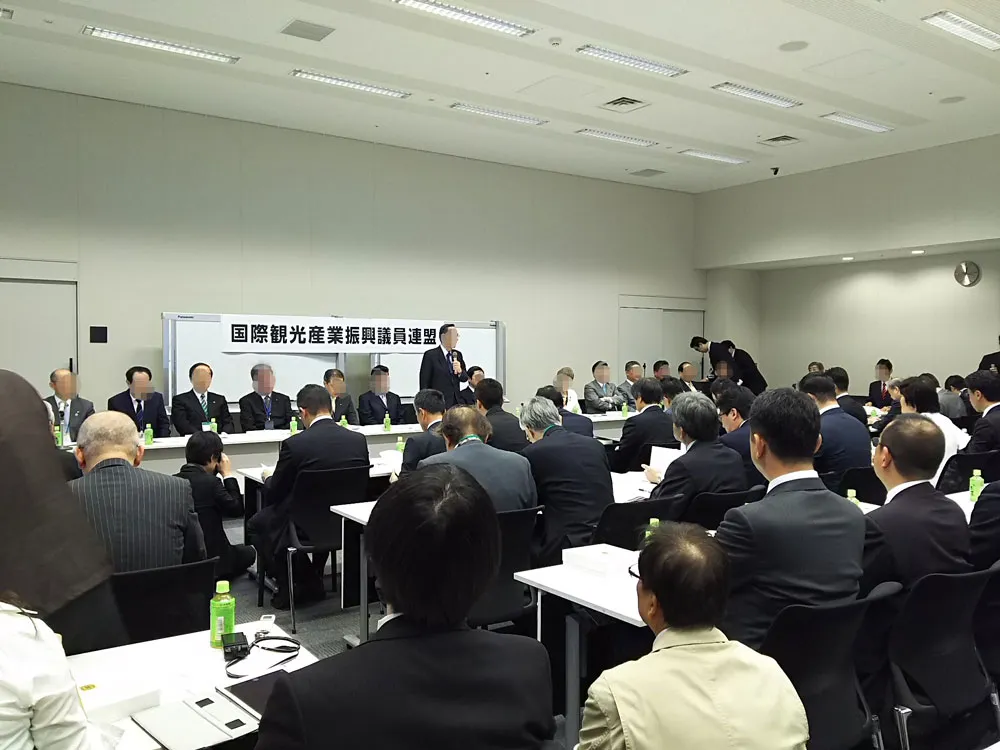
Looking back more than 10 years before the “Parliamentary League for the Promotion of International Tourism” (IR League) was launched in 2010 in response to Singapore’s success, Mr. Ishihara, who ran for Governor of Tokyo in 1999, put forward the “Odaiba Casino Plan” as one of his campaign pledges.The Liberal Democratic Party’s “Comprehensive Policy Compilation 2016: J-File, June 2016” sets out detailed pledges across more than 400 items; the sections related to MICE are excerpted below.
- #20 Promotion of the Cool Japan Strategy: Promoting
the construction of MICE facilities such as large-scale exhibition venues and international conference centers
#40 Promotion of a Tourism-Oriented Nation: Attracting and hosting international conferences, etc., and promoting integrated resorts (IRs), including casinos
#392: Realizing a Sports-Oriented Nation Based on the Basic Act on Sports: Supporting efforts to double the number of executives from Japanese sports organizations serving on international federations, and initiatives to host international competitions
#397: Promoting the Industrialization of Sports. Promote the industrialization of sports. Fundamentally review the management of existing stadiums and arenas, and promote reforms to transform them from cost centers into profit centers
During this period, the government’s 2013 New Growth Strategy, “Strategy for Revitalizing Japan,” focused solely on tourism promotion, encouraging inbound tourism, and promoting MICE. However, in the 2014 revised version of the “Strategy for Revitalizing Japan,” it was explicitly stated that “Integrated Resorts (IRs) are expected to contribute to tourism promotion, regional revitalization, and industrial development.”On the other hand, since it is necessary to consider institutional measures to prevent problems from arising from the perspectives of crime prevention and public safety, the healthy development of youth, and the prevention of addiction—which serve as prerequisites—relevant ministries and agencies will proceed with deliberations based on the status of the IR Promotion Bill and the national debate regarding IRs.” What was once a resort including a casino has evolved into an Integrated Resort including a casino, and I believe that we, particularly those involved in the MICE industry, should actively participate in these discussions.
Summary
Among public gambling operations is the “TOTO Lottery,” which is administered by the Ministry of Education, Culture, Sports, Science and Technology. While its revenue structure differs entirely from that of casinos, two-thirds of its revenue is allocated to the promotion of sports, and one-third is remitted to the national treasury. Simply put, the breakdown is as follows:
- Revenue is calculated by subtracting prize payouts and operating expenses from lottery sales.
- Two-thirds of the revenue is allocated as project funding for sports promotion, one-third goes to sports organizations, and one-third is distributed as grants to local governments and other entities.
- One-third of the revenue is paid into the national treasury.
(The amount paid to the national treasury is allocated to projects related to the promotion of education and culture, the conservation of the natural environment, the healthy development of youth, and international sports exchange.)
Originally launched as the “Sports Promotion Lottery” for the purpose of promoting sports in Japan, the Japan Professional Football League was designated as the organizing body for matches eligible for sports promotion betting. It is scheduled to contribute tens of billions of yen as one of the funding sources for the New National Stadium to be used in 2020.While Integrated Resorts (IRs) differ entirely in both purpose and form, I have recently been wondering whether, similar to sports promotion, a portion of the revenue paid to the national treasury from future Integrated Resorts (IRs) could be allocated to projects that contribute to further enhancing and internationalizing Japan’s MICE industry. As we move from the enactment of the bill to the enactment of the implementing legislation, I hope to encourage active discussion and participation from those involved in the MICE industry, while keeping a close eye on future developments.
*This article is a reprint of a contribution to the November 2016 issue of “MICE Japan.”
<Reference>
・LDP Comprehensive Policy Compilation 2016, J-File Item 455 (June 2016)
・House of Representatives Bill Title: Bill on the Promotion of the Development of Integrated Resort Areas
・Nikkei Article (April 2, 2015)
・Yokohama City: Report on the Study for New Strategic Urban Development, Including IR (Integrated Resorts) (March 2016)
・Osaka Prefecture: Location of Integrated Resorts (IRs) Including Casinos (April 2014)
・Hokkaido Government: Social Impact and Economic Effects of Introducing IRs in Hokkaido
・Tomakomai City: Challenges in the IR Concept
・Kushiro City: Report on the Results of the Feasibility Study and Review of Integrated Resorts (IR) (May 2016)
・Nagasaki Prefecture: Outline of the Nagasaki IR Concept (Draft)
・Casino IR Japan: List of Industry-Related Organizations and Local Promotion Groups
・Japan Society for Casino Health and Wellness
・Japan Federation of Bar Associations: Statement Opposing the So-Called "Bill to Promote the Legalization of Casinos"
・JETRO: Trends in the Singapore Economy (2013)
・"Japan Revitalization Strategy" Revised 2014
・Recruitment Guidelines for Part-time Staff Attached to the Deputy Chief Cabinet Secretary (Special Mission)
・Japan Sports Agency, Sports Promotion Division