IBTM World 2024 Report: Reflections on the Presence of Countries and Cities

IBTM World 2024 was held in Barcelona, Spain, from November 19 to 21. This report focuses primarily on two themes: “The Presence of Countries and Cities at MICE Trade Shows” and “Achieving Sustainable MICE.”
This year’s theme is “People Power Potential.”
I felt that the organizers chose this theme with the intention of focusing on the power and potential of people, and to emphasize the significant impact that MICE has on human interaction and its outcomes.
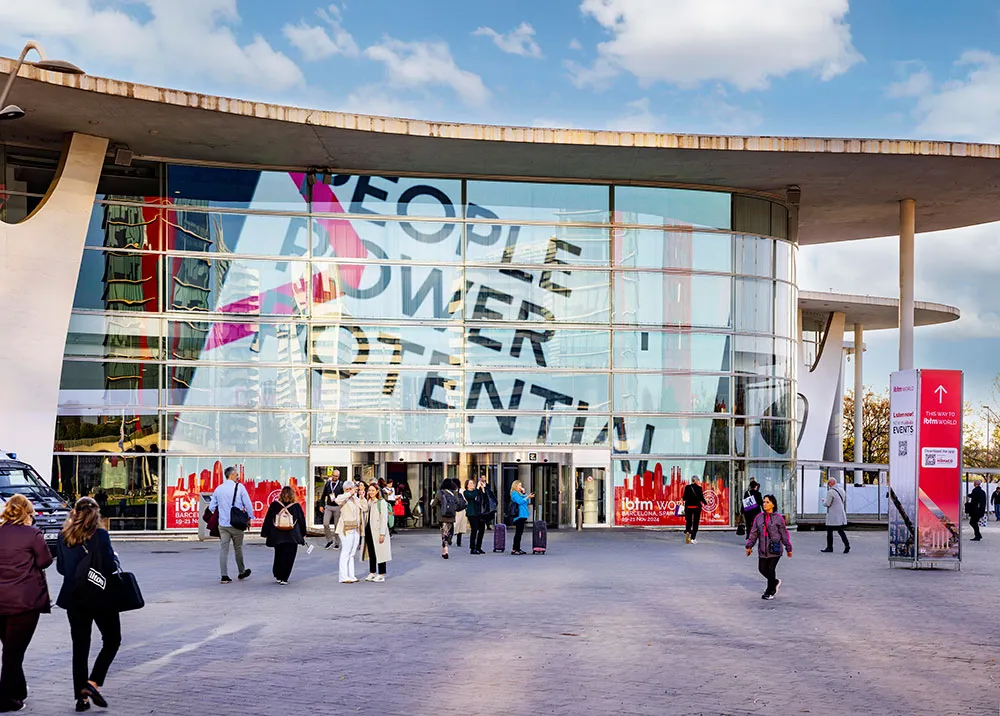
IBTM stands for Incentives, Business Travel & Meetings. IBTM World, held in Barcelona, brings together professionals from the global MICE industry to network and explore new business opportunities. It is a trade show where many countries and cities set up pavilions, and within them, individual businesses conduct business meetings with buyers. Over 2,000 Hosted Buyers*1 participate each year, with the organizers covering a portion of their airfare and hotel expenses. During the three-day event, Hosted Buyers conduct a specified number of business meetings assigned by the organizers, while also participating in seminars and networking events.
This year’s total attendance was 11,899, of which 2,528 were Hosted Buyers—a 22% increase from last year. While approximately 60% of buyers were from within Europe, participants came from a wide range of countries, representing 96 nations in total. With momentum building toward securing MICE business for 2025 and beyond, the venue was even more vibrant than last year.
*1 A system in which airfare and accommodation costs are covered to invite MICE organizers, planners, and operating companies such as PCOs who influence venue selection.
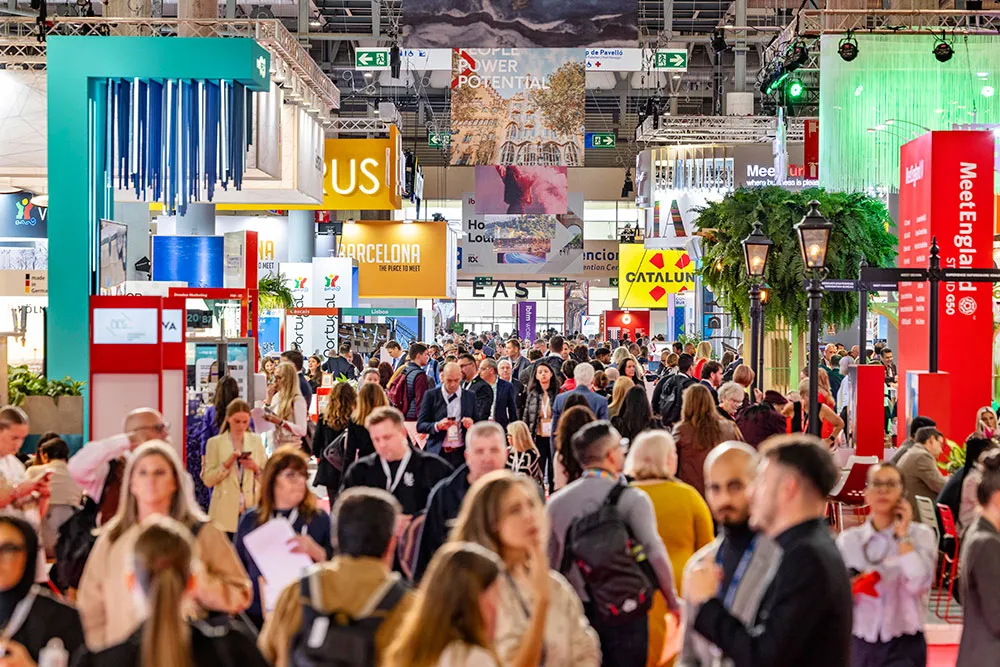
From Japan, the Japan Pavilion organized by JNTO and the Tokyo Pavilion by the Tokyo Convention & Visitors Bureau, as well as companies exhibiting at individual booths, were located in an area close to the center of the venue. Compared to IMEX*2, a similar MICE trade show, the location of the Japanese booths at this venue was more favorable—perhaps because the organizer’s point of contact*3 is based in Japan. I felt there was a clear advantage in being able to convey preferences and requests directly to exhibitors in Japanese.
*2 A trade show for meetings, events, and incentive travel held annually in Frankfurt in May and in Las Vegas in October. The major players in the global MICE industry always meet at these two events, IMEX and IBTM World.
*3 The organizer of IBTM World is RX (Reed Exhibitions Limited). Within the Japanese branch of RX, there is a department that handles sales for the company’s overseas exhibitions and serves as the point of contact for exhibitors from Japan.
Many exhibitors felt the number of business meetings was higher than at IMEX
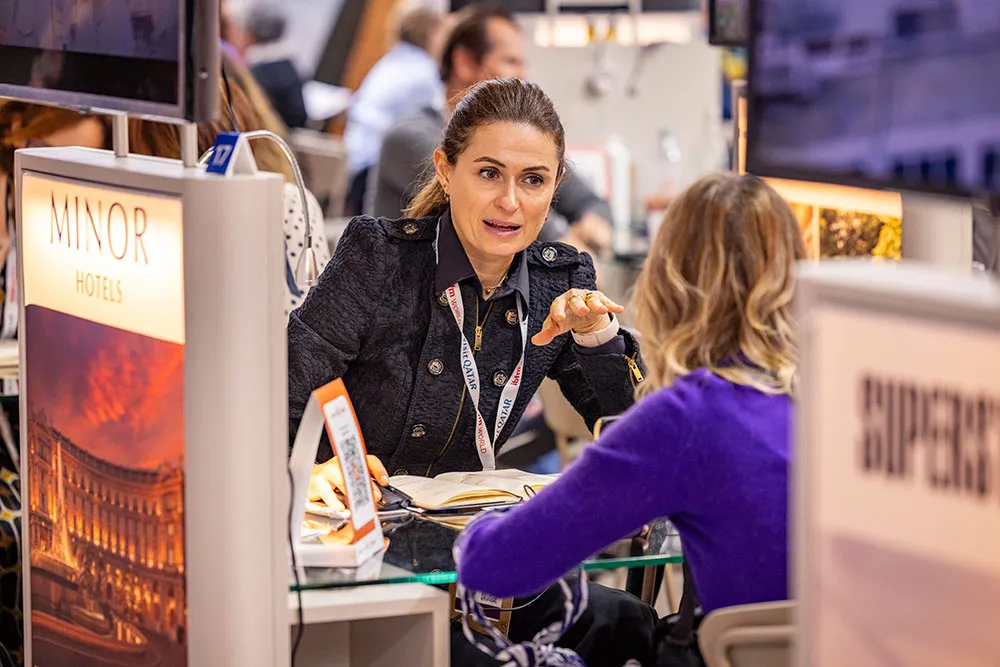
According to feedback from actual exhibitors, as of the morning of the first day, they reported having “a large number of pre-scheduled meetings. ”For exhibitors in the pavilions—such as CVBs*4, DMOs*5, and hotels—the total number of appointments over the three days is 30 to 40, which means that over a dozen business meetings are scheduled per day. Each meeting lasts 30 minutes, with a 10-minute interval between them, and buyers arrive one after another. From 9:00 AM to 6:00 PM, I believe exhibitors were unable to leave their booths for the most part.
When I checked in on the situation on the evening of the second day, the feedback fell into two main categories:
“There are some ‘Go Shows’*6, but there are many ‘No Shows’*7.”
“While there are some concrete discussions, most of the conversations are about leisure travel.”
The overall sentiment seemed to be, “It’s not bad, but it’s not as good as we’d hoped.” I’m sure all the exhibitors fully understand this, but the effectiveness of participating in trade shows like this needs to be evaluated over a period of time. Above all, I believe it’s important to build relationships with buyers by participating consistently—showing the same face—to raise your personal profile.
As for the comment that “there are some ‘Go Shows,’ but many ‘No Shows’,” I think this is somewhat unavoidable in this type of trade show. Some buyers may have had to miss their appointments due to a previous meeting running long, and it’s not uncommon to lose track of time while in the bustling venue.
The fact that “there is a lot of talk about leisure travel” may be due to Japan’s popularity as a tourist destination. While this isn’t necessarily a bad thing, since IBTM is a trade show focused on incentives and MICE, there naturally needs to be a greater volume of inquiries regarding those sectors. One reason for this is likely that, while many European resort destinations and other locations actively promoting incentives are exhibiting, Japan unfortunately isn’t widely recognized as a destination for incentive travel.
*4 Abbreviation for Convention & Visitors Bureau. An organization that conducts marketing and other activities to attract conventions and tourists.
*5 Abbreviation for Destination Management Organization. An organization that is well-versed in all regional resources and works in cooperation with the local community to host MICE events and develop tourist destinations.
*6 When
a buyer shows up without a prior appointment. *7 When a buyer fails to show up despite having made a prior appointment.
To Enhance Japan’s Presence
1. What can be done to enhance Japan’s presence?
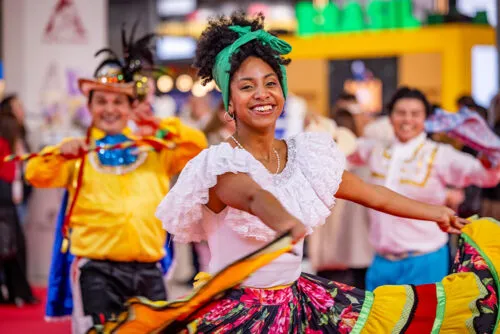
What initiatives can be considered to enhance Japan’s presence? My proposal is to create booths that focus a bit more on attracting incentives. I believe national and city pavilions serve two purposes: first, to enable exhibitors to conduct numerous successful business meetings, and second, to showcase the country or city’s presence in the MICE business. This year, South Korea held quiz contests and slot machine games on screens, drawing visitors all day long. At the Colombia booth, there was a constant line from morning to evening of people seeking delicious Colombian coffee. The Denmark booth also made an effort to “first spark interest,” with all exhibitors chanting and singing together in the morning. Unfortunately, my honest impression is that the Japan booth was too business-oriented, quiet, and unremarkable. Since the organizers have gone to the trouble of placing Japanese exhibitors in the same area, I feel that if they could demonstrate a united front in attracting visitors, it would create a much more effective platform for promotion.
2. Is it possible to discuss ways to further enhance Japan’s presence?
The events we aim to attract are “business events*8,” so our target audience differs from that of a tourism trade show. However, since buyers are, after all, human beings, isn’t it only natural that they would find places that evoke a sense of “fun” attractive when searching for destinations that will delight their customers? A long line had formed for the calligraphy performance organized by JNTO. One Turkish buyer, looking very pleased, held up a piece of paper with the word “happiness” written on it and said, and said, “Turks love Japan. Our association’s conference isn’t very large—about 500 people—but I’d like to hold it in Japan someday.” It was a moment when I truly realized that this is how we build “Japan fans.” Could we create a forum for everyone to discuss how to present our country and city—addressing questions like “What does
it mean to promote Japan?”, “What defines ‘Japanese-ness’?”, and “What kind of booth do buyers find appealing?”
*8 An event where participants with business objectives gather at a specific venue.
This Year’s Trends at IBTM
1. Trends in This Year’s Seminars
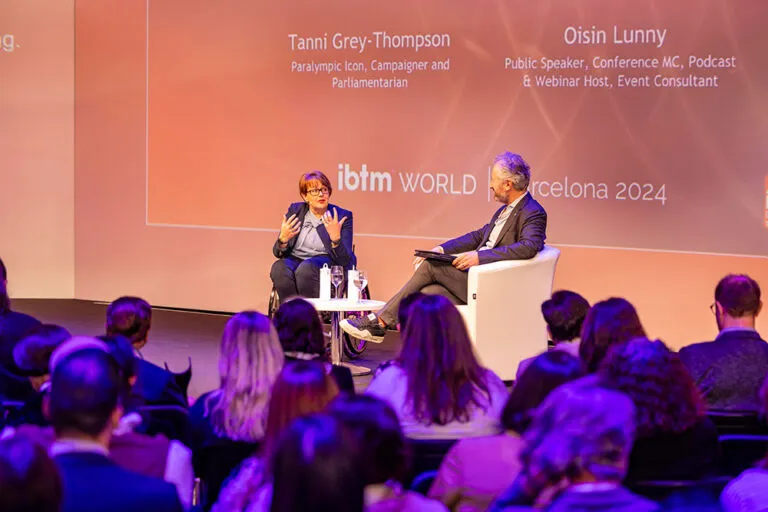
Another highlight of IBTM is its seminars on a variety of topics. On the main stage, seminars cover relatively broad themes related to the MICE industry as a whole. The first session on the opening day was a seminar titled “People Potential” led by a British Paralympian, who shared the perspectives of those around her and family anecdotes about her challenges. During the Q&A session, a participant with a child with a disability asked, “What will happen to our family from now on?” Her response—“The same things that happen to all parents who worry about their children”—was very memorable. Starting with this seminar, it seemed to me that there were many programs this year centered on the themes of “diversity” and “inclusion. ”This is purely my impression based on the seminars I attended, but I felt there were few sessions discussing the latest topics or concrete details regarding “sustainability” as a whole or “environmental issues.” Last year, for example, there was a presentation by a consultant who prioritized flights using “SAF*9” when planning business trips, but I didn’t see anything like that this year.
*9 Abbreviation for Sustainable Aviation Fuel. A sustainable aviation fuel made from biomass or waste cooking oil.
2. Trends in Country Pavilions
Many booths featured designs centered on the theme of “Nature.” I believe this is a trend leading toward sustainable MICE. Countries such as those in Northern Europe, Iceland, and the Baltic states created booths using photographs of forests and mountains. While they looked very beautiful and effectively conveyed their imagery, they all utilized woodwork structures with “keshihari” (a technique where printed paper is affixed to a wooden signboard).While such structures are certainly highly aesthetic and best suited for conveying a booth’s concept, they also generate a significant amount of waste. It is unclear whether this is directly related to the booth structures, but overall, I felt that the momentum behind “consideration for environmental impact” had weakened.
3. Are we moving toward the realization of sustainable MICE?
This question applies to the seminars as well. As I mentioned earlier, there were many themes related to diversity and inclusion. While “human rights” are an important theme in MICE, this does not mean we can relax our efforts regarding “environmental impact.” Some suggest, “Perhaps they are deliberately avoiding the topic because it has become the standard?” However, given the adoption of waste-generating structures, it feels as though we have regressed slightly to previous conditions. Organizers switched to paper name tag holders and distributed water bottles made from sugarcane that do not emit toxic gases when burned. The venue, Fira Barcelona, had installed paper recycling bins. However, looking around the venue, I got the impression that there were fewer booths promoting sustainability than I had expected. To put it bluntly, I suspect the “enthusiasm has cooled.” If they were truly serious about realizing sustainable MICE, I think we should be seeing more examples of best practices—such as “this is what we can do” or “this is what we should do”—as well as stories from “top runners”*11 explaining “how far we’ve come” toward net-zero*10.
Is it just me, or did the overall impression seem to be that they were desperately trying to recoup the MICE events that couldn’t be held and the business that couldn’t be secured during the COVID-19 pandemic? The venue was incredibly lively; buyers were moving around with their lists, and it was a spectacular sight to see every booth’s negotiation tables filled. A buyer I know remarked, “Business has only returned to about 70% of pre-pandemic levels,” and it seems everyone is focused on “winning back what we lost now!”—making the revival of business their top priority. However, this leaves me feeling a bit disappointed. Since I had assumed the industry would rebound as a sustainable MICE sector post-pandemic, I couldn’t help but wonder: Is it really possible to achieve “NET ZERO CARBON EVENTS*10”—a goal we were supposed to reach by 2050?
*10 A declaration jointly announced by several international event industry organizations in conjunction with COP26 in 2021, pledging to “reduce CO2 emissions from events to zero by 2050.”
*11 A trailblazer. Someone active at the forefront of their field.
Summary —What Is the Legacy of MICE?—
Another theme frequently discussed at the seminars was “legacy*12.”MICE events are often criticized for the significant environmental impact caused by participants’ air travel, and the industry is under pressure to demonstrate that the benefits and value of hosting these events outweigh this environmental burden. As a result, host cities are actively proposing to organizers how they can leave a “legacy” (positive benefits resulting from the event) in the host city. In other words, host cities attract events by promoting the idea that “If you hold your event in City X, you can leave this kind of legacy. ”While this trend is a positive development for both organizers and host cities, I feel that this aspect does not always align well with sustainability. In particular, since incentives are primarily centered on “travel,” the reality is that achieving both goals is difficult. I walked around the venue hoping to discover some new ideas or ways to reconcile these two goals, but unfortunately, I did not find any this year. It was a few days during which I felt that while I believe someone is surely thinking about this right now, I also want to continue thinking about it myself.
*12 Heritage. Things built in the past and passed down to future generations.
Photo courtesy of IBTM World
著者