How Do Japanese DMOs Generate Revenue? ~Toward Autonomous and Sustainable Operations~
Registration for candidate organizations for the Japanese-style DMO (hereinafter referred to as the Japanese-style DMO) began in November 2015.The roles undertaken by Japanese-style DMOs consist primarily of non-profit activities, such as conducting marketing research, developing strategies based on that research, building consensus among stakeholders, and steering various projects. As a result, many candidate organizations are struggling with the challenge of securing stable operating funds. In this column, we will explore how Japanese-style DMOs can secure stable operating funds to ensure autonomous and sustainable operations.
Registration for candidate organizations for the Japanese-style DMO (hereinafter referred to as “Japanese-style DMO”) began in November 2015, and the seventh round of registrations has now been announced. By January 2017, the number of registered organizations had reached 123. This means that, in just one year and two months, a framework for tourism promotion centered on Japanese-style DMOs has been established nationwide. However, as the term “candidate organization” suggests, there are still many challenges facing the initiatives of these organizations. In particular, the requirement to “secure stable operating funds” necessary for Japanese-style DMOs to conduct autonomous and continuous activities (see the Japan Tourism Agency’s “Guidelines for the Formation and Establishment of Japanese-style DMOs (1st Edition),” p. 6) is one of the issues causing headaches for many candidate organizations.
The roles undertaken by Japanese-style DMOs consist almost entirely of non-profit activities, such as conducting and analyzing marketing research, formulating strategies based on those findings, building consensus through vigorous debate with stakeholders, and implementing various projects as a leader and steward. In this column, we will examine how to secure stable operating funds while fulfilling these roles.
1. We organized and analyzed the revenue plans of 99 Japanese-style DMOs
How are Japanese-style DMOs planning to generate revenue to secure stable operating funds for autonomous and sustainable activities?
To be registered as a candidate Japanese-style DMO, organizations must create a “Japanese-style DMO Formation and Establishment Plan” and submit it to the Japan Tourism Agency. This plan must include a “forecast of operating expenses related to activities and methods of procurement” for the three to five FYs following the application, outlining strategies for securing revenue through the final FY of the plan.
In this section, we organized and analyzed the revenue plans of 99 organizations (“Regional Collaboration DMOs” and “Regional DMOs”)—excluding “Wide-Area Collaboration DMOs” with large target areas—out of the 112 entities registered by December 2016 that had submitted such plans.
2. The revenue scale of Japanese-style DMOs ranges widely from 5 million yen to 3 billion yen
First, let’s look at the scale of revenue.
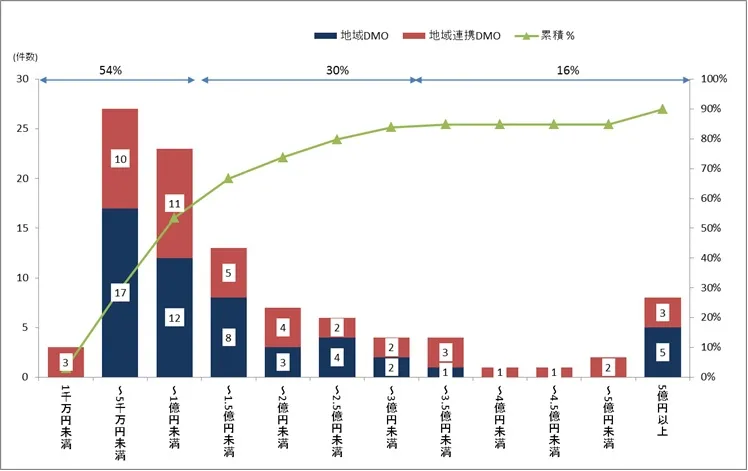
The largest Japanese-style DMO is the “Kobe International Tourism and Convention Association” (a general incorporated foundation), with a revenue scale of 3 billion yen. However, this is a special case; as shown in Figure 1, the distribution is as follows: large-scale DMOs with revenues of 300 million yen or more account for 16% (16 cases) of the total; organizations with revenues of 100 million yen or more but less than 300 million yen account for 30% (30 cases); and organizations with revenues of less than 100 million yen account for 54% (53 cases).The smallest DMO is the regional partnership DMO “Nooto (Toyooka City, Yabu City, Asago City, and Sasayama City, Hyogo Prefecture),” with an annual revenue of 5 million yen.
There appears to be little correlation between revenue scale and the distinction between “Regional DMOs” and “Regional Collaboration DMOs. ”Furthermore, there appears to be little correlation with the size of cities within the target area. For example, among DMOs with an annual revenue of 500 million yen or more, the breakdown is as follows: for regional collaboration DMOs, there are three prefectural-level DMOs (Osaka Prefecture, Yamagata Prefecture, and Kagawa Prefecture); for regional DMOs, there are two government-designated cities (Kyoto City and Kobe City) and three other cities (Sumida Ward, Nagasaki City, and Satsumasendai City).
3. 70% of Japanese-style DMOs Do Not Rely Solely on Subsidies
Next, let’s examine the revenue structure.
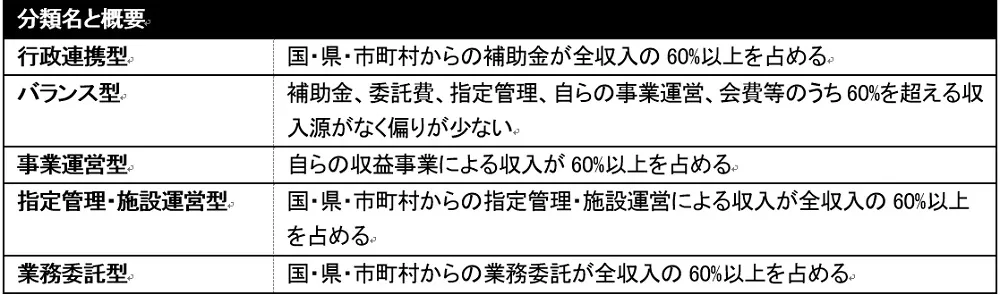
Revenue sources for Japanese-style DMOs include subsidies and contributions from the national, prefectural, and municipal governments; service contracts from national, prefectural, and municipal governments as well as private companies; designated management and facility operations for national, prefectural, and municipal governments; membership fees and contributions from private companies; and revenue from the DMOs’ own business operations.
When classified based on which of these revenue sources serves as the main pillar, the results are shown in Figure 2. While the “Government Collaboration Type,” which relies primarily on government subsidies, accounts for the largest share at 24%, the “Balanced Type” (which does not rely solely on government subsidies) and the “Business Operation Type” (which relies primarily on its own business operations) together account for 70%. This indicates that Japanese-style DMOs are moving toward an operational model where they generate a certain level of revenue independently.
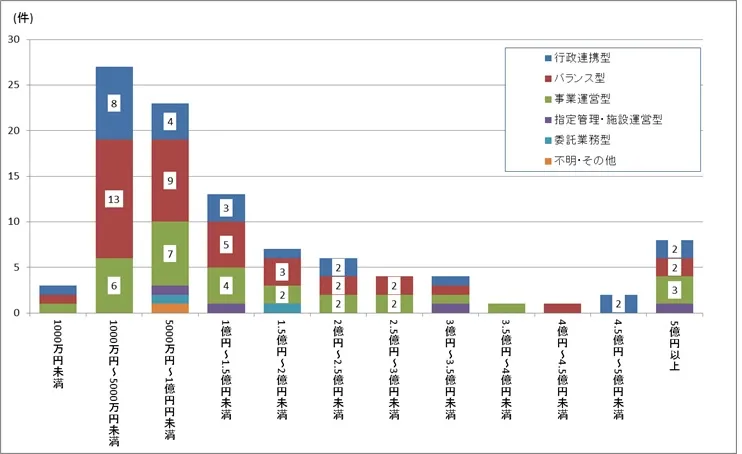
Furthermore, it is evident that these types are widely distributed across DMOs of all sizes, from those with small revenue to those with large revenue (Figure 3).
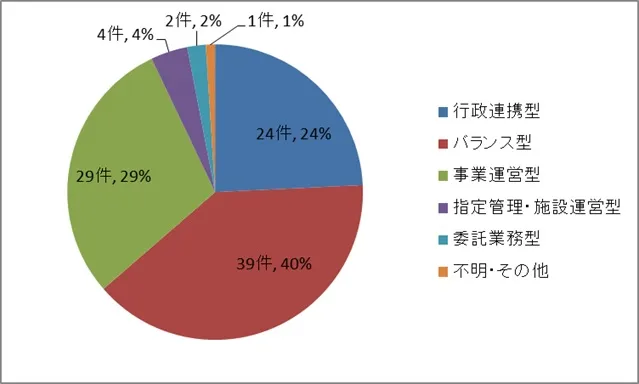
Source: Prepared by JTB Tourism Research & Consulting based on the “Plan for the Formation and Establishment of Japanese-Style DMOs”
4. The Revenue Generation Mechanism of Japanese-Style DMOs
To further explore the revenue-generating mechanisms of Japanese-style DMOs, let’s examine some distinctive examples.
1) Government-Collaborative Type: “Hagi City Tourism Association (Public Interest Incorporated Association)”
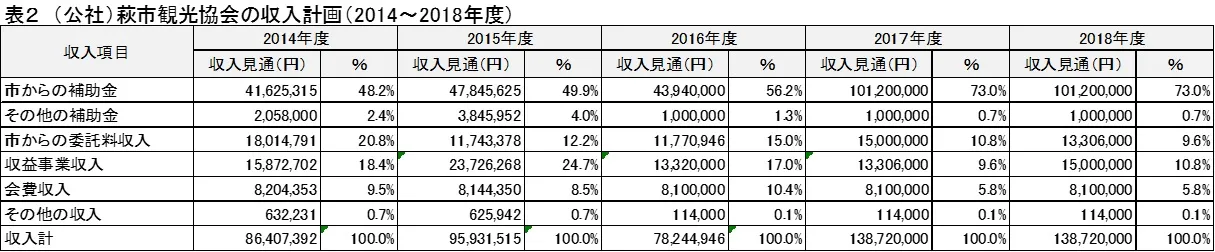
Hagi City views the 150th anniversary of the Meiji Restoration (FY 2018) as a major opportunity and is implementing various initiatives centered on the World Heritage site “Meiji Industrial Revolution Sites in Japan” and the “Hagi City Museum.” The city’s regional DMO, the “Hagi City Tourism Association (Public Interest Incorporated Association),” receives 70% of its funding from municipal subsidies. However, rather than relying solely on government subsidies, the association has outlined the following “initiatives and policies for autonomous and sustainable operations”: (1) expansion of revenue-generating businesses through incorporation as a general incorporated association (scheduled for April 2017); (2) establishment of a solid foundation through the expansion and streamlining of projects commissioned by the city and other entities; (3) expansion of advertising revenue through attractive online content; (4) expansion of merchandise sales; and (5) securing increased subsidies from the city and other entities.
Notably, regarding point (5), the plan specifically states that it will “request the establishment of a new DMO operational fund, funded by Hagi City’s hot spring tax, with a target date of 2018.”The Japan Tourism Agency also recommends creating mechanisms to allocate a portion of new administrative revenue sources generated by tourism and other activities toward DMO operating expenses as a means of securing “stable operating funds.” Accordingly, the other 13 Japanese-style DMOs are also attempting to establish systems for introducing and utilizing revenue sources such as the hot spring tax, accommodation tax, and hometown tax contributions as DMO funding.
2) Balanced Model: “Amami Oshima Tourism and Local Products Federation (General Incorporated Association)”
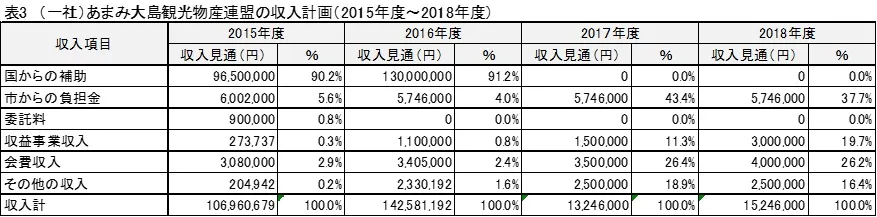
The “Amami Oshima Tourism and Local Products Federation (General Incorporated Association) (currently: Amami Oshima Tourism and Local Products Association)” is a regional partnership DMO comprising five municipalities on Amami Oshima. It aims to provide tourists with a one-stop experience of Amami Oshima’s culture, including its sea, songs, sake, cuisine, and scenery.
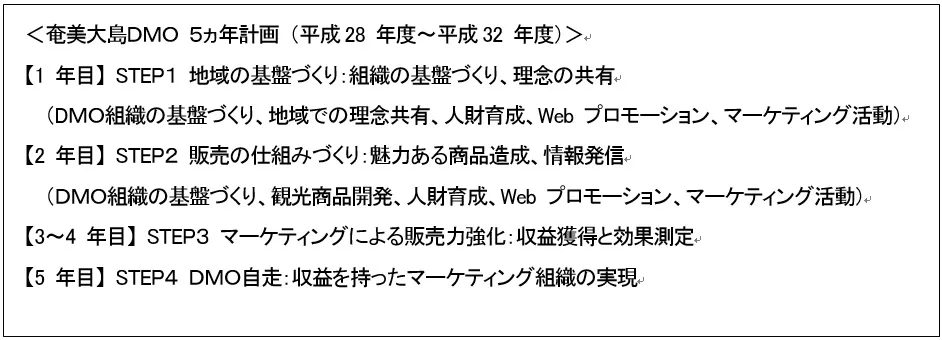
Initially, 90% of its revenue came from government subsidies. However, with the presentation of the Amami Oshima DMO Five-Year Plan (FY2016–FY2020), the organization has planned to “secure stable operating funds” starting in FY2017 to enable autonomous and sustainable operations by increasing revenue from commercial activities and membership fees.
The Amami Oshima Tourism and Local Products Federation (General Incorporated Association) completely revamped its website in January 2017 (“Amamikke”).This website features a system that allows tourists to directly book and purchase experiential content and other offerings online. Such services serve as one of the revenue sources for Japanese-style DMOs. The JTB Group was deeply involved in the development of this system, making it a model that can be adopted by other DMOs as well. This is a case study that can serve as a reference for addressing the challenges faced by Japanese-style DMOs.
3) Business-Operating Type: “Specified Nonprofit Corporation ORGAN (Nagaragawa DMO)”
"Specified Nonprofit Corporation ORGAN" is a regional partnership DMO covering the upper and middle reaches of the Nagara River (Gifu City, Seki City, Mino City, and Gujo City in Gifu Prefecture). It draws its appeal from the "Nagara River Basin Culture," which encompasses the lifestyle and culture nurtured by the river, the industries established at river ports through water transport, and the reverence for water. In particular, the organization plans to leverage the interactions with Nagara River fans accumulated through the “Nagara River Hot Spring Expo*” and initiatives that utilize the “Clear Stream Nagara River Ayu (recognized as a Globally Important Agricultural Heritage System)” brand to revitalize the region.
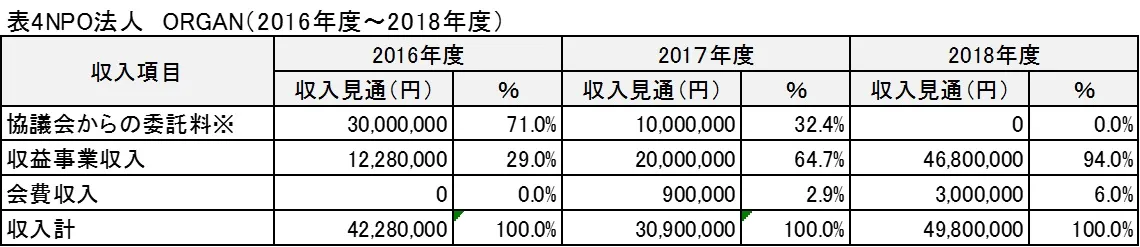
Regarding revenue, the plan is for over 90% to come from revenue-generating operations in FY 2018. These include tourism marketing surveys in the Nagara River basin and the sale of those reports; establishing a Nagara River DMO supporter system for tourism-related businesses (membership fee revenue); the development and sale of in-region experiential products; and sales from the “Nagara River Department Store,” a business selling local specialties from the Nagara River basin (via online and physical stores).A key feature of our DMO’s revenue-generating initiatives is our focus on revitalizing local industries—such as agriculture, fisheries, and traditional manufacturing—by aiming to brand products from the Nagara River basin and establish direct sales channels.
*Commonly known as “Nagaragawa Onpaku.” An event centered on experiential programs held for approximately one month in various municipalities throughout the Nagaragawa River basin, primarily in Gifu City.
5. Japanese-Style DMOs: From Establishment to Operation
So far, we have taken a brief, bird’s-eye view of the “revenue-generating mechanisms” of Japanese-style DMOs, examining specific models. It is important to note that these are still at the planning stage, and there are many cases where things do not proceed as planned. However, I believe it is safe to say that each Japanese-style DMO is working to clarify the roles of the government, the private sector, and the DMO itself, and is striving to build a model for “profitable regional development” suited to its specific area (in this article, we have categorized them into government-collaboration type, balanced type, and business-operation type).
The role of Japanese-style DMOs is to create “profitable regional development,” and while establishing a self-sustaining and continuous operational model is important, it alone does not guarantee the achievement of their original objectives. In particular, as Japanese-style DMOs transition from the establishment phase to the operational phase, there will likely be both failures and successes. Going forward, it will be crucial to accumulate meaningful insights for the next steps not only from success stories but also from failures. While keeping in mind the need to link these insights to a PDCA cycle for the Japanese DMO sector as a whole, I intend to continue deepening my understanding of DMOs and destination management.