Let’s Help Children Reconnect with Nature

To lay the emotional foundation for healthy, resilient children and to preserve our rich natural environment, we will explore the significance of nature-based activities from a mental health perspective and discuss the need to address nature deficit disorder amid the COVID-19 pandemic.
According to a survey released by the Ministry of Education, Culture, Sports, Science and Technology last September, it has become clear that childhood experiences in nature, society, and culture play a crucial role in fostering the foundations of mental health, such as self-esteem, extroversion, and psychological resilience.
Among these, experiential activities in natural environments are believed not only to promote physical and mental well-being but also to foster an awareness of the need to preserve a rich natural environment for future generations.
As someone who has studied health psychology, is a certified health exercise instructor, and is a mother of three, I would like to examine the significance of nature-based experiential activities from the perspective of children’s mental health care and discuss the need to address “nature deficit disorder.”
1. Experiential Activities Build the Foundation of Mental Health
Since the first state of emergency declared in response to the spread of COVID-19, children have been deprived of opportunities for experiential activities with each new wave of the pandemic. With restrictions on going out, school events such as sports days and field trips have been repeatedly postponed or canceled. According to a survey published in June 2021 by The Nippon Foundation and Mitsubishi UFJ Research & Consulting, the scaling back or cancellation of school events has had a particularly significant negative impact on cognitive abilities and lifestyle habits among elementary school students.
According to the “Survey and Research on Experiential Activities for Youth in FY 2020” released by the Ministry of Education, Culture, Sports, Science and Technology in September 2021, children who engaged in many experiential activities during elementary school tended to exhibit higher levels of self-esteem (feeling positive about themselves and being satisfied with themselves), extroversion (considering themselves active), and mental resilience (showing interest in new things, regulating their emotions, and maintaining a positive outlook on the future) by the time they reached high school. It is also becoming clear that a diverse range of experiences, rather than just a single experience, is effective.
In other words, diverse experiential activities are thought to have a positive impact on mental strength and resilience, and may raise stress thresholds (tolerance to stressors). However, there is concern that due to the COVID-19 pandemic, children are unable to engage in the necessary experiential activities they should be having. This not only results in a lack of “mental nourishment” but also deprives them of opportunities to build the foundation for their mental health.
2. The Natural Environment Accelerates Resilience
According to research from the University of Cambridge in the UK, it was reported that during the COVID-19 lockdowns, children who “spent more time in nature” had lower levels of behavioral and emotional problems compared to children whose “time spent in nature remained the same or decreased.” This indicates that exposure to natural environments accelerates recovery from stress, and it is believed that the sense of well-being provided by nature plays a role in this.
It is known that in natural environments, “components” such as phytoncides (volatile substances with antibacterial properties emitted by trees and other plants) found in forests—which provide the benefits of forest bathing—and aerosols from the sea (fine particles of seawater carrying negative ions) have a positive effect on the body. In addition, sensory experiences such as fluctuating sounds and light, as well as sensations of warmth and coolness, are said to stimulate the reticular activating system in the brainstem, activating the brain and enhancing consciousness. This is why, in general, “engaging the five senses” leads to clearer memories and improved productivity. Furthermore, invisible ultraviolet rays trigger the secretion of serotonin—known as the “happiness hormone”—while inaudible ultrasonic sounds (hypersonic sound) provide a sense of calm. It is believed that the overall “sense of well-being” experienced in natural environments has a positive impact on both mental and physical health. As a “holistic environment” that cannot be achieved through any single element alone, experiential activities in natural settings are highly meaningful.
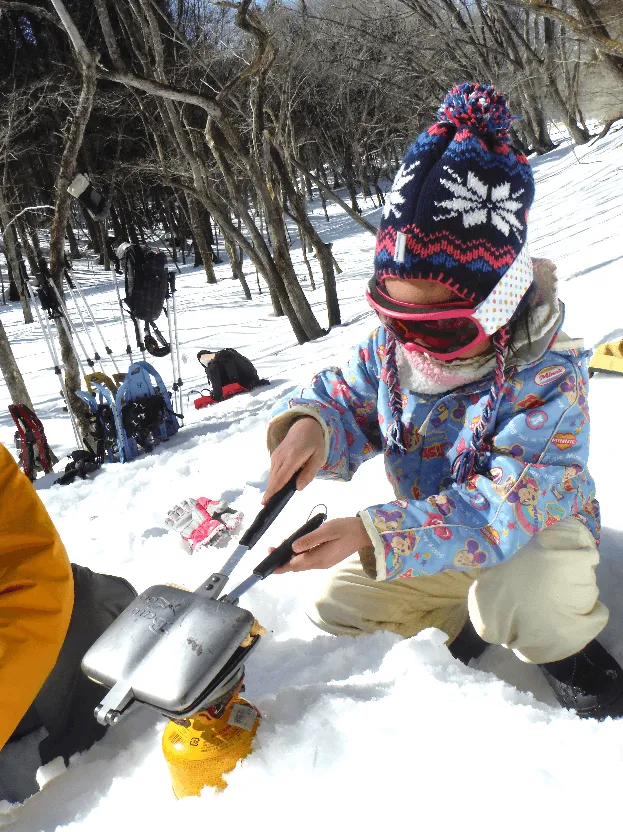
3. Nature Experiences Enhance Environmental Conservation Awareness
Even before the COVID-19 pandemic, there were concerns about the decline in children’s experiential activities in natural environments. This reduction in opportunities has diminished interest in nature and made it difficult to maintain natural environments—which serve as “places for physical and mental recovery.”
In 2012, the National Trust in the UK published a list titled “50 things to do before you’re 11 3/4,” outlining 50 nature-based activities children should experience by around age 12. It is said that activities experienced by this age are more likely to be repeated and maintained as habits later in life. The National Trust recommends engaging in these experiential activities both to protect the natural environment and to foster connections with family and friends.
In this way, experiential activities in natural environments are believed to not only promote physical and mental health but also foster an interest in nature and a future commitment to conservation, ultimately leading to the passing of these values on to the next generation.
4. Reclaiming Nature Deficit to Build Resilience
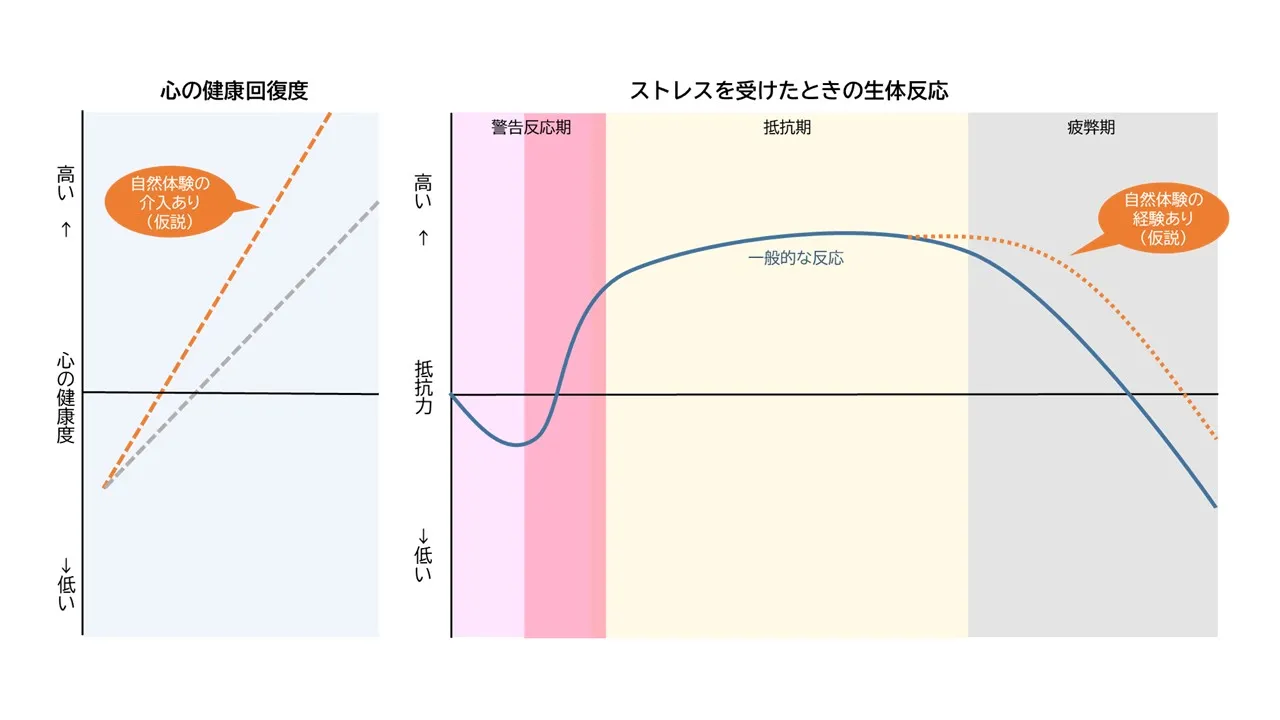
Generally, resilience to stress varies depending on the amount of time one is exposed to stressors. Immediately after exposure to a stressor, resilience temporarily drops, but afterward, the mind and body adopt a “fight against stress” mode. However, if this stress exposure persists, one becomes fatigued and exhausted from the struggle, leading to various physical and mental health issues. And now, as the COVID-19 pandemic drags on, I feel that children may be entering this “exhaustion phase.”
However, engaging in experiential activities in nature is expected to nourish exhausted minds and promote recovery. Furthermore, I believe it can help build a mental foundation that makes it harder for resilience to decline in response to stressors.
Japan offers a wealth of locations where children can engage in activities amidst rich natural environments, such as World Heritage sites, national and quasi-national parks, and geoparks. There are also places that provide health-conscious programs, such as forest therapy bases and health resorts. As a nature experience that nurtures the mind, it is desirable to engage in activities that offer a “thrill” and a sense of “accomplishment” in an “unfamiliar” setting.
There is a saying, “Send your children on a journey,” but this “journey” does not refer to “travel” per se, but rather to any kind of firsthand experience. I believe we should place greater value on experiential activities during childhood, utilizing them as opportunities for physical and mental growth and health promotion in natural environments, and preserving them for future generations.
<References>
・Ministry of Health, Labour and Welfare, “Report on the Results of the FY2020 Survey on Experiential Activities for Youth: Analysis of the Effects of Experiential Activities Using the 21st Century Birth Cohort Longitudinal Study,” September 8, 2021
・The Nippon Foundation and Mitsubishi UFJ Research & Consulting, “Survey on the Impact of the COVID-19 Pandemic on Educational Disparities and Non-Cognitive Skills Among Children,” June 29, 2021
・Research by Samantha Friedman et al. at the Center for Family Research, University of Cambridge
著者