[Special Contribution] “Tourism × Children’s Development and Travel Education” — Cultivating Non-Cognitive Skills Through Travel: What Is the Significance of Travel Education in a Society That Supports Parents for the Sake of Children’s Future?
For children’s growth and education, traveling—which offers a break from daily life—is an excellent opportunity to experience the breadth of society and diverse values.At a time when there are concerns that movement restrictions during the COVID-19 pandemic will affect children’s futures, it is essential for society as a whole to support learning through travel—which recognizes children’s talents and fosters non-cognitive skills such as self-esteem and communication skills. The author, who practices “travel-based education” firsthand and advocates for the “Travel-Based Education Method,” reflects on its benefits and social significance.
1. Why “Travel Education” Now? Timing Is Key to Children’s Learning
Watching my own child’s eyes light up with curiosity about all sorts of things, I discovered the potential of “fostering children’s growth through travel—Travel Education.” While putting this into practice myself, I have been sharing the significance and know-how of family travel as a “way to deepen the parent-child bond” and a “way to nurture a child’s growth.”Recently, I have been collaborating with local governments and companies to develop an environment for “Travel Education” geared toward the next generation.
Through my work supporting families, I feel that now—as we look toward the post-COVID era—it is more important than ever for children to learn through travel, and this is a golden opportunity to raise awareness of travel as an educational tool (“Travel Education”).
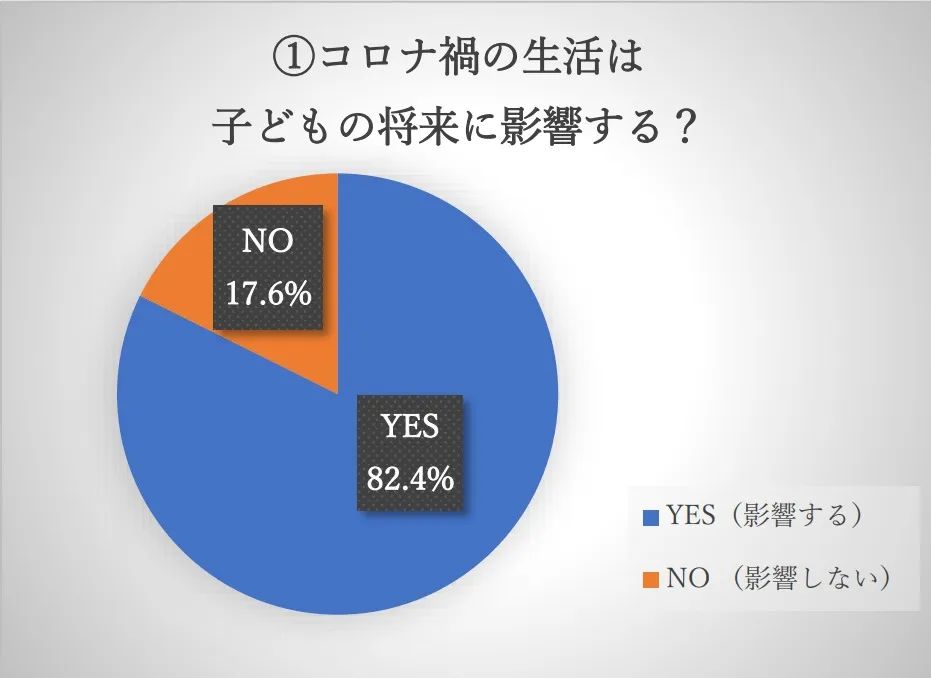
During the COVID-19 pandemic, children were forced to live under restrictions; events and field trips were postponed or canceled, depriving them of opportunities to have their efforts recognized and to encounter new experiences and take on challenges.In a survey (*1) of parents at elementary schools and kindergartens where I gave a lecture on “travel-based education,” 82.4% answered “YES (it will have an impact)” to the question, “Will life during the COVID-19 pandemic affect their future?”(See Graph 1). Reasons cited included “We were unable to provide them with necessary experiences at the right time” and “With reduced social interaction and the continued use of masks, I’m worried whether their communication skills are being nurtured.” These responses reveal a sense of concern that, for children who are growing every day, the timing of experiences and learning is crucial—and that things will not simply return to normal once the pandemic subsides.There were also many comments such as, “If circumstances allow, I want to let my child take on new challenges and have many experiences.” Furthermore, there is a growing sense of momentum—even among those who are not parents—to consider what can be done for the future of children who have lived through the pandemic.
When promoting “travel-based education,” it is essential to empathize with parents’ feelings and concerns. Taking into account the social environment surrounding parents and the sentiments of those who have weathered the pandemic, we will introduce the social significance and benefits of travel-based education for the tourism industry, along with concrete tips.
2. Travel Is an Opportunity to Recognize the Breadth and Diversity of Society
Although globalization and diversity are frequently discussed, children’s connections with society have become more tenuous than one might imagine. Changes in lifestyle—such as the shift toward nuclear families, the increase in dual-income households, and advances in IT technology—are the main factors, and the COVID-19 pandemic has further widened the gap between children and society.
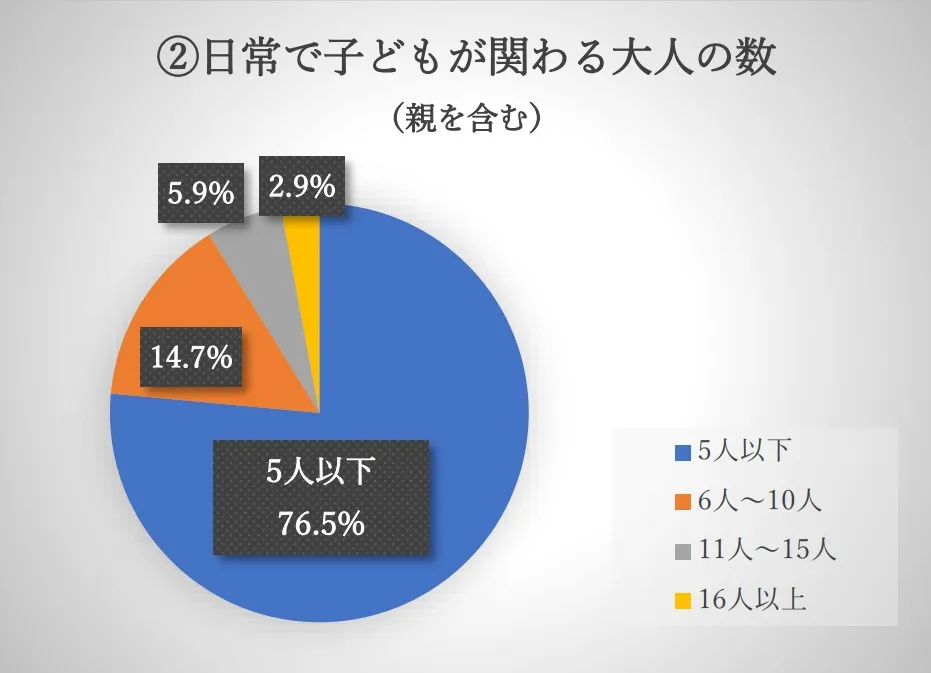
In the aforementioned parent survey, 76.5% of respondents reported that the “number of adults (including parents) with whom their child interacts on a daily basis” was “five or fewer” (see Graph 2). This likely includes parents, teachers at school or preschool, instructors for extracurricular activities, and the mothers of friends—that’s about it.The same trend has been observed in past surveys, indicating that children are spending their daily lives within a narrow and limited set of values. From a safety perspective, the rule “Don’t talk to strangers” has become firmly established in households, leaving children’s opportunities to learn about society dependent on just a few people, including their parents.
In the past, with grandparents often living under the same roof and vibrant community events fostering deep neighborhood ties, children had opportunities to experience intergenerational interaction and diversity without even trying. As society played a deeper role in child-rearing, it helped recognize strengths and talents that neither parents nor the children themselves were aware of, fostering self-esteem and helping them discover life goals.
Children tend to believe that their immediate surroundings represent the entirety of society; as a result, they may feel constrained by narrow values or become deeply troubled by trivial matters. Realizing that “my daily life is only a small part of the wider world” helps them develop resilience and live authentically.In today’s world, where it is difficult to recognize the breadth and diversity of society in daily life, it is necessary to consciously create such opportunities—and travel offers the perfect chance to do so. Many parents are unaware of just how narrow their children’s worldviews can be. I believe that if we in the tourism industry recognize the importance of travel for children, communicate this from a broader perspective, and take concrete action, it will create a significant societal movement that will become a pillar supporting Japan’s future.
3. “Non-cognitive Skills,” Which Are Gaining Attention, Are Nurtured Through Travel
The primary concern for parents today lies in “education”—specifically, “How should we raise our children so they can lead happy lives true to themselves?” As we enter an era of rapid and unpredictable change, the skills required by society and the nature of education (such as school curricula and university entrance exam systems) are also evolving.Replacing traditional knowledge and academic ability, so-called “non-cognitive skills” (social-emotional skills)—such as “self-esteem” and “communication skills,” which form the foundation for all activities—are gaining attention.
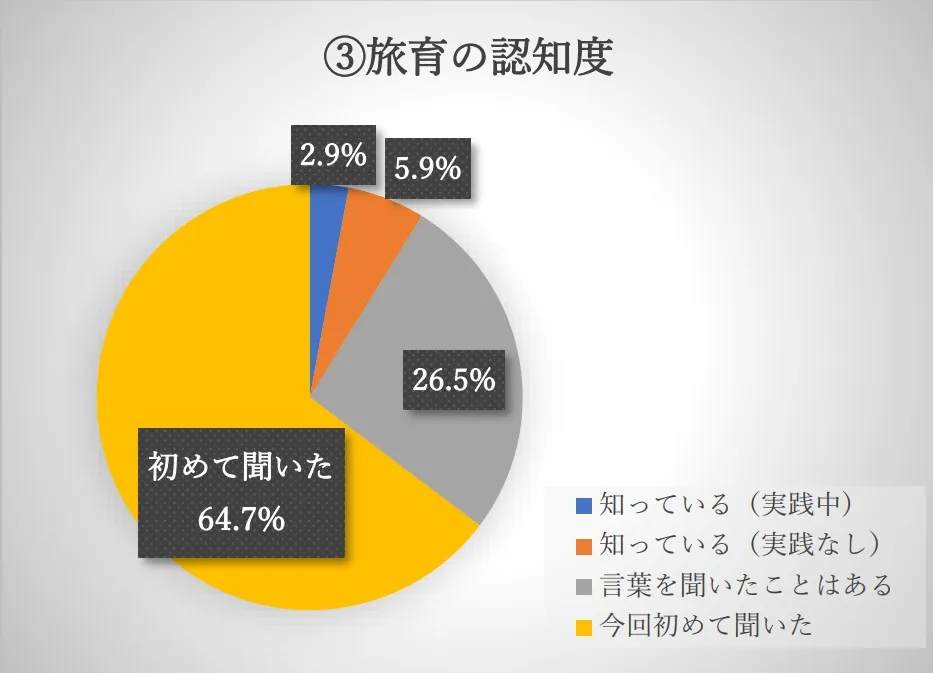
Many non-cognitive skills can be nurtured through travel, and while the goals of modern education align closely with the benefits of travel, most people do not think of travel as an educational tool (see Graph 3).Even when people understand the importance of “non-cognitive skills,” the reality is that they either go through a process of trial and error without knowing exactly how to apply them, or they continue to devote time and money to exam preparation just as they always have.
Travel to environments different from daily life is full of opportunities to build self-esteem—such as taking on new challenges and achieving success, or discovering new interests and passions.By interacting with many people and encountering diverse values, children learn to embrace diversity and hone their communication skills. The “joy of knowing and learning”—essential in an era of rapid change that demands continuous learning—can also be cultivated through the extraordinary experience of travel.
By carefully and specifically explaining questions such as “Why travel now?”, “How does travel contribute to a child’s growth?”, and “What should we keep in mind?”, while empathizing with parents’ concerns and proactively providing services and environments that anticipate their needs, we can help children lead better lives.
For the tourism industry as well, linking “education”—parents’ top concern—with “travel” offers significant benefits. For example, if the perception that family travel is “education, not just leisure” becomes widespread, parents will be more motivated to take time off, leading to longer stays and increased business on weekdays.If travel expenses are viewed as part of educational costs, they will be less susceptible to economic fluctuations, and budget increases can be anticipated.
Furthermore, in “travel education,” the question “What will we do?” is more important than “Where will we go?”—and the presence of famous tourist spots or facilities is irrelevant. With a little creativity, many regions can implement these initiatives, which can also contribute to regional revitalization.
4. Tips for Travel Education Initiatives—Based on the “Travel Education Method?”
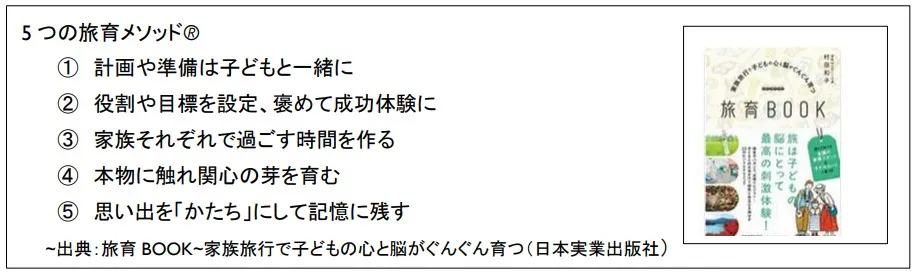
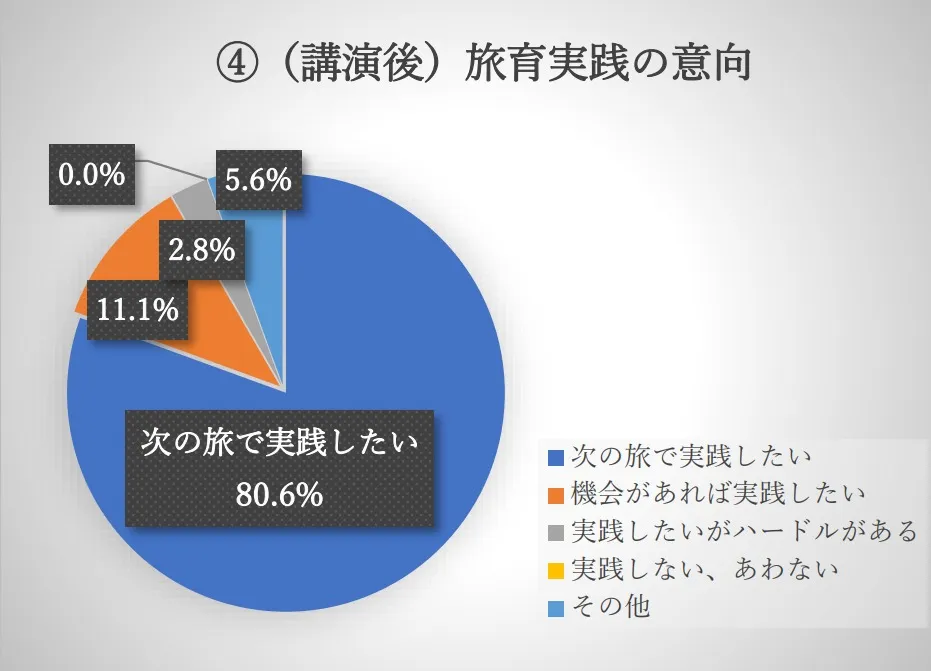
While travel itself is a treasure trove of learning, to maximize that learning, we have compiled and proposed communication tips to keep in mind as the “Travel Education Method?” (see below). This is intended for children aged 3 to 9. Parents who have learned about travel education through lectures and other events show a high level of motivation to put it into practice, reaffirming the potential of travel as an educational tool (see Graph ④).
To foster genuine growth during short trips, support from those around the child—not just parents—and a supportive environment are necessary. Below, based on the “Travel Education Method?,” we introduce initiatives and tips that tourism businesses can consider.
Plan and Prepare Together with Your Child
The success of “Travel Education” hinges on the pre-trip phase. Rather than parents planning everything on their own, planning together as a family boosts children’s motivation for the trip, encourages them to actively enjoy the experience, and enhances their learning.
Supporting pre-trip planning can also create a virtuous cycle for tourism businesses: “Deepening understanding of the region and facilities ⇒ Children enjoy themselves and grow ⇒ Satisfaction increases ⇒ Repeat visits (or word-of-mouth promotion, etc.).”
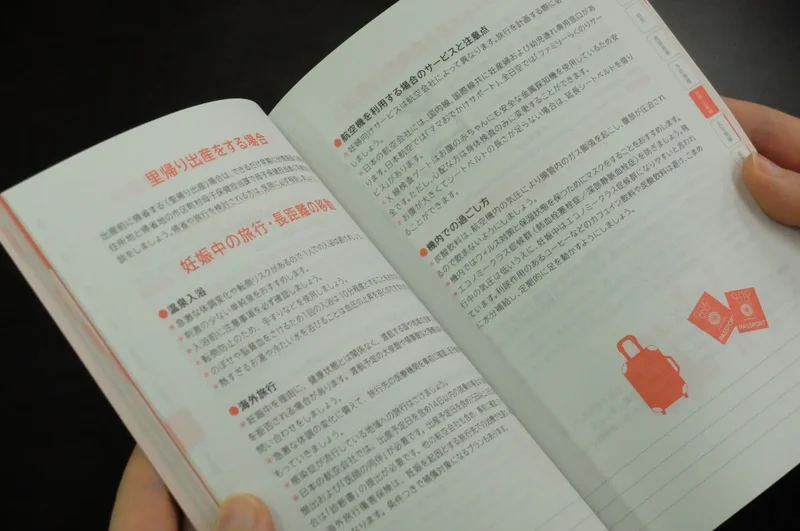
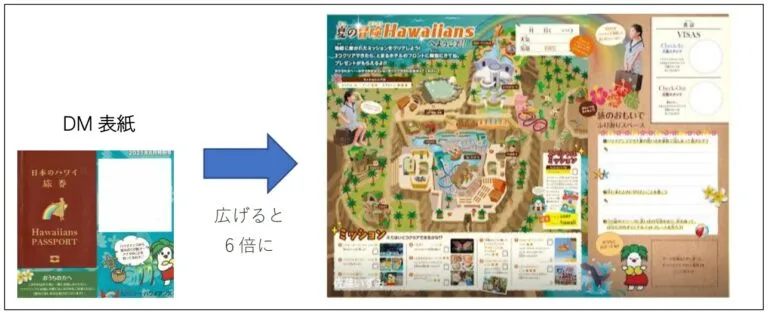
While IT tools like websites, email, social media, and online tours come to mind for pre-trip planning, direct mail (hereinafter “DM”) is also effective.In 2021, Spa Resort Hawaiians in Fukushima Prefecture created a DM for children; true to the resort’s style, the cover featured a passport design. When the folded insert is opened, it unfolds to reveal a large, full-page map of the resort, designed so that travelers can write down their travel plans.You can almost picture families gathered around the DM, excitedly asking, “What should we do?” This DM won the “Silver Prize” at the 36th All-Japan DM Awards, sponsored by the Japan Post.
“Hawaii in Japan” Passport: Summer Adventure at Hawaiians
This approximately 20-centimeter-square, folded direct mail piece expands to six times its original size when opened.It is designed so that children can take the lead in planning the trip and write down their travel memories afterward. By serving as a catalyst for family conversation, it was crafted to encourage visitors to come even amid the COVID-19 pandemic, when traveling was difficult. The number of reservations generated by this DM grew to 60% of pre-pandemic levels and was approximately five times higher than the previous year.Creating Time for Each Family Member to Spend on Their Own
By spending time away from their parents and with people they’ve never met before, children experience significant growth—broadening their horizons and honing their expressive skills. For parents, this provides time to recharge both mentally and physically; when the family reunites, they can share their experiences, leading to more active family communication.
Currently, the environment for programs and spaces where children—especially preschoolers—can have experiences on their own is not yet sufficient. From the perspective of workation initiatives, interest in places for children to stay while their parents work is expected to grow, and we feel it is necessary to move forward with developing such facilities. It is also important to provide and propose options for busy parents to refresh themselves.
Set Roles and Goals, and Praise to Foster a Sense of Achievement
By setting small goals, children take initiative on their own, and praising them when they succeed creates a sense of accomplishment. We should strive to “watch over rather than teach,” “respect children as travel companions,” and “praise their efforts.”
That said, parents have their own strengths and weaknesses, and as children enter the upper elementary school years—when the “rebellious phase” begins—there are increasingly more things parents simply cannot do.Staff at tourist attractions and lodging facilities are in a unique position to interact directly with children. Since parents are often feeling their way through parenting, staff can enhance the effectiveness of “travel education” by actively engaging—whether by supporting the learning that takes place during the trip or by recognizing a child’s strengths from a perspective different from that of the parents.
While there are various other ways to enhance “travel-based education”—such as expanding experiential programs—I’d like to highlight two common pitfalls to avoid.
(1) Don’t base your thinking solely on local or company resources
It is important to first envision the children’s growth through travel—asking questions such as, “What challenges do we aim to address?” and “How do we want the children to grow?” From there, by considering “What resources from the region or our own company can be useful?” and “What new elements are needed?”, you can create compelling initiatives that resonate with parents.
(2) Draw out children’s “I want to do this” and “That looks fun” reactions
The term “travel-based education” often leads to an overemphasis on “teaching” or “making children learn something,” which can result in services or products that are too knowledge-focused and lack excitement from the children’s perspective.What’s important is for children to think for themselves and make their own decisions—and for that to become a positive experience. Valuing children’s feelings of “I want to do this” and “That looks fun,” or devising ways to draw out those feelings, is the key to success.
5. As a Tourism-Oriented Nation and as an Investment in the Future
As mentioned at the beginning, there are concerns that the restricted lifestyles during the COVID-19 pandemic may lead to a decline in children’s non-cognitive skills, such as “self-esteem” and “communication skills.”
We cannot change the past, but we can change the future. To reiterate, travel provides an opportunity to discover a child’s talents and interests; successful experiences during travel lead to self-esteem, and it is not uncommon for a single experience on a trip to become the foundation for a child’s future goals and dreams.
The bonds deepened through family travel provide emotional stability, and the sense of pride and confidence gained from overcoming challenges—along with the pleasant memories of the trip—will remain with the child, serving as emotional support well into the future.
Eventually, children will grow up, and the day will come when they, as parents, take their own children on trips.
The fact that children nurtured through travel go on to live happily as their true selves and become individuals capable of thriving on the global stage brings benefits in various ways to Japan, a nation that relies on tourism. As a way of sowing seeds for the future, I strongly feel the social significance and necessity of engaging in “travel education” right now.
*1) Parent Survey: Conducted before and after a lecture on “Travel Education” held in July 2022, with the cooperation of Seitoku Gakuen Elementary School and Seitoku Kindergarten (n=34 before the lecture, n=36 after the lecture)
*2) Reference: The 36th All-Japan DM Awards
著者