"Kindness" Creates New Travel Opportunities: Considering Accommodations for Travelers with Young Children and Expectant or New Mothers
With the Act on the Elimination of Discrimination against Persons with Disabilities set to take effect in April 2016, “universal design” has been garnering increasing attention. Consequently, the tourism sector is also seeing a growing movement to develop the necessary infrastructure to promote “universal tourism,” where everyone can enjoy travel with peace of mind. This report, supported by JTB Tourism Research & Consulting, explores efforts to create a travel environment that everyone can enjoy.
With the Act on the Elimination of Discrimination against Persons with Disabilities set to take effect in April 2016, attention has been focusing on “universal design.” Consequently, the tourism sector is also beginning to take steps to improve infrastructure aimed at promoting “universal tourism,” where everyone can enjoy travel with peace of mind.
Recently, media reports have highlighted issues regarding strollers on public transportation and in urban areas. Travel by families with infants and young children, as well as by pregnant women, is also a key focus of universal tourism. As women’s participation in society continues to grow, opportunities for families with young children and pregnant women to go out and travel are expected to increase. However, in reality, many people still face both mental and physical challenges, indicating a need to foster greater societal understanding on both fronts.
With the aim of supporting the creation of a travel environment that everyone can enjoy, JTB Tourism Research & Consulting has established a specialized department to promote initiatives related to universal tourism. As part of these efforts, we have been commissioned by the Japan Tourism Agency to carry out the “Project to Promote Travel for Families with Infants and Pregnant Women,” which aims to promote and raise awareness about comfortable and safe travel for these groups. Simultaneously, as an independent initiative, we have included “Precautions for Long-Distance Travel and Trips” for the first time in the information section of the “Maternal and Child Health Handbook” published by the General Incorporated Association for the Promotion of the Parent-Child Health Handbook. This report covers these two initiatives.
1. Universal Design and Universal Tourism
"Universal Design" refers to design that can be used regardless of differences in culture, language, or nationality; differences in age, gender, or ability; or differences in disability or capability. "Barrier-free" refers to the removal of physical and psychological barriers.In Europe and the United States, where laws prohibiting discrimination against people with disabilities are already in effect, not only has the infrastructure been adapted, but an awareness of “coexistence” has taken root throughout society. It is recognized as a matter of course that everyone can enjoy life, even without explicitly advocating for “barrier-free” or “universal design.”
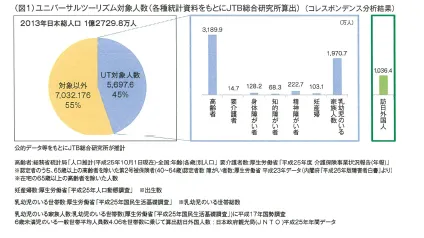
According to the Japan Tourism Agency, “universal tourism” refers to “travel designed so that everyone, including those who face some form of barrier when traveling, can participate without hesitation.” Its target audience is broad, encompassing the elderly, people with disabilities, pregnant women, those traveling with infants, and foreign visitors. According to our estimates, this group accounts for about half of Japan’s population, representing a significant market for a society facing a declining birthrate and an aging population (Figure 1).
Promoting universal tourism not only enables older adults and people with disabilities who have given up on travel to experience the joys of life and live a fulfilling life through travel, but also holds promise for preventive health benefits (the positive psychological and physical effects of travel).
2. The Importance of Promoting Travel for Families with Infants and Young Children and for Pregnant Women
In Europe and the United States, it is widely recognized that, just as with wheelchairs, the use of strollers requires consideration when going out or traveling. However, in Japan, understanding of travel by families with infants and young children, as well as pregnant women, has not yet fully developed among the general public, businesses, and other stakeholders. While one reason for this may be that the economic importance of this sector is not fully recognized by local communities and the tourism industry, promoting travel by families with infants and young children and pregnant women is expected to create the following travel opportunities.
- Expansion of a New Three-Generation Market
- Expansion of off-season demand through family trips and trips among mothers
- Children who travel frequently during their early years are more likely to make travel a habit in the future, fostering a future generation of travel enthusiasts
From a social perspective, family travel is expected to improve relationships within the family (such as between spouses) and foster mutual understanding, and it also appears to contribute to stress relief (refreshment) as a measure against postpartum depression.
3. About the Japan Tourism Agency’s “Project to Promote Travel for Families with Infants and Young Children and Expectant and New Mothers”
(1) Overview of the “Project to Promote Travel for Families with Infants and Young Children and Expectant and New Mothers”
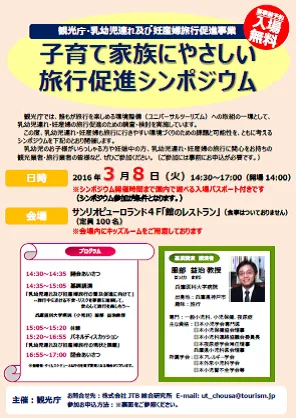
The Japan Tourism Agency is focusing its efforts on developing an environment for universal tourism. As part of these efforts, our company was commissioned to carry out the “Project to Promote Travel for Families with Infants and Young Children and Expectant and New Mothers” as a FY 2015 initiative. Through this project, we conducted surveys targeting consumers, local and tourism businesses, and travel agencies to identify the current state of travel and business initiatives, as well as the challenges that need to be addressed in the future.On March 8, we held a symposium (Photo 1) at Sanrio Puroland—a venue highly regarded for its family-friendly environment—to discuss measures for promoting the initiative and addressing challenges.Over 100 people attended the event, approximately half of whom were women traveling with infants. In a post-symposium survey, participants shared comments such as, “It was reassuring to know there are so many others facing the same challenges,” and “Hearing the travel experiences of the mothers on the panel, as well as the ryokan’s reception policies and the doctor’s advice, made me want to try traveling.” Some business operators also remarked, “I realized that if we don’t address this now, it will lead to a crisis in the future.”
(2) Survey and Results Regarding Travel with Infants and Young Children and Travel by Pregnant Women and New Mothers
The survey involved questionnaires, group interviews, and in-depth interviews to understand the actual travel habits and needs of consumers, as well as the current initiatives and challenges faced by local communities, tourism operators, and travel agencies, thereby clarifying the perspectives of both groups. The following are some of the findings.
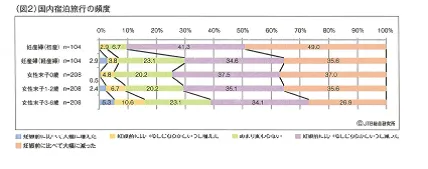
1) Compared to before pregnancy, travel frequency decreased for 75% of mothers with infants under 1 year old and 71% of mothers with children aged 1–2. The primary reason for both groups was “heavy luggage and physical strain.” “Causing inconvenience to others” was also frequently cited.
For mothers with children aged 3–6, travel frequency decreased by 61%. The main reason was “financial burden,” with rising travel costs being a major obstacle.
When asked how their travel frequency had changed before and after pregnancy, 90.3% of first-time expectant and new mothers reported a decrease in domestic overnight trips (combining those who answered “somewhat decreased compared to before pregnancy” and “significantly decreased compared to before pregnancy”). The rates were 75% for women (mothers) whose youngest child was 0 years old, 71% for those whose youngest child was 1–2 years old, and 61% for those whose youngest child was 3–6 years old (Figure 2).
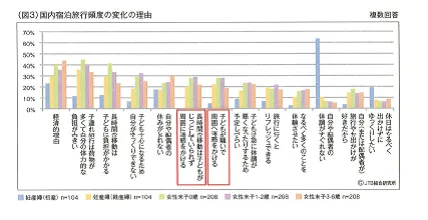
When asked about the reasons for changes in travel frequency, “feeling unwell” was the top reason during pregnancy. However, for mothers with children aged 0 or 1–2 years, the reasons were “financial burden,” “heavy luggage and physical strain,” and “the burden of traveling with a child.” There were also many responses citing “children causing a disturbance to others during long trips” and “children making noise and disturbing others” (Figure 3).
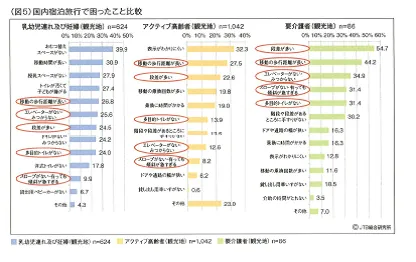
2) Regarding difficulties encountered at domestic travel destinations, mothers of 0-year-olds cited “breastfeeding spaces.” Mothers of 3–6-year-olds cited “the location of restrooms” and “restrooms being dirty, which children dislike,” while fathers of 0–2-year-olds cited “the lack of multipurpose restrooms.”
Next, we asked about difficulties encountered during domestic trips involving overnight stays by pregnant women, new mothers, and those traveling with infants and toddlers. The top responses were “lack of diaper-changing areas (39.9%)”, “long travel times (30.9%)”, “lack of breastfeeding areas (27.9%)”, and “dirty restrooms that children dislike (27.4%)” (Figure 4).By respondent group, pregnant women cited “steps” and “location of restrooms”; mothers of youngest children aged 0 cited “breastfeeding areas”; and mothers of children aged 1–2 cited “diaper-changing areas.”Mothers of children aged 3–6 cited “toilet location” and “toilets being dirty, which children dislike,” while fathers of youngest children aged 0–2 cited “lack of multipurpose restrooms,” indicating that toilet-related issues were frequently raised. Overall, difficulties were more commonly experienced during travel or while engaging in outdoor activities rather than at the accommodation itself, suggesting that the infrastructure needed to allow families to go out with peace of mind still has a long way to go.
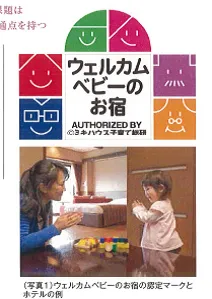
For reference, regarding lodging facilities, the Mikihouse Child-Rearing Research Institute’s “Welcome Baby Lodging” certification program certifies individual rooms at facilities that score 70 points or higher based on a 100-item checklist designed to ensure a safe and comfortable stay for families with infants and toddlers (Photo 2).
3) Tourism operators that actively promote travel for families with infants and young children, as well as pregnant women and new mothers, see increases in both the number of travelers and average spending through repeat business and multi-generational travel
We conducted interviews with tourist destinations, accommodation facilities, and travel agencies that actively promote travel for expectant and new mothers and families with infants to investigate the significance of such initiatives. While many establishments still refrain from participating due to perceived risks and the extra effort involved, we found that companies taking a proactive approach are capturing high-value customers: expectant and new mothers and families with infants are more likely to become repeat or regular customers, and they often engage in three-generation family trips, which tend to have relatively high per-person spending.We also found that since many of these travelers visit on weekdays or during the off-season, this contributes to evening out room occupancy rates.
(3) Improving facilities for travelers with infants or pregnant women ultimately leads to improved facilities for senior travelers
In Figure 4 above, we compared the results of this survey with those from the Japan Tourism Agency’s “FY2014 Universal Tourism Promotion Project,” which asked “active seniors” (seniors who do not feel restricted in going out) and “people requiring care” (as reported by their caregivers) about the difficulties they encountered during domestic overnight trips. “Long walking distances”“steps,” “multi-purpose restrooms,” and “elevators” were issues frequently cited by all groups: those traveling with infants or young children, pregnant women, active seniors, and those requiring care. The survey revealed that improving facilities for travelers with infants or young children, as well as for pregnant women, ultimately leads to improved facilities for older adults. The essence of universal tourism can be said to be that, with the right reception systems, support from companions, and the understanding of those around them, anyone who wants to travel can do so.
4. “Travel and Long-Distance Travel” Included for the First Time in the Information Section of the Maternal and Child Health Handbook
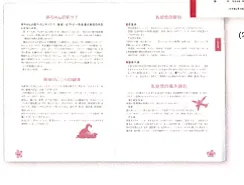
In our efforts to improve travel and transportation environments for families with infants and young children as well as pregnant women and new mothers, we noted that the Maternal and Child Health Handbook distributed by local governments to expectant mothers contains almost no information regarding travel.Consequently, we endorsed the activities of the General Incorporated Association for the Promotion of Parent-Child Health Handbooks (hereinafter the “Association”) under its “Let’s Change Japan’s Maternal and Child Health Handbook Project.” As a result, we were able to include key points regarding “travel and long-distance travel” on the information page of the Association’s Maternal and Child Health Handbook for the first time (Photo 3).Furthermore, this handbook is scheduled to be distributed to pregnant Japanese nationals residing overseas through Japanese embassies and consulates general in various countries via the Ministry of Foreign Affairs, and we have donated copies from our company.
(1) What is the Maternal and Child Health Handbook, a system born in Japan?
The Maternal and Child Health Handbook system is a unique Japanese system that began in 1948, during the post-war reconstruction period. It is said that the system has made a significant contribution to the dramatic improvement in the infant mortality rate since 1950, which has now become the lowest in the world. Under the current system, the handbook is typically issued by the mayor of the applicant’s municipality upon confirmation of pregnancy.The handbook contains essential health and childcare information for expectant mothers and infants, and it also allows expectant mothers to record their own prenatal and postnatal experiences.
In recent years, efforts by the Ministry of Foreign Affairs and JICA (Japan International Cooperation Agency) to spread the excellent system of the Maternal and Child Health Handbook to emerging nations around the world have begun to yield results. Recently, it was reported that among the few belongings carried by refugees who fled from Syria to Europe, there were Maternal and Child Health Handbooks.
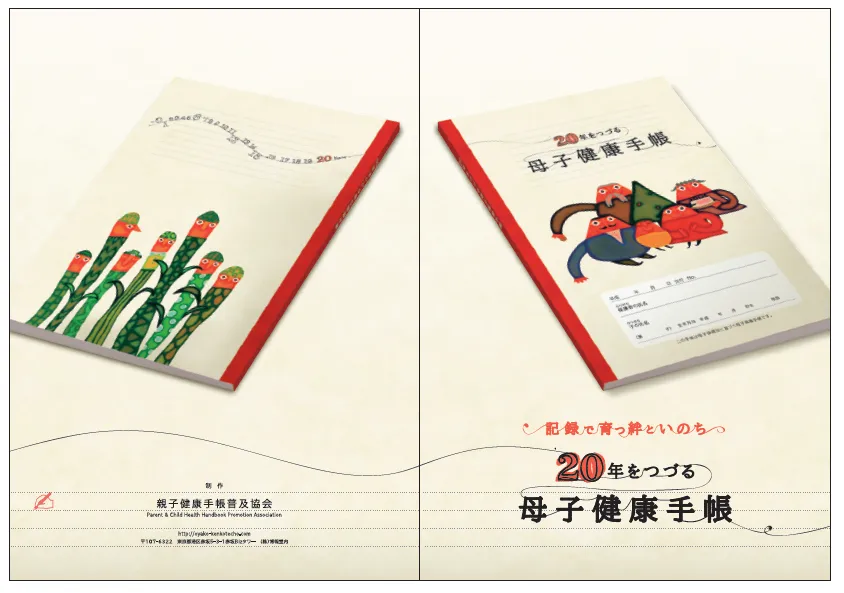
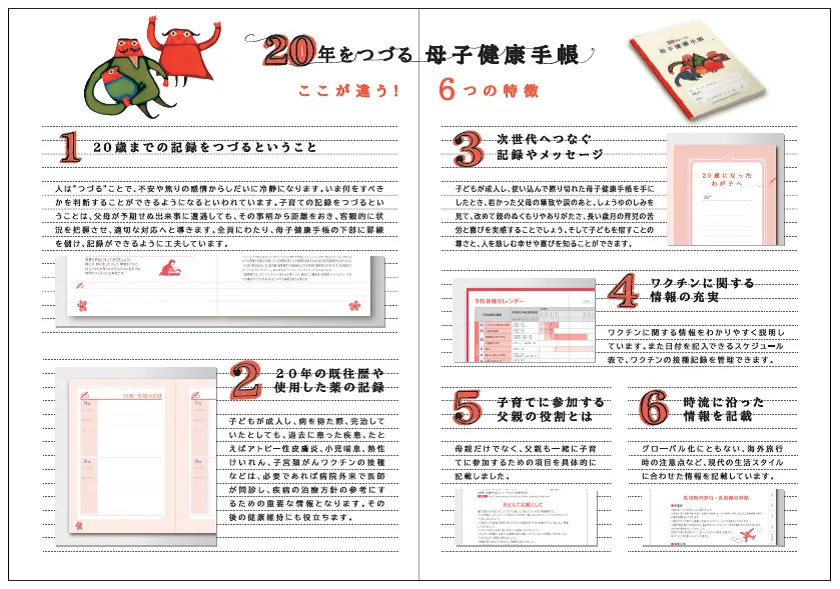
The Parent-Child Health Handbook Promotion Association aims to improve child-rearing environments both domestically and internationally by promoting the use of the Maternal and Child Health Handbook in local governments across Japan and in developing countries overseas. To this end, the association produces and sells the handbooks and conducts awareness campaigns to promote their use.Based on the Maternal and Child Health Act, the Association has created the “20-Year Maternal and Child Health Handbook,” which allows parents to record their child’s development from the fetal stage through age 20. This handbook serves as a lifelong record of medical history and vaccination status, helping to maintain health even after the child reaches adulthood. (Photo 4)
(2) The Background Behind the "Travel and Long-Distance Travel" Section in the Maternal and Child Health Handbook
We often hear that people overseas do not refrain from traveling with infants and toddlers to the same extent as Japanese people do. In Japan, as revealed by the aforementioned survey, opportunities for outings and travel have clearly decreased. Furthermore, the trend toward nuclear families has led to a growing number of mothers suffering from postpartum depression due to anxiety and loneliness during child-rearing. Although not scientifically proven, it is thought that freeing mothers from the isolation of life with just their baby and allowing couples to communicate while traveling may help prevent postpartum depression.In the Maternal and Child Health Handbook, under the sections on travel and long-distance travel, we have organized the information so that the details you need to know and the points to consider are clearly visible at a glance, categorized by the three stages: “during pregnancy,” “traveling with an infant,” and “traveling with a toddler” (Photo 5).
The recognition that travel with infants and toddlers, as well as travel by pregnant women and new mothers, constitutes universal tourism remains limited not only among tourism operators but also among the individuals directly involved and society at large. As indicated by a survey in which many fathers of 1- to 2-year-old children reported inconvenience due to the lack of multipurpose restrooms, there appears to be a reality where physical infrastructure has yet to catch up, even though there is a desire to support childcare. At the same time, it is necessary to urgently broaden public understanding beyond just those directly involved. Supporting travel for families with infants and young children, as well as expectant and new mothers, ultimately leads to support for travel by the elderly and people with disabilities. “Kindness” undoubtedly creates new opportunities for mobility.