"Reasonable Accommodations" from the Perspective of Universal Tourism

In May 2021, the “Amended Act on the Elimination of Discrimination against Persons with Disabilities” was enacted, making the “provision of reasonable accommodations” mandatory for private-sector businesses within the next three years, rather than merely a recommended practice. In this column, we will examine what “reasonable accommodations” entail from the perspective of universal tourism and discuss what steps should be taken in light of this new requirement.
The Act on the Elimination of Discrimination against Persons with Disabilities, which came into effect in 2016, “prohibits government entities—including the national government, prefectures, and municipalities—as well as businesses such as companies and stores, from discriminating against people with disabilities on the basis of their disability without justifiable grounds. ”In May of this year, the “Amended Act on the Elimination of Discrimination against Persons with Disabilities” was enacted, and within the next three years, the “provision of reasonable accommodations” will shift from a best-effort obligation to a mandatory requirement for private-sector businesses. When something is mandated by law, many people may feel daunted about what exactly they need to do. In this column, we will examine what “reasonable accommodations” mean from the perspective of universal tourism and discuss what steps should be taken now that they have become mandatory.
Please note that this article uses two different spellings: “disability” and “handicap.” Our group uses “handicap” when referring to people, and “disability” when referring to legal terms and societal barriers. We will use the original spelling as provided by the source.
1. The Ambiguity of “Reasonable Accommodation” in the Act on the Elimination of Discrimination against Persons with Disabilities
"Reasonable Accommodation" refers to "consideration that is reasonable and appropriate. "Under the Act on the Elimination of Discrimination against Persons with Disabilities, public and private entities are required to provide “reasonable accommodation”—measures taken within a reasonable scope—when requested by a person with a disability to remove barriers. Reasonable accommodation is understood as a state in which the intentions of both the party requiring accommodation and the party providing it align. To achieve this state, the following three conditions must be met:
- The measure must be intended to remove “social barriers” that act as obstacles for the person requiring accommodation
- The measures must be tailored to the “individual needs” of the person requiring accommodation
- It must not impose an “undue burden” on the party providing the accommodation
What specific situations would satisfy these conditions?
Regarding (1), for example, suppose a wheelchair user is having difficulty at a location with only stairs. Since the absence of stairs would resolve the issue, the social barrier in this case is the staircase. It is necessary to remove the barrier (i.e., the stairs) for the wheelchair user.
Regarding (2), a common misunderstanding is when a person with a visual impairment asks to be guided to a restroom, and the person guiding them directs them to a multi-purpose restroom. For a person with a visual impairment, a large restroom is full of barriers because they cannot see where things are located. If the accommodation does not match their individual needs, it becomes misguided. It is important to discard the assumption that “all people with disabilities face the same difficulties.”
Regarding (3), there is concern about the burden placed on businesses providing these accommodations. We are not demanding that businesses “meet every unreasonable request” simply because they are asked for assistance.
For the conditions mentioned above to be met, communication between both the person requiring assistance and the provider of accommodations is essential. If you see a wheelchair user struggling with stairs, ask, “Where would you like to go?” Even if the response is “I want to go up those stairs,” it is difficult for a business to immediately make those stairs barrier-free. In such cases, a process is needed to propose and provide reasonable accommodations—such as guiding the person to an alternative route—to resolve the problem.
However, when you think about it, this kind of communication seems like something we do on a daily basis. Laws and guidelines do not provide clear standards or boundaries for reasonable accommodation, and this lack of clarity seems to be one reason why people feel apprehensive. So why has it become mandatory, and what will change as a result?
2. Why Was Reasonable Accommodation Made Mandatory for Private Businesses?
Of the two major measures in the “Act on the Elimination of Discrimination against Persons with Disabilities,” which came into effect in April 2016, the “prohibition of unfair discriminatory treatment” is an “obligation” for both government agencies and private businesses. However, regarding the provision of reasonable accommodation, it is an “obligation” for government agencies but only a “duty to make efforts” for private businesses.
Reviewing the discussions within the Cabinet Office’s Committee on Disability Policy at the time the bill was enacted reveals that a major point of contention regarding the obligation to provide reasonable accommodation to private businesses was the lack of clarity regarding what exactly needed to be done and to what extent. Consequently, the law was enacted with a provision stating that only government agencies would be subject to a legally binding “obligation,” while private businesses would be subject to a “duty to make efforts.” The intention was to accumulate case law and judicial rulings on the matter and “review the provisions three years after the law’s enforcement.”
Subsequently, during the committee’s deliberations on the amendment, the central debate centered on the lack of consistency between the bill—which imposed only a “duty to make efforts”—and the “Convention on the Rights of Persons with Disabilities,” adopted by the United Nations and ratified by Japan in 2014, which mandates reasonable accommodation to ensure the social participation of persons with disabilities. Consequently, the committee established the principle that failing to provide necessary accommodations for persons with disabilities when capable of doing so constitutes unfair discrimination. Business associations also agreed to the mandatory requirement based on the principle that “socially constructed barriers created by businesses must be removed in accordance with social norms,” and the “Amended Act on the Elimination of Discrimination against Persons with Disabilities” was enacted. With this mandatory requirement, private-sector businesses are now required to be even more aware of the social barriers they have created and to take steps to eliminate them. This measure is intended to prevent situations where necessary accommodations are not provided despite the ability to do so.
3. Tokyo Metropolitan Government’s Pioneering Efforts to Mandate This Through Ordinance
Prior to this legal amendment, the Tokyo Metropolitan Government was quick to mandate the provision of reasonable accommodations in October 2018. Since the decision to host the Tokyo 2020 Olympic and Paralympic Games (hereinafter, the Tokyo 2020 Games) was made in 2013, the Metropolitan Government has been promoting barrier-free initiatives in both physical infrastructure and service systems to welcome a diverse range of visitors.
To realize the “inclusive society” legacy of the 2020 Tokyo Games, the Tokyo Metropolitan Government promoted “accessible tourism” (Note 1)—aiming to create a city where anyone can comfortably enjoy tourism—and our company was also involved in this effort. To raise awareness among tourism-related businesses, the following initiatives were implemented alongside the 2018 mandate for reasonable accommodation:
- 2016– Present: Consultant Dispatch Program for Hardware and Software Barrier-Free Initiatives
- 2017–: Regular holding of seminars to promote accessible tourism
- 2017–: Regular symposiums on promoting accessible tourism
- 2019–: Project to promote barrier-free accommodations (dispatching advisors, holding seminars)
Survey results from seminars on accessible tourism and related topics indicate that an increasing number of businesses are developing a positive view of accessible tourism.
Furthermore, Tokyo Metropolitan Government initiatives, various projects, barrier-free information, and business operator initiatives have been consolidated and made accessible to everyone on the “Tokyo Accessible Tourism Portal Site.”
While the Tokyo Metropolitan Government’s initiatives are based on the 2020 Tokyo Games, their background lies in the 1964 Tokyo Olympic and Paralympic Games (hereinafter referred to as the 1964 Tokyo Games). Since this was the first time the term “Paralympics” was used globally, it holds special significance. At the 1964 Tokyo Games, Japanese athletes participated as part of their rehabilitation while still in the hospital, but foreign athletes reportedly enjoyed sightseeing after their matches and even indulged in alcohol in the evenings. Many Japanese people were deeply moved by this, and it likely served as a major catalyst for the independence and social participation of people with disabilities in Japan.
(Note 1) “Universal Tourism” is a term used by the Japan Tourism Agency; it is a portmanteau of “Universal Design” (designs and layouts that are easy for everyone to use) and “Tourism.” Since this term is unfamiliar to people overseas, the Tokyo Metropolitan Government uses “Accessible Tourism,” which is commonly used internationally. Both terms mean “initiatives that allow everyone to enjoy travel.”
4. Aiming for a World Where Seeing Wheelchair Users Riding Roller Coasters Is a Common Sight
As mentioned at the beginning of this text, reasonable accommodation is defined as a state where three conditions are met: (1) “social barriers” are removed, (2) it meets “individual needs,” and (3) it does not impose an “undue burden” on the provider. The primary objective of the recent legal amendments mandating obligations for private-sector businesses is the elimination of social barriers. However, especially regarding physical infrastructure, this often requires significant funding and time, and not all issues can be addressed immediately. Furthermore, when it comes to addressing individual needs—where clear standards cannot be established—we must rely on human effort. It is essential to implement measures that avoid imposing an undue burden.
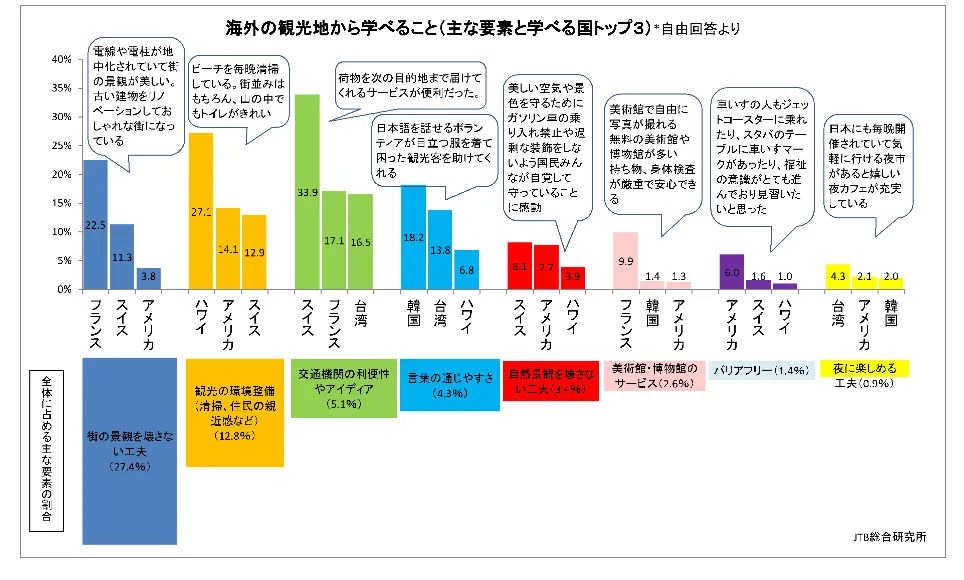
Our survey conducted in 2016 yielded some interesting results. When we asked general international travelers, in an open-ended format, “What did you think Japan should learn from your travel destination?”, we received comments regarding barrier-free accessibility (Figure 1). Among these, the statement “I saw a wheelchair user riding a roller coaster” was particularly striking. Given current attitudes in Japan, few people would likely view that scene as normal.
Going forward, to create a society where everyone can live comfortably and eliminate social barriers, a further shift in mindset is necessary. If business operators assume that “wheelchair users cannot ride roller coasters,” then roller coasters will remain designed without considering wheelchair users. If this becomes a legal requirement, operators must provide reasonable accommodations when a wheelchair user expresses a desire to ride. Even if they cannot fully meet the need, they will still have to go through a lengthy process to reach a consensus. What is crucial is to incorporate reasonable accommodations—specifically, the assumption that wheelchair users will ride—right from the initial design phase of the roller coaster. For example, installing an elevator to the boarding area or introducing a roller coaster with no steps when transferring to the seats makes it accessible to a wider range of people.
Moving forward, as we consider how to build an inclusive society, the very first step in creating or launching anything will be crucial. It is also necessary to see, hear, and experience things firsthand in order to dispel preconceived notions. If we can build a society that prioritizes accessible design and accessibility from the very beginning, a time will surely come when the sight of wheelchair users riding roller coasters becomes perfectly natural in Japan as well.
著者