Toward Hot Springs Everyone Can Enjoy: Insights from a Pilot Project in Higashi-Naruko Onsen, Miyagi Prefecture
To explore how to achieve diversity in hot spring resorts, we will examine the “People-Friendly Hot Spring Resort Project” in Higashi-Naruko Onsen, Miyagi Prefecture, which promotes initiatives aimed at creating a hot spring resort where everyone can enjoy themselves through the use of private baths available to all guests.
For those who feel uncomfortable being naked in public, hot spring facilities and inns that offer private baths can be a great source of comfort. While society as a whole is making efforts to embrace diversity—the acceptance of diverse values—we will examine the implementation of diversity in hot spring resorts using the “People-Friendly Hot Spring Resort Project” in Higashi-Naruko Onsen, Miyagi Prefecture, as a case study. This project aims to create hot spring resorts that everyone can enjoy.
1. Higashi-Naruko Onsen “People-Friendly Hot Spring Resort Project”
It is likely that there are more people than one might expect who feel uncomfortable being naked in public and require private baths. If everyone could use private baths freely, anytime they wish, wouldn’t more people be able to enjoy hot springs more comfortably?
Launched in 2012, the “Pink Ribbon Inn Network” includes over 100 member accommodations nationwide where even those who have undergone breast cancer surgery can stay with peace of mind. Many of these facilities offer services designed to minimize the risk of being seen naked by other guests, such as shower partitions, bath robes, and private baths.
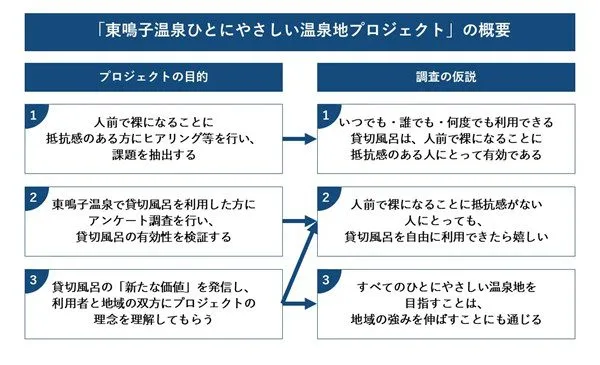
During my college days, I was part of a club that frequently visited Higashi-Naruko Onsen in Osaki City, Miyagi Prefecture, where I helped promote the culture of hot spring therapy. Hot spring therapy is a traditional travel culture involving long-term stays at hot spring resorts for the purpose of physical and mental recuperation, convalescence, and rest. Believing that Higashi-Naruko Onsen—which still strongly preserves the traditions of hot spring therapy—could become a resort where everyone can enjoy themselves by incorporating a diversity perspective, I launched the “Higashi-Naruko Onsen: A Hot Spring Resort Kind to People Project” in 2019 (Figure 1). The key points are as follows.
- Seven of the 11 inns offer private baths that guests can use freely at no additional charge
- The amenities and services at the hot spring inns are simple and user-friendly for most people
- The tradition of Higashi-Naruko Onsen, which has continued for 1,300 years, of welcoming all people regardless of social status, serves as the foundation for an environment where everyone can comfortably enjoy the hot springs
While the “People-Friendly Hot Spring Resort Project” is intended for “everyone,” this time we conducted a survey specifically targeting transgender and non-binary individuals (Note 1) as well as those who have undergone breast cancer surgery.
Another objective of this project is to promote the value of private baths. Private baths have been used by many people even before the “People-Friendly Hot Spring Resort Project” began. By viewing private baths as the “foundation for everyone to truly enjoy the hot springs,” we can elevate the services of the inns into attractions for the entire region. We believe that by highlighting the new appeal of “what already exists,” we can contribute to the creation of a sustainable tourist destination.
Note 1: People with diverse sexual orientations and gender identities are sometimes referred to as “LGBTQ+.” This acronym is derived from the initials of Lesbian, Gay, Bisexual, Transgender, Queer (a self-identity that views sexual minorities in a positive light), and Questioning(those who have not yet determined or are unsure of their sexual identity).
2. Diverse Needs Regarding Hot Springs That Are Often Overlooked
Recently, Japan Airlines made headlines for discontinuing the phrase “Ladies and gentlemen” in its in-flight announcements starting in October 2020. This was done because gender is irrelevant to airline service and to show consideration for passengers of various gender identities. In the case of hot springs, while many people may not realize it, for transgender and non-binary individuals, choosing which bath to enter based on their physical or legal gender can be a painful experience. This is because they are not only forced to make a “gender” choice but are also effectively declaring that choice to those around them.
When the author conducted a survey on hot spring usage among people of diverse gender identities, the following experiences were shared. While people of various gender identities live their lives and travel, there are still many services designed with the majority in mind.
- I have been stared at by other bathers
- As a non-binary person, I feel uncomfortable entering the women’s bath
- It’s difficult to use facilities when the amenities differ between men’s and women’s sections
- When staying at a hot spring inn as a same-sex couple, I felt uncomfortable when the staff went out of their way to say, “You’re just friends, right?”
Rather than “special treatment,” ensuring that everyone can spend their time comfortably and naturally is crucial for creating a community open to all. In the context of hot springs, private baths that anyone can easily use are one solution. For those who feel uncomfortable in large communal baths, this allows them to enjoy the hot springs with peace of mind. Even for those who don’t feel uncomfortable, they can enjoy the hot springs alone or with a companion without any reservations.
In interviews with transgender individuals, we heard comments such as: “I sometimes stay at hot spring inns with private baths in the guest rooms, but the rates are high, so I can’t use them often”; “I use mixed-gender baths too, but I feel uncomfortable about being seen naked in the changing room”; and “For transgender people, simply knowing whether private baths are available is helpful.”
3. Pilot Project at Higashi-Naruko Onsen
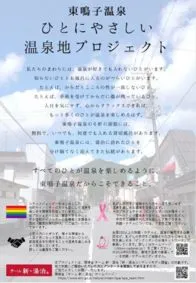
In September 2019, coinciding with a local event, the “People-Friendly Hot Spring Resort Project” also began its pilot phase. We distributed pamphlets (Figure 2) at various facilities, including participating inns, and conducted a questionnaire survey among guests staying at the participating inns.
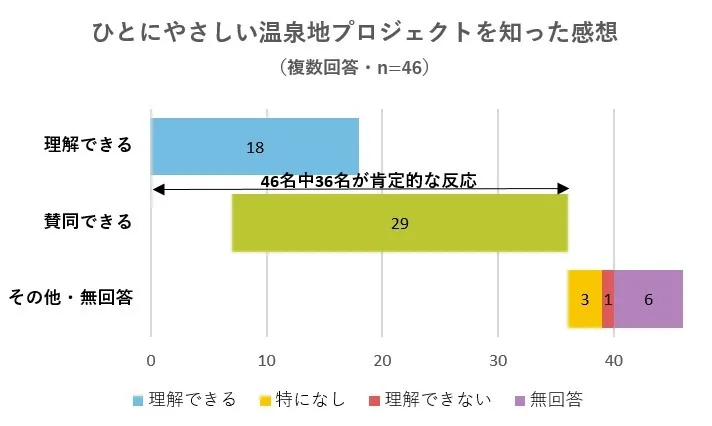
We received responses from 46 guests, 36 of whom expressed understanding or support for the project. Comments in the open-ended section included: “I’m neither a member of a sexual minority nor a breast cancer patient, but I appreciate the private baths,” “I’d like to recommend this to a friend who has had breast cancer,” and “I can recommend this to elderly people who feel uncomfortable using communal baths. ”It became clear that private baths—which guests can use anytime, by anyone, and as often as they like—are highly valued, and that this project is generally understood or supported (Figure 3).
To gather more detailed feedback, we invited four individuals who had undergone breast cancer surgery, a transgender person, and a supporter of sexual minorities to actually stay at the facility. As a result, we received positive feedback such as, “I was happy to learn about the project,” and “I was able to take a hot spring trip for the first time in a long while.”
On the other hand, we also heard calls for greater understanding of diverse sexual identities, as well as for the organization and dissemination of information, highlighting challenges for the future.
4. The simple services offered by hot spring inns provide a clue to creating a “People-Friendly Hot Spring Resort”
Private baths hold the potential to accommodate a wide range of needs for those wishing to enjoy hot springs. They offer the possibility for various individuals—such as foreign visitors who feel uncomfortable being naked in public, ostomates using colostomy bags or urostomy bags, and people with tattoos—to comfortably enjoy the hot springs. And of course, regardless of whether or not they have specific reasons for feeling uncomfortable being naked in public, many people are likely to appreciate having access to private baths.
At the same time, it is necessary to address a variety of needs beyond private baths. For example, individuals undergoing cancer treatment may become sensitive to odors, requiring facilities to implement measures such as designated smoking areas or smoke-free zones. Furthermore, for members of the LGBTQ+ community, gender-neutral amenities and services are key to ensuring a comfortable stay.
Furthermore, it may be necessary to reevaluate whether ryokan services that emphasize gender differences—such as women-only amenities or luxurious yukata—are truly appreciated by all guests. Simple services, such as those offered at hot spring inns that accommodate long-term stays, have the potential to meet diverse needs. There are examples where guest satisfaction has increased by consolidating amenities in the lobby area or communal baths rather than placing them in guest rooms, thereby reducing costs while allowing guests to freely choose the amenities they prefer. If reviewing these services also improves the inn’s productivity, wouldn’t this be an initiative that is also considerate of the staff working there?
Currently, with the spread of COVID-19, ensuring safety and maintaining operations are critical challenges. However, the days when we can travel freely will surely return. To ensure that everyone can enjoy the hot springs to the fullest, we will continue the Higashi-Naruko Onsen “People-Friendly Hot Spring Resort” Project.
This project was carried out as part of the “Naruko Youth Hot Spring Therapy” initiative by the University of Tokyo Hot Spring Club OKR (Okeru). It was selected for the Ministry of the Environment’s Team New Hot Spring Therapy “New Hot Spring Therapy Content Model Survey,” which provided us with the opportunity to conduct a monitor stay survey. We are grateful to the Ministry of the Environment’s Hot Spring Area Protection and Utilization Promotion Office for supporting this unprecedented initiative, and to the Japan Travel Bureau (Public Interest Incorporated Foundation) for serving as the secretariat, sharing our sense of purpose, and providing enthusiastic support. In conducting the survey and preparing the materials, we received full cooperation from members of “The University of Tokyo TOPIA,” an organization of sexual minority individuals and their supporters. We also received valuable feedback from various perspectives from the members of “Pink Ring,” a support group for young breast cancer patients. We would like to express our sincere gratitude to everyone.
Sources
: Pink Ribbon Inn Network website
; Japan Airlines press release “Japan’s First ‘JAL LGBT ALLY Charter’ Wins Japan Tourism Award”;
University of Tokyo TOPIA/Tottoko website “Changing Society from the University of Tokyo: Komaba Festival 2019”
著者