Preservation of Local Nature and Culture and Tourism

There is a growing social demand for forms of tourism—such as ecotourism and adventure tourism—that allow visitors to immerse themselves deeply in a region by experiencing its nature and culture firsthand. What role do nature and culture play in local communities? In this paper, we examine the value of nature and culture as tourism resources by exploring the objectives and methods communities use to preserve them.
1. The Relationship Between Nature, Culture, and the Local Community
If you look up the terms “nature” and “culture” in a dictionary, they are defined as follows:
“Nature: Mountains, rivers, grass, trees, and all other things in this world, excluding those altered by human hands. The natural, unaltered state of things, untouched by human intervention.
Culture: The entirety of human lifestyles. The totality of tangible and intangible achievements built up by humanity through its own efforts.
(Source: Shogakukan Digital Daijisen)”
In other words, while nature refers to the unaltered state of things untouched by human hands, culture refers to the achievements built up by humans and the way of life itself.
In this column, we define nature as mountains, rivers, grass, trees, the sea, and other things that exist as they were born, without human intervention, and culture as the tangible and intangible achievements that humans have built with their own hands.
Many travelers seek experiences unique to a particular region, such as “enjoying natural landscapes” or “experiencing unique culinary cultures.” Since regional cultures have been shaped through interaction between regions while adapting to their respective natural environments, nature and culture share a deep relationship, which defines a region’s uniqueness. And it is precisely this uniqueness that serves as a key factor in differentiating a region from others.
To discover a region’s appeal and sustain its value over the long term, the conservation of nature and culture is essential. Conservation can be seen as the foundation for building an attractive tourist destination.
2. National Initiatives Focused on Nature and Culture Tourism
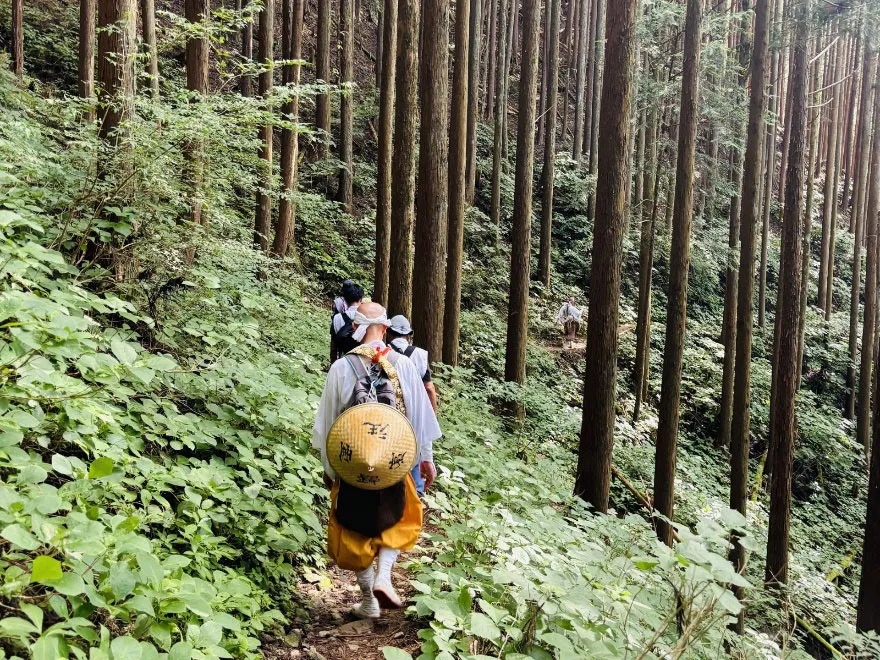
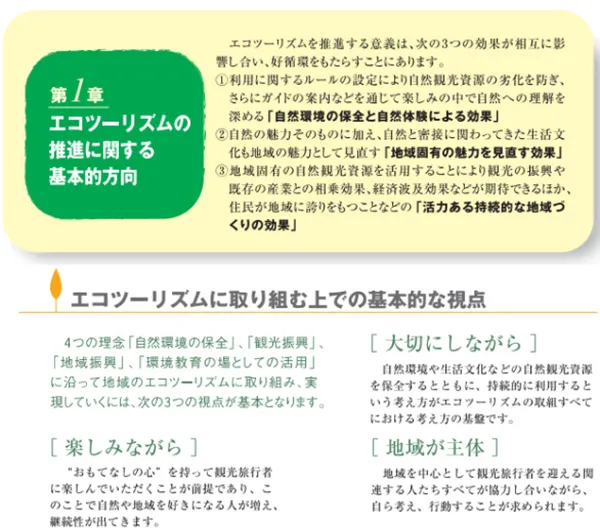
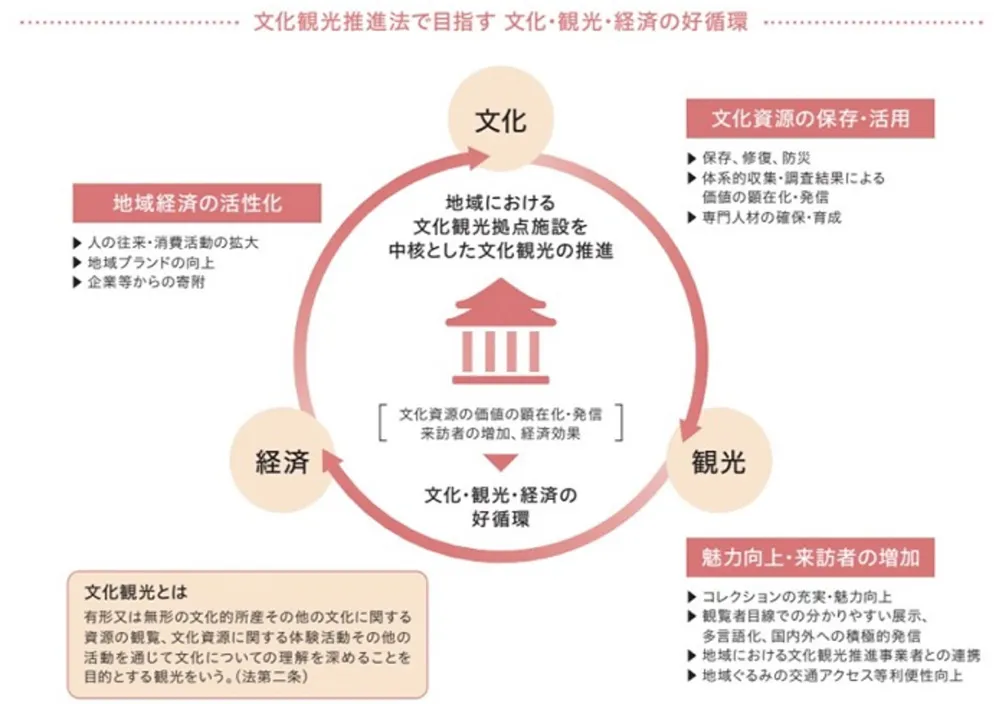
In terms of tourism policies regarding nature and culture, there are two important laws: the “Act on the Promotion of Ecotourism” (enacted in 2007) and the “Act on the Promotion of Cultural Tourism in Regions Centered on Cultural Tourism Hub Facilities” (Act on the Promotion of Cultural Tourism, enacted in 2020).
The Act on the Promotion of Ecotourism was established to provide a comprehensive framework for promoting appropriate ecotourism. This was in response to a situation where, as the number of ecotourism initiatives increased, simple nature experience tours that lacked environmental consideration were mistakenly labeled as ecotours, and cases of environmental degradation were observed. The purpose of the law is to promote the conservation of the natural environment, tourism, regional development, and environmental education
.
On the other hand, the Cultural Tourism Promotion Act defines “cultural tourism” as travel aimed at deepening understanding of culture through viewing cultural resources and participating in experiential activities. It was enacted with the goal of linking this to the promotion of tourism and regional revitalization, thereby creating a virtuous cycle in which the economic benefits are reinvested into the promotion of culture.
Although each law focuses on nature and culture, respectively, what they have in common is the idea that “sustainable utilization” based on “understanding of nature or culture” and “conservation, preservation, and transmission” leads to “regional revitalization.”
3. Conservation of Nature and Culture
In this chapter, we will examine the objectives, methods, and effects of nature and cultural conservation through case studies.
(1) “Environmental Conservation Through Rule-Making” – Kanasakubaru, Naze, Amami City, Kagoshima Prefecture
Kinsakuhara is an area within the mountains of Amami Oshima that boasts a unique natural environment often referred to as the “Galapagos of the East,” where numerous natural subtropical broad-leaved trees remain. In response to the increase in tourists following its designation as a World Natural Heritage Site in 2021, Amami City, private-sector operators, the national government, and the prefectural government collaborated to establish usage rules aimed at balancing the protection of the natural environment with high-quality tourism experiences. These rules have been in effect since February 2019.
There are two main pillars to these rules. The first is the mandatory requirement to be accompanied by an “Amami Islands Certified Eco-Tour Guide” when visiting Kanasakubaru. The second is the restriction on the number of vehicles and visitors allowed in the area during specific time slots.
While the primary purpose of these rules is to protect the natural environment, an additional benefit is that the presence of guides improves both visitor satisfaction and the quality of safety management. Furthermore, the entry restrictions help protect the living environment of local residents, creating a system where conservation efforts yield multiple benefits.
(2) “Nature and Cultural Conservation by the National Trust” – Tsumago-juku, Minamikiso Town, Kiso District, Nagano Prefecture
The National Trust originated in the United Kingdom and refers to a movement in which citizens use their own funds to purchase and protect local natural and historical environments, thereby preserving them for future generations. Tsumago-juku in Minamikiso Town, Kiso District, Nagano Prefecture, is preserving its historic landscape through the National Trust.Tsumago-juku is an area where the historic streetscape that flourished as a post town along the Nakasendo Road remains intact. Prompted by plans to improve and widen the Nakasendo Road, residents and the local government have worked together to preserve the historic landscape. Residents established the “Residents’ Charter to Protect Tsumago-juku,” which upholds the three principles of “do not sell,” “do not rent,” and “do not demolish,” along with the principle of prioritizing preservation. The local government enacted the “Tsumago-juku Preservation District Ordinance” to respect these principles. Today, a new “Minamikiso Town Tsumago-juku Preservation District Ordinance” has been enacted, and as a result of these efforts, the area has been designated as Japan’s first Important Traditional Building Group Preservation District.
These efforts have fostered a spirit of regional cultural preservation and, by transforming the area into a tourist destination, have created livelihoods for local residents involved in tourism. The designation as an Important Traditional Building Group Preservation District has created an environment more conducive to preservation, preventing the hollowing out of the town by enabling even small-scale businesses to sustain their operations.
(3) “Local Performing Arts Evolving and Being Passed Down Through a New Wind” ~ Iwami Kagura, Onsen-cho, Oda City, Shimane Prefecture ~
Iwami Kagura expresses the deities and demons depicted in Japanese mythology through dynamic dance. Local residents have been exposed to Iwami Kagura from a young age as it is performed regularly in their daily lives, and those who have been inspired by the dance are the ones carrying on this local performing art.
The “Iwami Kagura Onsenzu Maiko Group” is one of the performing troupes in the Iwami region. They hold numerous performances, including regular evening Kagura shows and Kagura dedications at shrine festivals, and are also undertaking new initiatives that involve people from outside the local community.
In 2005, this troupe collaborated with students from Kyoto University of Art and Design (now Kyoto University of the Arts) to create “Umi Kagura” (Sea Kagura), set against the backdrop of the Sea of Japan. Held once a year on the coast of Onsen-tsu Town at dusk, this performance unfolds a fantastical world against the setting sun over the Sea of Japan. It is a newly created work that blends the region’s unique natural environment with the traditional performing arts passed down through the ages. As the number of performances has increased, it has gradually established itself as a signature attraction of Yunotsu Town, leading to an expansion of tourists not only from outside the prefecture but also from overseas. Furthermore, the group has taken on new challenges, such as collaborations with Balinese dance and pairings of local sake with Kagura performances, captivating tourists.
By building on the foundation of traditional preservation while incorporating fresh perspectives from outside the region, Iwami Kagura has become a powerful tool for attracting tourists. Its continued preservation and transmission are made possible by the combined efforts of not only local residents but also people from outside the region who have been drawn into the initiative.
4. Insights from the Case Studies
We can derive important insights from these three case studies.
First, “the community is the primary agent of preservation.” It is none other than the people living in the region who can protect its nature and culture.
Second, “through the conservation of nature and culture, a sense of regional pride and identity is fostered.” Conservation activities nurture a sense of attachment to and pride in the region, serving as the driving force for passing these values on to future generations.
The third point is that “the conservation of nature and culture generates additional benefits, leading to valuable local tourism resources.” Conservation produces various effects, including not only attracting tourists but also creating livable environments for local residents, fostering sustainable industries, and promoting community learning.
What is important is that turning these elements into tourism resources is not the goal in itself; rather, attractive tourism resources are created as a result of the process of maintaining and passing on local pride and identity. Consequently, tourists perceive the nature and culture—imbued with the region’s affection and spirit—as authentic rather than as resources preserved solely for tourists; they take an interest in them, experience a sense of the extraordinary, and feel satisfied.
From the perspective of attracting tourists, it is crucial to create a virtuous cycle between conservation and tourism. An economic cycle is necessary to secure stable funding for activities through the collection of admission fees and other charges, thereby enabling sustainable conservation. Relying solely on government-led, FY subsidies makes sustainable conservation difficult. Instead, securing funds for conservation activities by utilizing these resources as tourist attractions—even if this involves some adaptation—based on consensus with the stewards of nature and culture, is essential to ensuring that these resources remain authentic. Furthermore, it is important to develop visitor attraction strategies that target tourists who deeply understand and appreciate the value of nature and culture. By effectively communicating the region’s appeal, we must attract tourists who share a sense of the significance of conservation and who will enjoy its value.
Finally
What, ultimately, does “protecting nature and culture” mean?
I believe it is about protecting the sentiments of the people who live there. The passion of people who care deeply about their region and feel, “We don’t want to lose our local nature and culture,” serves as the driving force behind conservation and ultimately enriches the lives of those who live there. Nature and culture offer a variety of values: they stimulate people’s curiosity, satisfy intellectual curiosity, and evoke new discoveries and memories of the past.
Such “relationships between people, nature, and culture” enrich our lives and are irreplaceable to us. I believe we must earnestly consider and put into practice whatever we can do to engrave this preciousness in our hearts and pass it on to the future.
著者