The Potential of High School Students to Revitalize Their Communities
In December 2018, the “Cool Japan High School Student Story Contest” was held. Organized by the Cool Japan Public-Private Partnership Platform (Secretariat: Intellectual Property Strategy Promotion Office, Cabinet Office), this contest challenges high school students to discover “Cool Japan”* resources unique to their local communities or Japan as a whole, and to compete by crafting “stories” that convey the appeal of these resources to people overseas. In this article, we explore the potential of high school students as “human capital” capable of revitalizing their communities, as revealed by this contest.
Last December, the “Cool Japan High School Student Story Contest” was held. Organized by the Cool Japan Public-Private Partnership Platform (Secretariat: Intellectual Property Strategy Promotion Secretariat, Cabinet Office), this contest challenges high school students to discover “Cool Japan”* resources unique to their local communities or Japan as a whole, and to compete by crafting “stories” that convey the appeal of these resources to people overseas. In this article, we explore the potential of high school students as “human capital” capable of revitalizing their communities, as revealed by this contest.
*Cool Japan: The “appeal” of Japan that is perceived as “cool” by the world (including things with that potential). It is not limited to “food,” “anime,” or “pop culture,” but holds the potential to expand infinitely in response to shifting global interests, making it applicable to a wide range of fields. (From the “Cool Japan Strategy” (September 2019))
1. The “Cool Japan High School Student Story Contest”: A contest where high school students explore and connect new local attractions from their own perspective to create stories
This contest was planned as part of the Cabinet Office’s Cool Japan Strategy. As the Cool Japan Strategy is currently undergoing a review, this contest—which invites high school students to “discover the charms of their local communities through their free thinking and broad perspectives, and create stories that resonate with people around the world”—aims to provide an opportunity for high school students, who will become the future leaders of Japan, to engage with and recognize the appeal of their regions and share it with the world. The contest overview is as follows.
<Eligibility Requirements>
- High school students residing in Japan
- Applications may be submitted individually or as a team (cooperation from a supervising teacher or equivalent adult is required)
<Contest Theme>
Identify the inherent appeal of various aspects of your local community and create and share compelling stories that resonate with people around the world.
*You are not limited to highlighting just one aspect of the region’s appeal. *The appeal does not need to resonate with everyone.
*Fieldwork (interviews with relevant parties, on-site research, etc.) is mandatory. *To discover appeal that people around the
world find compelling—rather than appeal that only Japanese people find appealing—interviewing foreign nationals is generally required. However, if conducting interviews is difficult, you may rely solely on information obtained from relevant literature or the internet.
<Evaluation Criteria and Perspectives>
| ① Perspective | How did you come to recognize the appeal of the Cool Japan resources you are presenting (not limited to one)? |
|---|---|
| ② Global Perspective | Does the analysis capture the essence of the appeal of the Cool Japan resource being presented, and can people around the world relate to that appeal? |
| ③ Appeal of the Story | Is the story compelling and tailored to the target country or region, and is it easy for people around the world to relate to? |
| ④ Storytelling Process | Describe the steps taken to develop a story, starting from the initial discovery of the Cool Japan resource to be promoted |
<Judging Process>
- Preliminary Screening: Document review by the secretariat
- Judging Panel: A panel of six judges selects the top three entries
- Final Judging: Selection of one Grand Prize winner and two Excellence Award winners
<Awards and Recognition>
The top three entries will be presented and awarded at the FY2018 Cool Japan Public-Private Partnership Platform General Meeting
Ultimately, 174 students from 61 teams at 48 high schools across 22 prefectures nationwide participated in the contest. It has been decided that this contest will be held again in FY 2023, and applications will open shortly.
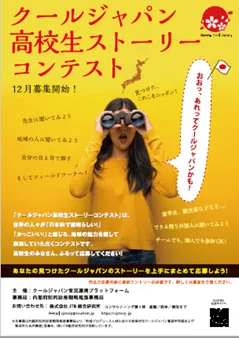
<FY2018 Call for Entries>

2. High School Students’ Perspectives and Stories as Seen in the Three Outstanding Entries
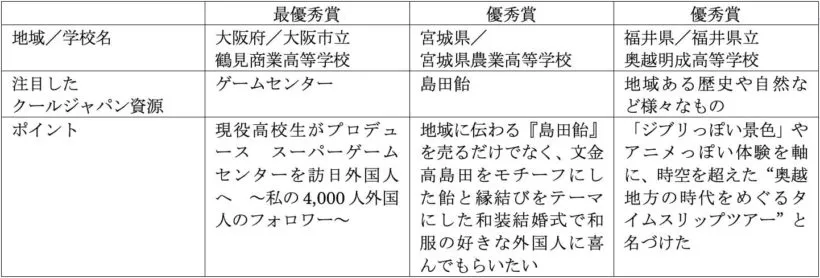
FY2023’s winning entries embodied the contest’s objective of “searching for the appeal of Japan that is considered ‘Cool’ from the perspective of creating a story that resonates with people around the world” (Table 1). All winning entries were praised for their fresh and unique perspectives and approaches characteristic of high school students, with one foreign judge commenting that “stakeholders nationwide should learn from their methods.”
(Table 1) Overview of Award-Winning Entries

1) Grand Prize: Osaka Municipal Tsurumi Commercial High School
The resource they focused on was “arcades.” Students with many foreign followers on social media reexamined their daily lives based on the hypothesis that the ordinary daily life of Japanese high school students is actually what makes Japan cool, as revealed through their interactions with these followers. Their meticulous analysis identified challenges in Osaka’s nighttime economy, and their bold creativity in proposing a solution through the “Super Game Center” concept was highly praised.
2) Excellence Award: Miyagi Prefectural Agricultural High School
They focused on “Shimada Ame,” a traditional local confectionery, noting its aesthetic appeal and Instagram-worthy qualities. Using the candy’s reputation as a symbol of matchmaking as a motif, they wove in historical and cultural context to narrate the charm of bridal processions and festivals, and proposed traditional Japanese-style weddings tailored for international visitors.
3) Excellence Award: Fukui Prefectural Okuechi Meisei High School
Rather than focusing on specific “Cool Japan” resources, they explored the region’s appeal through numerous interviews. Inspired by a foreign interviewee’s comment that the area felt “like a Ghibli movie”—a sentiment resonating globally—they realized, “It’s not just the scenery; mopping floors and pasting shoji screens are cool too. After all, they appear in Ghibli films, embody the essence of Japan, and would surely be an interesting experience.” By connecting various local resources, they conceived a “time-slip tour” of the Okuechi region.
3. The Impact and Potential of High School Students’ Involvement on the Region
What does this kind of high school student involvement bring to the region? Through this contest, we identified the following five possibilities; however, here we will focus primarily on No. 3, which is expected to have short-term, immediate effects, and No. 4, which brings medium- to long-term benefits.
- Discovery of New Local Resources
- Interest in and Engagement with Regional Revitalization, and the Creation of New Talent Capable of Contributing
- Encouraging awareness and change among the older generation in the community
- Fostering a sense of attachment to the community among young people
- In the long term, an increase in the “related population” that leads to the promotion of migration and settlement from outside the region
(1) Encouraging awareness and change among the local older generation
The town resources that caught the attention of the high school students from Miyagi Prefectural Agricultural High School—who won the Excellence Award—were viewed by adults as old and unattractive, or as things that would inevitably disappear due to a lack of successors. However, the fact that the students found them “interesting,” conducted impromptu interviews with foreigners and received positive feedback, and expressed their desire to “not let this town disappear!” acted as a catalyst for the townspeople. As a result, joint public-private initiatives are now beginning to take shape.
One teacher from a participating school made a particularly memorable comment: “If we look solely at the polish and level of completion, the students’ work probably can’t compete with that of professionals or adults. However, there is something deeply moving about their passion and presentations—a mysterious power that makes you want to listen.” Isn’t it precisely this sincere, unencumbered, and straightforward energy that moved the adults in that town—people who are often trapped by preconceptions and social constraints?
(2) Fostering Young People’s Attachment to the Community
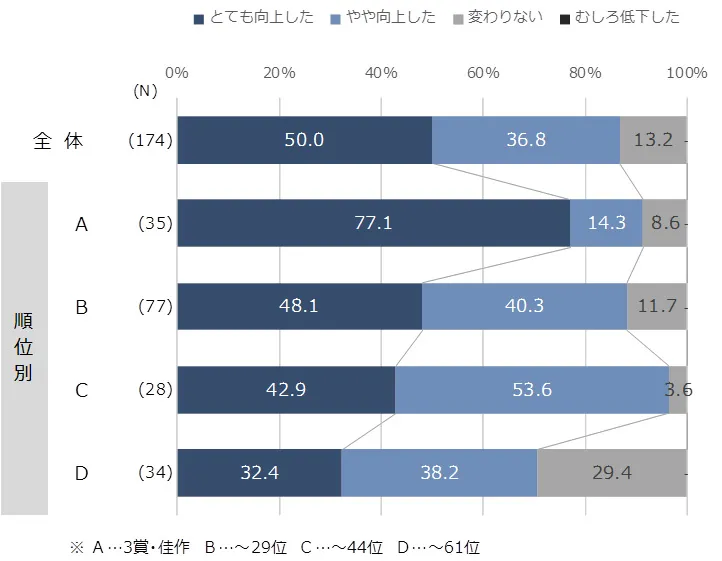
Regarding the changes the high school students themselves felt through participating in this contest, 86.8% reported an “increase in interest in and attachment to the local community” (Figure 1).In particular, a high percentage of students who submitted outstanding entries reported that their interest in and attachment to the community had “greatly increased.” It is likely that the time and effort they invested in fieldwork and interviews with local residents and foreign visitors led to a positive cycle: by taking an interest in the area where they live and learning about its charms and challenges, their attachment to the community grew, which in turn resulted in better entries. One student commented, “I could feel the warmth of the local community, and I truly realized just how amazing my hometown is!” If we can instill pride and attachment to their local communities through these problem-solving initiatives and lessons, it will be possible for students to maintain a connection with their region even after they leave to pursue higher education or employment elsewhere. This could serve as the first step toward building a future “relational population.”
(Figure 1) Changes students themselves felt as a result of participating in the contest [Interest in and attachment to the community]

4. Regional Revitalization Is a Total War: High School Students Living in the Future Are Valuable Members ~“Regional Issues” Can Also Serve as “Resources” in Educational Settings~
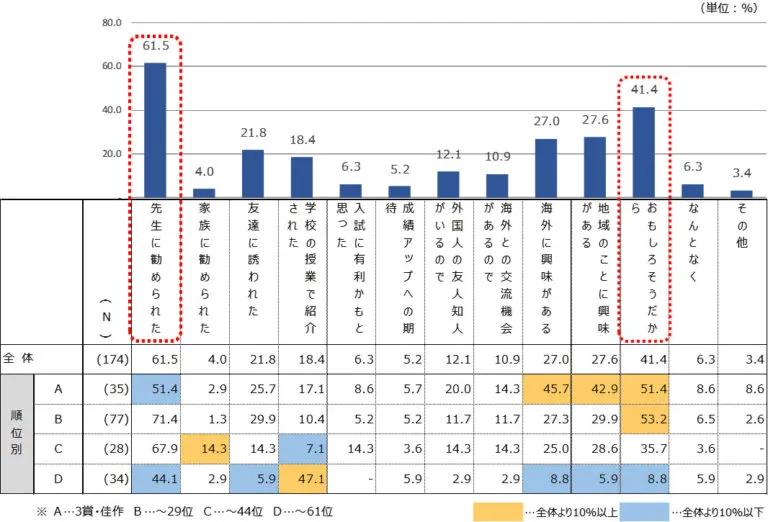
The most common reason for entering the contest (Figure 2) was “because my teacher recommended it.” This was followed by many students simply feeling that “it looked interesting.” As exemplified by a teacher’s comment—“Although they usually had neither the opportunity nor the inclination to focus on the local community, it was heartwarming to see the students tackle this with excitement, seizing an unprecedented chance for discovery and self-expression”—many teachers noted that themes stimulating students’ curiosity lead to their voluntary engagement in learning. Following the revision of the new curriculum guidelines effective from FY 2020, interest in “problem-solving-based learning” is rapidly growing in educational settings. As attention focuses on the fact that real-world “community issues” can serve as valuable educational resources that foster student growth, it is expected that more educators will seek to engage with the local community from an educational perspective. To direct high school students’ interest toward the local community, it is time for the community to consider how to engage with high school students and educators—who can serve as agents of revitalization—while also understanding the educational challenges and needs faced by influential teachers.
It is often said that “outsiders, young people, and fools” are the ones who change communities, but until now, perhaps not many stakeholders have consciously included high school students and other students living in the community within the category of “young people.” However, it is a 16-year-old high school student from Sweden who is now leading children in over 130 countries in strikes demanding action against global warming—a movement that is mobilizing even adults—because “the future is in crisis. ”Regional revitalization, too, has reached a point where young people and children—who will live in the future—need to develop a sense of ownership. We should increase opportunities for these young people, who are highly motivated to contribute to society, to learn about and engage with the current situation. As members who bear responsibility and expectations, isn’t it important to recognize the presence of local high school students?
(Figure 2) Motivation for Entering the Contest

著者