Redefining Tourism Digital Transformation Through the Lens of the Future of Tourism Destinations

Tourism DX refers to a process of transformation that leverages digital technology in key areas to realize a vision for the future of tourist destinations and implement strategic initiatives. However, current efforts are limited to improving operational efficiency and have not yet led to true transformation. To treat DX as a strategic investment, it is necessary to link the vision for the future with DX initiatives and establish metrics to measure results. In this column, we will discuss the design of metrics as a common language for enhancing the value of tourist destinations and offer insights into sustainable regional management.
1. What Is Tourism DX?—From Digitization to “Digital Transformation”
In recent years, the term “Tourism DX” has come into frequent use in the tourism sector. Tourism DX refers to digital transformation in the tourism sector. According to the Japan Tourism Agency’s definition, it is not merely about improving efficiency through the digitization of operations, but rather involves driving transformation—such as reevaluating business strategies and creating new business models—through the analysis and utilization of data collected via digitization (*1).Currently, various stakeholders involved in tourism—including the national government, educational institutions, local governments, DMOs (Destination Management Organizations), DMCs (Destination Management Companies), and tourism businesses—are promoting and utilizing digital technologies. However, many tourist destinations face the problem that “simply introducing digital technology” has become an end in itself, failing to link to post-implementation effects or the transformation of the destination as a whole.In essence, Tourism DX is not about the introduction of digital technology itself, but rather a process of transformation that uses digital technology as a means in necessary areas to realize a destination’s vision and strategy for the future. If the introduction of digital technology becomes an end in itself, the perspective of “which values of the destination will be enhanced by this measure” is lost, leading to strategic dysfunction.
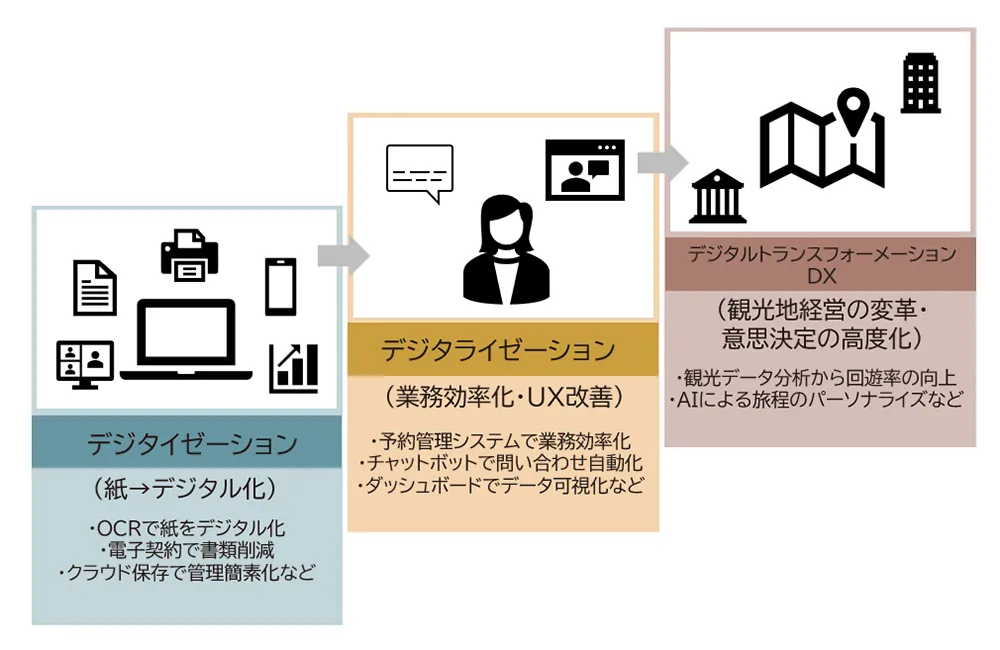
Here, we outline the stages of digitalization in tourism destinations (Figure 1).
The first stage, “Digitization,” involves replacing paper documents and analog processes with digital data.The second stage, “Digitalization,” refers to the stage where digital technology is leveraged to improve business processes and the traveler experience itself. Finally, the third stage, “Digital Transformation (DX),” means transforming the management of the tourist destination itself through these changes and advancing data-driven decision-making.
Japan’s tourism DX tends to remain stuck in the second stage of digitization. However, what is needed going forward is not short-term efficiency gains, but rather a strategy designed by working backward from medium- to long-term goals. What kind of future vision is the destination aiming for? What changes are needed to realize it? And in which areas is digital technology necessary? Only when digital technology is introduced with consistency within that narrative will a DX strategy become a powerful tool to drive the destination forward.
2. Global Travel Tech Trends: Simultaneously Transforming the Traveler Experience and Destination Management
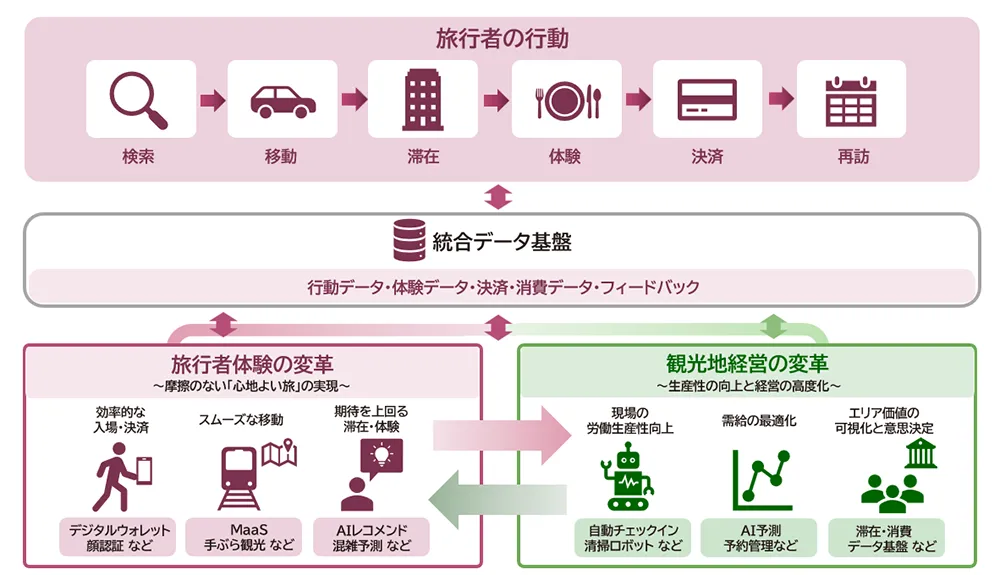
The implementation areas of Tourism DX—the transformation process aimed at realizing a destination’s vision and strategy—can be broadly divided into two categories: “Transforming the Traveler Experience” and “Transforming Destination Management” (Figure 2).
Transforming the Traveler Experience: Realizing a Frictionless, “Pleasant Journey”
Transforming the traveler experience means eliminating friction (stress) at every stage of the journey and maximizing the sense of wonder.
For example, utilizing facial recognition and digital wallets can streamline entry to tourist facilities and payment processes, reducing the time spent waiting in lines. Furthermore, introducing MaaS (Mobility as a Service) and “hands-free” tourism services enables travelers to move seamlessly using just their smartphones. Additionally, AI-powered personalized recommendations and crowd prediction allow travelers to visit places that match their preferences at the optimal time, creating a stay experience that exceeds their expectations.
Transforming Tourism Destination Management: Improving Productivity and Advancing Management
Transforming tourism destination management means maximizing the value of a destination with limited resources.
For example, introducing self-check-in kiosks and cleaning robots can address severe labor shortages and improve on-site labor productivity. AI-driven demand forecasting enables crowd control and demand dispersion; when combined with reservation management, it also helps alleviate the burden on residents caused by overtourism. Furthermore, analyzing travelers’ stay and spending data allows for an objective understanding of a region’s “earning power,” enabling the visualization of area value and more sophisticated decision-making.
The global travel tech industry has evolved primarily by eliminating friction in the areas of “entry, transportation, accommodation, experiences, and payment.” In this process, traveler behavior and experience data have been integrated, and designs that connect the entire travel experience are advancing.In recent years, building on this integrated data, we have entered a phase where AI agents support or even replace travelers’ decision-making. Given this global trend, local governments and DMOs are now required to rethink tourism DX not as a series of “individual measures,” but from a perspective that encompasses the overall management of tourist destinations.
3. Why Has the Adoption of Digital Technology in the Tourism Sector Failed to Become a Full-Fledged “Strategy”?
The Ministry of Internal Affairs and Communications’ “2021 White Paper on Information and Communications” (*2) outlines the status of companies implementing DX initiatives by industry. In the tourism sector, “Accommodation and Food Service Industries” stand at 16.4%, “Lifestyle-Related Services and Entertainment Industries” at 18.3%, and “Transportation and Postal Services” at 16.9%, lagging behind other sectors in DX adoption.The reasons cited for this include “a lack of recognition of the need,” “insufficient funding,” and “not knowing where to start or how to proceed” (*3).While the necessity of digital technology is recognized at the local government and business levels, it is not uncommon for organizations to begin considering its adoption without a clear vision of “what they aim to achieve” or specific metrics for measuring success. A more fundamental issue is that many local governments and businesses approach digital adoption primarily as a means to “improve operational efficiency,” often failing to delve into the overarching goal of “what kind of value they wish to create.”
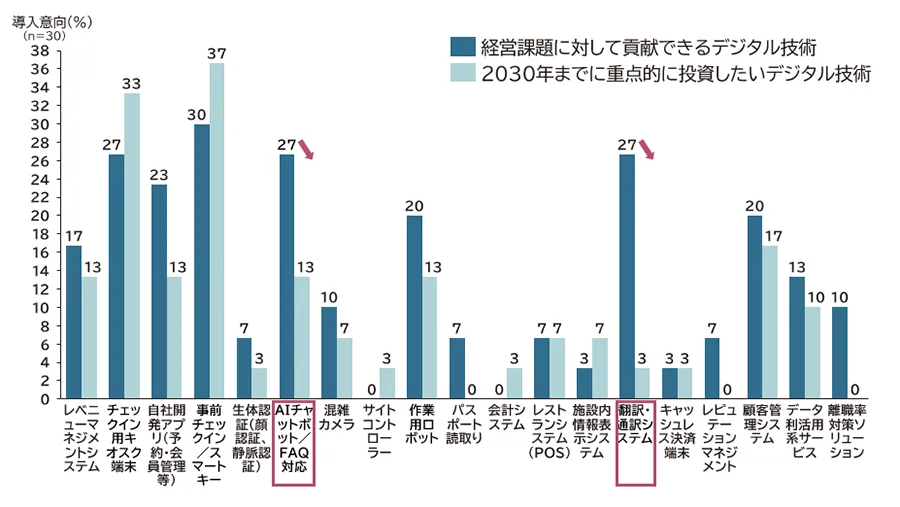
A survey we conducted among accommodation providers regarding their intentions to adopt digital technologies revealed their “approach to investment decisions.” The results showed a significant gap between technologies perceived as “contributing to business challenges” and those they “actually intend to prioritize for investment by 2030” (Figure 3). Specifically, while there is a high intention to invest in technologies such as check-in kiosks and pre-check-in systems, the intention to invest in AI chatbots and translation/interpretation systems is low.
In particular, technologies like check-in kiosks—where the direct benefit of “reducing front desk workload” is easily visible—are prioritized. Conversely, technologies such as AI chatbots and translation systems—where “the benefits are difficult to visualize in the long term” or “are unlikely to lead to a direct increase in revenue”—tend to be put on the back burner.
This trend suggests that the adoption of digital technology is viewed not as an “investment that generates future value,” but rather as a “cost (expense) that supports immediate operations.” Although these surveys are based on responses from individual facilities, when viewed collectively, they reveal a structure in the tourism sector where digital technology tends to be treated as a short-term “expense-based investment” rather than a long-term “asset-based investment” that generates future revenue and enhances the value of tourist destinations.As long as this remains the case, it is difficult to formulate a DX strategy for the tourism destination as a whole that transcends individual facilities.
Furthermore, one reason tourism DX is treated as an expense is that the metrics and indicators needed to explain its effects as “results for the entire destination” have not been sufficiently established. The inability to communicate the significance of DX in a common language to diverse stakeholders—such as local governments, residents, financial institutions, and investors—further complicates decision-making.
4. How to Measure the Outcomes of Tourism Destination Management—Quantification as the Foundation of Tourism DX
To establish tourism DX as a viable “strategy,” its outcomes must be communicated in a “common language” that everyone can understand. That language is precisely the set of metrics that visualize these outcomes. So, what exactly constitutes success in sustainable tourism destination management? Simply increasing the number of tourists is not the sole objective.In this column, we propose a new concept called “Destination Value” as a way to visualize the outcomes of destination management. This concept integrates three perspectives—“quantity,” “quality,” and “circulation”—into a single metric.This concept is based on the equation for regional economic contribution through tourism (total tourism output) proposed by Professor Tetsuo Shimizu of the University of Tokyo. We have restructured it by setting “Destination Value” as a common goal and incorporating our company’s unique perspective on how digital technology clarifies “where, how, and why improvements should be made” (*4).
Destination Value is calculated as the product of the following three elements:
Destination Value = ① Number of Inbound Tourists × ② Average Tourism Spending × ③ Local Procurement Rate
① The number of inbound tourists is a “quantity” indicator showing how many people the region attracts, while ② the average tourism expenditure per visitor is a “quality” indicator showing how much money visitors spend in the region.
The most important factor is ③ the local procurement rate. This is a “circulation” indicator showing the extent to which revenue generated by tourism spending is reinvested in local procurement and employment.
By multiplying these three factors, we can comprehensively evaluate the contribution of tourism to the local economy—specifically, “how many people are attracted, how much revenue is generated, and how much of that profit is reinvested in the region.”
Case Study: Understanding the Value of a Tourist Destination Using a Port Town as an Example
For example, suppose this town successfully attracts inbound tourists and the number of visitors doubles. However, what if most travelers stay at foreign-owned hotels and get their meals at national convenience store chains? The average spending per tourist would not increase, nor would the local procurement rate, while burdens such as congestion and litter would only grow. In this situation, no matter how much the number of visitors increases, we cannot say that the “value of the tourist destination” has risen.
On the other hand, suppose this port town prioritizes improving the local procurement rate—which leads to regional purchasing and employment—and introduces a digital map featuring local shops and a booking site for experiential programs guided by local fishermen. In that case, even if the number of visitors increases only slightly, travelers will enjoy unique local experiences, and spending at local shops will increase.Furthermore, as natural interactions and mutual support develop between travelers and residents, and as tourism-related congestion and friction are reduced, residents’ sense of satisfaction with their living environment and overall social well-being will increase.
This state of affairs goes beyond mere economic circulation; it demonstrates that desirable relationships for the region are being sustained. Consequently, by increasing both the average spending per tourist and the local procurement rate, it significantly boosts the town’s overall “tourism value.”
In this way, by setting “tourism destination value” as a shared goal, we can clearly define “where, how, and why” digital technology should be applied. For example, if the goal is to “increase the number of visiting tourists,” one approach is to use AI recommendations to communicate attractions that resonate with individual travelers and increase the number of repeat visitors. If the challenge is to “raise the average tourism spending per visitor,” it would be effective to encourage wider-area tours using MaaS or increase spending opportunities through cashless payments.Furthermore, to achieve the goal of “increasing the local procurement rate,” digital technology can help optimize the procurement of locally produced goods using demand forecast data, thereby contributing to the financial stability of local businesses.
Digital technology only becomes a “strategic investment” when it contributes to one or more of these three metrics.
5. Conclusion—Tourism DX is a process for realizing the future vision of a tourist destination
Tourism DX is not merely a set of digital initiatives. It is a series of processes—involving the formulation of strategies, the implementation of measures, and the verification and improvement of results—designed to realize a vision for the future of a tourist destination.
The quantification of “destination value” presented in this column is not an end in itself, but rather a common language designed to make the vision and strategy actionable. By sharing common metrics, diverse stakeholders—including local governments, DMOs, DMCs, accommodation and tourism operators, IT providers, and local residents—can discuss issues with a shared focus and make highly accurate decisions.As a result, the quality of all decision-making related to tourism destination management—including government budget allocation, investment decisions by financial institutions, and consensus-building among residents—will improve. Why not start by assessing the current status of your region’s “number of visiting tourists,” “average tourism spending per visitor,” and “local procurement rate,” even if only as rough estimates? That current reality should serve as the starting point for your tourism DX strategy for the future.
References
- *1 Japan Tourism Agency, “What is Tourism DX?”
- *2 Ministry of Internal Affairs and Communications, “2021 White Paper on Information and Communications”
- *3 Japan Tourism Agency, “2022 Tourism White Paper”
- *4 Tetsuo Shimizu: “Strategies Necessary for Future Regional Inbound Tourism Promotion: From the Perspective of Small and Medium-Sized Enterprises,” Corporate Management, Vol. 165, pp. 8–11, 2024.
*Some images in this column were generated using AI.
著者