“Tourism × Astrophysics”: What It Means to Travel

What does Professor Haruo Saji, a leading authority on the “fluctuation” theory related to the origin of the universe, consider to be the fundamental value of travel?
Whenever I hear the word “journey,” there’s something that always comes to mind: the man-made object that, since leaving Earth, has traveled farther than any other in human history and continues on a journey from which it will never return.It is Voyager 1, the interplanetary probe launched by NASA 48 years ago, in 1977. Voyager is an interplanetary probe that set out into the far reaches of space—places we cannot reach directly—to serve as the eyes and ears of humanity on Earth.As of January 2025, it is located approximately 24.8 billion kilometers from Earth—a vast distance that would take 23 hours and 8 minutes to reach even at the speed of light.To intuitively grasp this vast distance, imagine the Sun as a 1-meter-diameter exercise ball. In that scenario, Earth would be a 1-centimeter-diameter marble located 100 meters away from it. Neptune, the outermost planet in the solar system, would be a cherry situated 3 kilometers away.And Voyager 1 is one-tenth the size of an influenza virus located 17 kilometers away. On its journey so far, Voyager 1 has made countless discoveries that humanity could never have foreseen, and it continues to fly at the staggering speed of 60,000 kilometers per hour.As seen from Earth, it is heading in the direction of the constellation Ophiuchus. Moreover, it remains connected to Earth via radio waves. Although its camera has failed—so it can no longer “see”—its “ears” are still functioning. Even at this very moment, as it travels through the pitch-black expanse of space, it continues to send back to Earth the sounds of stellar winds echoing from its surroundings.
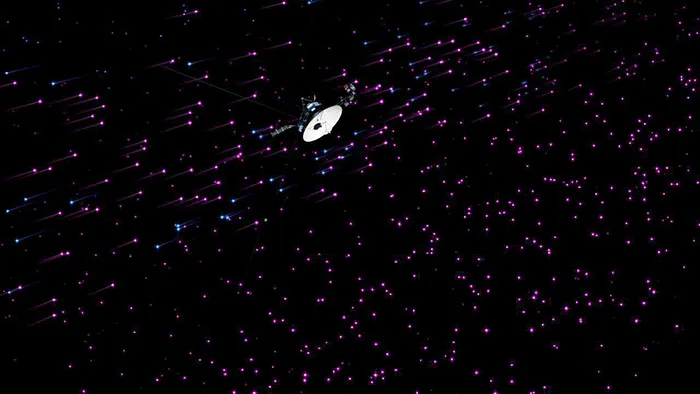
(Courtesy NASA/JPL-Caltech)
And, as is well known, it carries the Golden Record—a disc containing information about Earth—on its side. This record is a copper disc exactly the same size as an LP record, with a gold-plated surface. It features a message from Jimmy Carter, the 39th President of the United States at the time of the launch: “This is a gift from a small, distant planet.It represents our sounds, science, images, music, thoughts, and feelings... (omitted)... We hope that once we have solved the problems we now face, we can join you as fellow citizens of the galaxy.”In addition, the record contains greetings in 55 different languages from Earth; the 23rd of these is a Japanese greeting: “Hello, how are you?” It also includes 32 pieces of world music, including folk music, three of which are works by Bach.This content was included based on the idea that the mathematical properties inherent in Bach’s music might function as a universal language should we encounter extraterrestrial intelligent life (i.e., ETs) within the Milky Way; part of this was my own suggestion.
Furthermore, the surface of the record sleeve features a mathematical diagram illustrating how to play the record, along with a diagram engraved to show Earth’s position within the Milky Way.In addition, the surface of the cover is coated with uranium-238, which has a half-life of approximately 4.5 billion years; this is designed so that whoever finds the record can estimate the year of its creation based on the residual radiation levels.In other words, this Golden Record is a testament to Earth’s civilization—a time capsule sent out with the next 4.5 billion years in mind. By that time, Earth will likely have been swallowed up by the expanding Sun, and all traces of our planet will have vanished without a trace from the Milky Way.If, by then, this record is discovered by some extraterrestrial intelligent civilization, Earth—and we—will be brought back to life in their imagination. It feels as though this endless journey is, in fact, the ultimate journey.

(Courtesy NASA/JPL-Caltech)
What Is Travel in Our Daily Lives?
Now, what does “journey” mean in our daily lives? In fact, if we trace the history of our evolution as living beings, we see that we are designed in such a way that we cannot survive by remaining in one place. This is likely because life itself could not have come into existence without interaction with the environment—including the intake of air and food.Life is, by its very nature, unable to survive on its own. Moreover, since the environments in which living organisms inhabit are constantly changing, they must adapt by changing themselves in order to survive.
On the other hand, for living beings like us that possess a “mind,” becoming too accustomed to our environment can lead to a loss of the ability to detect environmental changes, which can sometimes hinder our evolution as a species. In other words, most sentient organisms are designed to perceive the state of the external world as a change in that world.However, as we commonly experience, if we are constantly surrounded by the same scent, we eventually stop noticing it. This is because, in order to survive, we must adapt to our environment. On the other hand, if we encounter a different scent, we are able to detect it.
This is because, if that scent is emitted by something that poses a threat to our survival, we must avoid it immediately. Speaking of snakes, in reference to this year’s zodiac sign, the reason snakes flick their tongues back and forth is to detect changes in infrared radiation.Prey with a body temperature constantly emits infrared radiation, but when the prey moves, the intensity of the infrared radiation changes; snakes use these changes to pinpoint the prey’s location. Therefore, it is said that when you encounter a venomous snake, it is essential to remain completely still.
In this way, for organisms to grow and survive, they must adapt to their environment and respond sensitively to new environments; by doing so, they acquire new wisdom and transform themselves, thereby strengthening their ability to survive. On a different note, the Japanese eel is a fish famous for its long journey.Although they are caught in waters near Japan, their spawning grounds are reportedly in the Western Mariana Islands, more than 3,000 kilometers away from Japan. It seems that their distinct flavor—which differs from that of farmed eels—stems from this journey.
Incidentally, for us humans as well, the ability to refresh both body and mind by occasionally changing our environment is likely a trait shaped by the long process of biological evolution. Why not consider that this is the origin of travel? Just as our mood can change simply by rearranging the furniture in a room—without even stepping outside—humans are highly sensitive to their environment.In other words, human emotions and sensibilities—such as our feelings and perspectives—are greatly influenced by our environment. This means that traveling can lead to a renewed sense of self, and by discovering things that were previously unknown, our horizons can expand significantly.It is certainly possible to broaden one’s horizons through activities like reading. However, the encounters we have while traveling are accompanied by physical sensations. It is an experience gained by placing one’s body within that environment, seeing with one’s own eyes, hearing with one’s own ears, and savoring it with one’s entire being. That said, it is not only major trips, such as traveling abroad, that hold meaning.Even on your usual commute—a route you pass by on the bus every day—if you walk it occasionally, you might come across a tiny flower peeking out from a crack in the concrete by the roadside, or an interesting sign you’d always overlooked. Or perhaps you’ll take a short train ride and find renewed energy from a cup of tea enjoyed at a small café overlooking the ocean. These, too, are the benefits of a small journey.

What Is a Journey Inward?
By the way, travel isn’t just about going out into the world. We also need to embark on a journey inward. This is a journey of the heart that we can experience while taking time to engage with the things we love.Amid the hustle and bustle of daily life, taking even a brief moment to embark on this inner journey can lead to an encounter with a new side of yourself and give you a fresh burst of energy. Embarking on both outward and inward journeys is the first step toward a fulfilling life. It’s no exaggeration to say that setting out on a journey and looking toward the distance is the same as getting to know the self that is closest to you.
Now, as I conclude this article, I would like to touch upon Matsuo Bashō, a haiku poet from the early Edo period.As is well known, at the beginning of his masterpiece *The Narrow Road to the Deep North*, Basho wrote: “The days and months are travelers of a hundred generations, and the years that come and go are also travelers.” In other words, he expressed that “time is an eternal traveler that never lingers, and the years that arrive and pass are also travelers.”Compared to the vast and boundless universe, he likens the finite existence of human life to a journey, seeking to superimpose his own existence upon the eternal time and space of the universe. If a “trip” is a limited period of time with a starting point and an endpoint, I feel that a “journey” contains a longing for the endless, the eternal.There is a haiku said to have been composed by Basho at the very end of his life. It is believed to have been written on October 8, Genroku 7—four days before his death—and has long been regarded as Basho’s death poem.
“Sick on my journey, my dreams roam the withered fields”
The circumstances surrounding the composition of this haiku are recorded in detail in *The Diary of the Memorial Service for Old Man Basho*, written by his disciple Shiko; however, I am intrigued by the preface attached to this haiku, which reads “Composed While Ill.”Since I am not a literary scholar, I hesitate to delve into a detailed analysis here; however, if this had truly been a death poem, I doubt such a preface would have been added.That said, even if we assume it was added later by one of his disciples, it still feels unnatural when considering the final circumstances we can infer from the aforementioned document—namely, the recorded scene of Basho and his disciples refining the haiku together. This suggests that Basho himself was still fully conscious. Therefore, I wonder:Although it was indeed composed while he lay on his deathbed, I am beginning to feel that Basho himself may not have regarded it as a death poem. Did Basho not strongly hope that one day his illness would be cured and he could set out on a journey again?To live is to compile one’s own travel chronicle, and perhaps that is the flame of hope that burns quietly yet eternally within one’s heart.
著者