An Examination of Improving Labor Productivity in the Tourism Industry and Securing University Graduates in Regional Areas

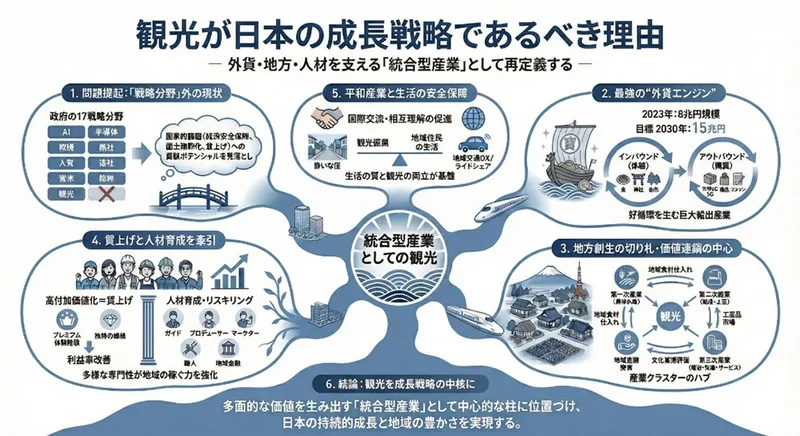
The Fifth Basic Plan for Promoting Japan as a Tourism-Oriented Nation will take effect in April 2026. Targets of 60 million international visitors and 15 trillion yen in spending are under consideration, and it is expected that the pillar of the plan—"Strengthening Tourism Destinations and the Tourism Industry"—will involve a full-scale effort to improve labor productivity. This paper examines ways to enhance productivity in the tourism industry and secure new university graduates in regional areas.
Current Status of Labor Productivity in the Tourism Industry
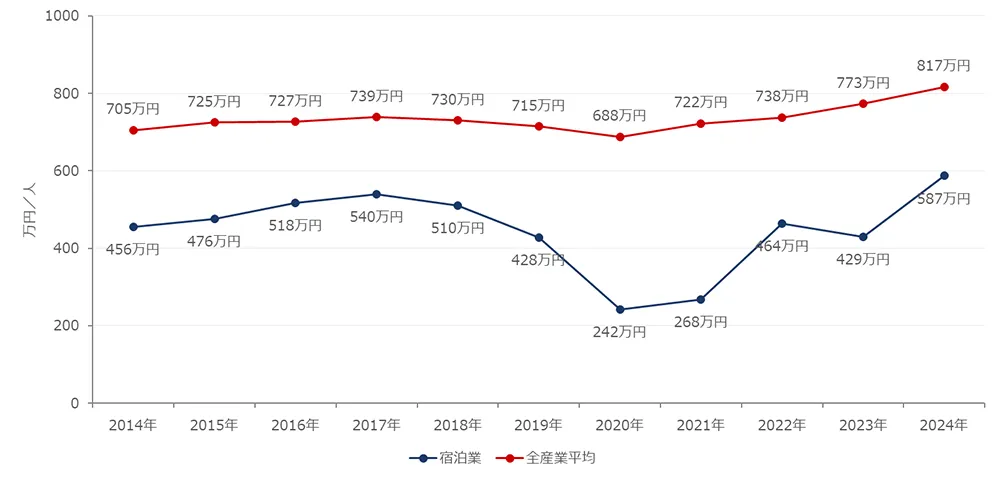
Based on the latest published data available at the time of writing, looking at the five-year period up to 2024 (2020–2024), labor productivity in the accommodation sector—a representative industry within the tourism sector—has grown by 142.5%, significantly exceeding the all-industry average of 18.7%.Even in the most recent three-year period (2022–2024), which marks the start of the recovery cycle from the COVID-19 pandemic, the sector showed a 26.5% increase, exceeding the all-industry average of 10.7%. When compared to 2014—10 years ago—the accommodation sector also outperformed the all-industry average, with a 28.7% increase versus the average’s 15.8%.
Labor productivity is an indicator of output per employee or per hour, and the Japan Tourism Agency calculates it as value added divided by the average number of employees during the period. Although labor productivity in the accommodation industry temporarily declined during the COVID-19 pandemic, it has shown growth exceeding that of all industries. The accommodation industry, where low labor productivity has long been a challenge, can be said to be making steady progress toward overcoming this issue.
Labor Productivity (Accommodation Industry vs. All-Industry Average)
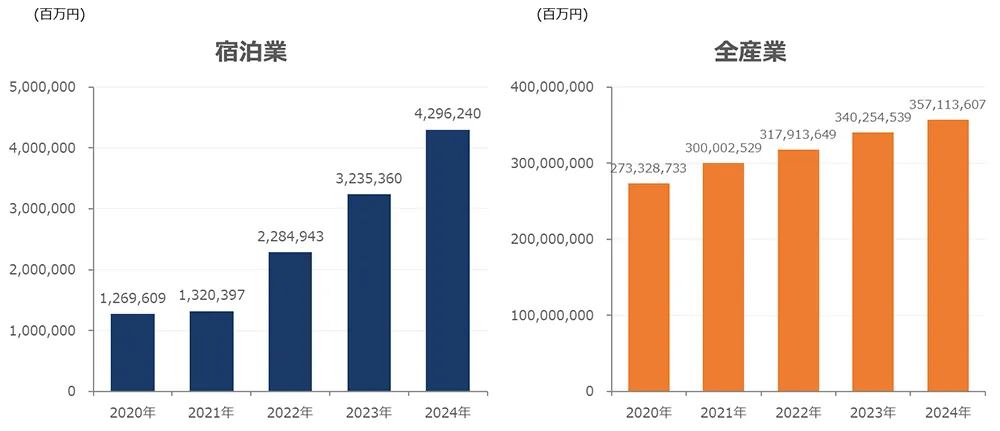
So, what is the trend in value added for the accommodation industry? It has grown approximately 3.4-fold between 2020 and 2024, representing extremely strong growth even when compared to the approximately 1.3-fold growth seen across all industries.To put this in terms of export categories, the tourism market is expanding steadily, as exemplified by spending by foreign visitors to Japan, which has reached 9.5 trillion yen—second only to the 22.5 trillion yen generated by the automotive industry. It is no exaggeration to say that the sector is on its way to becoming a core industry, as outlined in the “2040 Industrial Structure Vision” currently under discussion by the Subcommittee on New Approaches to Industrial Policy under the Industrial Structure Council of the Ministry of Economy, Trade and Industry.
Value Added (Accommodation Industry / All Industries)
Average Room Rate and Wages in the Accommodation Industry
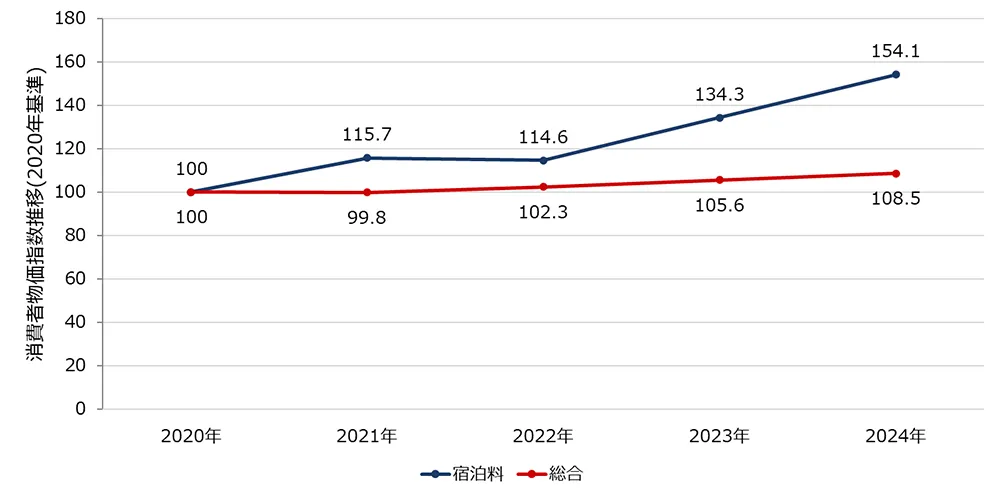
Accommodation rates, which are the primary driver of increases in labor productivity and value added, rose by 54.1% over the five-year period from 2020 to 2024, significantly outpacing the 8.5% increase in the overall Consumer Price Index (CPI). This rate of increase is extremely high within the CPI—similar to that of rice—and is contributing to the rise in value added in the accommodation industry.
Consumer Price Index (Accommodation/Overall)
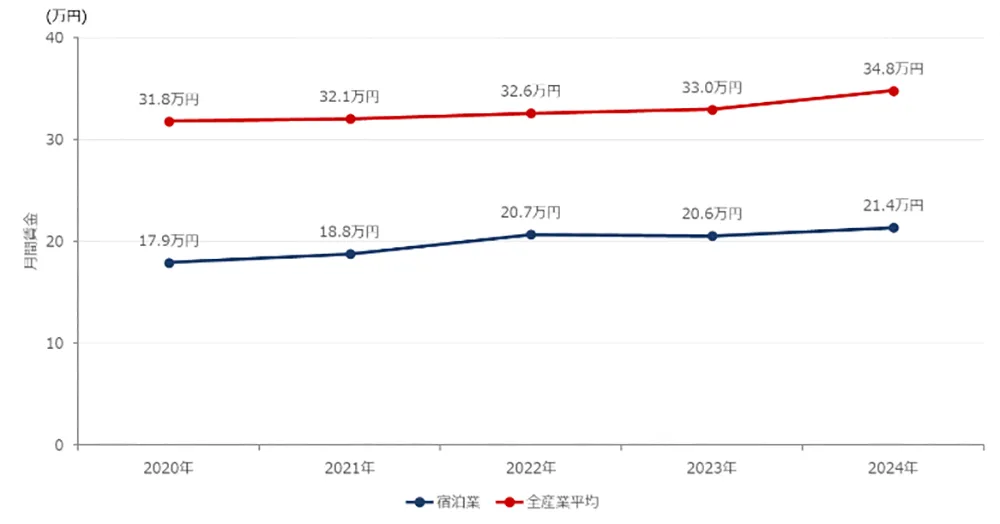
How do wages compare to the growth in accommodation rates? The wage growth rate in the accommodation industry from 2020 to 2024 remained at 7.7%, falling short of the all-industry average of 8.2%. In other words, while accommodation rates in the CPI have risen significantly, wage growth in the accommodation industry has lagged behind the all-industry average, indicating that there has been no improvement in the labor share of income.Amid a worsening nationwide labor shortage, wage growth that falls below the all-industry average raises concerns that it will be difficult to secure sufficient personnel and further increase value added.
Monthly Wages (Accommodation Industry vs. All-Industry Average)
Strengthening the Tourism Industry under the 5th Basic Plan for Promoting Japan as a Tourism Nation (Draft)
The new "5th Basic Plan for Promoting Japan as a Tourism Nation" will commence in April 2026.The Tourism Subcommittee of the Transport Policy Council at the Ministry of Land, Infrastructure, Transport and Tourism, which is currently deliberating on the plan, defines the significance of tourism as “a strategic industry that is rapidly growing into Japan’s second-largest export industry and leading the development of regional and national economies.” It identifies the following challenges: “To fully realize the multifaceted significance of tourism, it is necessary to address the severe labor shortage and promote high value-added growth, as well as to ensure resilience against various risks such as disasters, infectious disease crises,changes in the international situation, and enhance the sustainability of tourism.”
Based on this, the subcommittee has identified three pillars of policy: “Balancing the reception of inbound tourists with ensuring the quality of life for residents,” “Expanding domestic travel and outbound tourism,” and “Strengthening the resilience of tourist destinations and the tourism industry.”
Regarding the strengthening of tourism destinations and the tourism industry, the plan states, “Through initiatives aimed at increasing total overnight stays and improving labor productivity, we aim to achieve 6.8 trillion yen in value added generated by the accommodation sector by FY 2030,” setting a target of 1.6 times the 2024 level.At the same time, the plan highlights the need to “secure personnel for tourist destinations and the tourism industry,” aiming to secure sufficient human resources to increase added value in a tourism industry currently suffering from labor shortages.
Measures to Improve Labor Productivity in the Tourism Industry and Secure University Graduates: The Case of Miyakojima
As is well known, tourism is an industry characterized by extreme fluctuations between peak and off-peak seasons. While every region lists countermeasures for the off-season as a priority, very few have achieved significant results. These seasonal fluctuations also create difficulties in securing personnel. Although some tourism operators have introduced flexible working hour systems to accommodate both peak and off-peak periods, this has not led to a resolution of the labor shortage.
As mentioned at the outset, since labor productivity is an indicator of output per employee or per hour, improving it is, in theory, a simple matter of numbers. It involves either reducing the number of employees or shortening their working hours through the use of AI, without lowering sales. A characteristic of the tourism industry is that it relies heavily on non-regular employees, such as part-timers and temporary workers, to address seasonal fluctuations from an employment perspective; it is an industry where it is difficult to increase the number of regular employees.On the other hand, by leveraging these seasonal fluctuations—for example, by setting regular employees’ working hours at 8 hours per day during peak seasons and 5 hours per day during off-peak seasons when occupancy rates drop drastically—and thereby reducing annual working hours, labor productivity will naturally improve. Furthermore, if monthly salaries are maintained at current levels, even if wage increases are not possible, the benefits for regular employees will grow significantly due to reduced working hours. If employees use the time saved to pursue side jobs, increasing their annual income is not out of the question.
Since the opening of the Irabu Bridge in January 2015, the number of visitors to Miyako Island and tourism spending have roughly tripled. From the perspective of tourism spending, in particular, it could be said that this region has been the most successful over the past decade. On the other hand, there are no vocational schools, and the only university option is the first year of the Tourism Department at Takarazuka University of Medical Sciences. Consequently, as with other remote islands, young people leave Miyako Island immediately after graduating from high school.Despite the overwhelming presence of the tourism industry in the region, it faces a severe labor shortage, making the securing of talented personnel an urgent priority.
Miyakojima City is attempting to establish the “Miyakojima Model,” in which the local community supports universities in developing students from tourism-related faculties (departments) into highly skilled tourism professionals through internships, seminar research, and academic studies. Recognizing the wage gap with Tokyo as the biggest obstacle to attracting tourism talent, the city is combining Tokyo’s strengths (high annual income) with Miyakojima’s strengths (low cost of living and short commute times) from a wage perspective.In Tokyo, the average daily commute takes 1.6 hours for which no wages are paid, whereas in Miyakojima, this time can be used for side jobs. Even if there is a difference in the wage levels of their primary jobs, it can be argued that when side income and living costs are taken into account, the effective wages are nearly the same.
Wage Disparities Between Tokyo and Miyakojima and Side Hustles
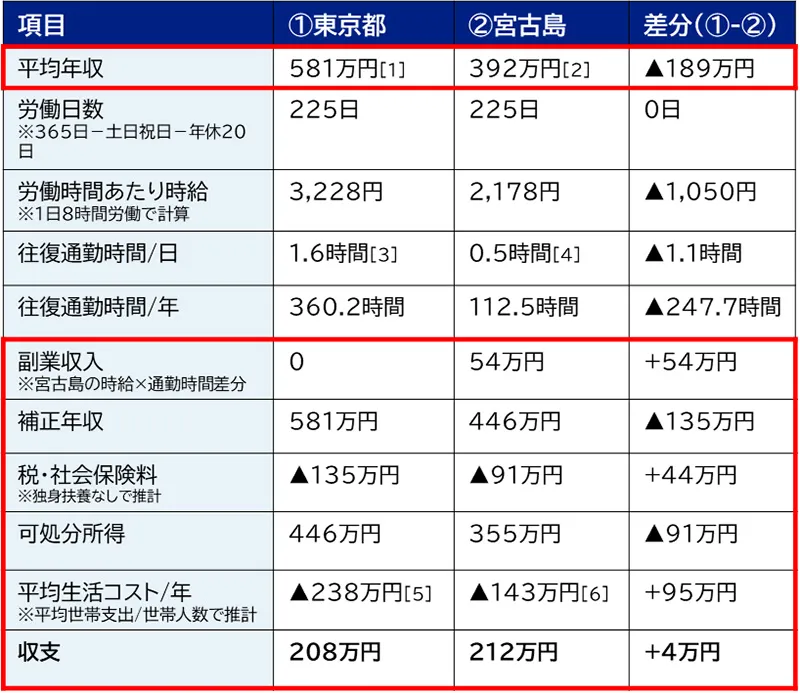
FY 2023, Miyakojima City hosted 22 students from Rikkyo University, Shukutoku University, and ZEN University for internships ranging from two weeks to one month. While working at Shigira Resort and Hilton Okinawa Miyakojima Resort, the students devised models to solve local issues and experienced an internship focused on bridging the wage gap between Tokyo and Miyakojima through side businesses.In regions like Miyakojima, where tourism spending per resident reaches 1.93 million yen, there are numerous business opportunities and many nascent small businesses that have yet to be monetized. One of the objectives of the internship was to examine business opportunities for side hustles from the perspective of students about to enter the job market, while also keeping their primary career goals in mind. By implementing side hustles on a societal level, the wage gap with Tokyo—which is a major bottleneck—could be resolved, potentially making it easier to secure university graduates.
A survey of the 22 students accepted into the internship program revealed that while students do not have the mental bandwidth to consider side businesses during the job-hunting phase, they show significant interest in side businesses once they have become accustomed to their main jobs. We concluded that presenting side business models to students as early as the corporate recruitment phase is an effective strategy for encouraging them to choose local companies.
Summary
According to the FY 2025 Basic Survey of Schools (Ministry of Education, Culture, Sports, Science and Technology), 143 of the 812 universities nationwide are located in Tokyo, and of the total student population of 2.646 million nationwide, 699,000 students—a full 26.4%—are in Tokyo. The combined student share of the so-called eight major metropolitan areas—Tokyo, Saitama, Chiba, Kanagawa, Aichi, Kyoto, Osaka, and Hyogo—reaches 66.7%.
The 2040 Industrial Structure Vision states: “As inbound demand (both the number of visitors to Japan and per-capita spending by foreign visitors) continues to grow, the tourism industry’s position within the Japanese economy will solidify. It will become the most critical foreign exchange-earning industry in a country with a shrinking working-age population, and—centered on the diverse cultural and artistic resources—including crafts, fashion, and design—as its core, and will generate the greatest positive ripple effects on economic and social standards (such as wage levels and infrastructure sustainability), thereby securing its status as a key national industry.” Consequently, the deployment of university graduates—who are currently concentrated in the three major metropolitan areas, particularly Tokyo—to regional areas will be key.
Reducing working hours by leveraging seasonal fluctuations is an effective strategy for improving labor productivity. By allocating the time saved to side jobs, the annual income gap with Tokyo can be eliminated. We are confident that by implementing this approach—which transforms regional weaknesses into strengths through tourism management—as a regional social system, it will become easier to improve labor productivity and secure university graduates in rural areas.
著者