Why Tourism Should Be Part of Japan’s Growth Strategy: Redefining It as an “Integrated Industry” That Supports Foreign Currency, Regional Economies, and Human Resources

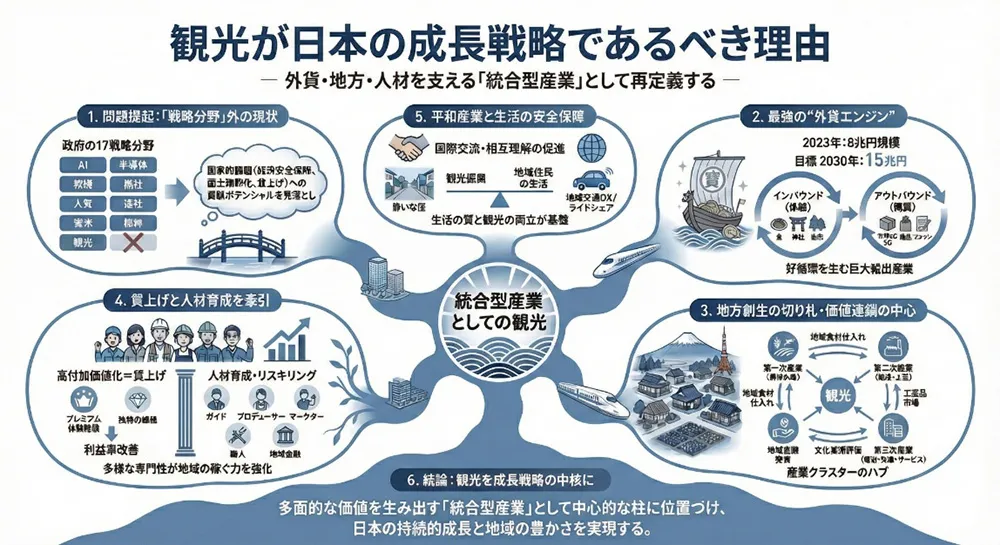
Although tourism is a vital sector that supports foreign exchange earnings, regional industries, and human resource development, it is not included in the government’s “17 Strategic Sectors.” In this column, I propose that we redefine tourism as an “integrated industry” that contributes to solving national challenges and position it as a central pillar of our growth strategy.
1. The Issue of Tourism Disappearing from the "Strategic Sectors"
The government is currently formulating new economic measures that will shape Japan’s future. At the heart of this effort are the “Proposed Priority Measures to be Included in the Comprehensive Economic Measures,” which list 17 strategic sectors—including AI, semiconductors, energy, space, and content—that will underpin Japan’s future. Given rising geopolitical risks and supply chain instability, the policy’s emphasis on investing in “hard power” is understandable; however, the word “tourism” was notably absent from the list.
To date, tourism has contributed to many sectors, including GDP growth, job creation, and the revitalization of regional economies. However, there are concerns that its position within the national growth strategy does not necessarily reflect its importance.If tourism is perceived solely as an extension of “leisure” or “hospitality,” might there not be aspects that need to be reconsidered in future growth strategies? This is because tourism has the potential to simultaneously contribute to the three national challenges Japan faces: “economic security,” “national resilience,” and “wage increases.”
Below, we will examine the reasons for this in order.
2. Tourism is the “world’s largest industry” and Japan’s most powerful “foreign exchange engine”
First, let’s redefine the term “supply capacity” from the perspective of tourism.
When we hear “supply capacity,” we tend to think of factory production capacity, but for resource-poor Japan, “the ability to generate foreign currency” itself is supply capacity. In 2024, consumer spending by foreign visitors to Japan has already reached 8 trillion yen. The government has set a target of 15 trillion yen by 2030, and tourism is increasingly being positioned as a “massive export industry” on par with automobiles and electronic components.
Tourism has a characteristic that other export industries lack. It creates a strong virtuous cycle: “tourism experiences within Japan (inbound experiences) → purchases of Japanese products and services after returning home (outbound purchases).” This virtuous cycle generates consumption such as the following:
- Purchasing Wagyu beef or fruit eaten in Japan via cross-border e-commerce after returning home
- Fans who visit anime and game pilgrimage sites continue to purchase related merchandise and content
- Travelers who visit production sites or workshops specifically seek out and purchase traditional crafts
Inspired by these experiences, sustained demand for Japanese food, products, culture, and services is generated around the world. Tourism is not only an industry that directly earns foreign currency but also a “foreign currency engine” that drives demand for other export industries.
3. Tourism is the Key to Regional Revitalization — The “Hub of the Value Chain” Connecting Regions, from Primary Industries to the Service Sector —
It is not only primary industries and manufacturing that support regional economies. In reality, the tertiary sector—represented by accommodation, food and beverage, retail, transportation, and tourism services—accounts for the majority of regional employment and serves as the backbone of the regional economy.
Tourism serves as the “gateway” to these tertiary industries, attracting demand from outside and acting as the starting point for raising the income of the entire region.Tourism is not merely a service that welcomes travelers. It plays a role in circulating value by connecting directly and indirectly with the diverse local stakeholders—such as agriculture, forestry, and fisheries (primary industries), local manufacturing (secondary industries), traditional crafts, cultural and historical resources, and regional finance. These connections bring value to the region in ways such as the following:
- The use of local ingredients by lodging facilities increases agricultural revenue.
- Offering experiential programs creates new markets for craftspeople.
- Growing tourism demand increases investment opportunities for local financial institutions.
- The reevaluation of cultural resources fosters regional pride and cultivates new leaders.
In this way, tourism functions as a “hub for industrial clusters,” reconnecting the region’s diverse industries and circulating earning power within the community.
4. Tourism: A Core Sector Driving “Wage Increases” and “Human Resource Development”
For a long time, the Japanese tourism industry has faced the challenge of wage levels that fall below the average for all industries. However, precisely because it holds significant growth potential, tourism has the potential to become a core sector driving “wage increases” in Japan.For the tourism sector to achieve wage increases, a shift in its “earning power” is essential. Until now, Japanese tourism has been prone to price competition, with a “low-margin, high-volume” structure posing a challenge. However, there is a growing segment of travelers—particularly from Europe, the U.S., and Australia—who are willing to pay a fair price for “one-of-a-kind experiences.”
If we can appropriately price the unique natural scenery, culture, cuisine, and way of life found in each region as experiential value, profit margins will improve significantly, leading to wage increases. Adding high value-added services is the most effective wage-increase strategy in the tourism industry.
Furthermore, tourism is a growing sector where young people and women can thrive. It involves a surprisingly diverse range of professions, extending far beyond the “visible” service industries such as lodging, transportation, food and beverage, and leisure.Beyond customer service and guidance, the sector includes guides who convey the region’s appeal, producers who plan experiential programs, marketers specializing in digital and data analysis, and management personnel overseeing tourist destination operations. Furthermore, tourism is a “comprehensive industry” where diverse professionals collaborate to create value—including producers supporting food and crafts, local creators, photographers, videographers, content creators, certified tour guides, regional financial experts, and custodians of traditional culture.
Reskilling—a program promoted by the government—is what underpins this diverse range of expertise. Human resource development in the tourism sector is not merely about improving skills; it is an “investment” that enhances the region’s added value itself. Tourism is a sector where the region’s earning power grows stronger as human resources are developed, laying the groundwork for wage increases.
Positioning tourism as a core sector for “wage increases” and “human resource development” is the most rational approach to achieving sustainable regional growth.
5. Tourism: A Peace Industry Supporting “Livelihood Security” and International Exchange
Finally, I would like to touch upon the relationship between tourism and society. In recent years, with the rapid increase in foreign visitors to Japan, issues such as the local living environment, public etiquette, and traffic congestion have garnered significant attention. As these issues become more visible, the question of how to harmonize tourism with daily life in local communities has emerged as a major social theme.
At the same time, tourism also serves as a “peace industry” that promotes cross-border exchange and deepens mutual understanding, thereby easing tensions between nations. Now, as reliance on hard power in diplomacy and security grows, the role played by exchange at the local level is becoming even more crucial.
Furthermore, we must not forget that the sustainability of tourism depends on the “security of daily life” for local residents. Situations where local roads become congested due to tourism, residents are unable to board buses, or their peaceful lives are threatened are not sustainable in the long run.The Japan Tourism Agency’s initiatives to digitize regional transportation and promote ride-sharing are practical steps toward balancing daily life with tourism. Creating transportation systems that meet tourism demand while protecting local living environments increases a region’s capacity to host visitors and serves as the foundation for sustainable tourism.
Ultimately, for tourism to function as a “peace industry,” it is essential to protect the livelihoods of local residents and create an environment where they can welcome tourists with peace of mind. Only when quality of life is ensured and residents can take pride in and trust tourism will tourism bring positive value to society as a whole.
Tourism is an industry that serves as a bridge between international exchange and local life. Establishing a system where the community and travelers can coexist comfortably, based on the security of daily life, is the very essence of sustainable tourism.
6. Conclusion: Placing Tourism at the Core of Growth Strategies
As we have seen, tourism is not limited to the mere provision of services. From generating foreign exchange to fostering collaboration among local industries, from raising wages and developing human resources to harmonizing international exchange with daily life… tourism is a rare “integrated industry” capable of simultaneously creating multifaceted value.
By intersecting with diverse fields such as MICE, sports, food culture, art, nature experiences, and digital content, it brings new demand and employment to local communities. There are few other industries that possess such multifaceted value.
Nevertheless, the fact that tourism is not included in the government’s “17 Strategic Fields” indicates that the policy framework, which has viewed tourism as a single service industry, has failed to keep pace with current realities. Tourism is, in essence, a “field of implementation” that cuts across diverse sectors—including food, transportation, digital technology, finance, human resources, the environment, and urban development—to create value in local communities.
That is precisely why, as we chart Japan’s growth strategy today, a paradigm shift is essential: we must position tourism not as a complementary sector, but as a “core” component. We must use tourism to generate foreign currency and circulate those proceeds to local communities and the workforce. Establishing this mechanism is the key to achieving both the sustainable growth of the Japanese economy and the prosperity of local regions.
著者