The Accelerating Transformation of Tourism AX and DMOs: How a Shared Data Space Drives Next-Generation Decision-Making in Destination Management

As society as a whole grapples with population decline and labor shortages, it is no easy task for tourism destinations to secure personnel with the specialized expertise required to leverage AI and digital technologies. For DMOs to promote the use of AI, they must enhance their organizational capabilities. In this article, we will present ideas for addressing data silos and the lack of specialized expertise, as well as outline the future of tourism DX to realize a new era of tourism.
Introduction
As the use of AI in the tourism sector accelerates, a series of policies were announced this past March to strongly support this trend.The Ministry of Land, Infrastructure, Transport and Tourism (MLIT) formulated the Sixth Basic Plan for Technology in Land, Infrastructure, Transport and Tourism, a five-year plan starting in FY 2026. Aiming to establish an “innovation ecosystem” that fosters technological innovation, the plan outlines measures for technology development and human resource development. It includes initiatives to promote the use of cutting-edge technologies such as generative AI and to disseminate best practices across the sector.Furthermore, based on the Basic Act on the Promotion of Japan as a Tourism Nation, the new Fifth Basic Plan for the Promotion of Japan as a Tourism Nation was approved by the Cabinet. The plan also covers a five-year period starting in FY 2026. Under “Strengthening Tourism Destinations and the Tourism Industry”—one of the three pillars of its basic policy—the plan clearly states that tourism digital transformation (DX) will be promoted to capture travel demand and improve profitability and productivity.Moving forward, as balanced and sustainable development that considers not only tourists and tourism businesses but also the well-being of local residents becomes essential, the management of tourist destinations—which involves diverse stakeholders—will increasingly require policy implementation grounded in data and evidence, with clearly defined policy objectives.
People are at the center of this effort. Even as AI technology evolves and the implementation of agentic AI progresses, the process of interpreting data and fostering regional consensus remains deeply human. As American sociologist Alison Pue describes it, this “collective labor”—the “Last Human Job”—involving emotional connections between people will grow in importance.However, this does not mean that expertise in handling data is unnecessary simply because the work is inherently human. The importance of human-centered expertise will increase as we connect data fragmented across regions and businesses and utilize generative AI.
However, securing personnel with the expertise required to utilize AI and digital technologies in tourism destination management—across the more than 300 registered DMOs—is no easy task, given that society as a whole is grappling with population decline and labor shortages. Therefore, it is necessary to enhance the organizational capabilities of DMOs to promote the use of AI. In this article, I would like to present ideas for resolving data fragmentation and the lack of expertise, along with a vision for the next phase of tourism DX to realize a new era of tourism.
Progress in AI Adoption
Examples of tourism DX utilizing generative AI are spreading across the country.Since FY 2022, the Japan Tourism Agency has actively implemented demonstration projects and subsidy programs to promote tourism DX, and in FYs 2025 and 2026, it conducted surveys and demonstration projects specifically focused on the use of generative AI. The author attended the results presentation held in March 2026, where detailed innovations in AI utilization tailored to solving on-site challenges were presented; the atmosphere, filled with high interest and enthusiasm from stakeholders, was particularly impressive.
In the Tourism DX demonstration project conducted in FY 2025, 25 cases were advanced, 14 of which utilized generative AI. The objectives ranged widely, from enhancing the experience value for inbound tourists to advancing the management of tourist destinations, demonstrating the potential for generative AI to be applied in various tourism scenarios.
For example, a consortium in Hakone Onsen implemented an AI-powered restaurant recommendation feature to address the challenges of “dinner refugees”—inbound tourists struggling to find dinner—and those resorting to convenience stores, which arose due to the increase in inbound visitors. Inbound tourists can discover restaurants near their accommodations that match their preferences and make direct reservations. Additionally, restaurants utilized AI voice functions to enable the acceptance of phone reservations and automated responses.This allowed restaurants that could not accept online reservations to participate, and by enabling operations to continue as usual, the system became user-friendly. Furthermore, for accommodation providers, this reduced the workload associated with guiding guests to dinner venues. As a suggestion for AI implementation, the report outlined a process for streamlining overall operations: by closely observing on-site workflows and challenges, and clearly identifying which steps the AI can resolve, it lowers users’ psychological barriers, channels operational feedback into further improvements, and enhances efficiency across the entire workflow.
AI Implementation Roadmap: Conditions for Organizational Strengthening Derived from Leading Examples of European NTOs
On the other hand, a lack of in-house expertise poses a significant barrier for DMOs aiming to achieve tourism digital transformation (DX). The “2023 Survey on the Current Status of Registered DMOs” revealed that among the challenges recognized by registered DMOs, “marketing and DX” was cited by 58%, following “securing and developing talent” (82%) and “budget and funding” (80%). The situation is similar in other countries.A report titled “AI in Tourism: Evaluating and Supporting NTO Research and Marketing Activities,” published in 2025 by the European Travel Commission (ETC)—a non-profit organization comprising the National Tourist Offices (NTOs) of European countries—also identified the lack of AI expertise as the greatest barrier.
While various talent development programs have been implemented to cultivate specialized personnel, promoting tourism DX as an organization requires not only a focus on securing talent but also the design of comprehensive policies to develop and strengthen the organizational capabilities of DMOs (Ebisuzawa, Kobayashi, & Yamada, 2026).For example, the aforementioned survey of 29 European NTOs provides a fascinating insight into the current state of AI utilization within these organizations and outlines a roadmap for its promotion.AI is already transforming the daily operations of NTOs. Currently, staff members who were early adopters of AI within their organizations are reporting improvements in productivity and quality, fostering a positive attitude toward AI adoption and driving its rapid spread. On the other hand, there are varying levels of enthusiasm within organizations; while the marketing department is proactive in utilizing AI, the research and development department is noted to be in the exploratory phase.The role of the marketing department here involves immediate efficiency gains, such as content generation (copywriting), campaign optimization, and brainstorming. The research department, on the other hand, is responsible for improving the accuracy of strategic decisions through consumer sentiment analysis (a method of analyzing customer emotions from text data on social media and review sites), trend forecasting, and the automation of desk research.
Staff skill development is a high priority. In addition to focused investment in training, the report emphasizes that the research department must establish a roadmap for AI implementation, while the marketing department requires budgetary support. It notes that accelerating the responsible adoption of AI will create a competitive advantage in the global tourism market.
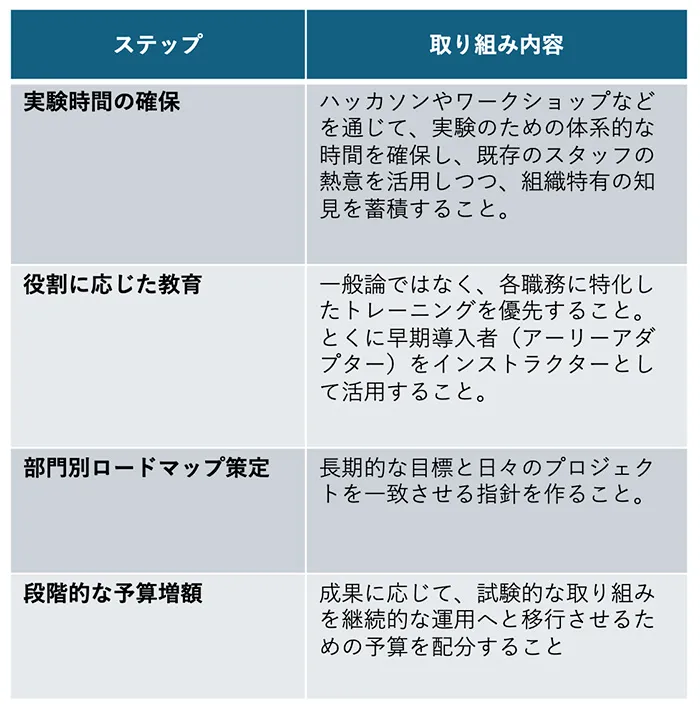
Furthermore, the NTO presents the following four practical suggestions for NTOs to successfully integrate AI: First, secure dedicated time for experimentation through informal hackathons, internal innovation sprints (to develop and validate new ideas), or simple workshops. This leverages the enthusiasm of existing staff while generating insights specific to the organization.Second, prioritize training programs tailored to specific roles, rather than merely raising staff awareness. In doing so, it is effective to enlist early adopters within the organization as instructors. Third, develop roadmaps for each organizational department to align the trial-and-error phase with long-term goals. For example, a framework that links the results of pilot projects to relevant organizational performance metrics would be beneficial for the marketing team.Finally, gradually increase the dedicated AI budget by linking it to concrete results. This makes it possible to transition successful pilot projects into a phase of continuous operation. In other words, the study points out that NTOs possess favorable conditions for AI adoption, and that the development of systematic organizational capabilities and strategic leadership serve as strong driving forces for moving from the trial-and-error phase of AI utilization to the implementation phase.
Compared to the national-level DMOs (NTOs) covered in this study, the organizations and budgets of regional DMOs in Japan are likely much smaller. Consequently, the hurdles to achieving organizational expertise are expected to be even higher. Therefore, drawing on the insights regarding AI implementation discussed so far, we will now consider specific measures to enhance the expertise of Japanese DMOs.
Recommendation: Advancing Tourism Destination Management Through AI, DMOs, and a Common Data Space
To advance “Strategic Attraction of Inbound Visitors and Ensuring Quality of Life for Residents”—one of the pillars of the 5th Basic Plan for Promoting Japan as a Tourism Nation—it is increasingly important to promote policies utilizing data in order to involve more stakeholders in consensus-building and to advance tourism through trial and error. To achieve this, rather than having individual DMOs act alone, a mechanism could be established to enhance organizational capabilities across a broader region and utilize data collectively.Specifically, this involves establishing a shared data space at the prefectural or regional level and setting up a "Regional Data Utilization Platform" (tentative name) to serve as a venue and organization for the shared use and operation of that data. To encourage regional-level DMOs to utilize AI, this platform will fulfill the following roles:
- Build a shared data space and design a shared DMP that regional DMOs can utilize according to their specific needs.
- Staff the platform with highly specialized personnel to support regional DMOs in advancing digital transformation through AI utilization.
- We will network the regional DMOs that are users of the platform, share know-how through seminars and workshops, and provide the latest information on an ongoing basis.
- Addressing issues such as AI ethics and legal regulations, which will require greater attention in the future.
- We will promote pilot programs through industry-government-academia collaboration to address specific challenges.
We intend to utilize the accommodation tax, which will be introduced in the future, as a funding source for operating the platform. Furthermore, we will promote initiatives to form a tourism ecosystem—such as industry-academia-government collaboration projects with local tourism businesses and the cultivation and support of travel tech—to enhance the competitiveness and resilience of the entire tourism destination.
Furthermore, to build a tourism ecosystem, it is necessary to nurture the key players who will drive it. It is the businesses, not the DMO, that directly provide the experiential value of tourism through their products and services. Therefore, to strengthen the tourism sector, a perspective that emphasizes large, medium, and small-scale businesses collaborating to create value for a single destination is essential. In particular, we want to prioritize the development of the travel tech sector, which leverages AI to create innovative business models.
For example, in Paris, the Welcome City Lab—an innovation platform incorporating the world’s first incubator specialized in the tourism sector—is active. Operated by “Paris & Co,” the City of Paris’s economic development and innovation agency, it aims to make Paris the global capital of tourism innovation by identifying future leaders in the tourism industry and creating synergies between traditional companies and startups.It provides startups with services such as coworking spaces, experimental platforms, and industry trend monitoring. In Japan, for example, Tokyo has the “Tokyo Innovation Base,” a hub where domestic and international startups and supporters gather; one could envision this facility incorporating a dedicated travel tech division.It might also be worthwhile to establish a tourism division within SusHi Tech Tokyo—a concept and event dedicated to solving sustainable urban challenges—or to create tech and social entrepreneurship divisions at Tourism EXPO Japan. Through these initiatives, we aim to foster a tourism innovation ecosystem that serves as a platform for collaboration among diverse organizations—including the government, local authorities, research institutions, and businesses—and establishes a framework for improving and advancing measures for technological development and human resource development.
Conclusion: The Future of Tourism AX and the Ecosystem
The utilization of AI presents a crucial opportunity to transform tourism destination management into a model that contributes to the region’s true sustainable development. This can be described as “AI Transformation in Tourism,” or “Tourism AX.” In this paper, we have proposed initiatives such as a common data space and a wide-area data utilization platform to drive this transformation.
To realize this, we also wish to promote industry-academia collaboration. In the field of tourism studies, research themes specializing in the digital sector are referred to as “Smart Tourism.” The World Congress on Smart Tourism (WCST), an international conference covering this specialized field, will be held in Da Nang, Vietnam, this December.As a committee member, I am engaged in activities to promote smart tourism research and its implementation in society. This international conference is not limited to the academic world; it also encourages presentations by practitioners, aiming to create opportunities for innovation through active exchange between academia and the industry.Since practitioners can participate through presentations without needing to submit a paper, I hope many DMOs and businesses from Japan will join us. Additionally, there are sessions where presentations can be given in Japanese, a measure designed to lower the language barrier despite the conference being international. Last year’s event was held in Macau, where case studies from Hakone and Atami were presented, leading to very lively discussions between researchers and practitioners. I hope that by sharing challenges in such a setting, new collaborative networks among DMOs will emerge in the future.
References
Toshinori Ebisawa, Hirokazu Kobayashi, and Yuichi Yamada (2026), “A Study on the Relationship Between DMO Human Resources and Marketing Outcomes: From the Perspective of DMO Organizational Capabilities,” Journal of the Japan Society for International Tourism Studies (No. 33), pp. 127–133
著者