Energy Consumption by Transportation Modes in Tourism Travel
In this column, we will examine transportation—a key component of energy demand in the tourism sector—using Chichibu City as a case study, and present some thoughts on approaches to energy management in the context of tourism-related travel.
Current Status and Overview of Energy Consumption in Domestic Tourism
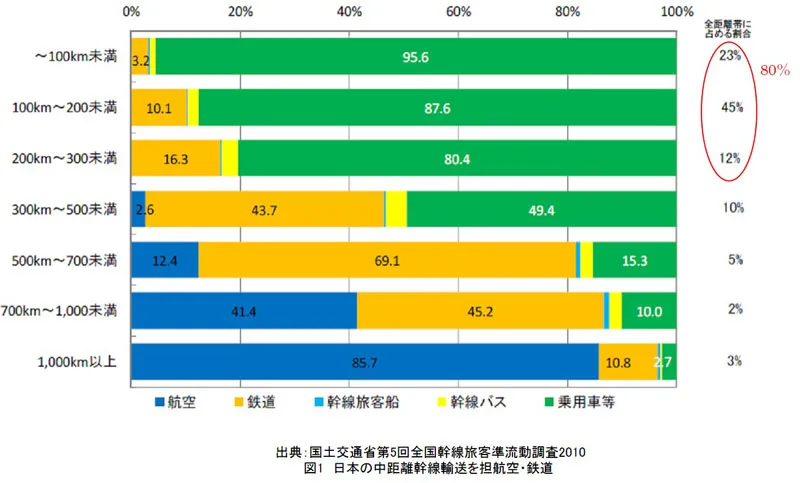
Looking at the distribution of transportation modes used for domestic travel, the division of roles for long-distance travel is clear: rail for distances of 500 km or more and air for 1,000 km or more. However, for distances under 300 km, there is a significant bias toward automobiles (Figure 1).
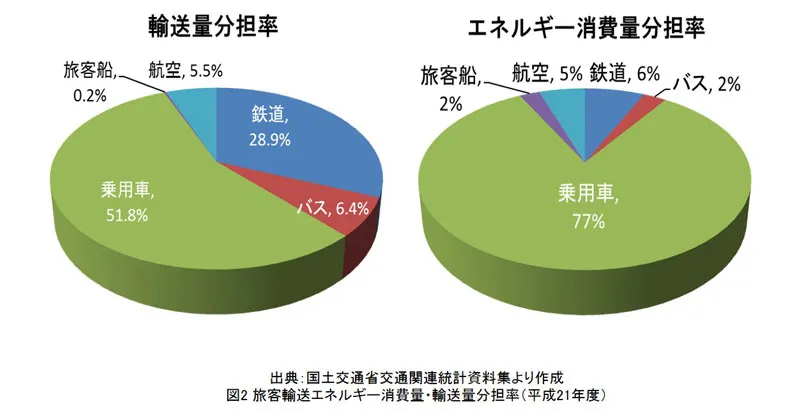
On the other hand, regarding trends in passenger energy consumption in tourism, a comparison of the share of transport volume versus energy consumption reveals that while passenger cars account for a large proportion of both, they represent approximately 52% of transport volume but approximately 77% of energy consumption—making them inefficient from an energy perspective (Figure 2). A comparison of passenger energy intensity also shows that passenger cars have a significantly higher energy intensity than other modes: 6.6 times that of rail and 1.6 times that of air travel.
Going forward, it is necessary to engage in discussions from an energy perspective regarding mobility options such as passenger cars, which will increasingly become the backbone of short- and medium-distance transportation. As Japan aims to become a tourism-oriented nation, research into the development of short- and medium-distance transportation outside major metropolitan areas is crucial for achieving the shift from centralization to decentralization (regional dispersion).
Verification of Potential in Domestic Regions
Chichibu City has developed primarily around cement-related industries, but the population has been declining significantly due to factors such as the closure of factories that were once located in the city center. Given the current situation where the city cannot rely on cement, new revitalization measures and countermeasures against population decline are urgently needed. Amidst these circumstances, the city has been designated as a “Forest Resource Utilization Energy Demonstration Model” area by the Ministry of Internal Affairs and Communications and Saitama Prefecture, and commercialization efforts are underway centered on “gasification and bio-oil production” using woody biomass.
However, while the ultimate goal is the revitalization of Chichibu City as a whole, a business ecosystem approach is essential to contribute to solving major social challenges such as the declining birthrate, aging population, and population decline. To expand and promote this ecosystem, increasing the flow of people is a key factor.
In the case of Chichibu City specifically, due to its location near Tokyo and the high potential of its tourism resources, it consistently attracts approximately 9.5 million tourists annually, with passenger cars accounting for about 70% of tourist transportation. In order to activate the business ecosystem described below, we will focus on energy consumption related to tourism-related travel.
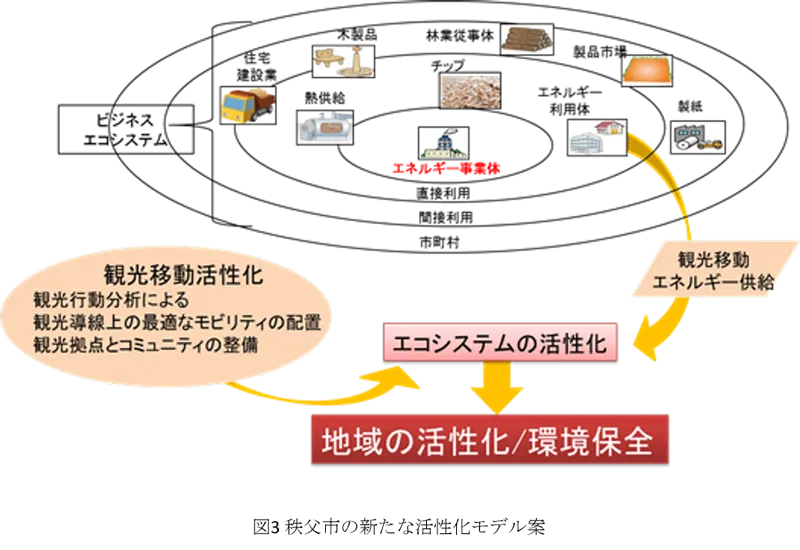
Regarding the introduction of renewable energy into the region, it is becoming increasingly clear that this alone is insufficient when considering its ripple effects on the local economy. This is due to the current reality that large-scale biomass power generation is rare and has not yet reached a level of supply sufficient to support industry and daily life. Consequently, many concepts for business ecosystems are being proposed, viewing a portion of the regional economy as a single ecosystem and clustering wood-based industries within a biomass-centered ecosystem. Adding a tourism model to this ecosystem is becoming an important new approach (Figure 3).
It is necessary to verify the potential for improving the overall regional economy through the integration of perspectives from both the tourism and energy sectors, and to explore the development of methodologies that generate effective proposals by considering and linking energy, tourism, and mobility as an integrated whole.