The Potential of Universities to Determine the Success or Failure of "Regional Revitalization"
In response to the wave of “regional revitalization” that began last year, various initiatives have emerged across the country aimed at revitalizing local communities by increasing visitor numbers through tourism promotion, creating new industries, and improving infrastructure to welcome international tourists. To yield tangible results from this series of regional revitalization policies, it is necessary to incorporate diverse insights from both within and outside the region, fuse them to generate new “knowledge,” and provide concrete “venues” and “know-how” where “regional management talent”—those who will lead the region—can thrive. To realize regional revitalization, I believe it is necessary to develop this “know-how” through education and research, while also re-examining the role of higher education institutions, particularly universities, as concrete “venues” for generating new knowledge. In this paper, I will examine the potential of universities to determine the success or failure of regional revitalization.
1. The Current State of Universities
Although calls for reform had been heard for some time, the environment surrounding the university sector had remained largely unchanged until the Central Council for Education’s January 2005 report, “A Vision for Higher Education in Japan,” served as a turning point. This report outlined the following priorities: “1. Global centers for research and education; 2. Training of highly specialized professionals; 3.Training a Broad Range of Professionals, 4. Comprehensive Liberal Arts Education, 5. Education and Research in Specific Specialized Fields (such as the arts and physical education), 6. Hubs for Lifelong Learning Opportunities in the Community, and 7. Social Contribution Functions (community contribution, industry-academia-government collaboration, international exchange, etc.)," and universities were suddenly swept up in a wave of reform.
Of the 780 universities currently in existence, the pressure on those facing financial difficulties—regardless of their legal status—to exit the market is intensifying year by year. In the university sector, a market governed by legal frameworks, delays in information disclosure are inherent to its structure. Consequently, the types and amounts of funds that can be injected—whether from the public or private sector—are limited, raising concerns that universities may lose their chance at revitalization.
Due to the declining birthrate, the decrease in the population of 18-year-olds has accelerated since 2006 (Heisei 18), and the number, which stood at 1.18 million in 2002 (Heisei 14), is increasingly likely to fall below the 1 million mark after 2018 (Heisei 30).Amid these circumstances, national universities are proceeding with faculty reorganization, such as the establishment of new faculties, with a view toward restructuring based on “integration of arts and sciences” and “regional contribution” through initiatives like COC+. Meanwhile, within Tokyo’s 23 wards, new trends driven by changes in the external environment—such as restrictions on university enrollment quotas—are emerging that are clearly different from the past. There are already examples at private universities of programs suspending recruitment or, in the worst cases, being discontinued. Against this backdrop
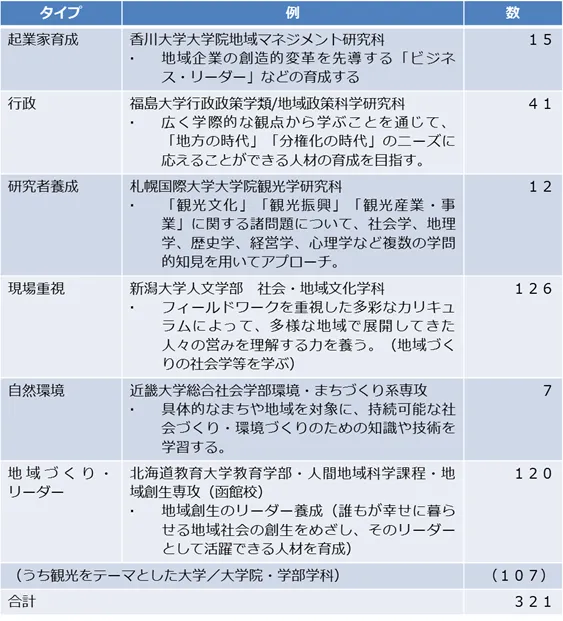
, there were 321 “region-oriented universities and graduate schools”—including those in the tourism sector—as of FY 2016. Given that the majority of these institutions emphasize on-site education such as fieldwork or focus on community development and leadership training, it is clear that connections with local communities have become an essential element for universities.
2. The Potential of Universities as “Functional Assets”
For a long time, universities have served as “hubs of knowledge,” with a mission to give back to local communities the fruits of their research and education while collaborating with local governments on various regional development initiatives. However, even when municipalities and universities signed agreements and implemented joint projects in theory, the results were not always favorable in practice—often because no policy issues worthy of collaboration could be identified, or because the university lacked the necessary resources to address them.
Against this backdrop, with the advent of the regional revitalization era, there has been an increase in cases where universities are involved in the formulation of “comprehensive strategies” compiled by local governments to revitalize the region, the provision of educational programs for the utilization of big data, and the development of human resources to lead regional revitalization efforts. From the universities’ perspective, tackling challenges such as regional economic decline and population decline holds significance in enhancing their brand power and positioning themselves to navigate an increasingly challenging business environment. For the regions, on the other hand, depending on how universities engage, it becomes possible to select and concentrate limited resources, thereby further increasing the likelihood of successful regional revitalization.
What is important here is the perspective of local communities—which have long felt at the mercy of universities confined within their “ivory towers”—to view regional revitalization as an opportunity and reconsider how they can effectively utilize universities as local resources.
In this context, I would like to point out that there are three types of universities when viewed as resources.
First, *1 “Human Resources.” Needless to say, universities across the country are home to approximately 3.076 million outstanding researchers, educators, and students who are engaged in daily study and research, as well as approximately 240,000 university staff members who perform back-office functions to support them. The number of highly skilled professionals among them is growing, and their potential as a resource is immense.
Second, “physical resources.” These include campuses and the facilities located on them—such as laboratories, libraries, museums, and various other structures—covering a total floor area of approximately 74.82 million square meters and a land area of approximately 1.5 billion square meters. *2 Even if their use deviates from their original purpose—for example, repurposing unused laboratories as startup support labs—the potential for utilizing these physical assets is extremely high.
Third, “information assets.” These are intangible assets such as intellectual property*3 that have not traditionally been reflected in financial statements. The development of an appropriate USR (University Stakeholder Relations + University Social Responsibility) strategy is precisely what enables this information to be leveraged as an “asset.” For example, in addition to existing data such as research outcomes and patents held by the university, all internal information and data—including research ideas currently under consideration—have the potential to be utilized as important “information assets. ”In Europe and the United States, evidence-based policy making (EBPM) is becoming mainstream, and the role universities can play—from data analysis to coordination among regional stakeholders—is growing increasingly significant. To achieve this, the function of Institutional Research (IR) becomes crucial: collecting, quantifying, and visualizing internal university information; using it as evaluation metrics; and broadly applying the results of this analysis across a wide range of areas, from education and research to student support and corporate management.
Based on these considerations, I would like to propose a new concept—"functional assets"—as a fourth category. Until now, the three resources mentioned above have been viewed in isolation; however, the concept of “functional assets” involves combining them in a comprehensive manner to derive solutions for specific challenges. In other words, “functional assets” function as initiatives resulting from the synthesis of diverse resources, such as new interdisciplinary research frameworks formed by combining university personnel and research seeds, and collaborative frameworks with local communities.
However, analyzing and synthesizing these resources requires an extremely keen and broad-minded discernment. To achieve this, it is all the more important for local governments—which utilize universities—to demonstrate the administrative capacity to empower themselves by recruiting diverse talent, networking them, and harnessing their collective power.
Terms such as “policy management” and “regional management” began to be widely discussed after the decentralization reforms of 2000, and within this trend, a transformation of the role of local government officials—who are primarily responsible for policy formulation—has been called for. With the progress of decentralization, we have entered an era of “network governance” in which regional challenges are resolved not through “governance” alone, but through “collaboration” among the public sector, the private sector, and citizens. Consequently, in regional revitalization, there is a growing need for professionals positioned as managers who can draw out the region’s potential by transcending the boundaries of the public and private sectors. Personnel working within DMOs—which are currently a focal point in tourism promotion—can be seen as fitting precisely into this context.
*1 Source: “Basic Survey of Schools FY2017 (Preliminary Report)”
*2 Source: “The 64th Japan Statistical Yearbook (2016)” “Chapter 25: Education” (Note: The building area for national universities refers only to the universities themselves and includes educational and research facilities, libraries, athletic facilities, support facilities, lodging facilities, affiliated schools, affiliated hospitals, administrative facilities, and equipment rooms, etc.)(Ministry of Education, Culture, Sports, Science and Technology, Minister’s Secretariat, Educational Facilities Planning Department, “FY2014 Report on the Actual Conditions of Facilities of National University Corporations, etc.” p. 15)
*3: The number of patent license agreements and similar arrangements at universities and other institutions has shown steady growth since FY2010, increasing approximately 2.4-fold over the five-year period through FY2015.reaching 11,872 cases in FY2015, a 9.9% increase from the previous year. Revenue from patent licensing and related activities has similarly grown, increasing approximately 1.9-fold over the same five-year period. In this way, university intellectual property is steadily contributing to university finances as a new source of revenue (Annual Report on Patent Administration 2017, p. 77)
3. Appropriate Models of Collaboration Between Regions and Universities for Regional Revitalization
The specific patterns of collaboration between local communities and universities can be broadly divided into “individual projects” and “agreement-based partnerships.”
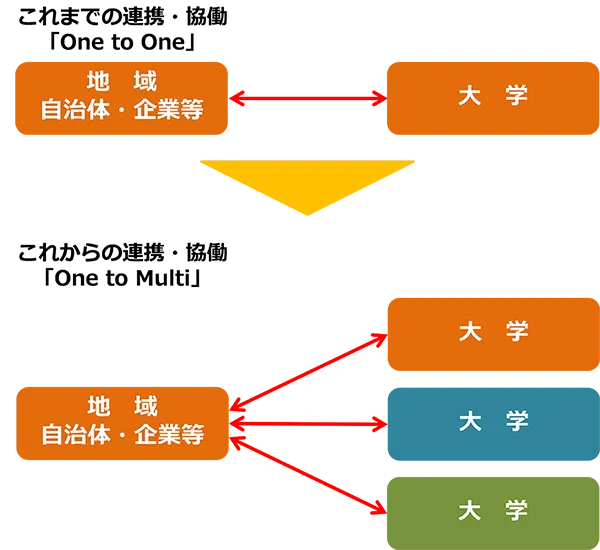
Currently, driven by regional revitalization efforts, there is a growing trend toward “agreement-based” collaboration, which goes beyond the traditional individual projects to seek comprehensive partnerships across a wide range of fields. By being formalized in writing, these agreements serve to ensure external accountability and provide a basis for decision-making within the administration, thereby helping to drive collaboration forward. The “regions” partnering with universities are no longer limited to local governments; the scope has expanded to include regional banks and leading companies. However, it is also true that “agreement-based” collaboration tends to remain at a general level, making it difficult to identify clear results at the concrete level. Thus, collaboration between universities and local governments or companies—whether through individual projects or agreements—has traditionally been based on building “one-to-one” relationships of equals.
Moving forward, in regional and industry-academia collaboration, it will be crucial to establish “one-to-many” relationships, in which local governments, companies, and other regional stakeholders systematically and comprehensively evaluate the research outcomes and educational programs of various universities to create combinations of universities best suited to solving their specific challenges.*4 It is precisely within such a relationship that the significance of universities as “functional assets” can be realized. For example, Kobe University has established the Graduate School of Science and Technology Innovation and adopted an approach that involves collaborating with faculty from the humanities to implement scientific and technological seeds into society, aiming to integrate the humanities and sciences. Furthermore, to efficiently realize the “One to Multi” model, universities themselves are moving toward functional integration. The “Kyoto University Model,” established through designation as a National University Corporation, involves the creation of a holding company (HD) that brings together three entities: Kansai T.L.O., Kyoto University Innovation Capital, and a company unique to Kyoto University.*5 Looking ahead to FY 2019, the national government has indicated a policy to introduce new grants starting in FY 2018 to revitalize regional universities. This aims to increase opportunities for students to live in regional areas during and after their studies, thereby helping to correct the excessive concentration of population in Tokyo.※6 This policy can be positioned as a concrete “rocket engine” to boost regional revitalization as it enters its next phase. Therefore, to bring regional revitalization efforts to fruition, it is precisely by building a system where local communities proactively and comprehensively evaluate the various “resources” held by universities, coordinate them in a manner suited to their needs, and work to utilize them effectively that we can discover new possibilities for regional revitalization.
*4 Reference: Tatsuro Shirai, Keynote Speech at the FY2017 Industry-Academia Collaboration Service Management Human Resources Development Project Symposium and Seminar, “The Potential for Developing Management Service Personnel through Industry-Academia Collaboration” (September 22, 2017), handout
*5 Nikkei Shimbun Digital Edition (September 5, 2017)
*6 Nikkei Shimbun Digital Edition (August 22, 2017)