The Key Challenge for the Region Lies in Utilizing and Communicating the Indigenous Values Hidden Behind World Heritage Status—On the Occasion of the Inscription of “Heritage Sites Related to Hidden Christians in the Nagasaki and Amakusa Regions” on the World Heritage List

On June 30, “The Hidden Christian Sites in the Nagasaki and Amakusa Regions” were inscribed on the World Heritage List. While this inscription is expected to draw attention and increase visitor numbers, there are also concerns that the concentration of visitors in the region could place a significant burden on the area, given that churches and other related sites continue to function as places of worship on a daily basis, regardless of their World Heritage status. What kinds of initiatives are being undertaken in the region to address this? With the World Heritage inscription serving as a catalyst, there is an expectation for more proactive measures to utilize cultural heritage—measures designed to convey the region’s unique character to tourists and to leverage visitor traffic for the maintenance and management of the heritage sites.
1. The Value of the “Hidden Christian Sites in the Nagasaki and Amakusa Regions”
1) Overview of the Property and the Process Leading to Its Inscription
“Hidden Christian Sites in the Nagasaki and Amakusa Regions” highlights heritage sites that serve as evidence of the period when the propagation and practice of Christianity were prohibited in Japan. Notable sites include the “Ruins of Hara Castle,” the site of the “Shimabara-Amakusa Rebellion” which was a major factor in the prohibition of Christianity, and “Oura Cathedral” in Nagasaki City, where Christians who had endured the ban were discovered by missionaries following the “Discovery of the Believers,” leading to a new form of religious practice. In addition, the component assets include 10 “Hidden Christian Villages” that serve as evidence of how unique forms of faith were secretly nurtured during the period of prohibition. During this time, many Christians moved from the center of Nagasaki to rural areas where government officials could not easily monitor them. Numerous traces of these settlements remain not only in Sotomi and Hirado, where the Endo Shusaku Memorial Museum is located, but also on the Goto Islands, where people migrated as persecution intensified in the mainland.
The process leading up to the nomination of the property was by no means smooth. Although the plan was to submit a nomination in 2016 under the title “Churches and Christian-Related Heritage in Nagasaki,” in February of that year, ICOMOS, the advisory body responsible for cultural heritage assessments, expressed the view that “the preservation of faith throughout a long history of persecution is a distinctive feature of Christianity in Japan, and registration would be difficult without focusing on this aspect.” Consequently, to ensure successful registration, it was decided to revise the narrative and the list of component assets, and the nomination for that year was withdrawn.
Looking back at the history of Christianity in Japan, the past 450 years—since Francis Xavier began his missionary activities in Japan in 1549—have been marked by a turbulent history rarely seen in the history of world religions. This includes the prosperity of Christianity under Christian daimyo, the severe persecution following the Hideyoshi era and the resulting period without priests, and the "collapse" following the "discovery of believers" in the Meiji period, followed by the concealment and revival of Christianity.The originally proposed nomination, “The Churches of Nagasaki and Related Christian Heritage,” sought to illustrate this long story through 14 component assets, including the Oura Cathedral and churches on the Goto Islands, as well as the ruins of Hara Castle, the site of the Shimabara Rebellion. Subsequently, based on advice from ICOMOS, the composition was reorganized to better convey the “uniqueness of the period of prohibition and hiding.” As a result, several churches were removed from the list of component assets, and the site was re-registered as a “settlement” unit, with the Amakusa region of Kumamoto Prefecture being added to the list.
2) The Value of the Heritage
The twists and turns leading up to the inscription provided an opportunity to reexamine how the value of the heritage, as understood by Japan, appeared to others—particularly from a Western perspective—and to question the very essence of that value. It became evident that there was a significant gap between the value of cultural properties measured by universal standards and the value recognized by the local community for these sites; one could also say that this revealed the limitations of the mechanisms for assessing value.Since the World Heritage system originated in Europe, there are numerous heritage sites related to Christianity throughout the world. The international cultural advisory bodies take the view that while the spread and development of Christianity are common to many regions worldwide, this does not constitute a “unique value.” Churches whose architectural history or technical superiority is unclear fall outside the framework of “cultural property” altogether.
Although the term “hidden” was included in the site’s name to highlight its objective and international value, if the very act of living in secret is considered valuable, this also implies a scarcity of physical historical evidence.Many of the church complexes built after the ban on Christianity was lifted—which seem to express overflowing joy—are excluded from this set of constituent assets. As a result, the nomination includes many properties whose value is difficult to grasp visually, making it challenging to understand the value and narrative of this property based solely on visual information. For local believers, these places of worship—which hold greater value than the labels of “cultural property” or “World Heritage Site”—will generate new value distinct from the past following the inscription, and this will inevitably have some impact on the local community.
2. Expectations and Measures for Promoting World Heritage Tourism
1) Visitor Demand
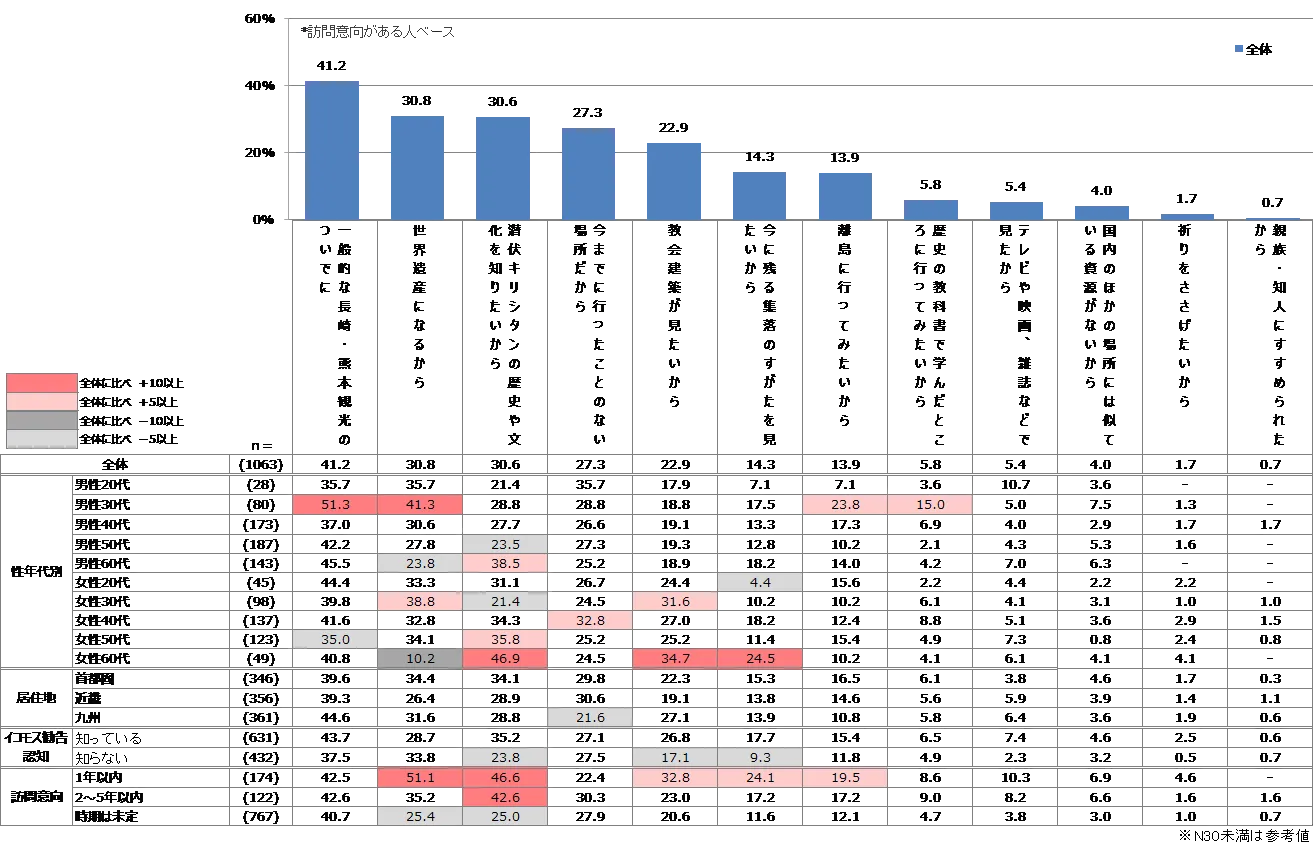
In an online survey conducted this past May, the most common reason cited for wanting to visit the “Hidden Christian Sites in the Nagasaki and Amakusa Regions” was “while sightseeing in Nagasaki or Kumamoto,” accounting for 40% of responses. Additionally, approximately 30% of respondents cited “its designation as a World Heritage site” as a reason (Figure 1).Furthermore, “wanting to visit remote islands” accounted for about 14%, indicating that the component sites are viewed as one of the elements that enhance the unique island tourism experience of the region; these visitors, for whom “learning about history and culture is not the primary purpose,” are mainly found among those in their 40s and younger.An increase in visitors from this “sightseeing-for-fun” demographic—who differ from the traditional customer base with deep knowledge of history and culture who thoroughly research the component sites on their own beforehand—is inevitable. Consequently, the region is promoting initiatives to ensure that when these visitors arrive, they are properly informed of the area’s attractions beyond the World Heritage designation, and that their visit serves as an opportunity to deepen their understanding of the region.
Among the component sites, the value of certain locations—such as villages and memorial sites associated with persecution—is not immediately apparent. However, particularly in the island regions, there is a shortage of taxis and guides, making it difficult to say that the infrastructure is in place for individual tourists to move around smoothly or arrange guides according to their schedules.To address these challenges, Nagasaki Prefecture is implementing initiatives such as assigning volunteer guides (church caretakers) to unmanned churches. Additionally, in the Goto Islands and Ojika regions, guided tour programs are being sold as destination-based tours, offering both safe and reliable transportation and the added value of interpretation.Future challenges include maintaining and improving the quality of paid guides and ensuring consistency across the board, as well as fostering a community-wide atmosphere where people from various backgrounds—such as accommodation and transportation providers, and local parishioners—can serve as local storytellers within their capacity, sharing aspects of the region’s history with visitors.
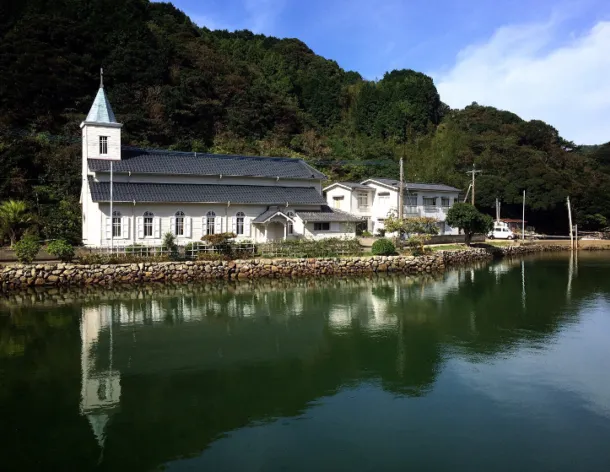
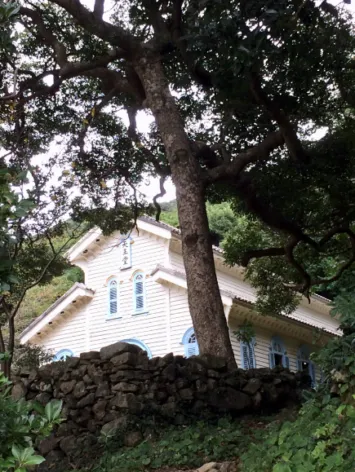
Furthermore, in the churches of this region (excluding historic churches), photography inside the church is prohibited as a matter of etiquette. In contrast, in Europe—the heartland of Christianity—many churches permit photography inside the church at times other than during Mass. Since the rule of “no photography in all churches” is a so-called local custom in Japan, not only Japanese tourists but also foreign tourists who are Christian believers may be unaware of this local custom or may question it.While it goes without saying that the wishes of local believers should be respected to the utmost, the resulting visitation rules and etiquette must also possess objective rationality and be acceptable to visitors. Taking the recognition of the international value of these local assets as an opportunity, rather than having the local community and visitors each assert their own rights, it is necessary to explore—through repeated implementation—methods for preserving this heritage for future generations, while both parties acknowledge a certain degree of burden and inconvenience.
2) Concerns Regarding Overtourism
While there are precedents for “villages” or “towns” designated as World Heritage sites, such as Shirakawa-go and Iwami Ginzan, the constituent assets of this property are located in areas far more closely integrated with daily life than those examples. Villages that possess the ancillary facilities and services typically found in tourist destinations—such as restaurants, lodging, restrooms, and parking lots—are rare.Particularly in island regions experiencing significant population decline, the number of parishioners is decreasing, and since a single priest often serves multiple churches, many churches stand empty. To prevent the concentration of visitors in such areas, it is essential to provide advance information to help manage tourist behavior. In this region, “advance notification” is required for visits to nine churches and former churches to inform the public of dates and times when visits are not possible due to church events, and to reduce the burden on aging facilities.However, information regarding this advance notification requirement is primarily posted or disseminated through local government websites or World Heritage-related websites and pamphlets; in reality, this information reaches only the aforementioned “traditional visitor demographic who independently research the component sites in advance.” As of the May survey, only 7.7% of people were aware of the advance notification requirement (Figure 2).Until this information becomes widely known, the only option for strictly enforcing visitor limits is to combine on-site visual guidance and warnings with the current system; consequently, the personnel costs associated with managing visitors are expected to be extremely high.To alleviate the concentration of visitors to component assets and preserve the environment of local communities, Shinkamigoto Town introduced a park-and-ride system in April 2018 for entry into the Shirahama district, where the Kabeshima Cathedral is located. By operating this system in conjunction with the advance notification requirement, the town aims to ensure proper maintenance of the facilities and to even out visitor traffic throughout the day.

3. “World Heritage” and “Non-World Heritage”
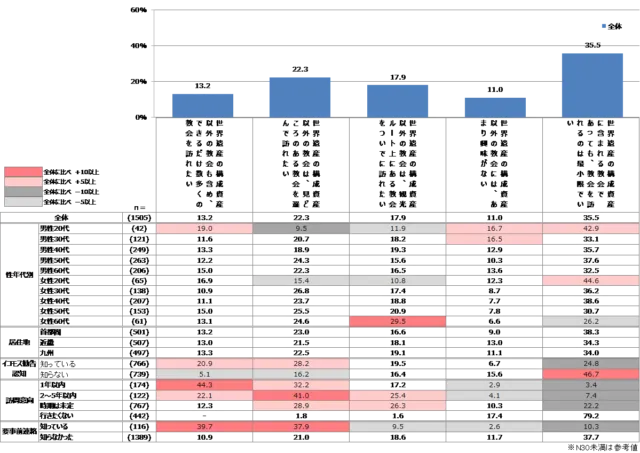
There are two points to keep in mind when leveraging this inscription to promote tourism. First, it is expected that visitors will primarily target “churches”—which are visually appealing and whose beauty and value are easily understood—rather than the “settlement,” a heritage site whose value may be less apparent.The other is that visitors are highly likely to use the distinction between “World Heritage sites” and “non-World Heritage sites” as a basis for deciding whether to visit. Approximately 13% of respondents said they “want to visit as many churches as possible, even those not included in the World Heritage list,” while 23% said they “want to select and visit churches outside the World Heritage list that are worth seeing” (Figure 3).In total, more than one-third expressed a desire to “see as many churches as possible.” On the other hand, over 40% of those in their 20s responded that “even if they are World Heritage sites, I only need to see a minimum number of churches,” indicating that the level of interest in the heritage varies significantly by age group.
Most churches do not charge admission fees. Furthermore, given the nature of the concept of “donations” in Christianity, it is difficult to mandate that individual churches collect fees for maintenance and management. That said, as the number of visitors from outside the local community increases, the costs of maintaining these facilities will rise.Given the strained national budget for cultural property maintenance, local municipalities lack the financial capacity to allocate ample funds for this purpose. Typically, the maintenance and cleaning of churches in each community are supported by local congregations. However, rather than creating systems that assume tourism will increase the burden on the community, it is necessary to explore mechanisms that utilize tourism as a means to alleviate that burden. This is essential for fostering a harmonious coexistence between local religious activities and tourism.It is an urgent priority to establish a conservation and management system that prevents costs from being shifted onto “World Heritage churches” and prevents revenue from being concentrated in popular churches, and instead ensures a balanced distribution of costs, revenue, and human resources among the “other churches.”
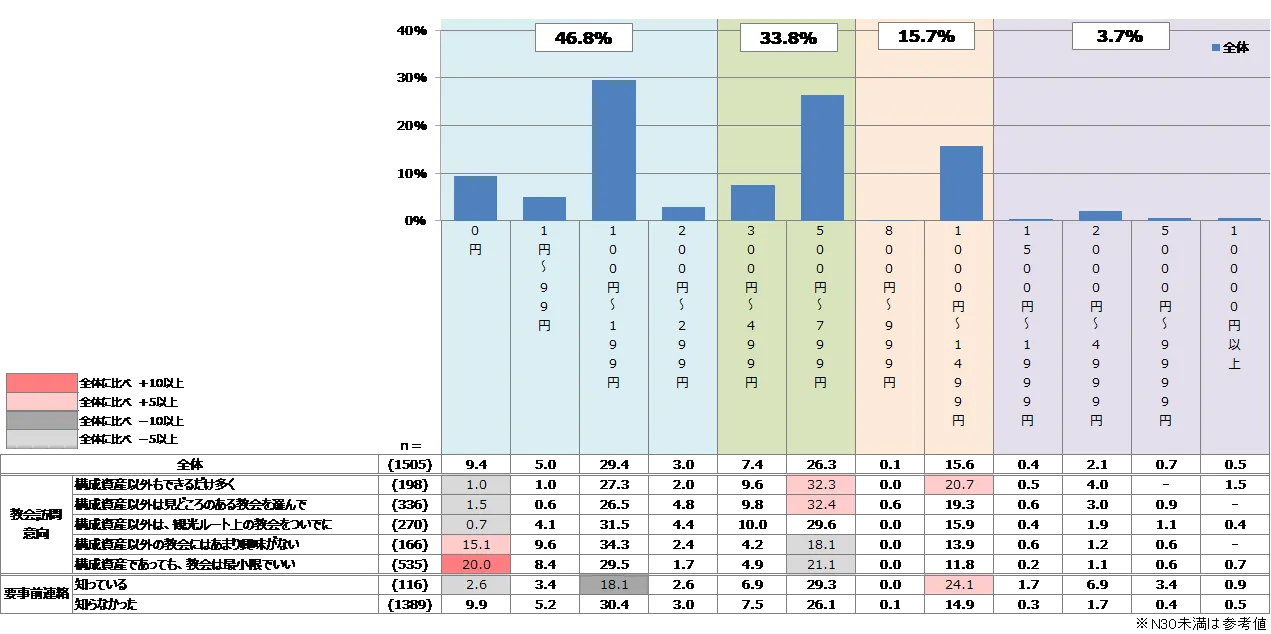
From the perspective of consumption at religious facilities beyond admission fees, one aspect that has garnered increasing attention in recent years is the “goshuin” (temple or shrine stamp). While there is no set price, many shrines and temples have established a fee of 300 yen. I believe one of the key reasons for the popularity of goshuin is that they provide a beautiful, tangible record of the connection formed with the facility (or the deity).While donations at churches are an expression of gratitude, making a one-sided donation alone does not allow one to visualize the memory of “having visited that place” or the sense of connection that comes from “having committed, even in a small way, to the benefit of that church.” In some European churches, pictures are placed near the offering box, and donors are encouraged to freely take one.In response to the question, “As a token of appreciation for visiting the church, how much would you be willing to contribute to the offering box?” the average response was 500 yen, and there is a correlation between the level of interest in cultural properties and church architecture and the amount contributed (Figure 4).In an environment where visits by non-believers are becoming more frequent, it may be worth considering the introduction of a “system that makes the act of donating visible,” one that can operate unattended. Some regions with natural heritage sites collect environmental taxes, and Tokyo has a “lodging tax.”While it is important for each visitor to feel that they are being “allowed to see” what the community has cherished and protected for hundreds of years, given the history of promoting World Heritage registration at the local administrative level, it is desirable to establish a system where visitors fairly share part of the costs for maintaining the heritage—in the form of cooperation fees or funds—rather than relying solely on individual goodwill.
4. What Becomes Invisible When Viewing a “World Heritage Site”
This could be seen as both a benefit and a drawback of regional branding: when too much attention is focused on one aspect of a region, other aspects often fade into the background. In this case as well, grouping resources scattered across a wide area under the common framework of “World Heritage” is likely to have a similar effect, particularly in regions where regional branding—especially in the context of tourism—has not yet been fully established.Following the enactment in 2016 of the “Act on Special Measures for the Conservation of Inhabited Border Islands and the Maintenance of Local Communities in Specified Inhabited Border Island Areas” (commonly known as the “New Border Islands Act”), the Cabinet Office launched the “Let’s Go to Japan’s Borders!!” project that same year to revitalize remote islands near the border. In the Goto Islands region as well, efforts are underway to expand new tourism content that leverages the unique environment and resources of these remote islands. Furthermore, the region is home to constituent assets of the Japan Heritage site “Border Islands: Iki, Tsushima, and Goto.” As a result, tourism in the Goto Islands region has come to be discussed through several lenses: “border,” “stay-type tourism on remote islands,” “World Heritage,” and “Japan Heritage.” While this highlights the diversity of the region’s tourism resources, it is undeniable that it also obscures the unique, intrinsic value inherent to the region.
Nozaki Island in Ojika, home to the former Noguchi Church, is a place where primitive megalithic beliefs served as a foundation, fused with Shintoism—which venerates gods capable of defeating foreign enemies, a characteristic of this western region—and later demonstrated an open-mindedness in accepting Christianity. When the Noguchi Church was rebuilt, many religious artifacts, such as rosaries, were buried in the ground. This reveals a uniquely Japanese philosophy—similar to that seen in ground-breaking ceremonies—of showing reverence and respect to the local deities. It demonstrates how, even while worshipping heavenly gods, a mysterious synthesis has been achieved with the Japanese people’s inherent religious outlook, deeply rooted in the land. Ojika Island has been inhabited since the Stone Age. Through exchanges with the Korean Peninsula, the island acquired iron early on and flourished through whaling, fisheries, and sake brewing, becoming an extremely “Japanese-style” city with a high degree of cultural maturity. The Lower Goto Islands, comprising Fukue Island and Kuga Island, and the Upper Goto Islands, centered on Nakadori Island, are regions where one can trace the footsteps of Christianity from its development through to persecution and the period of hiding; at the same time, they lie along the routes taken by the Japanese missions to Tang China and during trade with Korea. On Fukue Island, there is a temple associated with Kukai, who stayed there on his return journey from Tang China. Additionally, the “Chankoko” Nembutsu dance, which was the official performing art of the former Goto Domain, reflects remnants of Korean culture, and there is abundant evidence of exchanges with the mainland. On Hishima Island in Kamigoto, there is a cluster of ancient tombs dating primarily from the medieval to early modern periods, indicating that the area functioned as both a trade and military hub. Many stones not native to the area can be seen here, suggesting that ship ballast was utilized. Used continuously as a “communal cemetery” for a long period since the medieval era, the landscape—featuring a row of stone pagodas of various styles alongside modern gravestones—is exceptionally unique.
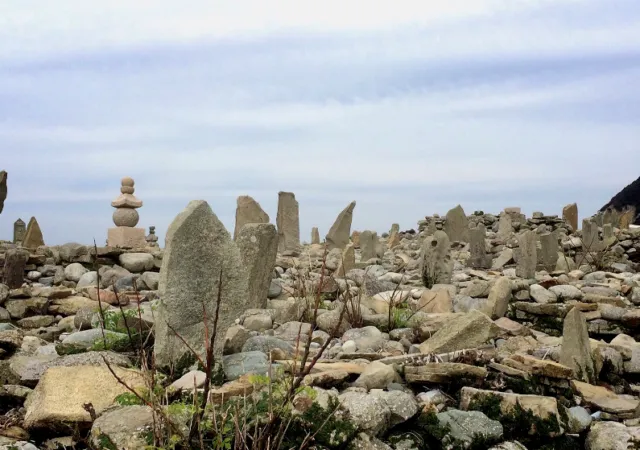
If we focus too much on the common context of “World Heritage,” there is a high risk that we will fail to fully convey the region’s unique historical value—one rooted in the multi-layered histories and indigenous beliefs and customs that Okinoshima, Kamigoto, and Shimo-Goto had each accumulated long before the arrival of Christianity. To promote sustainable tourism following World Heritage inscription, it is essential that the regions possessing the component assets collaborate and focus even more on expressing their regional distinctiveness.
The decision to postpone the World Heritage nomination following the ICOMOS recommendation has revealed a gap between the global value of the “Hidden Christian Sites in the Nagasaki and Amakusa Regions” and the value the local communities recognize in them.On Nozaki Island, believed to have been a sacred site of ancient beliefs, Christianity naturally integrated without causing destruction; and it was precisely because the Japanese have a tradition of depicting deities and Buddhas in images that the unique practice of “e-fumi” (stepping on images) proved effective, leading to the persecution of Christians. By tracing the history of the Hidden Christians and overlaying it with the region’s long history—including its geographical environment and industries—we can objectively reaffirm the uniqueness of Japan’s religious practices and the nature of syncretism that allows for the gentle blending of multiple faiths (a phenomenon not discussed in the context of World Heritage).Understanding “World Heritage” is, in essence, understanding the originality of Japan’s history and culture, and ultimately leads to an appreciation of the irreplaceable value of the regions where these traditions have thrived.
Figures 1–4 Source: “Consumer Awareness Survey on the ‘Hidden Christian Sites in the Nagasaki and Amakusa Regions’” (JTB Tourism Research & Consulting Co., Ltd.)
Dates: May 22–24, 2018 Survey Method: Online questionnaire Survey Participants: Men and women in their 20s to 60s residing in the Tokyo metropolitan area, the Kansai region, and the Kyushu region (excluding Nagasaki and Kumamoto) Sample Size: 1,505 Survey Cooperation: Bulk Co., Ltd.
著者