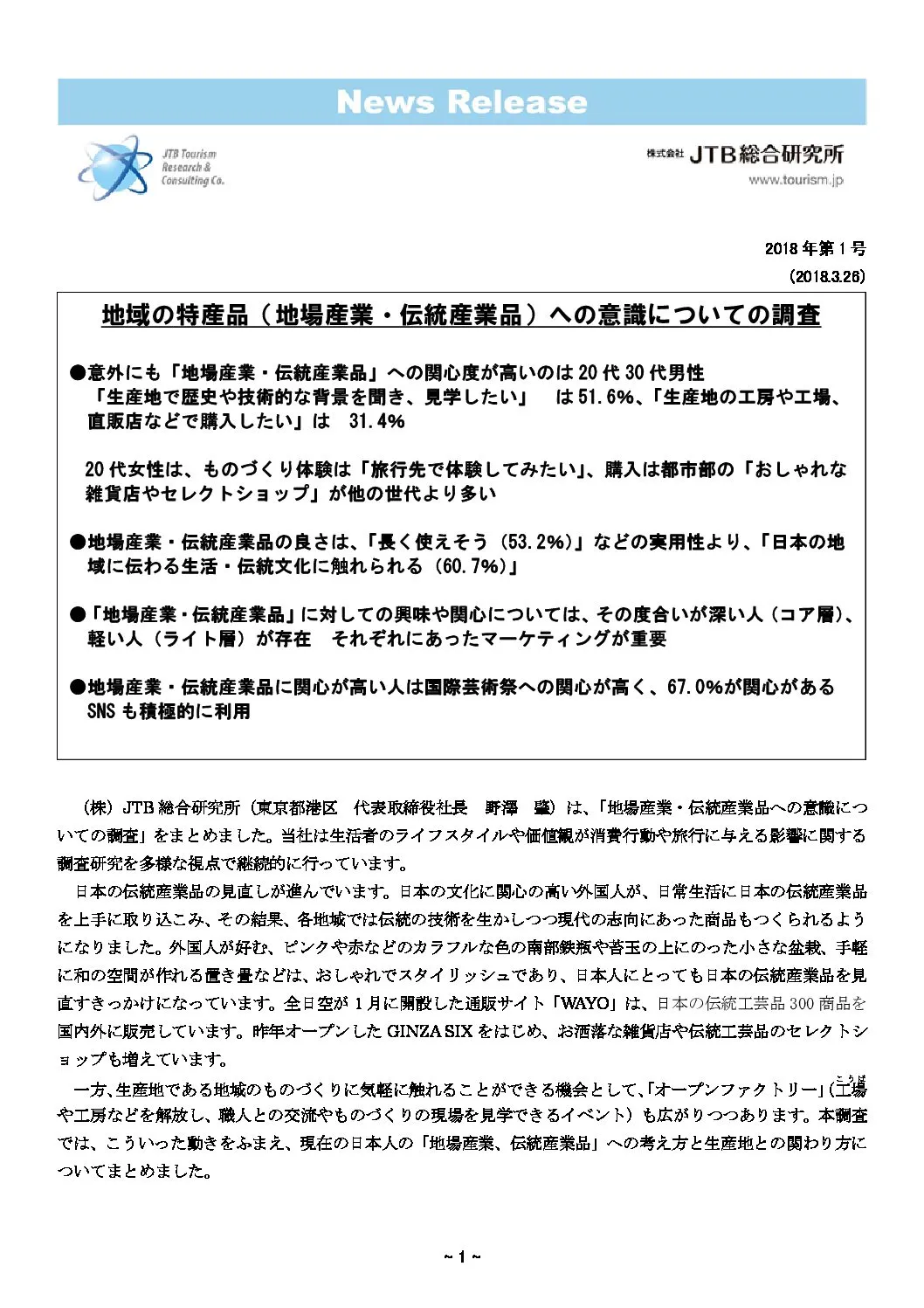
Survey on Public Awareness of Local Specialty Products (Local and Traditional Industries)
PDFダウンロード
公開日
JTB Tourism Research & Consulting Co., Ltd. (Minato-ku, Tokyo; President and CEO: Hajime Nozawa) has compiled a report titled “Survey on Public Perceptions of Local and Traditional Industries.” The company continuously conducts research from diverse perspectives on how consumers’ lifestyles and values influence their purchasing behavior and travel habits.
There is a growing reevaluation of traditional Japanese industrial products. Foreigners with a strong interest in Japanese culture are skillfully incorporating these products into their daily lives, and as a result, regions across the country have begun producing goods that utilize traditional techniques while also catering to modern tastes. Items favored by foreigners—such as colorful Nanbu iron kettles in shades of pink and red, small bonsai trees displayed on moss balls, and portable tatami mats that allow for the easy creation of a Japanese-style space—are fashionable and stylish, serving as a catalyst for Japanese people to re-evaluate traditional Japanese crafts as well. The online store "WAYO," launched by All Nippon Airways (ANA) in January, sells 300 traditional Japanese craft items both domestically and internationally. The number of stylish variety stores and select shops specializing in traditional crafts is also increasing, including GINZA SIX, which opened last year.
Meanwhile, “Open Factory” events—where factories and workshops open their doors to allow visitors to interact with artisans and observe the manufacturing process—are also gaining popularity as a way for people to easily experience local craftsmanship firsthand. In light of these trends, this survey summarizes current Japanese attitudes toward “local and traditional industrial products” and how people engage with their regions of origin.
* “Local and Traditional Industrial Products” (Reference: Daijirin Third Edition, World Encyclopedia Second Edition)
Local industrial products: Products produced by industries that have developed over a long period of time based on the resources and labor of a particular region and have become firmly established there.
Traditional industrial products: Among local industrial products, those that have existed for a long time and are made using techniques that are designated for protection within Japan (products that possess regional characteristics and a historical background).
There is a growing reevaluation of traditional Japanese industrial products. Foreigners with a strong interest in Japanese culture are skillfully incorporating these products into their daily lives, and as a result, regions across the country have begun producing goods that utilize traditional techniques while also catering to modern tastes. Items favored by foreigners—such as colorful Nanbu iron kettles in shades of pink and red, small bonsai trees displayed on moss balls, and portable tatami mats that allow for the easy creation of a Japanese-style space—are fashionable and stylish, serving as a catalyst for Japanese people to re-evaluate traditional Japanese crafts as well. The online store "WAYO," launched by All Nippon Airways (ANA) in January, sells 300 traditional Japanese craft items both domestically and internationally. The number of stylish variety stores and select shops specializing in traditional crafts is also increasing, including GINZA SIX, which opened last year.
Meanwhile, “Open Factory” events—where factories and workshops open their doors to allow visitors to interact with artisans and observe the manufacturing process—are also gaining popularity as a way for people to easily experience local craftsmanship firsthand. In light of these trends, this survey summarizes current Japanese attitudes toward “local and traditional industrial products” and how people engage with their regions of origin.
* “Local and Traditional Industrial Products” (Reference: Daijirin Third Edition, World Encyclopedia Second Edition)
Local industrial products: Products produced by industries that have developed over a long period of time based on the resources and labor of a particular region and have become firmly established there.
Traditional industrial products: Among local industrial products, those that have existed for a long time and are made using techniques that are designated for protection within Japan (products that possess regional characteristics and a historical background).
Key Findings
- Surprisingly, men in their 20s and 30s show the highest level of interest in “local and traditional products.” 51.6% said they “want to visit the production sites to learn about their history and technical background,” while 31.4% said they “want to purchase them directly from stores at the production sites.” Workshops and factoriesWomen in their 20s are more likely than other age groups to say they “would like to try hands-on crafting activities while traveling” and to shop at “trendy gift shops and select shops” in urban areas.
- The appeal of local and traditional products lies less in their practicality—such as the fact that they "seem durable" (53.2%)—and more in the opportunity to "experience the lifestyle and traditional culture passed down in Japan's regions" (60.7%).
- When it comes to interest in "local and traditional industries and products," there are those with a deep interest (the core segment) and those with a casual interest (the casual segment); it is important to tailor marketing strategies to each group.
- People with a strong interest in local and traditional industries also show a high level of interest in international art festivals, with 67.0% expressing interest; they also actively use social media.