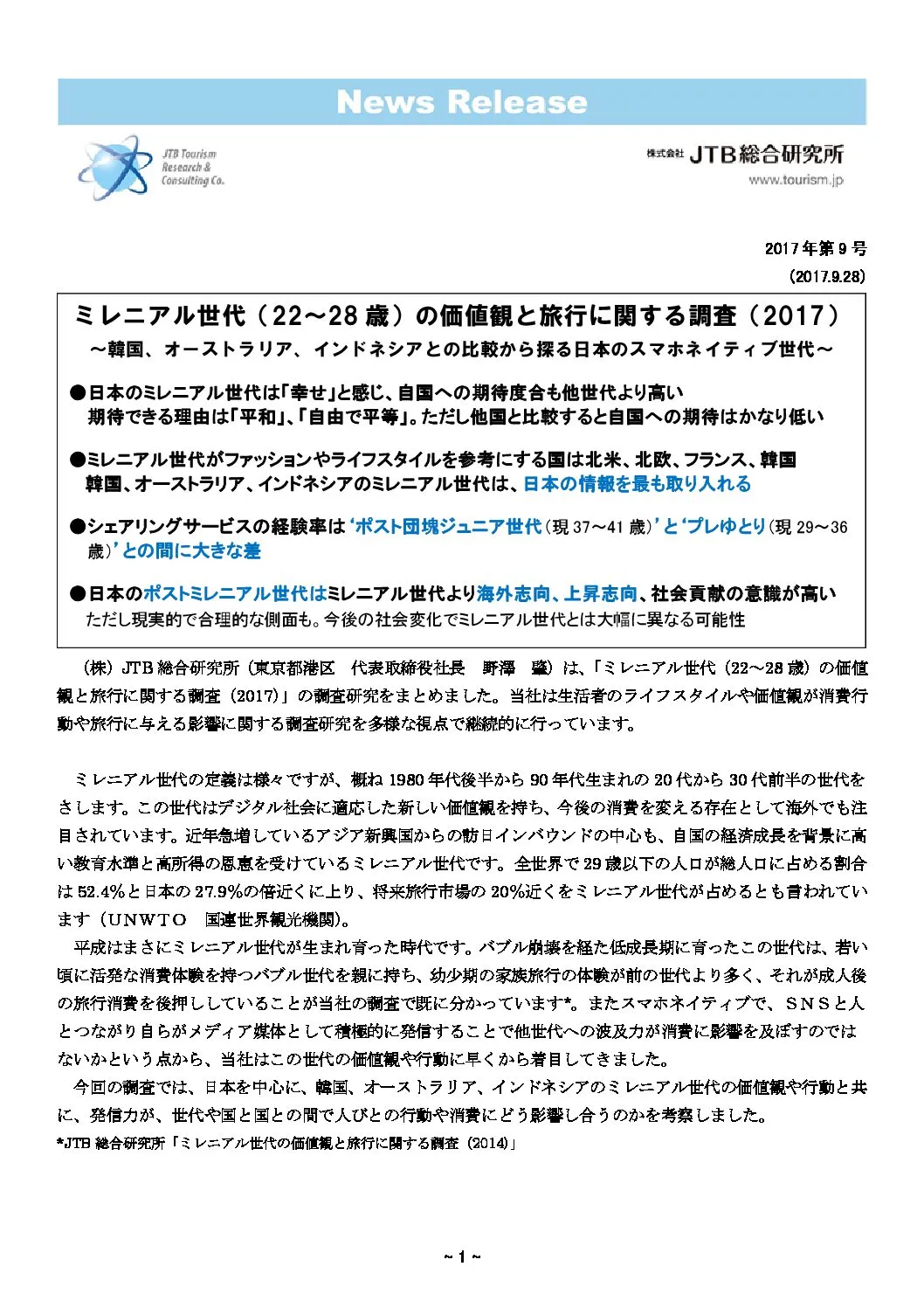
Survey on the Values and Travel Habits of Millennials (Ages 22–28) (2017): Exploring Japan’s “Smartphone-Native” Generation Through Comparisons with South Korea, Australia, and Indonesia
~Exploring Japan’s Smartphone-Native Generation Through Comparisons with South Korea, Australia, and Indonesia~
PDFダウンロード
公開日
JTB Tourism Research & Consulting Co., Ltd. (Minato-ku, Tokyo; President and CEO: Hajime Nozawa) has compiled the findings of its research study titled “Survey on the Values and Travel Habits of Millennials (Ages 22–28) (2017).”We continuously conduct research from diverse perspectives on how consumers’ lifestyles and values influence their consumption behavior and travel habits.
While definitions of the Millennial generation vary, it generally refers to those born in the late 1980s to the 1990s, who are now in their 20s to early 30s.This generation possesses new values adapted to the digital society and is attracting attention overseas as a force that will transform future consumption. The core of the rapidly growing number of inbound tourists to Japan from emerging Asian countries is also the Millennial generation, who benefit from high educational standards and high incomes against the backdrop of their countries’ economic growth. Globally, people aged 29 and under account for 52.4% of the total population—nearly double Japan’s 27.9%—and it is estimated that Millennials will account for nearly 20% of the future travel market (UNWTO, United Nations World Tourism Organization).
The Heisei era was precisely the time when the millennial generation was born and raised. Our research has already shown* that this generation, which grew up during a period of low growth following the collapse of the economic bubble, has parents from the “bubble generation” who enjoyed active consumer experiences in their youth. They also had more family travel experiences during childhood than previous generations, and this is driving their travel spending as adults. Furthermore, as smartphone natives who connect with others through social media and actively share content as media outlets themselves, we have long focused on this generation’s values and behaviors, believing their influence on other generations may impact consumption.
In this survey, we examined the values and behaviors of Millennials in Japan, South Korea, Australia, and Indonesia, and explored how their influence on social media affects people’s behaviors and consumption across generations and countries.
While definitions of the Millennial generation vary, it generally refers to those born in the late 1980s to the 1990s, who are now in their 20s to early 30s.This generation possesses new values adapted to the digital society and is attracting attention overseas as a force that will transform future consumption. The core of the rapidly growing number of inbound tourists to Japan from emerging Asian countries is also the Millennial generation, who benefit from high educational standards and high incomes against the backdrop of their countries’ economic growth. Globally, people aged 29 and under account for 52.4% of the total population—nearly double Japan’s 27.9%—and it is estimated that Millennials will account for nearly 20% of the future travel market (UNWTO, United Nations World Tourism Organization).
The Heisei era was precisely the time when the millennial generation was born and raised. Our research has already shown* that this generation, which grew up during a period of low growth following the collapse of the economic bubble, has parents from the “bubble generation” who enjoyed active consumer experiences in their youth. They also had more family travel experiences during childhood than previous generations, and this is driving their travel spending as adults. Furthermore, as smartphone natives who connect with others through social media and actively share content as media outlets themselves, we have long focused on this generation’s values and behaviors, believing their influence on other generations may impact consumption.
In this survey, we examined the values and behaviors of Millennials in Japan, South Korea, Australia, and Indonesia, and explored how their influence on social media affects people’s behaviors and consumption across generations and countries.
Key Findings
- Japanese millennials feel "happy" and have higher expectations for their country than other generations. The reasons for these expectations are "peace" and "freedom and equality." However, when compared to other countries, their expectations for their own country are quite low.However, there is also a realistic and rational side to this. Future social changes could make them significantly different from the millennial generation.
- The countries that millennials look to for fashion and lifestyle inspiration are North America, Northern Europe, France, and South Korea. Millennials in South Korea, Australia, and Indonesia are the most likely to take in information from Japan.
- There is a significant difference in the rate of sharing service usage between the "post-baby boomer junior generation" (currently aged 37–41) and the "pre-Yutori generation" (currently aged 29–36)
- Japan's post-millennial generation is more internationally minded, more ambitious, and more socially conscious than millennials