The Current State of Overseas Tourism in 2018
PDFダウンロード
公開日
JTB Tourism Research & Consulting Co., Ltd. (Minato-ku, Tokyo; President and CEO: Hajime Nozawa) has compiled the research report “Current Status of Overseas Tourism 2018.” The company continuously conducts surveys and analyses of consumer behavior and travel from a variety of perspectives.
Overseas travel by Japanese citizens is currently booming. The number of outbound travelers in 2017 reached 17.89 million, the second-highest figure on record. So far this year, the cumulative total from January to May stands at 7.36 million, a 3.9% increase year-on-year. If this trend continues, it is expected to come very close to the all-time high of 18.49 million recorded in 2012.Looking back to 2012, although the extremely strong yen had a positive effect on overseas travel spending (1 USD = 80.31 yen at the end of June 2012; 1 USD = 111.54 yen at the end of June 2018, according to Mitsubishi UFJ Bank),the economy itself was stagnating due to the Lehman Shock and the Great East Japan Earthquake, and the number of travelers to China and South Korea had begun to decline significantly due to international relations. Although the yen has since weakened, many companies are performing well, summer bonuses are on the rise, and the unemployment rate is improving; therefore, it is believed that this is not having a negative impact on the desire to travel abroad. Furthermore, the number of travelers to both China and South Korea is on a recovery trend, driven by increased people-to-people exchanges accompanying the expansion of business with China and the impact of the third Korean Wave. The launch of LCC routes connecting Asian cities with Japanese cities has increased travel opportunities not only for inbound tourists but also for Japanese travelers, suggesting that the environment surrounding overseas travel is improving.
On the other hand, many members of the baby boomer generation—who have historically driven overseas travel—are now entering their 70s. Meanwhile, the rise of the millennial generation—who have been familiar with smartphones since childhood and are garnering global attention for their influence on values and consumption—and the fact that the next generation (the post-Millennial generation) is reaching adulthood—all of these factors mean that the profile of overseas travelers has been changing significantly in recent years. Technological advancements are not only drastically transforming distribution systems but also giving rise to new business models, intensifying cross-industry competition in the travel sector. In addition to the package tours (travel product brands) offered by travel agencies that many travelers have traditionally used, overseas OTAs are expanding into the Japanese market, leading to increasing diversification in both travel content and booking methods.
In this research study, to visualize the profile of travelers in greater detail, we will conduct an analysis based on the accumulated data regarding the behaviors and values of different generations. Furthermore, as the means of booking travel online diversify, we will examine whether there have been any changes in travelers’ perceptions of traditional travel agency package tours (travel product brands) or in their points of contact with product information. We will then explore what is necessary to expand the number of overseas travelers to 20 million.
Trends in Outbound Travel Rates by Gender and Age (Reference) Trends in Outbound Travel Rates by Gender and Age (Source: Ministry of Justice “Immigration Statistics” / Statistics Bureau, Ministry of Internal Affairs and Communications “Estimated Population as of October 1”)
Overseas travel by Japanese citizens is currently booming. The number of outbound travelers in 2017 reached 17.89 million, the second-highest figure on record. So far this year, the cumulative total from January to May stands at 7.36 million, a 3.9% increase year-on-year. If this trend continues, it is expected to come very close to the all-time high of 18.49 million recorded in 2012.Looking back to 2012, although the extremely strong yen had a positive effect on overseas travel spending (1 USD = 80.31 yen at the end of June 2012; 1 USD = 111.54 yen at the end of June 2018, according to Mitsubishi UFJ Bank),the economy itself was stagnating due to the Lehman Shock and the Great East Japan Earthquake, and the number of travelers to China and South Korea had begun to decline significantly due to international relations. Although the yen has since weakened, many companies are performing well, summer bonuses are on the rise, and the unemployment rate is improving; therefore, it is believed that this is not having a negative impact on the desire to travel abroad. Furthermore, the number of travelers to both China and South Korea is on a recovery trend, driven by increased people-to-people exchanges accompanying the expansion of business with China and the impact of the third Korean Wave. The launch of LCC routes connecting Asian cities with Japanese cities has increased travel opportunities not only for inbound tourists but also for Japanese travelers, suggesting that the environment surrounding overseas travel is improving.
On the other hand, many members of the baby boomer generation—who have historically driven overseas travel—are now entering their 70s. Meanwhile, the rise of the millennial generation—who have been familiar with smartphones since childhood and are garnering global attention for their influence on values and consumption—and the fact that the next generation (the post-Millennial generation) is reaching adulthood—all of these factors mean that the profile of overseas travelers has been changing significantly in recent years. Technological advancements are not only drastically transforming distribution systems but also giving rise to new business models, intensifying cross-industry competition in the travel sector. In addition to the package tours (travel product brands) offered by travel agencies that many travelers have traditionally used, overseas OTAs are expanding into the Japanese market, leading to increasing diversification in both travel content and booking methods.
In this research study, to visualize the profile of travelers in greater detail, we will conduct an analysis based on the accumulated data regarding the behaviors and values of different generations. Furthermore, as the means of booking travel online diversify, we will examine whether there have been any changes in travelers’ perceptions of traditional travel agency package tours (travel product brands) or in their points of contact with product information. We will then explore what is necessary to expand the number of overseas travelers to 20 million.
Trends in Outbound Travel Rates by Gender and Age (Reference) Trends in Outbound Travel Rates by Gender and Age (Source: Ministry of Justice “Immigration Statistics” / Statistics Bureau, Ministry of Internal Affairs and Communications “Estimated Population as of October 1”)
Key Findings
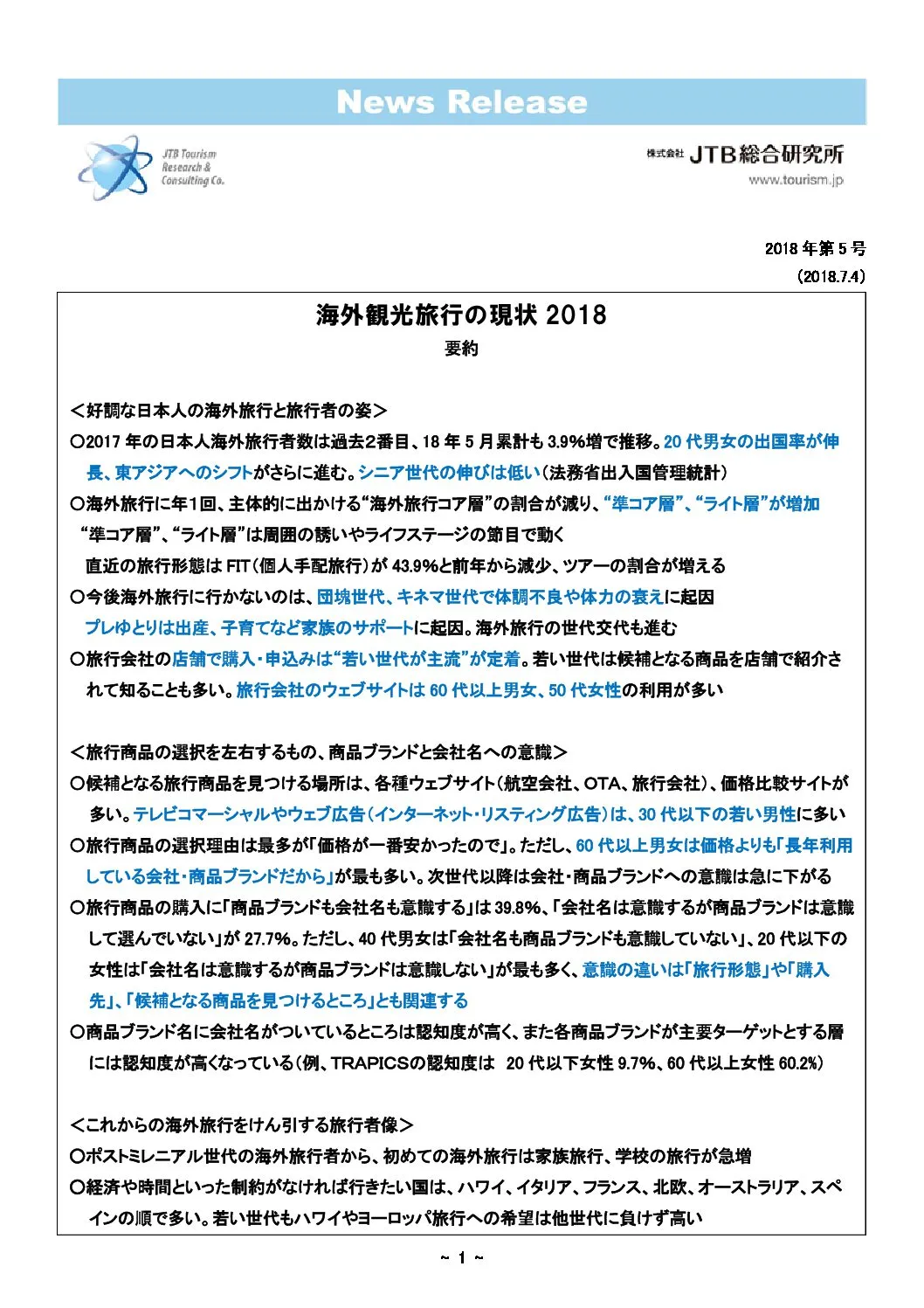
- The Rise in Overseas Travel by Japanese People and the Sight of TravelersThe number of Japanese travelers abroad in 2017 was the second-highest on record, and the cumulative total through May 2018 was up 3.9%. The outbound travel rate among men and women in their 20s increased, and the shift toward East Asia continued to accelerate. Growth among the senior generation remained low (Ministry of Justice Immigration Statistics)
The proportion of the “core overseas travelers”—those who proactively take one overseas trip per year—has decreased, while the “semi-core” and “light” segments have increased
. The “semi-core” segment,and “light travelers” tend to travel in response to invitations from others
or life milestones. The most recent travel trend shows FIT (independent travel) at 43.9%, down from the previous year, while the proportion of package tours has increased.
The Baby Boomer and Kinema generations are less likely to travel overseas in the future due to poor health and declining physical strength. The
Pre-Yutori generation is less likely to travel due to family responsibilities such as childbirth and child-rearing. A generational shift in overseas travel is also underway
The trend of “younger generations being the mainstream” for purchasing and booking at travel agency branches has taken hold. Younger generations often learn about potential travel options through in-store recommendations. Travel agency websites are used most frequently by men and women in their 60s and older, as well as women in their 50s - Factors Influencing the Choice of Travel Products: Perceptions of Product Brands and Company NamesPeople mostly find potential travel products on various websites (airlines, OTAs, travel agencies) and price comparison sites. TV commercials and online ads (search engine ads) are most popular among young men in their 30s and younger
The most common reason for choosing a travel product is “because it was the cheapest.” However, among men and women aged 60 and older, the most common reason is “because it’s a company or product brand I’ve used for many years,” rather than price. Awareness of company and product brands drops sharply among younger generations.
Regarding travel product purchases, 39.8% of respondents said they “consider both the product brand and the company name,” followed by 27.7% who said they “consider the company name but do not specifically choose based on the product brand.”However, while men and women in their 40s most frequently stated “I am not conscious of either the company name or the product brand,” women in their 20s and younger most frequently stated “I am conscious of the company name but not the product brand.” These differences in awareness are also related to “travel type,” “purchase location,” and “where potential products are found.”
Product brands that include the company name in their brand name have high brand awareness, and awareness is particularly high among the demographic groups that each brand targets (e.g., awareness of TRAPICS is 9.7% among women in their 20s and younger, and 60.2% among women aged 60 and older). - The Profile of Travelers Who Will Shape the Future of International TravelThere has been a sharp increase in the number of post-millennial international travelers whose first overseas trips were family vacations or school trips.
If not for financial or time constraints, the most popular destinations are Hawaii, Italy, France, Northern Europe, Australia, and Spain, in that order. The younger generation’s desire to travel to Hawaii and Europe is just as strong as that of other generations.