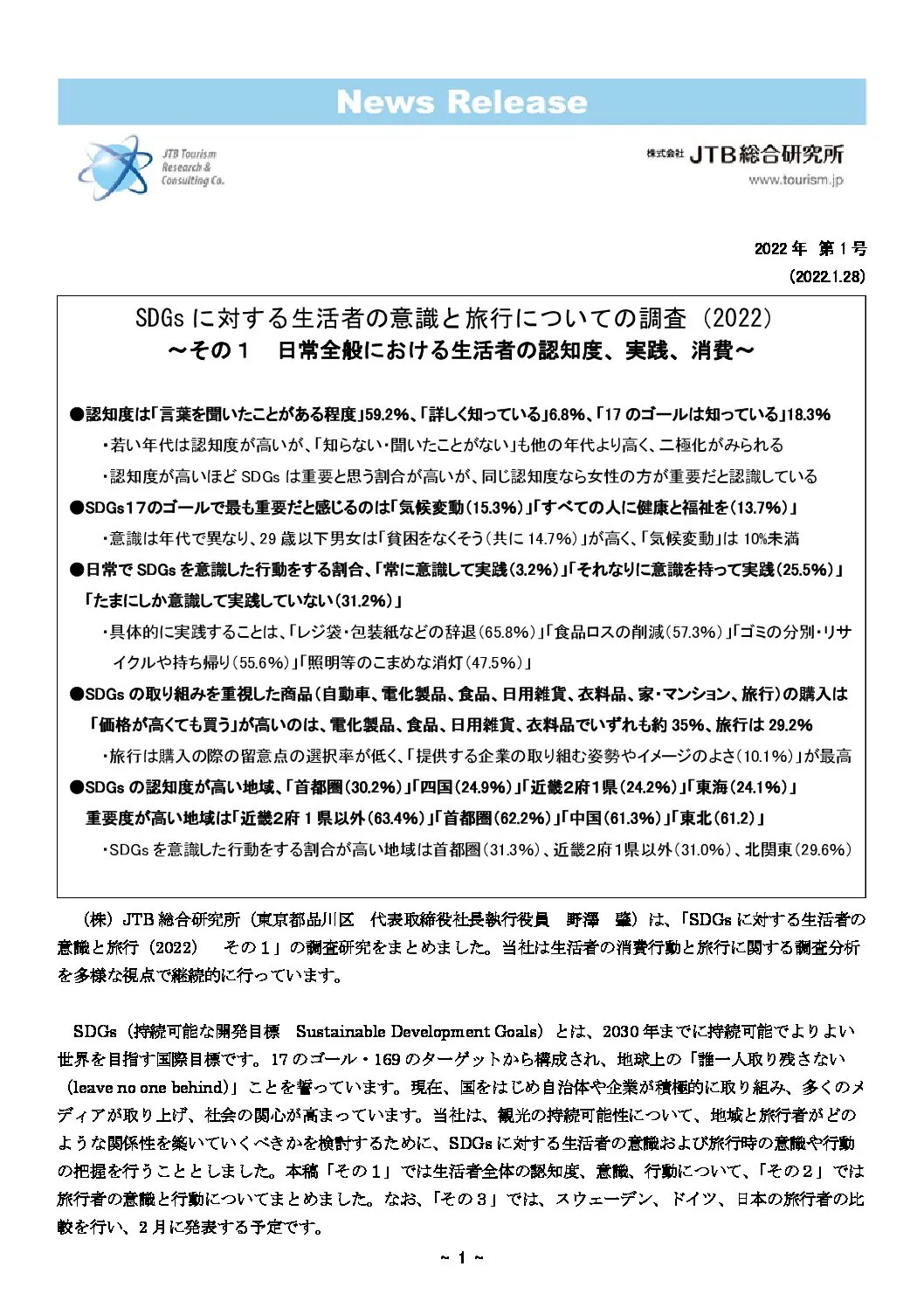
Survey on Consumers’ Awareness of the SDGs and Travel (2022) – Part 1: Consumers’ Awareness, Practices, and Consumption in Daily Life
The SDGs (Sustainable Development Goals) are international goals aimed at creating a sustainable and better world by 2030. Comprising 17 goals and 169 targets, they pledge to “leave no one behind” on Earth. Currently, national and local governments, as well as businesses, are actively working toward these goals, and with extensive media coverage, public interest is growing. To explore how regions and travelers should build relationships regarding the sustainability of tourism, we decided to assess consumers’ awareness of the SDGs, as well as their attitudes and behaviors while traveling. This first installment summarizes the overall awareness, attitudes, and behaviors of the general public, while the second installment will focus on the attitudes and behaviors of travelers. Additionally, the third installment will compare travelers from Sweden, Germany, and Japan, and is scheduled for release in February.
Key Findings
- Awareness levels were as follows: 59.2% had “heard the term,” 6.8% were “familiar with the details,” and 18.3% were “aware of the 17 goals.”While awareness is high among younger age groups, the percentage of those who say “I don’t know” or “I’ve never heard of it” is also higher than in other age groups, indicating a polarization.
The higher the level of awareness, the higher the percentage of people who consider the SDGs important; however, at the same level of awareness, women are more likely to view them as important. - The SDG goals that people feel are most important are "Climate Action (15.3%)" and "Good Health and Well-being (13.7%)"Attitudes vary by age group; among men and women aged 29 and under, “Ending poverty” (14.7% each) was the top response, while “Climate change” was cited by less than 10%
- Percentage of people who take SDG-conscious actions in their daily lives: "Always conscious and act accordingly (3.2%)", "Somewhat conscious and act accordingly (25.5%)", "Only occasionally conscious and act accordingly (31.2%)"Specific actions include “declining plastic bags and wrapping paper (65.8%),” “reducing food waste (57.3%),” “sorting and recycling trash or taking it home (55.6%),” and “turning off lights and other appliances when not in use (47.5%).”
- When it comes to purchasing products that prioritize SDG initiatives (such as automobiles, home appliances, food, daily necessities, clothing, homes and apartments, and travel), the percentage of consumers who say they would "buy them even if they are expensive" is highest for home appliances, food, daily necessities, and clothing—all at around 35%—while it stands at 29.2% for travel.When it comes to travel, the percentage of respondents citing specific factors as important considerations at the time of purchase was low, with “the provider’s commitment and positive image (10.1%)” ranking highest.
- Regions with high awareness of the SDGs: "Greater Tokyo Area (30.2%)", "Shikoku (24.9%)", "Kinki Region (2 prefectures and 1 prefecture) (24.2%)", and "Tokai Region (24.1%)" Regions where the SDGs are considered most important are "Areas other than the Kinki region (63.4%)," "the Tokyo Metropolitan Area (62.2%)," "Chugoku (61.3%)," and "Tohoku (61.2%)."The regions with the highest percentage of residents taking actions mindful of the SDGs are the Tokyo Metropolitan Area (31.3%), areas outside the Kansai region (31.0%), and Northern Kanto (29.6%)
JTB Research Institute Co., Ltd. (Shinagawa-ku, Tokyo; President and CEO Hajime Nozawa) has compiled the research report titled “Consumer Awareness of the SDGs and Travel (2022): Part 1.” The company continuously conducts surveys and analyses of consumer behavior and travel from diverse perspectives.
The SDGs (Sustainable Development Goals) are international goals aimed at creating a sustainable and better world by 2030. Comprising 17 goals and 169 targets, they pledge to “leave no one behind” on Earth. Currently, national and local governments, as well as companies, are actively working toward these goals; they are being widely covered by the media, and public interest is growing. To explore how regions and travelers should build relationships regarding the sustainability of tourism, we decided to assess consumers’ awareness of the SDGs, as well as their attitudes and behaviors while traveling. This first installment summarizes the overall awareness, attitudes, and behaviors of consumers, while the second installment will focus on travelers’ attitudes and behaviors. Additionally, the third installment will compare travelers from Sweden, Germany, and Japan, and is scheduled for release in February.