Survey on Smartphone Use and Travel Spending (2025)
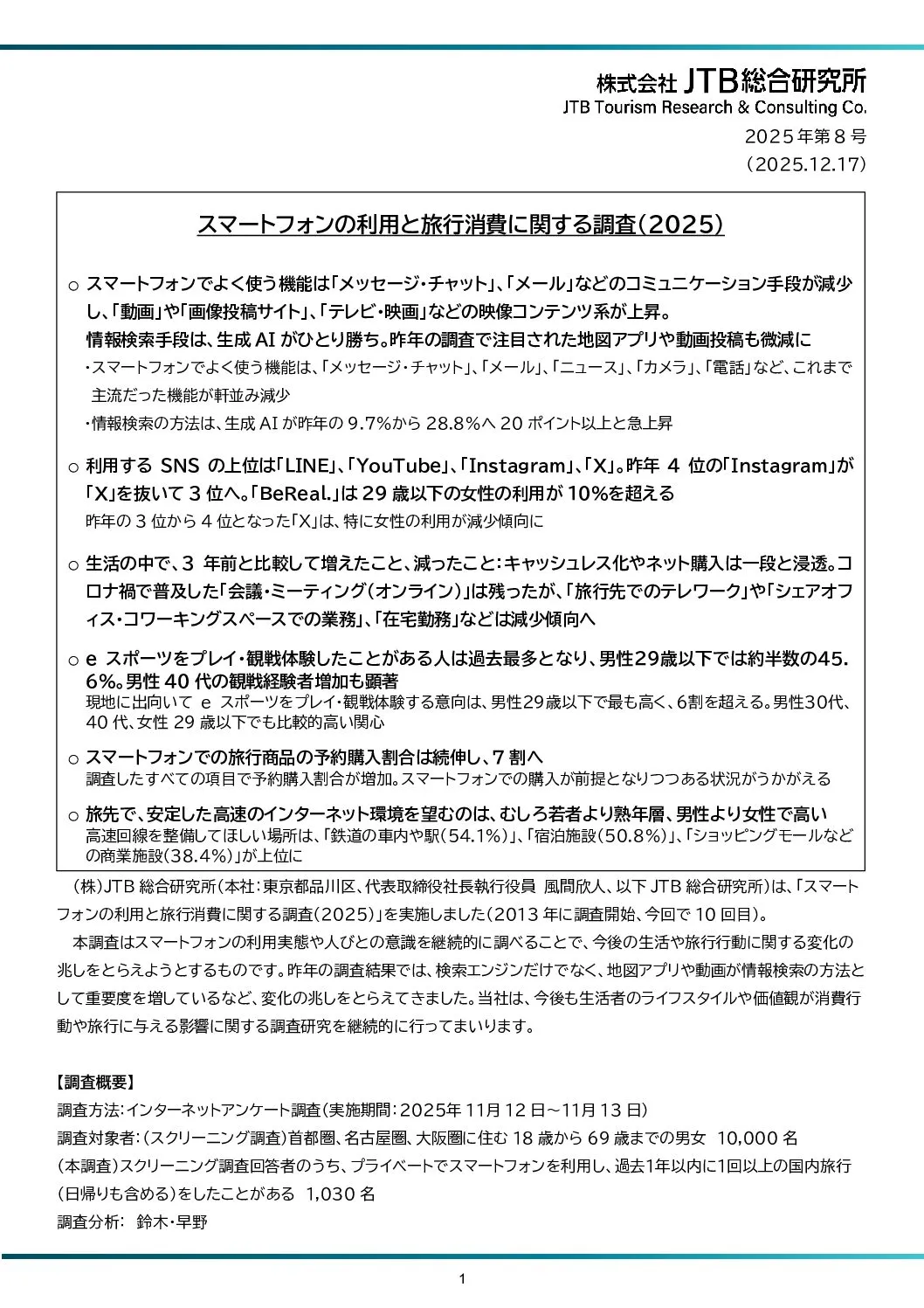
This survey aims to identify signs of future changes in lifestyles and travel behavior by continuously examining actual smartphone usage patterns and public attitudes. Last year’s survey results revealed signs of change, such as the growing importance of map apps and videos as information-search methods, in addition to search engines.We will continue to conduct research on how consumers’ lifestyles and values influence their consumption behavior and travel habits.
Key Findings
- The use of communication tools such as "messaging and chat" and "email"—which are commonly used on smartphones—has declined, while the use of video content services such as "video and image sharing sites" and "TV and movies" has increased. Among information search tools, only generative AI saw an increase, while map apps and video sharing—which garnered attention in last year's survey—saw a slight decline.The use of traditionally popular smartphone features—such as "messaging/chat," "email," "news," "camera," and "phone calls"—has declined across the board.
The use of generative AI for information searches has surged by approximately 20 percentage points, rising from 9.7% last year to 28.8%. - The top social media platforms are "LINE," "YouTube," "Instagram," and "X." "Instagram," which ranked fourth last year, has overtaken "X" to take third place. Use of "BeReal" exceeds 10% among women aged 29 and under."X," which dropped from third place last year to fourth, has seen a decline in usage, particularly among women
- Changes in daily life compared to three years ago: Cashless payments and online shopping have become even more widespread. While "online meetings," which gained popularity during the COVID-19 pandemic, have remained common, "teleworking while traveling," "working in shared offices or coworking spaces," and "working from home" are on the decline.Interest in going to an event to play or watch esports is highest among men aged 29 and under, at over 60%. Interest is also relatively high among men in their 30s and 40s, as well as women aged 29 and under.
- The number of people who have played or watched esports has reached an all-time high, with 45.6% of men aged 29 and under—roughly half—having done so. There has also been a notable increase in the number of men in their 40s who have watched esports.The proportion of pre-orders increased across all categories surveyed. This suggests that purchasing via smartphone is becoming the norm.
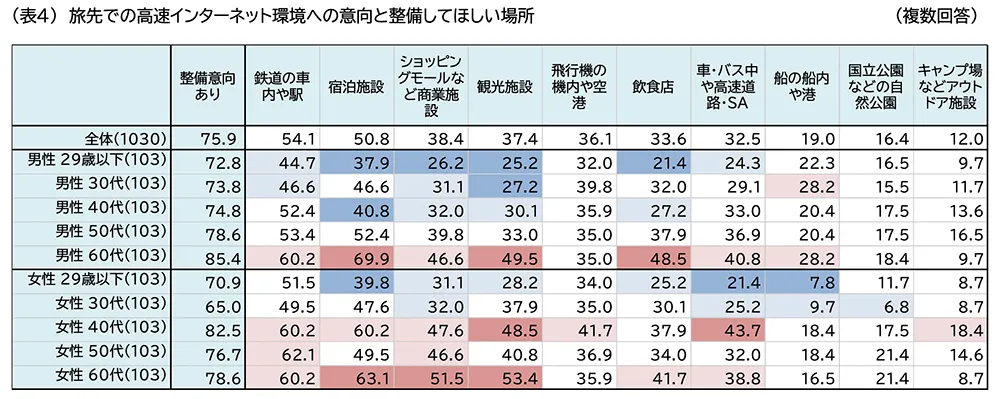
- The percentage of travel products booked and purchased via smartphone continues to rise, reaching 70%The top locations where people want high-speed internet access are "on trains and at stations (54.1%)," "accommodations (50.8%)," and "commercial facilities such as shopping malls (38.4%)."
- When traveling, the desire for a stable, high-speed internet connection is actually stronger among older adults than younger people, and among women than men.
Internet and Smartphone Usage Patterns
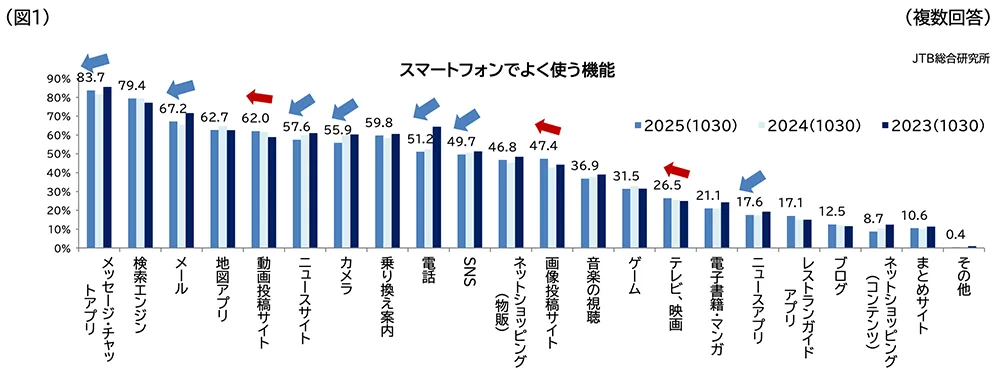
Among the functions most frequently used on smartphones, communication tools such as "messaging and chat" and "email" have declined, while video content categories such as "video and image sharing sites" and "TV and movies" have increased. Regarding information search methods, only generative AI saw an increase, while map apps and video sharing—which garnered attention in last year’s survey—saw a slight decrease.
Frequently used smartphone functions have seen a widespread decline in previously mainstream features such as “messaging/chat,” “email,” “news,” “camera,” and “phone calls,” while video content-related functions—such as video and image sharing sites, and TV and movies—have increased (Figure 1).
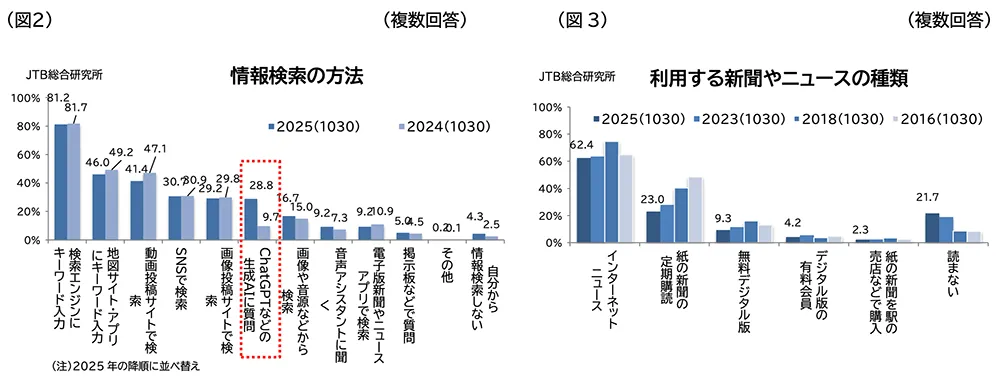
Regarding methods of information search, generative AI has increased by approximately 20 percentage points from 9.7% last year to 28.8%, gaining prominence (Figure 2).
Regarding news consumption, usage of all categories—including online news—has declined, while the percentage of respondents who “do not read news” is on the rise (Figure 3). Similarly, the percentage of users who “do not actively search for information” has increased, suggesting a growing trend where information is viewed as something that is automatically provided rather than something users must seek out themselves.
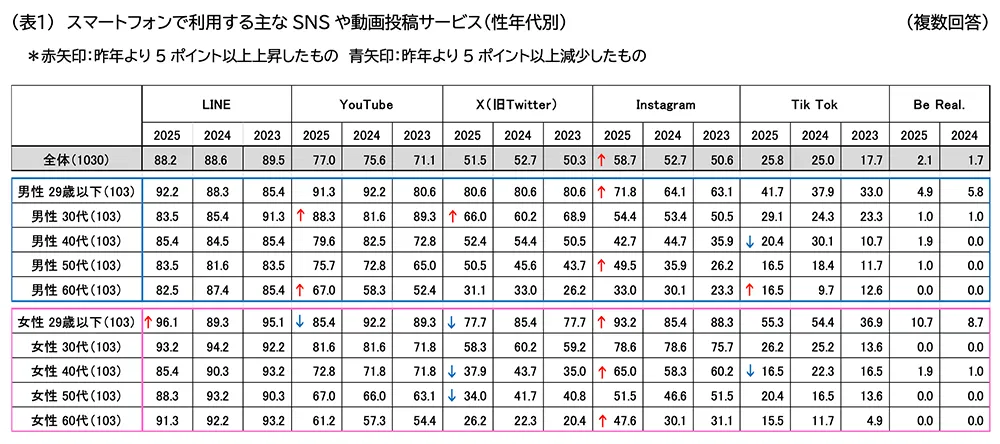
The top social media platforms used are "LINE," "YouTube," "Instagram," and "X." "Instagram," which ranked fourth last year, has overtaken "X" to take third place. Use of "BeReal" exceeds 10% among women aged 29 and under.
The main social media and video-sharing services used on smartphones are “LINE,” “YouTube,” “Instagram,” and “X.” While the top rankings remained unchanged from last year, usage of “LINE” and “X” declined slightly, and “Instagram” surpassed “X” to take third place."X" has seen a particularly sharp decline in usage among women. Additionally, "BeReal."—popular among Gen Z for allowing users to share authentic moments of daily life—saw a slight increase, with usage among women aged 29 and under exceeding 10% (Table 1).
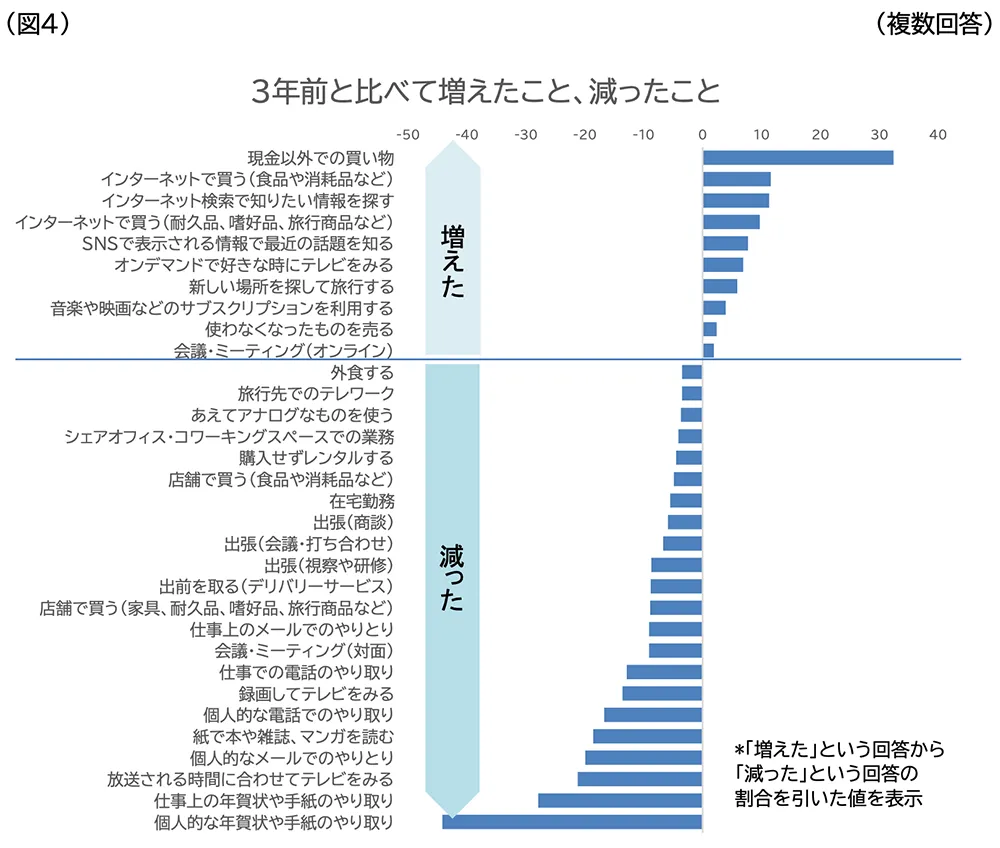
Changes in daily life compared to three years ago: Cashless payments and online shopping have become even more widespread. While “online meetings and conferences”—which became common during the COVID-19 pandemic—have persisted, “teleworking while traveling,” “working in shared offices or coworking spaces,” and “working from home” are trending downward.
We asked about changes in daily life compared to three years ago. “Cashless shopping” was by far the category where “increased” responses significantly outnumbered “decreased” responses, indicating the widespread adoption of cashless payments. Additionally, the proportion of people “shopping online” has also increased.
Furthermore, among the various activities that expanded during the COVID-19 pandemic, while “online meetings” saw more respondents reporting an increase than a decrease, “teleworking while traveling,” “working in shared offices or coworking spaces,” and “working from home” all decreased, resulting in a mixed picture (Figure 4).
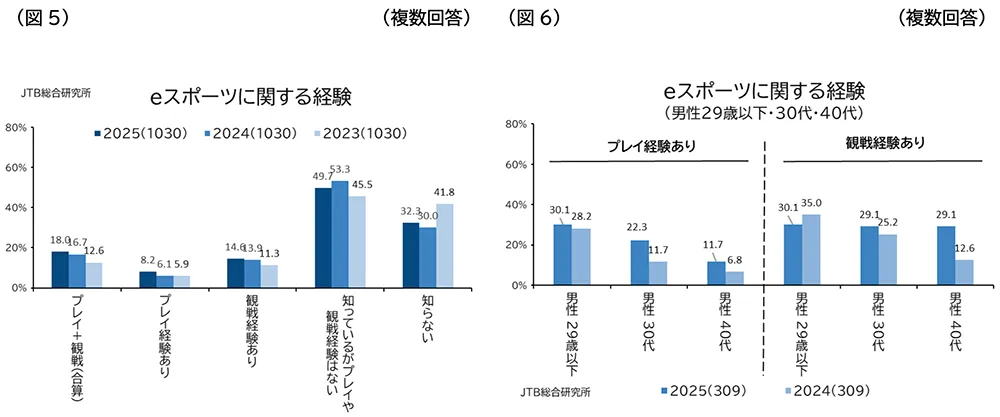
Interest in and experience with esports
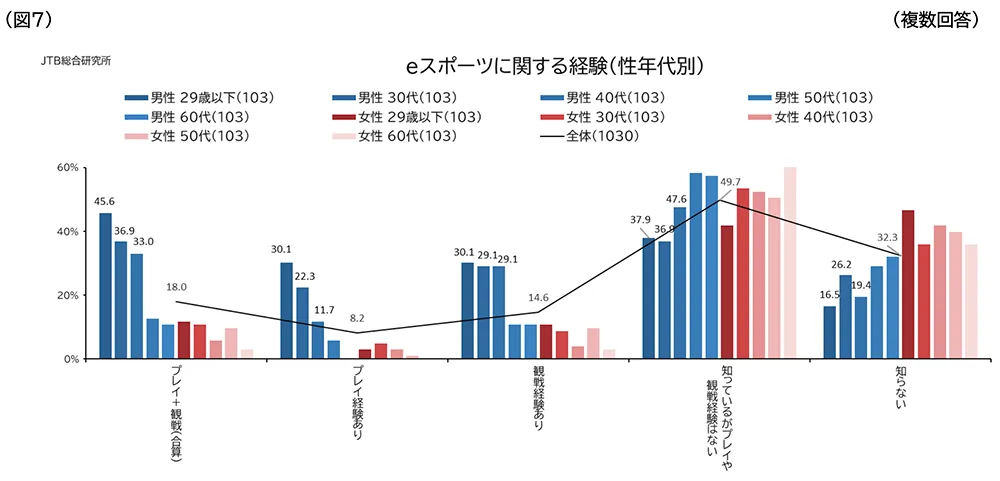
The number of people who have played or watched esports has reached a record high, with 45.6% of men aged 29 and under—roughly half—having done so. There has also been a notable increase in the number of men in their 40s who have watched esports.
Looking at experiences with and interest in esports, the percentage of respondents who answered “I don’t know” increased from 30.0% to 32.3% overall compared to last year’s survey results, indicating a slight decline in esports awareness.On the other hand, the percentage of people who have played or watched esports has risen for the third consecutive year, reaching the highest figure in the past three years (18.0%).Furthermore, when broken down by gender and age group, the percentage of people with experience playing or watching was highest among men aged 29 and under (45.6%), followed by men in their 30s (36.9%) and men in their 40s (33.0%).Compared to last year, there was a notable increase in playing experience among men in their 30s and in spectating experience among men in their 40s, and it can be inferred that these factors contributed to the increase in the number of people with playing and spectating experience this year (Figures 5–7).
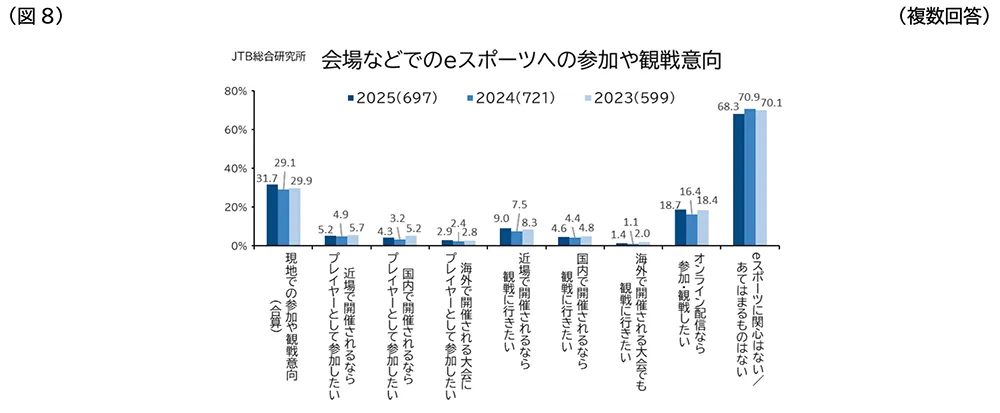
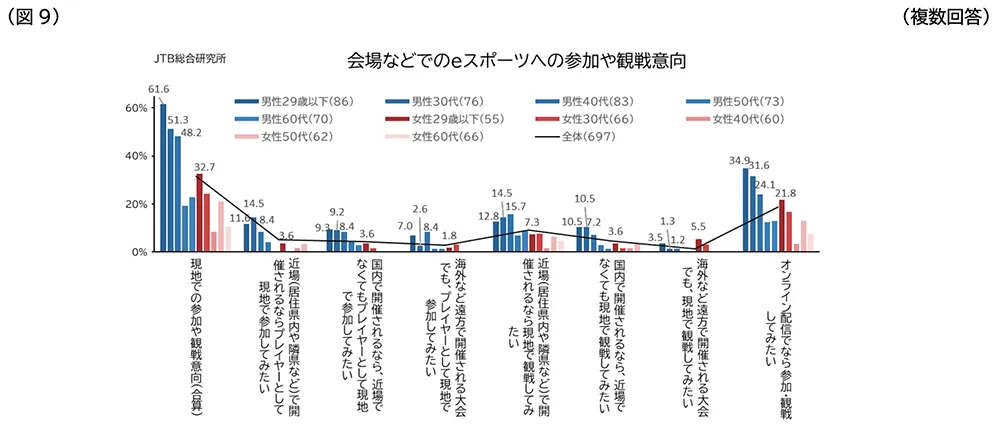
Among those who responded that they were “aware of” esports, regarding their intention to actually go to a venue to play or watch,the percentage of those who answered “not interested/none of the above” decreased from 70.9% in FY 2022 to 68.3%. The intention to participate in esports in person showed a slight increase, with a particularly high rate of 61.6% among men aged 29 and under—nearly double the overall average.Furthermore, relatively high levels of interest can be observed among men in their 30s (51.3%), men in their 40s (48.2%), and women aged 29 or younger (32.7%) (Figures 8 and 9).
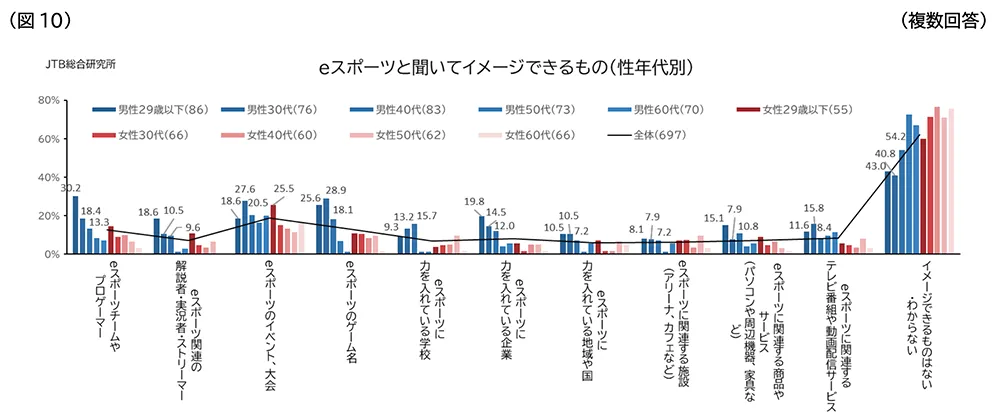
When asked what specifically comes to mind when they hear “esports,” “esports events and tournaments (18.7%)” was the most common response overall.Among men aged 29 and under, the percentages for “esports teams and professional gamers (30.2%)” and “companies focusing on esports (19.8%)” were also relatively high, suggesting that esports is often linked to corporate image.
Additionally, among men in their 30s, “esports game titles (28.9%)” ranked highest, while among men in their 40s and women aged 29 and under, “esports events and tournaments (20.5%/25.5%)” ranked highest.while among men in their 40s, “schools actively promoting esports (15.7%)” also ranked high. Thus, the specific elements people could visualize varied depending on their age and gender and their level of engagement with esports (Figure 10).
Regarding the Use of Travel Products and Services
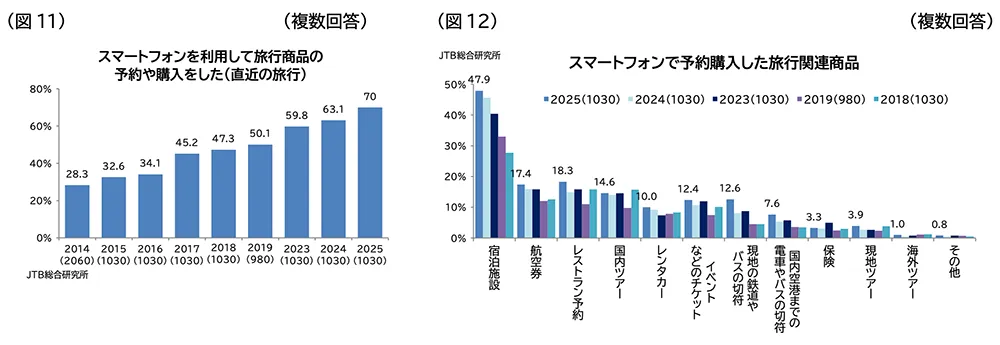
The proportion of travel products booked and purchased via smartphone continues to rise, reaching 70%
The proportion of travel-related products booked or purchased via smartphones has continued to rise since the survey began in 2013, reaching 70% in the 2025 survey (Figure 11). Looking at the breakdown of purchased travel-related products, the booking and purchase rate has increased across all categories, suggesting that smartphone purchases are becoming the norm (Figure 12).
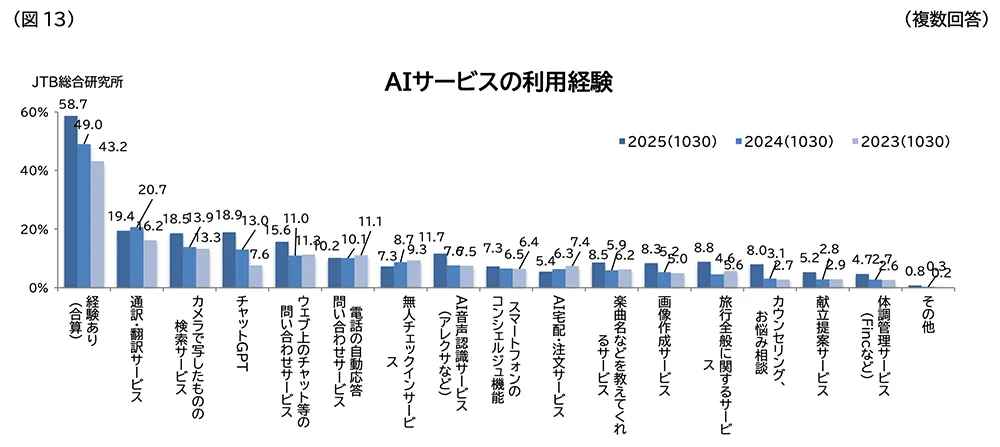
Experience with AI services rose to 58.7%, an increase of approximately 10 percentage points from the previous year. The top AI services people would like to use while traveling include “searching for local dining information (29.6%),” “language translation (25.1%),” and “itinerary and route suggestions (24.7%).”
Experience with AI services rose by nearly 10 percentage points from 49.0% in FY 2023 to 58.7%, indicating that AI services are becoming even more deeply integrated into our daily lives.Among the services people have used, “interpretation and translation services,” “image search services,” and “ChatGPT” ranked highest (Figure 13).
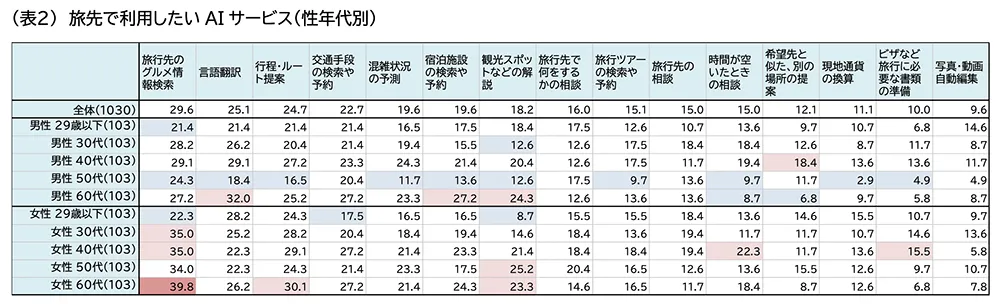
The most popular AI service respondents would like to use while traveling was “searching for local dining information at travel destinations (29.6%),” followed by “language translation (25.1%)” and “itinerary and route suggestions (24.7%)” (Table 2).When broken down by gender and age group, “searching for local dining information” was particularly popular among women in their 60s and women in their 30s and 40s.
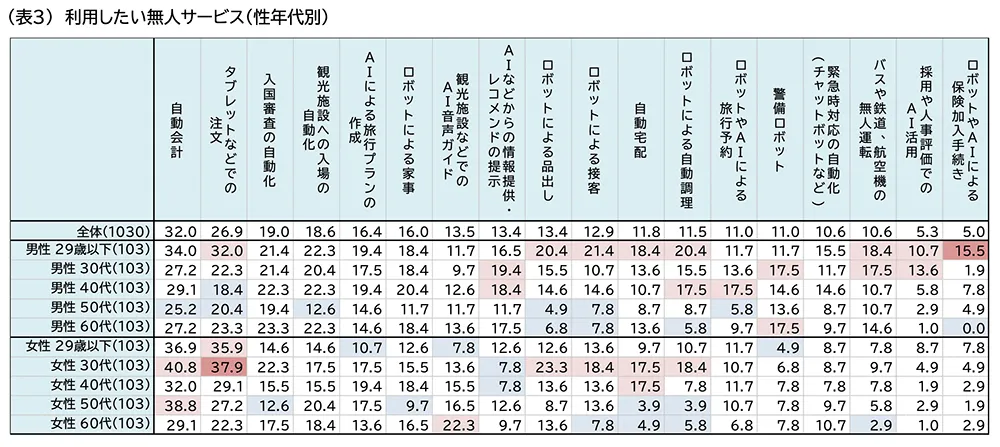
Additionally, regarding the intention to use “unmanned services” (not limited to AI), services that streamline procedures—such as “automated checkout (32.0%),” “ordering via tablets, etc. (26.9%),” and “automated immigration checks (19.0%)”—outpaced value-added services like “travel plan creation (16.4%)” and“audio guides (13.5%)” and “recommendations (13.4%).” By gender and age group, men aged 29 and under showed a generally higher tendency to use unmanned services (Table 3).
When it comes to wanting a stable, high-speed internet connection while traveling, older adults are more likely to desire it than younger people, and women are more likely than men.
Next, we asked about preferences regarding internet access while traveling. When examining usage intentions by gender and age group, the results surprisingly showed that people in their 60s, in particular, desire such infrastructure. Additionally, when broken down by gender, women appear to have a stronger preference than men.
The locations where the highest percentage of respondents wanted infrastructure were “inside trains and at stations (54.1%),” “accommodations (50.8%),” and “commercial facilities such as shopping malls (38.4%).”By gender and age group, women in their 40s—perhaps because many are raising children—showed relatively high percentages for “inside cars and buses, or on expressways and service areas” and “outdoor facilities such as campgrounds.”
Summary
Information Gathering: From "Searching" to "Consulting"
With the rapid proliferation of generative AI since last year, there has been a significant shift from the traditional “searching” approach to gathering information to the practice of “consulting” generative AI.Many websites are seeing a drastic drop in visitor numbers as users complete their information gathering entirely within generative AI platforms without ever visiting the sites themselves. While this makes it difficult to convey the information we want to share directly, it can also be seen as an opportunity to offer travelers options they never imagined before.
It is certainly worth considering how to provide the right information to our target audience and where the opportunities lie to expand latent demand.
For contactless services, “reducing hassle” is key
Regarding willingness to use “unmanned services,” including AI, services that streamline procedures—such as “self-checkout,” “ordering via tablet,” and “automated immigration checks”—outpaced value-added services like “travel itinerary planning,” “audio guides,” and “recommendations.”While terms like “time efficiency” have become widespread, it seems that as technology advances and makes various tasks more convenient, there is an even greater demand for “convenience” itself.
Awareness of esports has plateaued, but the number of people who have actually played or watched is on the rise
While awareness of esports saw a significant increase from 2023 to 2024, it remained largely flat from 2024 to 2025, suggesting that the growth in awareness may have plateaued.On the other hand, the number of people who have actually played or watched esports has increased for three consecutive years. This is thought to be partly due to an increase in male players and spectators in their 40s, and it can be inferred that this increase may be attributed to greater exposure to esports in children’s education (such as esports clubs in schools and specialized esports vocational schools).I believe the esports industry will continue to prioritize the question of “how to get people to actually experience esports,” and providing esports experiences that center on children and involve the whole family may become a key focus.