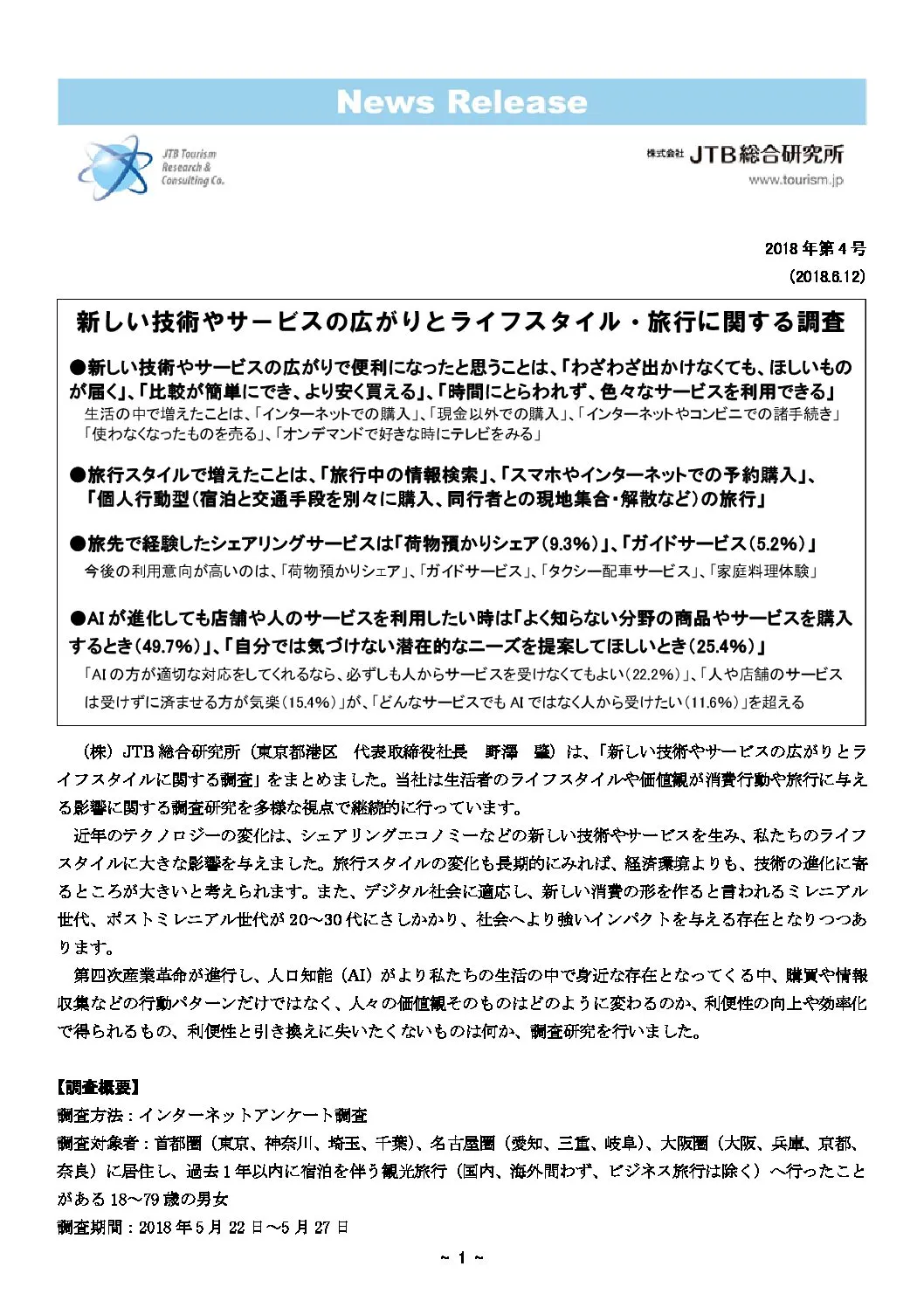
Survey on the Spread of New Technologies and Services, and on Lifestyles and Travel
PDFダウンロード
公開日
JTB Tourism Research & Consulting Co., Ltd. (Minato-ku, Tokyo; President and CEO: Hajime Nozawa) has compiled a report titled “Survey on the Spread of New Technologies and Services and Their Impact on Lifestyles.” The company continuously conducts research from diverse perspectives on how consumers’ lifestyles and values influence their consumption behavior and travel habits.
Recent technological changes have given rise to new technologies and services, such as the sharing economy, and have had a significant impact on our lifestyles. From a long-term perspective, changes in travel styles are believed to be driven more by technological advancements than by economic conditions. Furthermore, Millennials and Post-Millennials—generations said to be adapting to the digital society and shaping new forms of consumption—are now entering their 20s and 30s and are becoming a force with a stronger impact on society.
As the Fourth Industrial Revolution progresses and artificial intelligence (AI) becomes an increasingly familiar part of our lives, we conducted research to examine not only changes in behavioral patterns—such as purchasing and information-gathering—but also how people’s values themselves are shifting; what benefits can be gained through improved convenience and efficiency; and what people are unwilling to sacrifice in exchange for that convenience.
Recent technological changes have given rise to new technologies and services, such as the sharing economy, and have had a significant impact on our lifestyles. From a long-term perspective, changes in travel styles are believed to be driven more by technological advancements than by economic conditions. Furthermore, Millennials and Post-Millennials—generations said to be adapting to the digital society and shaping new forms of consumption—are now entering their 20s and 30s and are becoming a force with a stronger impact on society.
As the Fourth Industrial Revolution progresses and artificial intelligence (AI) becomes an increasingly familiar part of our lives, we conducted research to examine not only changes in behavioral patterns—such as purchasing and information-gathering—but also how people’s values themselves are shifting; what benefits can be gained through improved convenience and efficiency; and what people are unwilling to sacrifice in exchange for that convenience.
Key Findings
- Some of the ways I think new technologies and services have made life more convenient include: “Getting what I want delivered without having to go out of my way,” “being able to easily compare prices and buy things more cheaply,” and “being able to use various services without being tied to a specific time.”Things that have become more common in daily life include “online shopping,” “making purchases without cash,” “completing various procedures online or at convenience stores,” “selling items I no longer use,” and “watching TV on demand whenever I want.”
- Trends that have emerged with this style of travel include “searching for information while traveling,” “making reservations and purchases via smartphones or the Internet,” and “independent travel (such as booking accommodations and transportation separately, or meeting up with and parting ways from travel companions at the destination).”The services with the highest intention to use in the future are “shared luggage storage,” “guided tours,” “taxi dispatch services,” and “home-cooked meal experiences.”
- The sharing services experienced while traveling were “luggage storage sharing (9.3%)” and “guide services (5.2%)”"If AI can provide a more appropriate response, I don't necessarily need to receive service from a person (22.2%)" and "It's less stressful to get by without receiving service from people or stores (15.4%)" both exceed "I want to receive any service from a person rather than AI (11.6%)"
- Even as AI continues to evolve, people still prefer to use in-store or human-provided services in the following situations: “when purchasing products or services in a field they are not very familiar with (49.7%)” and “when they want suggestions for potential needs they haven’t realized themselves (25.4%)”