Survey on Attitudes Toward Changes in Work Styles and Telework
PDFダウンロード
公開日
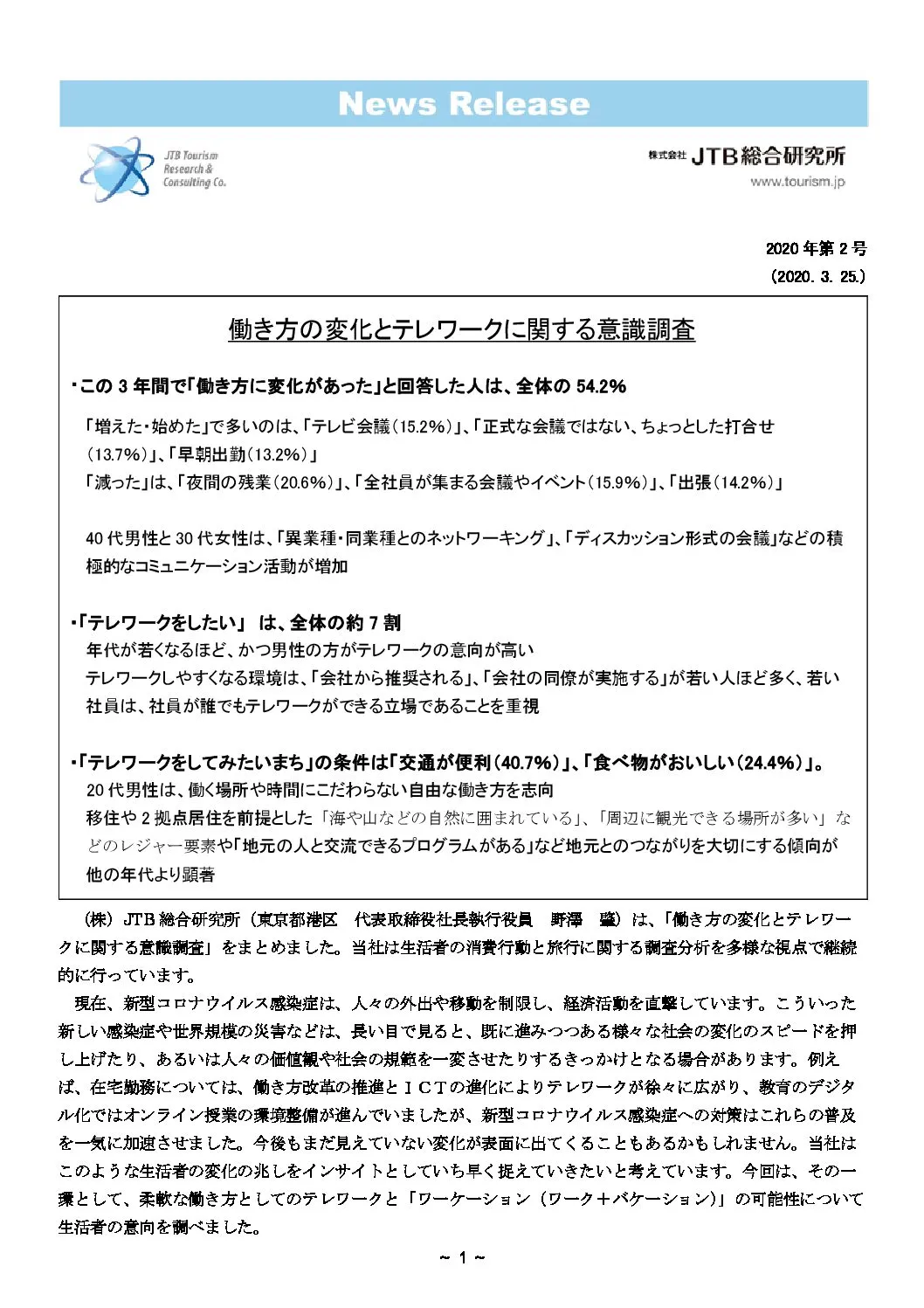
JTB Tourism Research & Consulting Co., Ltd. (Minato-ku, Tokyo; President and CEO: Hajime Nozawa) has compiled the results of a survey titled “Survey on Attitudes Toward Changes in Work Styles and Telework.” The company continuously conducts research and analysis on consumer behavior and travel from a variety of perspectives.
Currently, the COVID-19 pandemic is restricting people’s outings and travel, and has dealt a direct blow to economic activity. In the long term, new infectious diseases and global-scale disasters such as this can serve as catalysts that either accelerate the pace of various social changes already underway or radically transform people’s values and social norms. For example, regarding remote work, the promotion of work-style reforms and advancements in ICT had already led to its gradual expansion, and the digitization of education had been progressing with the development of online learning environments. However, measures to combat COVID-19 have dramatically accelerated the adoption of these practices. It is possible that changes not yet visible may come to the surface in the future. We aim to be among the first to identify these signs of change in consumers’ lifestyles as valuable insights. As part of this effort, we conducted a survey to gauge consumer attitudes toward telework as a flexible work style and the potential of “workation” (work + vacation).
Currently, the COVID-19 pandemic is restricting people’s outings and travel, and has dealt a direct blow to economic activity. In the long term, new infectious diseases and global-scale disasters such as this can serve as catalysts that either accelerate the pace of various social changes already underway or radically transform people’s values and social norms. For example, regarding remote work, the promotion of work-style reforms and advancements in ICT had already led to its gradual expansion, and the digitization of education had been progressing with the development of online learning environments. However, measures to combat COVID-19 have dramatically accelerated the adoption of these practices. It is possible that changes not yet visible may come to the surface in the future. We aim to be among the first to identify these signs of change in consumers’ lifestyles as valuable insights. As part of this effort, we conducted a survey to gauge consumer attitudes toward telework as a flexible work style and the potential of “workation” (work + vacation).
Key Findings
- Over the past three years, 54.2% of respondents said their work style had changed.The most common responses for “increased or started” were “teleconferences (15.2%),” “informal meetings (13.7%),” and “arriving at work early in the morning (13.2%)”
"Decreased" responses included "overtime work at night (20.6%)," "meetings or events attended by all employees (15.9%)," and "business trips (14.2%)"
Men in their 40s and women in their 30s reported an increase in proactive communication activities such as “networking with people in different or similar industries” and “discussion-style meetings.” - About 70% of respondents said they want to work remotelyThe younger the age group, the higher the preference for telework, particularly among men.
Factors that make telework more feasible—such as "company encouragement" and "colleagues teleworking"—are cited more frequently by younger employees, who place a high value on the fact that any employee can telework. - The criteria for "cities where people would like to try teleworking" are "convenient transportation (40.7%)" and "delicious food (24.4%)"Men in their 20s tend to prefer flexible work arrangements that do not restrict them to specific locations or hours.
Compared to other age groups, they are notably more likely to prioritize factors such as being "surrounded by nature, such as the ocean or mountains" and "having many tourist attractions nearby"—elements associated with leisure—as well as "programs that allow them to interact with local residents," reflecting a strong desire to build connections with the local community.