Travel Styles × Neuromarketing (A Neuroscientific Approach to Images): A Survey on American Travelers’ Preferences Regarding Travel to Japan
PDFダウンロード
公開日
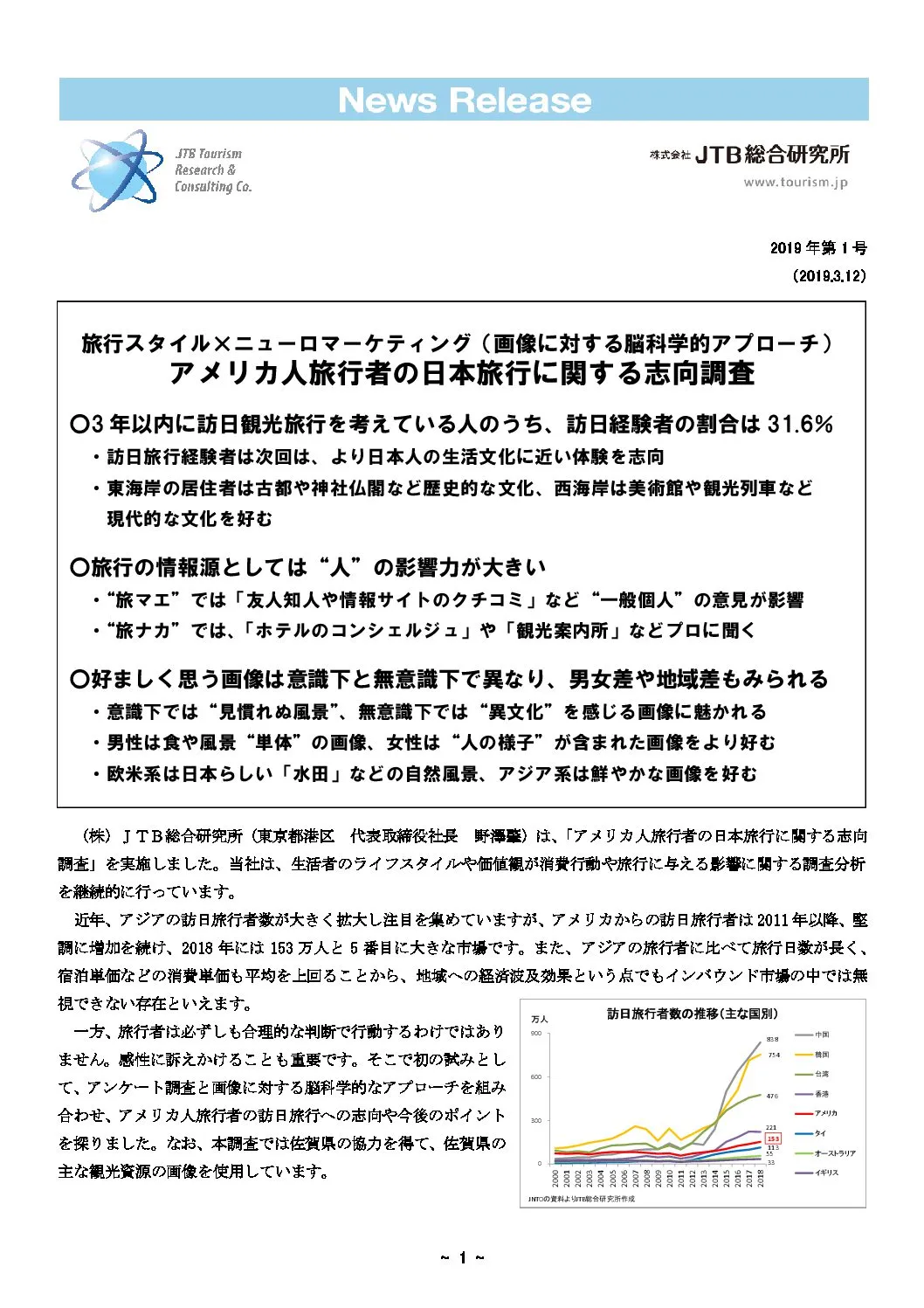
JTB Tourism Research & Consulting Co., Ltd. (Minato-ku, Tokyo; President and CEO: Hajime Nozawa) conducted a survey titled “Survey on American Travelers’ Preferences Regarding Travel to Japan.” The company continuously conducts research and analysis on how consumers’ lifestyles and values influence their consumption behavior and travel choices.
While the number of Asian visitors to Japan has expanded significantly in recent years and attracted considerable attention, the number of visitors from the United States has continued to grow steadily since 2011, reaching 1.53 million in 2018 and making it the fifth-largest market. Furthermore, compared to Asian travelers, they tend to stay longer and spend more per night on average, making them a significant presence within the inbound market in terms of their economic ripple effects on local regions.
However, travelers do not necessarily act based on purely rational decisions. Appealing to their emotions is also important. Therefore, as a first-of-its-kind initiative, we combined a questionnaire survey with a neuroscientific approach to images to explore American travelers’ preferences regarding trips to Japan and identify key areas for future focus. This survey was conducted with the cooperation of Saga Prefecture and utilized images of the prefecture’s major tourist attractions.
While the number of Asian visitors to Japan has expanded significantly in recent years and attracted considerable attention, the number of visitors from the United States has continued to grow steadily since 2011, reaching 1.53 million in 2018 and making it the fifth-largest market. Furthermore, compared to Asian travelers, they tend to stay longer and spend more per night on average, making them a significant presence within the inbound market in terms of their economic ripple effects on local regions.
However, travelers do not necessarily act based on purely rational decisions. Appealing to their emotions is also important. Therefore, as a first-of-its-kind initiative, we combined a questionnaire survey with a neuroscientific approach to images to explore American travelers’ preferences regarding trips to Japan and identify key areas for future focus. This survey was conducted with the cooperation of Saga Prefecture and utilized images of the prefecture’s major tourist attractions.
Key Findings
- Among those planning to visit Japan for tourism within the next three years, 31.6% have visited Japan before.People who have visited Japan before tend to seek experiences that offer a closer look at Japanese lifestyle and culture on their next trip.
Residents of the East Coast prefer historical cultural sites such as ancient capitals and shrines and temples, while those on the West Coast favor modern cultural attractions such as art museums and scenic trains. - People have a significant influence as a source of travel informationBefore a trip, people are influenced by the opinions of “ordinary individuals,” such as friends, acquaintances, and reviews on information sites.
During a trip, people seek advice from professionals, such as hotel concierges and tourist information centers. - The images people find appealing differ between the conscious and unconscious mind, and there are also differences between men and women and across regionsPeople are drawn to images that evoke a "familiar yet unfamiliar landscape" on a conscious level and a "different culture" on a subconscious level.
Men tend to prefer images of food or landscapes "on their own," while women prefer images that include "people."
Westerners tend to prefer natural landscapes that are typically Japanese, such as "rice paddies," while Asians tend to prefer vivid images.