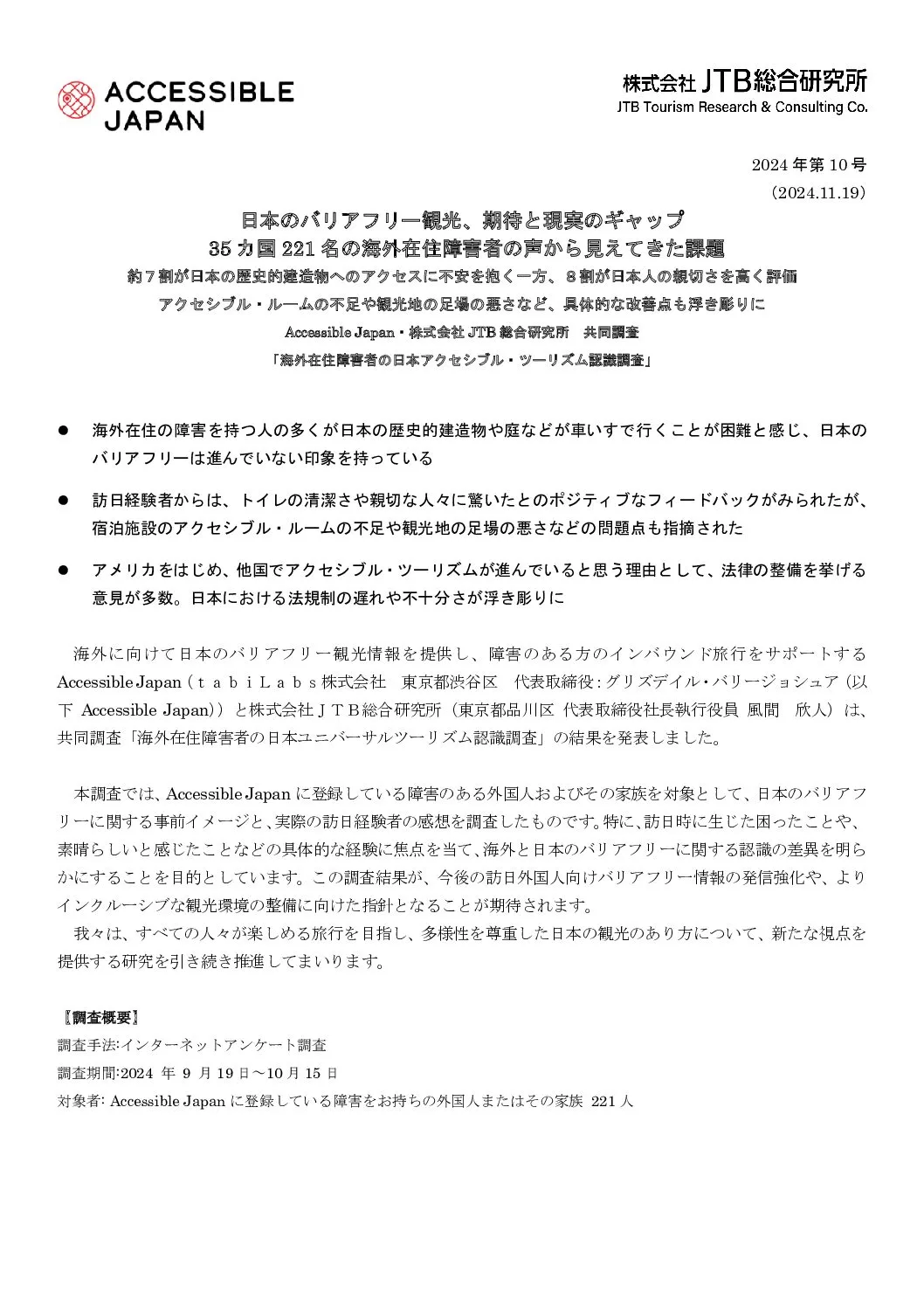
Joint Survey by Accessible Japan and JTB Tourism Research & Consulting: “Survey on the Perceptions of Accessible Tourism in Japan Among People with Disabilities Living Abroad” — The Gap Between Expectations and Reality in Japan’s Barrier-Free Tourism: Challenges Revealed by the Voices of 221 People with Disabilities Living in 35 Countries
This survey targeted foreign nationals with disabilities and their families registered with Accessible Japan, investigating their pre-visit perceptions of accessibility in Japan and the impressions of those who have actually visited the country. In particular, it focused on specific experiences—such as difficulties encountered and positive aspects—during their visits to Japan, with the aim of clarifying the differences in perceptions of accessibility between overseas and Japan.It is hoped that these findings will serve as guidelines for strengthening the dissemination of barrier-free information for international visitors and for developing a more inclusive tourism environment.
We will continue to promote research that offers new perspectives on the future of tourism in Japan, respecting diversity and aiming for travel that everyone can enjoy.
Key Findings
- Many people with disabilities living abroad find it difficult to visit Japan’s historic buildings and gardens in a wheelchair, and they have the impression that Japan has not made much progress in terms of accessibility.
- While visitors to Japan provided positive feedback, noting they were surprised by the cleanliness of the restrooms and the friendliness of the people, they also pointed out issues such as a lack of accessible rooms in accommodations and poor accessibility at tourist sites
- Many people cite the development of relevant laws as the reason why accessible tourism is advancing in the United States and other countries. This highlights the lag and inadequacy of legal regulations in Japan.
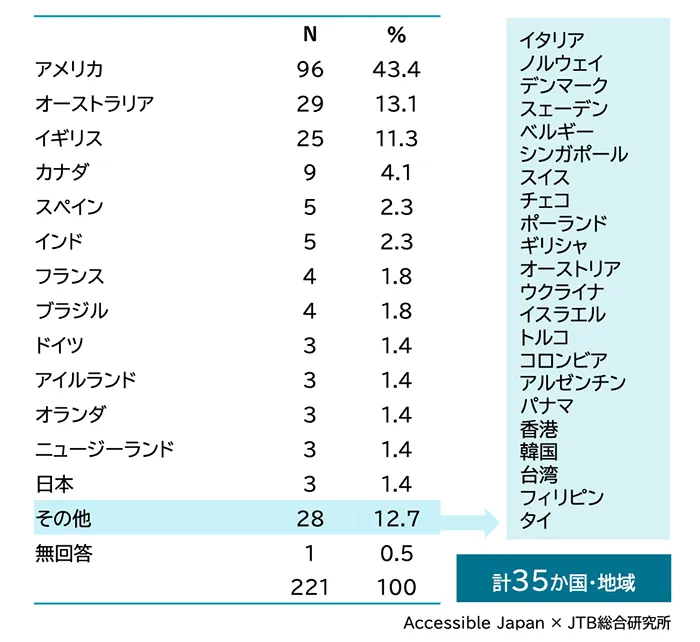
By country of residence, approximately 70% of respondents are from English-speaking countries, with more than 40% from the United States. Manual and electric wheelchairs each account for about 40% of the total. Given that more than 20% of respondents have intractable diseases—a group for which measures to accommodate electric wheelchairs will be required in the future—there is also a need to deepen our understanding of a wider range of disabilities.
The survey received a total of 221 responses from 35 countries and regions. Seventy percent of these respondents were from English-speaking countries, which is likely due primarily to the fact that Accessible Japan is an English-language website.In terms of the respondents’ countries and regions of residence, the United States accounted for the largest share at 43.4%, followed by Australia (13.1%) and the United Kingdom (11.3%). The United States also had the highest number of Accessible Japan members, suggesting a high level of interest in accessible tourism (Figure 1).
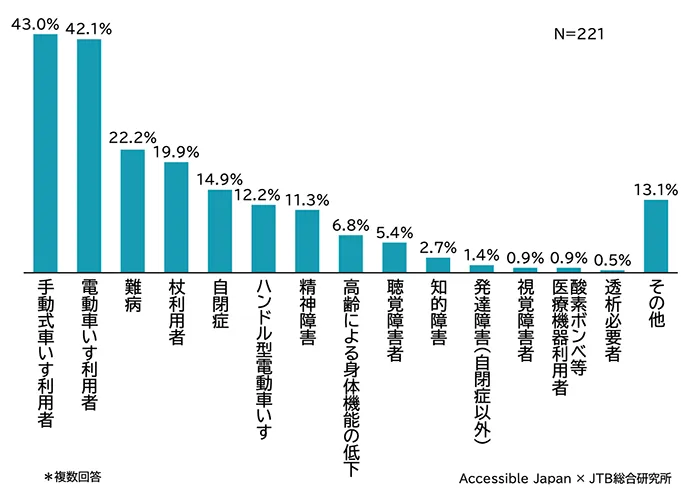
Regarding the type and condition of disability, manual wheelchair users accounted for 43.0% and electric wheelchair users for 42.1%, which were nearly equal. While manual wheelchairs are the mainstream in Japan, this indicates that the use of electric wheelchairs is also common overseas.Since electric wheelchairs require charging and voltage standards differ between Japan and other countries, measures must be taken to accommodate battery charging. Additionally, infrastructure capable of accommodating large electric wheelchairs is required.
Among other respondents, the breakdown included those with intractable diseases (22.2%), cane users (19.9%), and individuals with autism (14.9%). These results indicate that accessible tourism must accommodate a wide range of disabilities and circumstances (Figure 2).
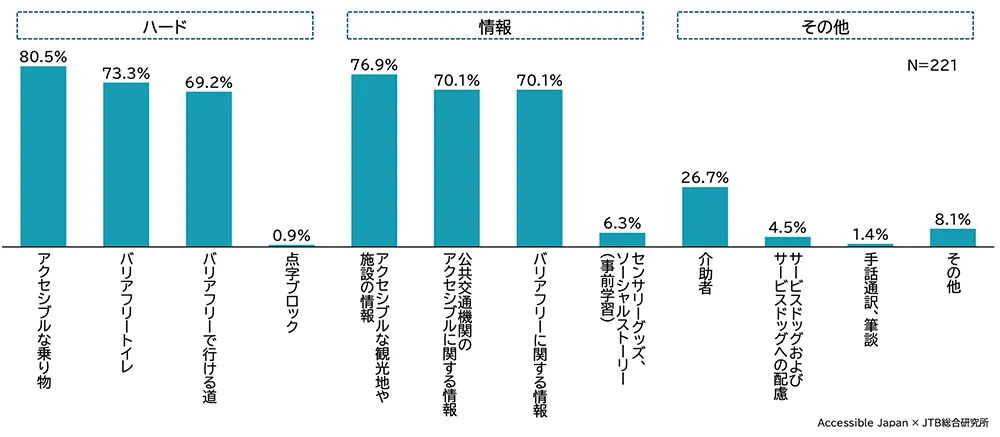
80.5% of people require accessible transportation, including public transit; there is a high demand not only for physical accessibility but also for information regarding accessibility
When asked what they needed to consider during their daily outings, 80.5% cited “accessible transportation,” 76.9% cited “information on accessible tourist sites and facilities,” and 73.3% cited “barrier-free restrooms.”The findings revealed that there is a high demand not only for physical accessibility features such as accessible transportation and barrier-free restrooms, but also for accessible information.Furthermore, there is a demand for accommodations for people with invisible disabilities, such as sensory aids and social stories. These are basic accommodations necessary for daily life and travel. Responding to these needs and disseminating information appropriately is expected to contribute to the promotion of travel to Japan (Figure 3).
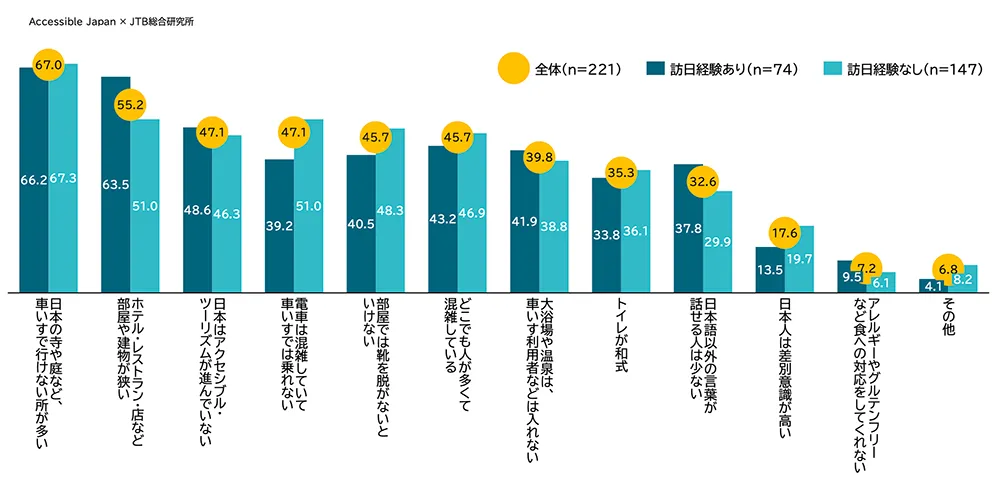
Regarding perceptions of accessibility in Japan, 67.0% of respondents cited “many places, such as Japanese temples and gardens, are inaccessible to wheelchair users.” Additionally, those who had visited Japan were more likely to agree that “rooms and buildings in hotels, restaurants, and shops are cramped” and that “accessible tourism is not well developed in Japan.” The results show that actual evaluations were lower than these perceptions.
The top concerns regarding accessibility in Japan centered on architectural styles, such as “many places, such as Japanese temples and gardens, are inaccessible to wheelchair users (67.0%)” and “rooms and buildings in hotels, restaurants, and shops are cramped (55.2%).”Additionally, a high proportion (47.1%) of respondents pointed out the lag in Japan’s accessible tourism and the difficulties faced by wheelchair users due to crowded public transportation.
When broken down by prior visit to Japan, those who had visited Japan were more likely to agree with the statements “Rooms and buildings in hotels, restaurants, and shops are cramped (63.5%)” and “Accessible tourism is not well developed in Japan (48.6%)”,“Wheelchair users cannot access public baths or hot springs (41.9%),” “Few people speak languages other than Japanese (37.8%),” and “Restaurants do not accommodate dietary needs such as allergies or gluten-free diets (9.5%).” This reveals that actual evaluations are lower than initial perceptions.These are areas that require urgent improvement.
Conversely, the response “Trains are too crowded for wheelchair users to board” was 10.8 percentage points higher among those who had never visited Japan than among those who had. Since Japan’s rush hour is sometimes featured in overseas media, many foreigners may hold this perception. It appears necessary to disseminate accurate information regarding Japan’s public transportation accessibility and related services (Figure 4).
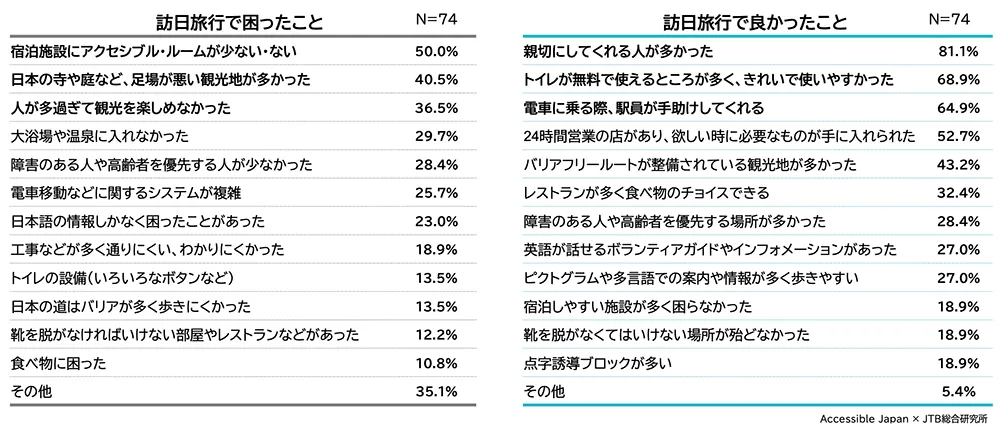
When asked about challenges they faced while traveling in Japan, 50.0% cited “a lack of accessible rooms at accommodations” and 40.5% cited “poor accessibility at tourist sites.” As for positive aspects, respondents mentioned “many people were kind,” “restrooms were easy to use,” and “station staff helped when boarding trains.”
We surveyed 74 respondents who had visited Japan about their travel experiences. More than half had visited Japan only once, and the top destinations cited were Tokyo, Kyoto, and Osaka. Their main interests during their trips were Japanese food culture and historical buildings. These findings were virtually identical to the travel needs of non-disabled visitors.
From an accessibility perspective, when asked about challenges and positive experiences during their trips to Japan, respondents cited a lack of accessible rooms in accommodations, poor footing at tourist sites, and difficulty accessing public baths and hot springs. These findings indicate that Japan’s tourism facilities and services are not yet sufficiently accessible for people with disabilities.In particular, responses regarding information provided only in Japanese and the inability to enjoy sightseeing due to overcrowding suggest that language barriers and stress caused by crowds are significant obstacles.
On the other hand, positive aspects such as the kindness of many people and the availability of free restrooms were highly praised, revealing that Japan’s culture of hospitality leaves a favorable impression on people with disabilities. Additionally, many respondents noted that “station staff assist them when traveling by train,” indicating that support provided by Japan’s public transportation system is highly valued (Figure 5).
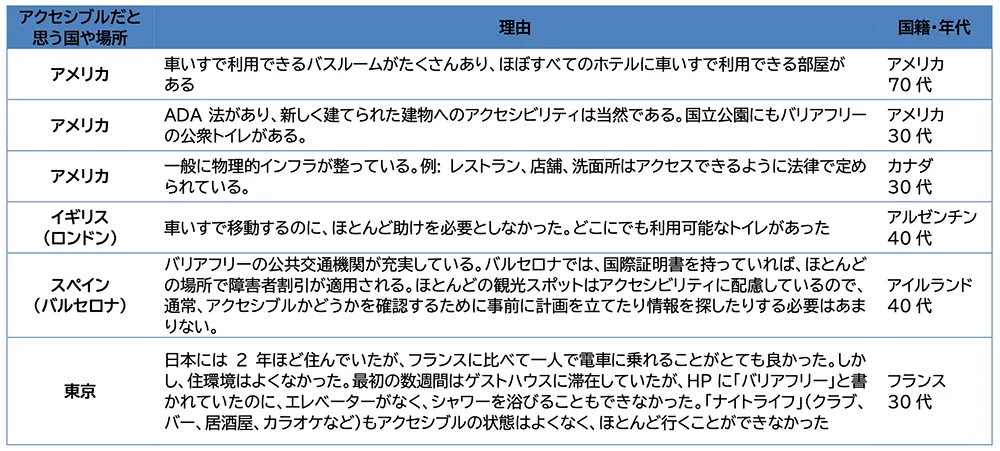
Countries where accessible tourism is considered to be well-developed include the United States and the United Kingdom. The reason cited is that "the legal framework is well-established." In Japan, many respondents mentioned "Tokyo," clearly highlighting the inadequacy of legal regulations on a national level.
Where do people with disabilities feel that accessible tourism is most advanced? When asked to provide open-ended responses, more than 40 people answered “the United States.”While this result is influenced by the fact that 40% of the survey respondents reside in the United States, many cited “it is mandated by the ADA¹” as the reason, indicating that understanding of the ADA is widespread both domestically and internationally. Other countries and regions mentioned included the United Kingdom, Spain, and the Nordic countries. These are nations where legal requirements regarding accessibility are more stringent than in Japan.
While Japan was also mentioned in the responses, many respondents specifically cited “Tokyo.” This highlights the current situation where, while specific major cities are actively improving accessibility, legal regulations at the national level are lagging behind or remain insufficient (Figure 6).
1. ADA (Americans with Disabilities Act): A civil rights law enacted in July 1990 that broadly prohibits discrimination based on disability
Summary
The results of this survey reveal that people with disabilities living abroad, while harboring some concerns about accessibility in Japan, have a strong interest in Japanese culture and services. However, based on their actual experiences visiting Japan, they have pointed out many areas for improvement, such as a shortage of accessible rooms and difficulties accessing tourist destinations.For example, while efforts to make public transportation barrier-free are progressing in major cities like Tokyo and Osaka, there are still cases where such measures remain insufficient in rural areas. At tourist destinations as well, there are many places where steps and staircases make it difficult for wheelchair users to enjoy historical buildings and natural landscapes.
Addressing these challenges and enhancing the provision of information could make it easier for people with disabilities to visit Japan. Examples include providing detailed barrier-free information via social media, strengthening staff training at tourist facilities and hotels, and promoting infrastructure development to improve accessibility.
Furthermore, the observation that Japan lags behind other countries in terms of legal regulations serves as important feedback for future accessibility policies. In particular, there is a need to strengthen support initiatives for people with disabilities across the entire tourism industry; this will help make Japan’s tourist destinations more attractive and capable of accommodating a wider variety of travelers.Furthermore, promoting accessible tourism is expected to provide more travel opportunities for people with disabilities within Japan and contribute to improving their quality of life. It is hoped that through such initiatives, the development of tourist destinations where both able-bodied individuals and people with disabilities can enjoy themselves together will progress.
About Accessible Japan
tabiLabs Co., Ltd. is a company dedicated to providing an environment where people with disabilities can travel with peace of mind.Established in 2015, “Accessible Japan” provides information on barrier-free accommodations, tourist attractions, and transportation within Japan, serving as a reliable information source for travelers with disabilities. The company also operates a global community called “tabifolk,” providing a space for travelers to exchange information.
Company Name: tabiLabs Co
., Ltd. Representative Director: Barry Joshua Grizdale Address
: Shibuya Dogenzaka Tokyu Building 2F-C
, 1-10-8 Dogenzaka, Shibuya-ku, Tokyo Established: 2015(Incorporated as tabiLabs Co., Ltd. on May 1, 2024)
URL: “Accessible Japan” Website
About JTB Tourism Research & Consulting Co., Ltd.
JTB Tourism Research & Consulting Co., Ltd. was established in 2012 to mark the 100th anniversary of JTB Corporation, with the aim of contributing to the resolution of social and regional issues through tourism.With research, consulting, and tourism education as its core pillars, the institute is advancing initiatives to contribute to the development of regions and businesses as a think tank for a new era that transcends the traditional framework of tourism.
Company Name: JTB Tourism Research & Consulting Co.
, Ltd. President and CEO: Yoshito Kazama
Address: Tokyo Front Terrace 7F
, 2-3-14 Higashi-Shinagawa, Shinagawa-ku, Tokyo 140-0002 Established:June 21, 2001 (Company name changed to JTB Tourism Research & Consulting Co., Ltd. on June 1, 2012)
URL: JTB Tourism Research & Consulting Co., Ltd. Website