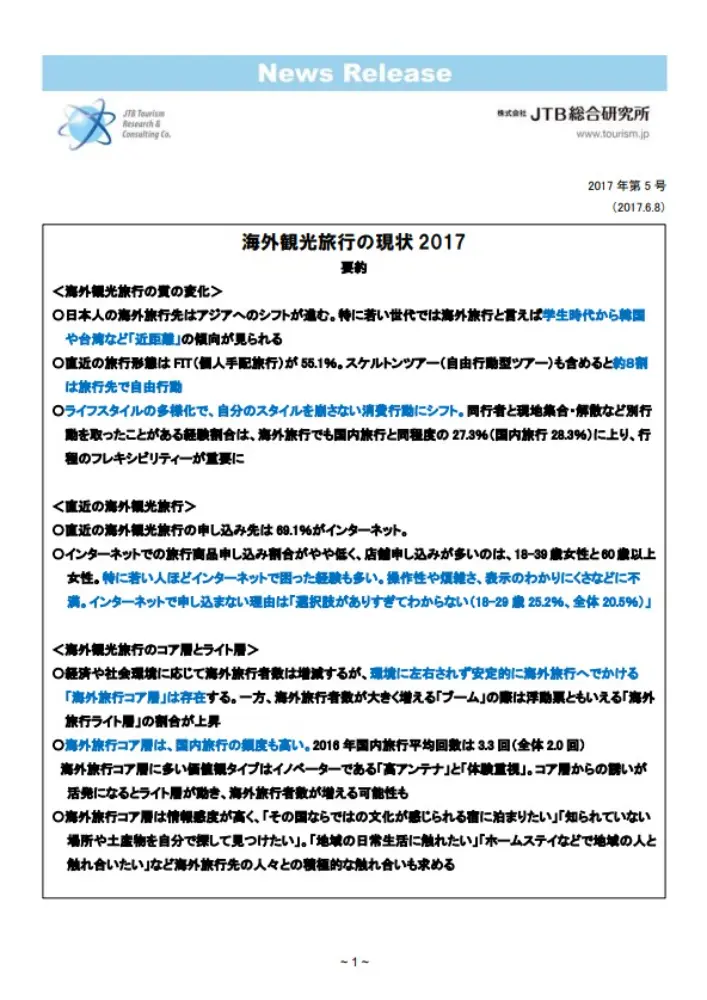
The Current State of Overseas Tourism in 2017
Key Findings
- Changes in the Quality of Overseas TourismJapanese travelers are increasingly shifting their overseas travel destinations toward Asia. Among younger generations in particular, there is a tendency to choose “nearby” destinations such as South Korea and Taiwan for overseas travel, a trend that begins as early as their student years.
Currently, 55.1% of travelers opt for FIT (independent travel). When including skeleton tours (tours with free time), approximately 80% of travelers spend their time at their destination doing as they please.
With the diversification of lifestyles, there has been a shift toward consumption patterns that allow travelers to maintain their own personal style. The percentage of travelers who have taken separate itineraries—such as meeting and parting ways with their travel companions at the destination—reached 27.3% for overseas travel, which is comparable to domestic travel (28.3%), highlighting the importance of itinerary flexibility. - My most recent overseas trip69.1% of people booked their most recent overseas vacation online.
The proportion of people booking travel products online is slightly lower among women aged 18–39 and women aged 60 and older, with more of them booking in person. Younger people, in particular, are more likely to have had trouble booking online.They express dissatisfaction with usability, complexity, and unclear displays. The reason for not booking online is “there are too many options to choose from” (25.2% of those aged 18–29, 20.5% overall). - Core and Casual International TravelersWhile the number of international travelers fluctuates depending on economic and social conditions, there exists a “core group of international travelers” who travel abroad consistently, regardless of external factors. On the other hand, during “booms” when the number of international travelers surges significantly, the proportion of the “light group of international travelers”—who can be considered swing voters—increases.
The core group of international travelers also travels domestically frequently.In 2016, the average number of domestic trips for this group was 3.3 (compared to 2.0 for the general population).
The value types most common among the core group of international travelers are “Highly Attuned” and “Experience-Oriented,” both of which fall under the Innovator category. If invitations from the core group become more frequent, the light group may be motivated to travel, potentially increasing the number of international travelers.
The overseas travel core group is highly information-sensitive, expressing desires such as “I want to stay at accommodations where I can experience the unique culture of that country” and “I want to discover lesser-known places and souvenirs on my own.” They also seek active interaction with people at their overseas destinations, such as “I want to experience local daily life” and “I want to interact with local people through homestays.”
The number of Japanese travelers abroad had been declining since peaking at a record high of 18.5 million in 2012, but it bottomed out in 2015 and began to rise again in 2016, reaching 17.11 million—a 5.6% increase from the previous year.While the average growth rate from January to April 2017 remained steady at 7.1%, the number of customers using travel product brands continued to fall below the previous year’s levels from December 2016 to February 2017 (*).This divergence from the market—where the number of travelers abroad is increasing while the number of people using branded travel products is decreasing—suggests that these products no longer meet the needs of today’s travelers.
The planning of overseas travel products has traditionally been influenced by numerous factors, including exchange rates, fare rules, and the supply environment for airline seats and accommodations in the global market. Furthermore, the spread of IT has significantly transformed distribution systems, and the entry of new business models has intensified competition in the travel sector. On the other hand, market analysis has traditionally focused on internal industry conditions.As people’s values and lifestyles diversify alongside societal changes, there appears to be room for examination regarding whether we are truly addressing the behaviors and needs of travelers as consumers.
In this survey, to identify clues for understanding the needs of today’s travelers, we adopted a new perspective by examining the differences between the “core segment”—those who consistently take overseas trips regardless of external conditions—and the “light segment”—those who do not. We attempted to visualize travelers in greater detail, exploring exactly who is taking what kinds of trips. Here are some of the findings.
(*) Source: Japan National Tourism Organization (JNTO), “Number of Japanese Travelers Departing the Country”; Japan Tourism Agency, “Status of Travel Product Brands (Package Tours)”